Ensure your event in NYC or NJ is compliant with music licensing. Learn how to navigate PRO coverage and secure the right permissions.
The event host or organizer is typically the party responsible for public-performance licensing in the United States, unless the venue holds its own blanket license and contractually assumes that role. If you’re booking a DJ, karaoke system, or AV setup in New York or New Jersey, you need two things in hand before the event: written proof of PRO coverage (ASCAP, BMI, SESAC, GMR, or AllTrack, depending on the repertoire) and confirmation that any karaoke service being used is a licensed commercial platform, not a consumer app.
Contracts can shift this responsibility between venue, host, and vendor, so don’t assume someone else has it covered. Do this now:
• Ask your venue or vendor for a current PRO license number or invoice.
• Ask your karaoke or DJ vendor which commercial platform they use and confirm it’s not YouTube or a personal streaming account.
• Keep every confirmation in writing, even if it’s just a screenshot of an email.
Public-performance licensing responsibility defaults to the event host or venue in the U.S., and written verification before the event date is the only reliable protection against liability.
| Point | Details |
|---|---|
| Identify the responsible party | The host or venue typically owns PRO licensing, but contracts can shift this, so confirm it in writing. |
| Verify, don’t assume | Request PRO invoices or license numbers directly from ASCAP, BMI, or SESAC before signing any vendor contract. |
| Karaoke needs two licenses | Commercial content licensing and PRO coverage are separate requirements; consumer apps satisfy neither. |
| Re-check two to four weeks out | Licensing status changes; confirm again close to the event date, not just at booking. |
| Choose vendors who handle compliance | Porcci NYC provides licensed karaoke, DJ, and AV rentals with documentation ready for NYC and NJ events. |
• Music Licensing for Events: Who’s Actually on the Hook
• How Do You Verify a Vendor or Venue’s Music License?
• Do Karaoke Nights and DJs Need Separate Licenses?
• Writing Contracts That Actually Allocate Risk
• A Simple Timeline for NYC and NJ Hosts
• What the Checklist Approach Gets Right, and What It Misses
• Booking Licensed Entertainment Without the Compliance Headache
• FAQ
Public-performance rights (PPR) give songwriters and publishers control over playing their music in public settings, and U.S. copyright law allows more than one party to be held liable when that permission is missing. That’s the part most first-time hosts miss: a claim doesn’t stop at the person who pressed play.
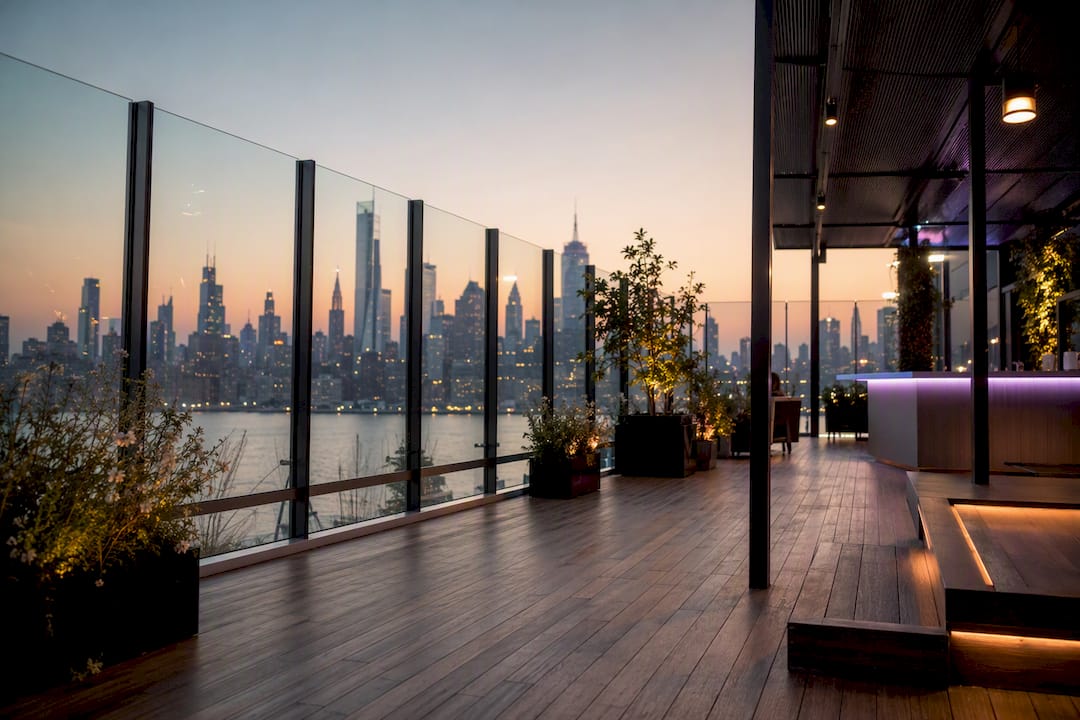
In practice, venues that host events regularly, bars, banquet halls, hotel ballrooms, tend to maintain their own blanket PRO licenses covering ongoing public performance on their premises. If you’re hosting a wedding or private party at one of those venues, the venue has likely already handled it. But if you’re renting a raw space, a backyard, a rooftop, a community hall, that safety net probably doesn’t exist, and responsibility for event music rights typically falls to you as the organizer.
DJs, mobile rental companies, and performers rarely carry blanket venue-level licenses of their own. That said, a DJ can become the responsible party if they’re effectively running the event (booking the space, selling tickets, controlling the guest list) or if their contract explicitly states they’re providing licensed coverage. For most U.S. events, the venue or the host remains the practical point of responsibility, and vendors are not the default license holder.
Here’s the uncomfortable truth: everyone in the chain, host, venue, and vendor, can be named in a claim if the music wasn’t properly licensed. That’s exactly why verification isn’t optional paperwork. It’s the one step that protects you if something goes wrong later.
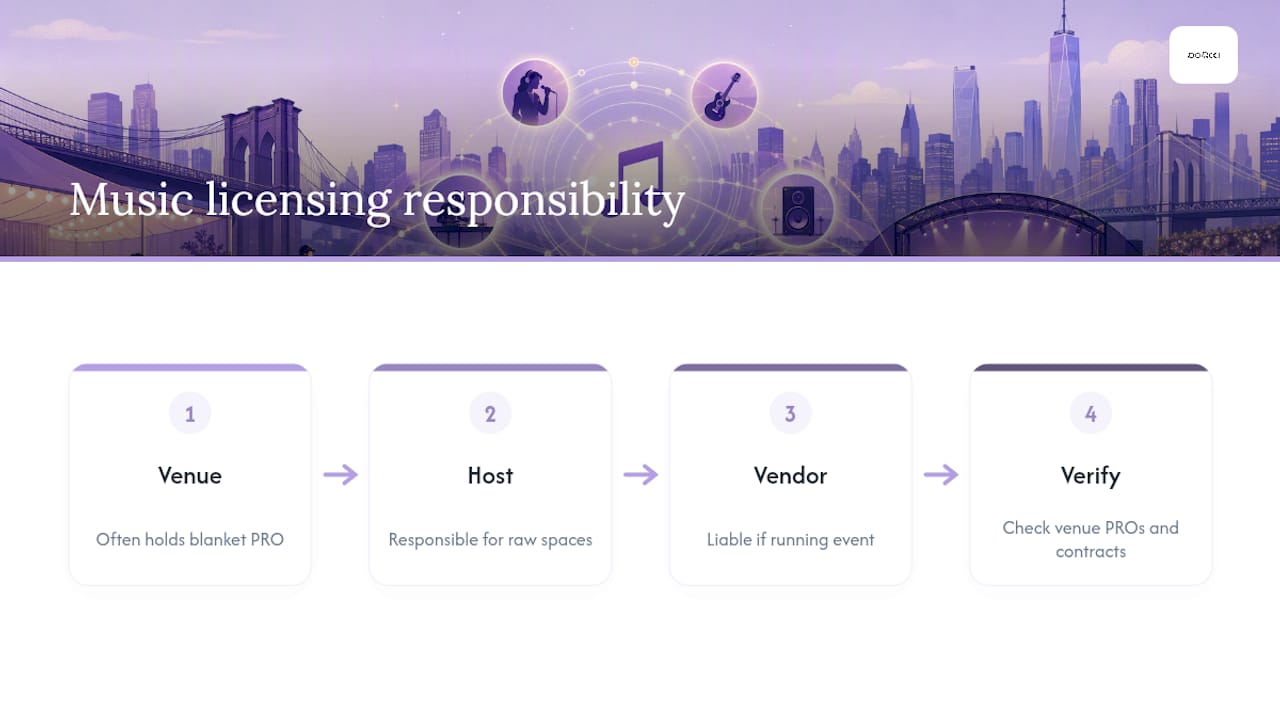
Don’t take anyone’s word for it. Get documents.
1. Request copies of current PRO license numbers or invoices from ASCAP, BMI, and SESAC, and from GMR or AllTrack if the venue’s repertoire calls for it. Ask for the license period and which locations it covers, since a license tied to one venue address won’t transfer to a backyard tent three towns over.
2. For karaoke, request proof the vendor uses a licensed commercial karaoke service, not a consumer YouTube playlist or a personal Spotify account. Ask which platform they subscribe to and at what tier.
3. If time is short, call the PROs directly. Have the venue name, event date, and expected attendance ready. Reps can confirm active coverage faster than waiting on a vendor’s email reply, and event organizers may need to check more than one PRO depending on repertoire.
4. Save everything: license scans, screenshots, written confirmations. Add a license-warranty clause into any vendor contract so the paperwork trail exists before, not after, a problem shows up.
Pro Tip: Request license proof at least two to four weeks before your event, not the week of. Vendors juggling multiple bookings respond faster when they’re not scrambling on a Friday deadline.
This is where most hosts trip up, because “karaoke” and “DJ set” aren’t single categories with a single rule.
• Karaoke requires two separate authorizations: a commercial content license covering backing tracks and lyrics, and a PRO public-performance license covering the songs themselves. Consumer-tier apps and YouTube playlists satisfy neither one in a commercial or ticketed setting, and using them puts the host at risk. Our own karaoke night guide walks through why this distinction trips up so many first-time hosts.
• DJs playing recorded sets inside a properly licensed venue are usually covered by that venue’s blanket license. Streaming the set live or recording it for later distribution is a different matter and may require additional clearance beyond what the venue’s license provides.
• Rental companies asked to play client-supplied MP3s or CDs should require a written warranty from the client confirming the material is properly licensed, plus contract language giving the vendor the right to refuse playback of anything questionable.
• Ticketed events and festivals carry higher exposure. Promoters running larger, revenue-generating events should consult PROs directly for event-scale coverage rather than assuming a standard blanket license applies.
Indemnity and hold-harmless clauses do real work, but they don’t do everything. A rental company can be fully indemnified in a contract and still get named in a lawsuit; indemnification creates a contractual right to recover costs afterward, it doesn’t stop someone from being sued in the first place. That distinction shapes how you should write these clauses.
1. Have the vendor warrant, in writing, that they use commercial-licensed platforms for any karaoke or streaming content they provide.
2. Have the venue or host warrant they carry active PRO coverage, and require proof delivered a set number of days before the event, not the morning of.
3. Require the hiring party to disclose all intended uses at booking, karaoke, live streaming, recording for social media, so the vendor can flag whether additional rights are needed before the event, not during it.
4. Build in a specific remedy: reimbursement of legal costs, the right to substitute a compliant vendor, or a last-minute shutoff clause if licensing can’t be confirmed.
Pro Tip: Add a single line requiring written disclosure of “all intended music uses” at booking. It’s the cheapest insurance clause in the whole contract, and most vendors will happily sign it because it protects them too.
Here’s how to sequence this so it never becomes a day-of scramble.
• At booking: Confirm license status with both venue and vendor, and get it written into the contract, not just discussed on a call.
• Two to four weeks out: Re-check licenses, request final documentation, and get written confirmation of the commercial karaoke platform if one’s being used.
• Day-of: Bring printed or digital proof on-site and assign one staff member to own music compliance for the event.
PRO fees generally show up as either blanket licenses (covering ongoing use at a fixed location) or per-event licenses, and pricing varies by venue capacity, repertoire, and event type. Skip the guesswork: ASCAP, BMI, and SESAC can give you a direct quote once you provide venue details, date, and expected attendance.
Most advice on this topic treats music licensing like a box to check once and forget. That’s the wrong model. Licensing status can change between when you sign a venue contract and when the event actually happens, vendors switch karaoke platforms, venues let licenses lapse, and nobody tells the host.
The bigger blind spot is the “private event” myth. A lot of hosts assume a private party or invite-only gathering is automatically exempt from public-performance rules. It often isn’t. Whether a gathering counts as a public performance depends on factors like ticketing, venue type, and audience size, not just the word “private” on an invitation.
What actually protects a host isn’t a signed contract sitting in a drawer. It’s the habit of re-verifying close to the event date, because vendor circumstances shift faster than paperwork gets updated. If you take one thing from this article, prioritize the two to four week check-in over the initial booking conversation. That’s the point where most exposure actually gets created, and it’s the easiest one to fix.
— PORCCI
Porcci NYC handles the entertainment side of this equation directly: DJ services, karaoke machine rentals running on commercial-tier platforms, and AV and sound-system rentals with delivery, setup, and breakdown across NYC and New Jersey, including Jersey City. Instead of chasing down license numbers from three separate vendors, you get one team that can confirm its karaoke platform subscriptions, include license-warranty language in your quote, and show up with documentation already sorted. If you’re weighing a venue that handles its own booking or coordinating a raw space where you’re comparing event space options, Porcci NYC gives you a single point of contact who owns the entertainment and compliance details instead of leaving you to track down five separate warranties. Ready to lock in your date? Start the booking process and ask about music-licensing support when you request your quote.
The host is typically responsible unless the venue already holds a blanket PRO license and confirms it covers the event in writing.
Usually not, since a DJ performing at a properly licensed venue is generally covered under that venue’s blanket license, though private or unlicensed venues may require separate verification.
No. Consumer streaming services and YouTube don’t provide public-performance rights for commercial or ticketed events, regardless of whether you have a paid personal subscription.
Save PRO license numbers or invoices, written vendor confirmations, and any license-warranty language included in your contracts, ideally collected two to four weeks before the event.
Yes, Porcci NYC’s karaoke rentals run on commercial-tier platforms rather than consumer apps, and the team can confirm licensing details as part of your quote.
Ensure your event in NYC or NJ is compliant with music licensing. Learn how to navigate PRO coverage and secure the right permissions.
The event host or organizer is typically the party responsible for public-performance licensing in the United States, unless the venue holds its own blanket license and contractually assumes that role. If you’re booking a DJ, karaoke system, or AV setup in New York or New Jersey, you need two things in hand before the event: written proof of PRO coverage (ASCAP, BMI, SESAC, GMR, or AllTrack, depending on the repertoire) and confirmation that any karaoke service being used is a licensed commercial platform, not a consumer app.
Contracts can shift this responsibility between venue, host, and vendor, so don’t assume someone else has it covered. Do this now:
• Ask your venue or vendor for a current PRO license number or invoice.
• Ask your karaoke or DJ vendor which commercial platform they use and confirm it’s not YouTube or a personal streaming account.
• Keep every confirmation in writing, even if it’s just a screenshot of an email.
Public-performance licensing responsibility defaults to the event host or venue in the U.S., and written verification before the event date is the only reliable protection against liability.
| Point | Details |
|---|---|
| Identify the responsible party | The host or venue typically owns PRO licensing, but contracts can shift this, so confirm it in writing. |
| Verify, don’t assume | Request PRO invoices or license numbers directly from ASCAP, BMI, or SESAC before signing any vendor contract. |
| Karaoke needs two licenses | Commercial content licensing and PRO coverage are separate requirements; consumer apps satisfy neither. |
| Re-check two to four weeks out | Licensing status changes; confirm again close to the event date, not just at booking. |
| Choose vendors who handle compliance | Porcci NYC provides licensed karaoke, DJ, and AV rentals with documentation ready for NYC and NJ events. |
• Music Licensing for Events: Who’s Actually on the Hook
• How Do You Verify a Vendor or Venue’s Music License?
• Do Karaoke Nights and DJs Need Separate Licenses?
• Writing Contracts That Actually Allocate Risk
• A Simple Timeline for NYC and NJ Hosts
• What the Checklist Approach Gets Right, and What It Misses
• Booking Licensed Entertainment Without the Compliance Headache
• FAQ
Public-performance rights (PPR) give songwriters and publishers control over playing their music in public settings, and U.S. copyright law allows more than one party to be held liable when that permission is missing. That’s the part most first-time hosts miss: a claim doesn’t stop at the person who pressed play.
In practice, venues that host events regularly, bars, banquet halls, hotel ballrooms, tend to maintain their own blanket PRO licenses covering ongoing public performance on their premises. If you’re hosting a wedding or private party at one of those venues, the venue has likely already handled it. But if you’re renting a raw space, a backyard, a rooftop, a community hall, that safety net probably doesn’t exist, and responsibility for event music rights typically falls to you as the organizer.
DJs, mobile rental companies, and performers rarely carry blanket venue-level licenses of their own. That said, a DJ can become the responsible party if they’re effectively running the event (booking the space, selling tickets, controlling the guest list) or if their contract explicitly states they’re providing licensed coverage. For most U.S. events, the venue or the host remains the practical point of responsibility, and vendors are not the default license holder.
Here’s the uncomfortable truth: everyone in the chain, host, venue, and vendor, can be named in a claim if the music wasn’t properly licensed. That’s exactly why verification isn’t optional paperwork. It’s the one step that protects you if something goes wrong later.
Don’t take anyone’s word for it. Get documents.
1. Request copies of current PRO license numbers or invoices from ASCAP, BMI, and SESAC, and from GMR or AllTrack if the venue’s repertoire calls for it. Ask for the license period and which locations it covers, since a license tied to one venue address won’t transfer to a backyard tent three towns over.
2. For karaoke, request proof the vendor uses a licensed commercial karaoke service, not a consumer YouTube playlist or a personal Spotify account. Ask which platform they subscribe to and at what tier.
3. If time is short, call the PROs directly. Have the venue name, event date, and expected attendance ready. Reps can confirm active coverage faster than waiting on a vendor’s email reply, and event organizers may need to check more than one PRO depending on repertoire.
4. Save everything: license scans, screenshots, written confirmations. Add a license-warranty clause into any vendor contract so the paperwork trail exists before, not after, a problem shows up.
Pro Tip: Request license proof at least two to four weeks before your event, not the week of. Vendors juggling multiple bookings respond faster when they’re not scrambling on a Friday deadline.
This is where most hosts trip up, because “karaoke” and “DJ set” aren’t single categories with a single rule.
• Karaoke requires two separate authorizations: a commercial content license covering backing tracks and lyrics, and a PRO public-performance license covering the songs themselves. Consumer-tier apps and YouTube playlists satisfy neither one in a commercial or ticketed setting, and using them puts the host at risk. Our own karaoke night guide walks through why this distinction trips up so many first-time hosts.
• DJs playing recorded sets inside a properly licensed venue are usually covered by that venue’s blanket license. Streaming the set live or recording it for later distribution is a different matter and may require additional clearance beyond what the venue’s license provides.
• Rental companies asked to play client-supplied MP3s or CDs should require a written warranty from the client confirming the material is properly licensed, plus contract language giving the vendor the right to refuse playback of anything questionable.
• Ticketed events and festivals carry higher exposure. Promoters running larger, revenue-generating events should consult PROs directly for event-scale coverage rather than assuming a standard blanket license applies.
Indemnity and hold-harmless clauses do real work, but they don’t do everything. A rental company can be fully indemnified in a contract and still get named in a lawsuit; indemnification creates a contractual right to recover costs afterward, it doesn’t stop someone from being sued in the first place. That distinction shapes how you should write these clauses.
1. Have the vendor warrant, in writing, that they use commercial-licensed platforms for any karaoke or streaming content they provide.
2. Have the venue or host warrant they carry active PRO coverage, and require proof delivered a set number of days before the event, not the morning of.
3. Require the hiring party to disclose all intended uses at booking, karaoke, live streaming, recording for social media, so the vendor can flag whether additional rights are needed before the event, not during it.
4. Build in a specific remedy: reimbursement of legal costs, the right to substitute a compliant vendor, or a last-minute shutoff clause if licensing can’t be confirmed.
Pro Tip: Add a single line requiring written disclosure of “all intended music uses” at booking. It’s the cheapest insurance clause in the whole contract, and most vendors will happily sign it because it protects them too.
Here’s how to sequence this so it never becomes a day-of scramble.
• At booking: Confirm license status with both venue and vendor, and get it written into the contract, not just discussed on a call.
• Two to four weeks out: Re-check licenses, request final documentation, and get written confirmation of the commercial karaoke platform if one’s being used.
• Day-of: Bring printed or digital proof on-site and assign one staff member to own music compliance for the event.
PRO fees generally show up as either blanket licenses (covering ongoing use at a fixed location) or per-event licenses, and pricing varies by venue capacity, repertoire, and event type. Skip the guesswork: ASCAP, BMI, and SESAC can give you a direct quote once you provide venue details, date, and expected attendance.
Most advice on this topic treats music licensing like a box to check once and forget. That’s the wrong model. Licensing status can change between when you sign a venue contract and when the event actually happens, vendors switch karaoke platforms, venues let licenses lapse, and nobody tells the host.
The bigger blind spot is the “private event” myth. A lot of hosts assume a private party or invite-only gathering is automatically exempt from public-performance rules. It often isn’t. Whether a gathering counts as a public performance depends on factors like ticketing, venue type, and audience size, not just the word “private” on an invitation.
What actually protects a host isn’t a signed contract sitting in a drawer. It’s the habit of re-verifying close to the event date, because vendor circumstances shift faster than paperwork gets updated. If you take one thing from this article, prioritize the two to four week check-in over the initial booking conversation. That’s the point where most exposure actually gets created, and it’s the easiest one to fix.
— PORCCI
Porcci NYC handles the entertainment side of this equation directly: DJ services, karaoke machine rentals running on commercial-tier platforms, and AV and sound-system rentals with delivery, setup, and breakdown across NYC and New Jersey, including Jersey City. Instead of chasing down license numbers from three separate vendors, you get one team that can confirm its karaoke platform subscriptions, include license-warranty language in your quote, and show up with documentation already sorted. If you’re weighing a venue that handles its own booking or coordinating a raw space where you’re comparing event space options, Porcci NYC gives you a single point of contact who owns the entertainment and compliance details instead of leaving you to track down five separate warranties. Ready to lock in your date? Start the booking process and ask about music-licensing support when you request your quote.
The host is typically responsible unless the venue already holds a blanket PRO license and confirms it covers the event in writing.
Usually not, since a DJ performing at a properly licensed venue is generally covered under that venue’s blanket license, though private or unlicensed venues may require separate verification.
No. Consumer streaming services and YouTube don’t provide public-performance rights for commercial or ticketed events, regardless of whether you have a paid personal subscription.
Save PRO license numbers or invoices, written vendor confirmations, and any license-warranty language included in your contracts, ideally collected two to four weeks before the event.
Yes, Porcci NYC’s karaoke rentals run on commercial-tier platforms rather than consumer apps, and the team can confirm licensing details as part of your quote.