
What NYC venues require at load-in: access windows, loading zones, freight elevators, insurance, permits and noise limits, plus a checklist to plan setup.
Load-in in New York is set by the venue, not by you. Before anything rolls through the door, get four things in writing: your access window, which entrance and elevator you use, what paperwork the building wants, and when everything has to be out. Get those right and the party starts on time. Miss one and your DJ, photo booth or sound system is stuck on the sidewalk while guests arrive.
This guide walks through what NYC venues typically ask for, which city rules apply, how noise limits and curfews shape your setup, and a simple order of operations you can follow whether you are throwing a 40-person birthday or a 400-person corporate night.
• Ask every venue for its load-in window, entrance, elevator rules, insurance requirements and teardown deadline before you book gear or entertainment.
• City-run spaces follow set hours: on weekdays access starts after 5:00 p.m. and events end by midnight, with longer weekend hours. Private venues set their own.
• Anything on a public sidewalk or curb lane, including drop-off and setup, can need a city permit. Amplified sound can need an NYPD permit.
• Commercial music is capped at 42 dB(A) measured inside nearby homes, so rooftops and residential blocks need a sound plan.
• Send your vendors the same one-page load-in sheet, so everyone arrives at the right door at the right time.
• TL;DR
• What load-in actually covers
• Questions to ask every venue before you sign
• What real NYC load-in rules look like
• Curbs, sidewalks and street permits
• Insurance: the paperwork that holds up load-in
• Safety and capacity: when a place of assembly certificate matters
• Noise limits, curfews and rooftops
• A load-in timeline you can copy
• Mistakes that cost the most time
• Right-sized sound and entertainment for your venue
• FAQ
• Sources
Load-in is everything between your vendor’s truck arriving and the room being ready for guests: unloading, getting equipment through the building, setup, a sound check and a clear floor. It also includes the mirror image, load-out, when everything leaves.
A good load-in plan records the permitted access times, entrance and delivery requirements, inventory and destinations, delivery order, setup responsibilities and handover contacts, and it plans collection and its deadline too. That list sounds obvious until you realize how many Manhattan buildings have one freight elevator shared with three other tenants.
The reason this matters more here than elsewhere: space is tight, buildings are old, and almost nothing has a private loading bay. A room can be perfect and still be a headache if the only way in is a narrow walk-up stairwell or a service door that closes at 5 p.m.

Put these in an email so the answers are in writing. Your vendors will ask for the same details.
1. What is the load-in window? Exact start and end time, and whether setup time counts toward your rental hours.
2. Which entrance do vendors use? Get the exact address and door. Service entrances are often on a side street.
3. Is there a freight elevator, and is it shared? Ask about its size and weight limit, and whether it needs to be reserved.
4. Is there a loading dock or curb access? And can a vehicle wait there?
5. What insurance does the venue want, and by when? Many ask for a certificate of insurance naming the building.
6. Who is the day-of contact? A name and a cell number, not a general inbox.
7. When does load-out have to be finished? Some venues want everything gone that night. Others allow the next morning.
8. What are the sound rules? Curfew, decibel limits, and whether an amplified sound permit is needed.
Organizers should also identify a day-of contact, coordinate shared entrances or elevators, and plan the delivery order. Put the loudest, heaviest or latest-needed items in the right sequence. Sound and lighting go first, because they need time to be tested. Décor and photo backdrops can follow.
Venue rules vary a lot. These published examples show the kind of detail you should expect to be asked about, or to ask about.
For city properties, the Department of Citywide Administrative Services says weekday access begins after 5:00 p.m. and events must conclude by midnight. On weekends, access may begin at 7:00 a.m. and events must conclude by 1:00 a.m. Those hours do not include preparation and breakdown. One hour of breakdown is included, and extra time is charged.
The 2026 city permitting guide adds that prep before 5:00 p.m. is available on request if it does not block pedestrian entry. It also shows how specific a single building can be: at 31 Chambers Street, the space opens at 2:00 p.m. for weekday setup, the freight elevator is on Reade Street, and everything entering is checked by a K-9 unit. If you are booking a public building, budget extra minutes for security.
Private venues write their own rules, and they can be strict:
• A Chelsea venue requires all deliveries to use its loading dock or freight elevator, never guest entrances. It requires floor protection before unloading, bans dragging gear, keeps sidewalks clear, and prohibits idling and double parking. Dock access is shared, so no bay is guaranteed.
• A Financial District banking hall wants load-in scheduled one week in advance through its service entrance, with deliveries on weekdays from 10 a.m. to 5 p.m. only. Items must be removed by noon the next day, and the door opening is 82 inches high by 70 inches wide.
• A Midtown landmark requires truck and driver details at least 48 hours ahead, accepts trucks no longer than 20 feet and no taller than 11 feet 3 inches, and limits its dock elevators to 10,000 pounds.
These are those venues’ own rules, not citywide law. Still, they show what to measure and ask: door width, elevator capacity, vehicle size, lead time and removal deadline.
Geography matters too. In Manhattan, a loft in a historic building usually means a freight elevator and a tight window. Industrial parts of Brooklyn and Queens more often have truck access and loading docks, which can make setup simpler. If load-in is your worry, ask about the entrance before you fall for the room.
Most load-in problems start on the street. If your vendor cannot park, gear gets carried farther, setup starts late and someone gets a ticket.
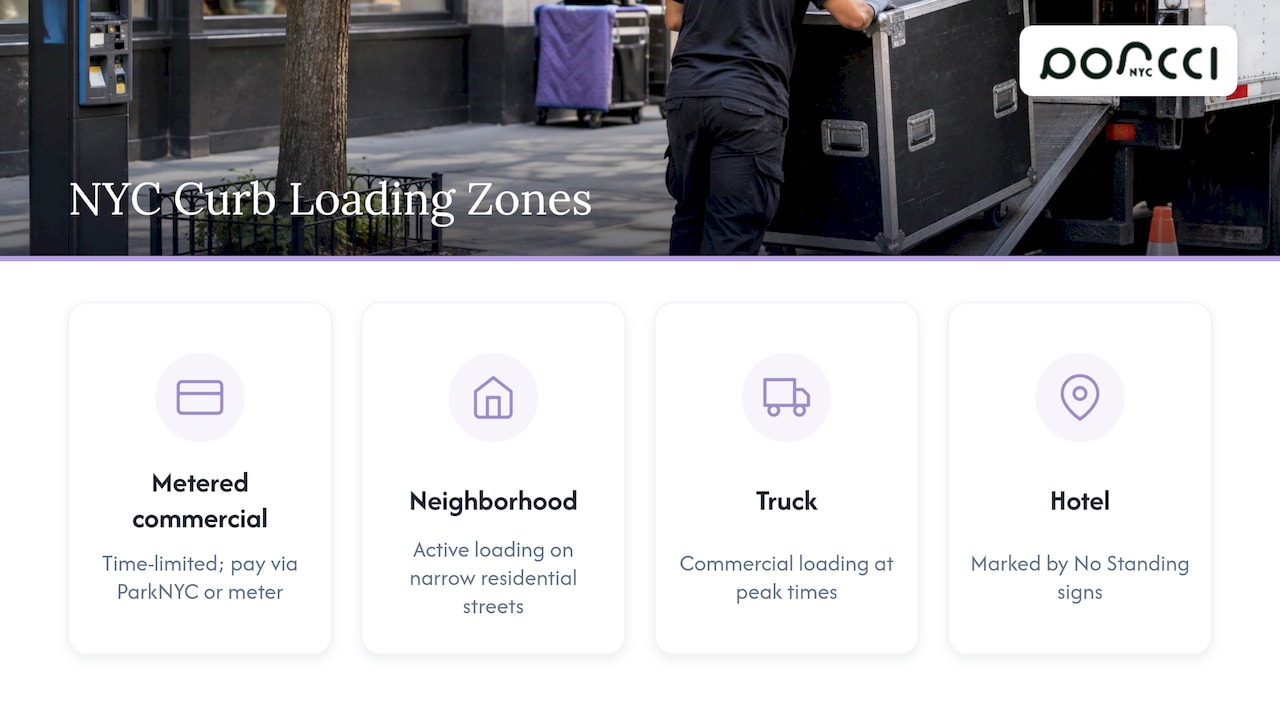
NYC DOT lists several curb loading zone types: metered commercial parking that is time-limited and paid through the ParkNYC app or a meter, neighborhood loading zones for active loading on narrow residential streets, truck loading zones for commercial loading at peak times, and hotel loading zones marked by No Standing signs. Read the signs on the block, and ask your vendor which one they plan to use.
When your activity goes beyond a quick drop-off, you may need a permit. A Street Activity Permit is required for any activity on a public street, curb lane, sidewalk or plaza that interferes with pedestrian or vehicle traffic. Applications need a processing fee, $1,000,000 in liability insurance and plans. The lead time is 30 days for commercial or promotional events and 10 business days for small sidewalk or curb-lane events. Full street closures must leave a 15-foot lane for emergency vehicles.
The city’s event office also describes a production event permit that covers curb-lane or sidewalk activity for pickup, drop-off, and setup or breakdown. It asks for an application 10 days ahead, a site plan and a run of show, and at least $1 million in insurance. The same page notes that amplified sound and no-parking signs may need NYPD permits, vehicles over 55 feet need a DOT permit, and generators need an FDNY certificate.
If your event is a block party, a street fair or anything that touches public space, start with our guide to community event permits for NYC and NJ planners.
Many venues will not let a vendor through the door without a certificate of insurance. The requirements differ by building. One major Midtown venue asks for documentation at least 14 calendar days before load-in, with $2 million in commercial general liability per occurrence and annual aggregate, workers’ compensation and $1 million in commercial auto liability. That is that venue’s standard, not a rule for the whole city.
The practical lesson: ask for the venue’s insurance requirements the day you book, not the week of the event. Then collect certificates from each vendor early. Our overview of the role of event insurance for NYC and NJ planners explains what the different policies cover.
If you are renting a rooftop or a bar for a larger crowd, the venue’s certification affects your event. The Department of Buildings requires a Place of Assembly Certificate of Operation where 75 or more people gather indoors or on roof terraces, or 200 or more outdoors. Rooftops and terraces at 20 feet or more above or below grade used for assembly are treated as indoor spaces. Assembly spaces must also follow the Fire Code’s safety and emergency preparedness requirements.
For your event, that means checking the venue’s certificate covers your headcount, and keeping egress routes clear when equipment goes in. The city’s permitting guide asks for a safety plan with clearly marked egress routes and suggests alternates if the existing ones lead attendees to unsafe spots such as a narrow sidewalk. When you place a photo booth, speaker stack or DJ table, keep exits and aisles open.
Sound is where a smooth load-in can still turn into a shutdown. Setup is when you test levels, so you need to know the limits before the first sound check.
The city’s Department of Environmental Protection treats commercial music broadly, including live performances and recorded audio from commercial establishments. The code sets a measurable cap: commercial music may not exceed 42 dB(A) measured inside a receiving dwelling, 45 dB in specified octave bands, or a 6 dB© increase over ambient sound when ambient exceeds 62 dB©. In plain terms, what matters is what the neighbor hears in their living room, not what the DJ hears at the booth.
That is why rooftops and ground-floor bars facing apartments need extra care. Sound travels up and out on a roof, and there is no ceiling to hold it. Many venues set their own earlier curfew on top of the city rules, so ask for it in writing.
On permits, any event with amplified sound, such as background music, DJ sets, live performance or amplified speaking, needs an NYPD sound permit, issued through the local precinct’s Community Affairs Officer. It sets decibel levels and hours, and operating without one or exceeding the levels can lead to equipment confiscation and shutdown. Our guide to the NYC amplified sound permit covers how to apply.
A few habits make noise easier to manage:
• Point speakers toward the room and away from neighboring buildings.
• Use several smaller speakers at lower volume instead of one big stack.
• Do the sound check during load-in at event volume, while a venue contact listens outside.
• Plan the loudest part of the night early and wind down before the curfew.
Here is a simple order that works for most parties and corporate events.
Four to six weeks out
• Ask the venue the eight questions above and get answers in writing.
• Confirm insurance requirements and collect vendor certificates.
• Check whether you need a street, production or sound permit, since some have lead times of several weeks.
One to two weeks out
• Build a one-page load-in sheet: address, entrance, elevator, window, contact name, parking plan and teardown deadline.
• Send it to every vendor, and ask each for their arrival time and vehicle size.
• Confirm the venue has your vendors’ names and insurance on file.
Day before
• Reconfirm the window and the day-of contact.
• Check the block for construction or street closures.
Day of
• Stagger arrivals so no two vendors fight for the elevator.
• Unload sound and lighting first, then décor, then photo and entertainment extras.
• Run a sound check at event volume, then clear cases and packaging from guest areas.
• Keep egress routes open and walk the room once before doors open.
After the event
• Start load-out when the venue says, not when the last guest leaves.
• Keep breakdown within the included time, since extra time is often charged.
For more on running the whole day, see our guide to managing party logistics in NYC and NJ and our NYC event planning checklist.
• Booking before asking about access. The room looks great online. The freight elevator is booked until 6 p.m.
• Counting setup inside your rental hours. Check whether load-in time is extra.
• Assuming the truck can park. Plan the curb, the loading zone or the dock in advance.
• Forgetting about door sizes. A 360 photo booth or a full sound rig has to fit through the door, around corners and into the elevator.
• Leaving insurance for the last week. Some venues want certificates two weeks early.
• Skipping the sound check. Finding out the limit at 9 p.m. with guests in the room is too late.
Most of the stress at an event comes before the first guest arrives. We see it as a simple idea: the less your vendors have to figure out on the day, the more you get to enjoy the night.
That is why we think of entertainment and equipment as a package with setup, delivery and breakdown included, not as a pile of gear dropped at the curb. When one team brings the DJ, the sound, the lighting and the photo booth, you have one load-in sheet to write and one schedule to follow, so your focus stays on the fun.
Our advice for any NYC venue: ask about the door, the elevator and the clock first. Then size your sound to the room, not to the biggest speaker you can find.
PORCCI
Tight venues call for gear that fits the space. Porcci NYC offers AV and sound system packages sized to the event: a Small Party Package at $210, a Medium Events Package at $310, a Bigger Events Package at $440 and an Ultimate Package at $550. See the AV and sound system rentals page for what each includes.
If you want music and a host handled together, DJ Service starts at $620, DJ Service + Sound System at $990 and an Event/Party MC at $550, all on the DJ services page. Our Standard Photo Booth is $715 on the photo booth rental page. Every offer comes with setup, delivery and breakdown across NYC and New Jersey, so tell us your venue’s load-in window and we can plan around it.
It depends entirely on the venue. City-run spaces generally open after 5:00 p.m. on weekdays, with earlier weekend access starting at 7:00 a.m. Private venues set their own windows, and some limit deliveries to business hours only. Ask for the window in writing before you book.
A quick drop-off at a legal loading zone usually does not. Activity on a sidewalk, curb lane or street that interferes with traffic, including extended setup, can require a city permit with insurance and lead time. Check the city’s permitting pages early, because some applications take weeks.
Commercial music is capped at 42 dB(A) measured inside nearby homes, among other limits in the Noise Code. Events with amplified sound may also need an NYPD sound permit that sets decibel levels and hours. Your venue may add its own curfew, and rooftops often have stricter ones.
The venue sets the rules, and you or your planner coordinate vendors around them. Share one load-in sheet with every vendor and name a single day-of contact. That keeps arrivals staggered and the elevator free.
Before you sign. Access windows, elevator limits and insurance requirements can change which vendors and equipment fit, and some venues want load-in scheduled a week ahead and insurance two weeks ahead.
• An event load-in checklist for the person organizing it
• Event Space Rental FAQ, NYC DCAS
• Comprehensive Event Permitting Guide for the City of New York, 2026
• Loading guidelines and license agreement, 124 W 19th St
• FiDi Banking Hall rules and regulations
• Vanderbilt Hall production manual, 2025
• Street Activity Permit Office Rules
• Place of Assembly Certificate of Operation, NYC DOB
What NYC venues require at load-in: access windows, loading zones, freight elevators, insurance, permits and noise limits, plus a checklist to plan setup.
Load-in in New York is set by the venue, not by you. Before anything rolls through the door, get four things in writing: your access window, which entrance and elevator you use, what paperwork the building wants, and when everything has to be out. Get those right and the party starts on time. Miss one and your DJ, photo booth or sound system is stuck on the sidewalk while guests arrive.
This guide walks through what NYC venues typically ask for, which city rules apply, how noise limits and curfews shape your setup, and a simple order of operations you can follow whether you are throwing a 40-person birthday or a 400-person corporate night.
• Ask every venue for its load-in window, entrance, elevator rules, insurance requirements and teardown deadline before you book gear or entertainment.
• City-run spaces follow set hours: on weekdays access starts after 5:00 p.m. and events end by midnight, with longer weekend hours. Private venues set their own.
• Anything on a public sidewalk or curb lane, including drop-off and setup, can need a city permit. Amplified sound can need an NYPD permit.
• Commercial music is capped at 42 dB(A) measured inside nearby homes, so rooftops and residential blocks need a sound plan.
• Send your vendors the same one-page load-in sheet, so everyone arrives at the right door at the right time.
• TL;DR
• What load-in actually covers
• Questions to ask every venue before you sign
• What real NYC load-in rules look like
• Curbs, sidewalks and street permits
• Insurance: the paperwork that holds up load-in
• Safety and capacity: when a place of assembly certificate matters
• Noise limits, curfews and rooftops
• A load-in timeline you can copy
• Mistakes that cost the most time
• Right-sized sound and entertainment for your venue
• FAQ
• Sources
Load-in is everything between your vendor’s truck arriving and the room being ready for guests: unloading, getting equipment through the building, setup, a sound check and a clear floor. It also includes the mirror image, load-out, when everything leaves.
A good load-in plan records the permitted access times, entrance and delivery requirements, inventory and destinations, delivery order, setup responsibilities and handover contacts, and it plans collection and its deadline too. That list sounds obvious until you realize how many Manhattan buildings have one freight elevator shared with three other tenants.
The reason this matters more here than elsewhere: space is tight, buildings are old, and almost nothing has a private loading bay. A room can be perfect and still be a headache if the only way in is a narrow walk-up stairwell or a service door that closes at 5 p.m.
Put these in an email so the answers are in writing. Your vendors will ask for the same details.
1. What is the load-in window? Exact start and end time, and whether setup time counts toward your rental hours.
2. Which entrance do vendors use? Get the exact address and door. Service entrances are often on a side street.
3. Is there a freight elevator, and is it shared? Ask about its size and weight limit, and whether it needs to be reserved.
4. Is there a loading dock or curb access? And can a vehicle wait there?
5. What insurance does the venue want, and by when? Many ask for a certificate of insurance naming the building.
6. Who is the day-of contact? A name and a cell number, not a general inbox.
7. When does load-out have to be finished? Some venues want everything gone that night. Others allow the next morning.
8. What are the sound rules? Curfew, decibel limits, and whether an amplified sound permit is needed.
Organizers should also identify a day-of contact, coordinate shared entrances or elevators, and plan the delivery order. Put the loudest, heaviest or latest-needed items in the right sequence. Sound and lighting go first, because they need time to be tested. Décor and photo backdrops can follow.
Venue rules vary a lot. These published examples show the kind of detail you should expect to be asked about, or to ask about.
For city properties, the Department of Citywide Administrative Services says weekday access begins after 5:00 p.m. and events must conclude by midnight. On weekends, access may begin at 7:00 a.m. and events must conclude by 1:00 a.m. Those hours do not include preparation and breakdown. One hour of breakdown is included, and extra time is charged.
The 2026 city permitting guide adds that prep before 5:00 p.m. is available on request if it does not block pedestrian entry. It also shows how specific a single building can be: at 31 Chambers Street, the space opens at 2:00 p.m. for weekday setup, the freight elevator is on Reade Street, and everything entering is checked by a K-9 unit. If you are booking a public building, budget extra minutes for security.
Private venues write their own rules, and they can be strict:
• A Chelsea venue requires all deliveries to use its loading dock or freight elevator, never guest entrances. It requires floor protection before unloading, bans dragging gear, keeps sidewalks clear, and prohibits idling and double parking. Dock access is shared, so no bay is guaranteed.
• A Financial District banking hall wants load-in scheduled one week in advance through its service entrance, with deliveries on weekdays from 10 a.m. to 5 p.m. only. Items must be removed by noon the next day, and the door opening is 82 inches high by 70 inches wide.
• A Midtown landmark requires truck and driver details at least 48 hours ahead, accepts trucks no longer than 20 feet and no taller than 11 feet 3 inches, and limits its dock elevators to 10,000 pounds.
These are those venues’ own rules, not citywide law. Still, they show what to measure and ask: door width, elevator capacity, vehicle size, lead time and removal deadline.
Geography matters too. In Manhattan, a loft in a historic building usually means a freight elevator and a tight window. Industrial parts of Brooklyn and Queens more often have truck access and loading docks, which can make setup simpler. If load-in is your worry, ask about the entrance before you fall for the room.
Most load-in problems start on the street. If your vendor cannot park, gear gets carried farther, setup starts late and someone gets a ticket.
NYC DOT lists several curb loading zone types: metered commercial parking that is time-limited and paid through the ParkNYC app or a meter, neighborhood loading zones for active loading on narrow residential streets, truck loading zones for commercial loading at peak times, and hotel loading zones marked by No Standing signs. Read the signs on the block, and ask your vendor which one they plan to use.
When your activity goes beyond a quick drop-off, you may need a permit. A Street Activity Permit is required for any activity on a public street, curb lane, sidewalk or plaza that interferes with pedestrian or vehicle traffic. Applications need a processing fee, $1,000,000 in liability insurance and plans. The lead time is 30 days for commercial or promotional events and 10 business days for small sidewalk or curb-lane events. Full street closures must leave a 15-foot lane for emergency vehicles.
The city’s event office also describes a production event permit that covers curb-lane or sidewalk activity for pickup, drop-off, and setup or breakdown. It asks for an application 10 days ahead, a site plan and a run of show, and at least $1 million in insurance. The same page notes that amplified sound and no-parking signs may need NYPD permits, vehicles over 55 feet need a DOT permit, and generators need an FDNY certificate.
If your event is a block party, a street fair or anything that touches public space, start with our guide to community event permits for NYC and NJ planners.
Many venues will not let a vendor through the door without a certificate of insurance. The requirements differ by building. One major Midtown venue asks for documentation at least 14 calendar days before load-in, with $2 million in commercial general liability per occurrence and annual aggregate, workers’ compensation and $1 million in commercial auto liability. That is that venue’s standard, not a rule for the whole city.
The practical lesson: ask for the venue’s insurance requirements the day you book, not the week of the event. Then collect certificates from each vendor early. Our overview of the role of event insurance for NYC and NJ planners explains what the different policies cover.
If you are renting a rooftop or a bar for a larger crowd, the venue’s certification affects your event. The Department of Buildings requires a Place of Assembly Certificate of Operation where 75 or more people gather indoors or on roof terraces, or 200 or more outdoors. Rooftops and terraces at 20 feet or more above or below grade used for assembly are treated as indoor spaces. Assembly spaces must also follow the Fire Code’s safety and emergency preparedness requirements.
For your event, that means checking the venue’s certificate covers your headcount, and keeping egress routes clear when equipment goes in. The city’s permitting guide asks for a safety plan with clearly marked egress routes and suggests alternates if the existing ones lead attendees to unsafe spots such as a narrow sidewalk. When you place a photo booth, speaker stack or DJ table, keep exits and aisles open.
Sound is where a smooth load-in can still turn into a shutdown. Setup is when you test levels, so you need to know the limits before the first sound check.
The city’s Department of Environmental Protection treats commercial music broadly, including live performances and recorded audio from commercial establishments. The code sets a measurable cap: commercial music may not exceed 42 dB(A) measured inside a receiving dwelling, 45 dB in specified octave bands, or a 6 dB© increase over ambient sound when ambient exceeds 62 dB©. In plain terms, what matters is what the neighbor hears in their living room, not what the DJ hears at the booth.
That is why rooftops and ground-floor bars facing apartments need extra care. Sound travels up and out on a roof, and there is no ceiling to hold it. Many venues set their own earlier curfew on top of the city rules, so ask for it in writing.
On permits, any event with amplified sound, such as background music, DJ sets, live performance or amplified speaking, needs an NYPD sound permit, issued through the local precinct’s Community Affairs Officer. It sets decibel levels and hours, and operating without one or exceeding the levels can lead to equipment confiscation and shutdown. Our guide to the NYC amplified sound permit covers how to apply.
A few habits make noise easier to manage:
• Point speakers toward the room and away from neighboring buildings.
• Use several smaller speakers at lower volume instead of one big stack.
• Do the sound check during load-in at event volume, while a venue contact listens outside.
• Plan the loudest part of the night early and wind down before the curfew.
Here is a simple order that works for most parties and corporate events.
Four to six weeks out
• Ask the venue the eight questions above and get answers in writing.
• Confirm insurance requirements and collect vendor certificates.
• Check whether you need a street, production or sound permit, since some have lead times of several weeks.
One to two weeks out
• Build a one-page load-in sheet: address, entrance, elevator, window, contact name, parking plan and teardown deadline.
• Send it to every vendor, and ask each for their arrival time and vehicle size.
• Confirm the venue has your vendors’ names and insurance on file.
Day before
• Reconfirm the window and the day-of contact.
• Check the block for construction or street closures.
Day of
• Stagger arrivals so no two vendors fight for the elevator.
• Unload sound and lighting first, then décor, then photo and entertainment extras.
• Run a sound check at event volume, then clear cases and packaging from guest areas.
• Keep egress routes open and walk the room once before doors open.
After the event
• Start load-out when the venue says, not when the last guest leaves.
• Keep breakdown within the included time, since extra time is often charged.
For more on running the whole day, see our guide to managing party logistics in NYC and NJ and our NYC event planning checklist.
• Booking before asking about access. The room looks great online. The freight elevator is booked until 6 p.m.
• Counting setup inside your rental hours. Check whether load-in time is extra.
• Assuming the truck can park. Plan the curb, the loading zone or the dock in advance.
• Forgetting about door sizes. A 360 photo booth or a full sound rig has to fit through the door, around corners and into the elevator.
• Leaving insurance for the last week. Some venues want certificates two weeks early.
• Skipping the sound check. Finding out the limit at 9 p.m. with guests in the room is too late.
Most of the stress at an event comes before the first guest arrives. We see it as a simple idea: the less your vendors have to figure out on the day, the more you get to enjoy the night.
That is why we think of entertainment and equipment as a package with setup, delivery and breakdown included, not as a pile of gear dropped at the curb. When one team brings the DJ, the sound, the lighting and the photo booth, you have one load-in sheet to write and one schedule to follow, so your focus stays on the fun.
Our advice for any NYC venue: ask about the door, the elevator and the clock first. Then size your sound to the room, not to the biggest speaker you can find.
PORCCI
Tight venues call for gear that fits the space. Porcci NYC offers AV and sound system packages sized to the event: a Small Party Package at $210, a Medium Events Package at $310, a Bigger Events Package at $440 and an Ultimate Package at $550. See the AV and sound system rentals page for what each includes.
If you want music and a host handled together, DJ Service starts at $620, DJ Service + Sound System at $990 and an Event/Party MC at $550, all on the DJ services page. Our Standard Photo Booth is $715 on the photo booth rental page. Every offer comes with setup, delivery and breakdown across NYC and New Jersey, so tell us your venue’s load-in window and we can plan around it.
It depends entirely on the venue. City-run spaces generally open after 5:00 p.m. on weekdays, with earlier weekend access starting at 7:00 a.m. Private venues set their own windows, and some limit deliveries to business hours only. Ask for the window in writing before you book.
A quick drop-off at a legal loading zone usually does not. Activity on a sidewalk, curb lane or street that interferes with traffic, including extended setup, can require a city permit with insurance and lead time. Check the city’s permitting pages early, because some applications take weeks.
Commercial music is capped at 42 dB(A) measured inside nearby homes, among other limits in the Noise Code. Events with amplified sound may also need an NYPD sound permit that sets decibel levels and hours. Your venue may add its own curfew, and rooftops often have stricter ones.
The venue sets the rules, and you or your planner coordinate vendors around them. Share one load-in sheet with every vendor and name a single day-of contact. That keeps arrivals staggered and the elevator free.
Before you sign. Access windows, elevator limits and insurance requirements can change which vendors and equipment fit, and some venues want load-in scheduled a week ahead and insurance two weeks ahead.
• An event load-in checklist for the person organizing it
• Event Space Rental FAQ, NYC DCAS
• Comprehensive Event Permitting Guide for the City of New York, 2026
• Loading guidelines and license agreement, 124 W 19th St
• FiDi Banking Hall rules and regulations
• Vanderbilt Hall production manual, 2025
• Street Activity Permit Office Rules
• Place of Assembly Certificate of Operation, NYC DOB


