Navigate your office party planning with this comprehensive vendor selection guide, ensuring seamless events and stress-free coordination.
For most office parties, the fastest path to a stress-free event is hiring one full-service vendor who covers entertainment, AV, and setup under a single contract. If your timeline is tight or your internal capacity is limited, that single-vendor route eliminates the coordination risk that sinks multi-vendor events. If you have 10–12 weeks and want per-category negotiating leverage, assemble a shortlist of 2–4 vetted vendors per category and follow a strict booking order.
Path A (single vendor): One contract, one day-of contact, one liability umbrella. You trade some per-item pricing flexibility for dramatically fewer moving parts.
Path B (shortlist): You collect at least three comparable quotes per category, score them against 5–7 criteria, and lock vendors in the right sequence. You may save on base costs, but you own the coordination.
Before either path, pin your total budget and translate it to a per-head number. Cvent’s holiday party planning checklist recommends building in a 10–15% contingency buffer because service charges and last-minute additions reliably appear late. For corporate event planning tips, that buffer is the single most overlooked line item.
• Choose Path A when: your event is under eight weeks out, your team has no dedicated planner, or the event is high-visibility and a vendor failure would be costly.
• Choose Path B when: you have 10–12 weeks, a clear scope per category, and someone who can own vendor communication daily.
| Point | Details |
|---|---|
| Pin budget and per-head ceiling first | Divide total spend by headcount, subtract 10–15% contingency, then allocate by category. |
| Choose your path early | Single-vendor (less coordination risk) or shortlist of 2–4 per category (more pricing leverage). |
| Book in order: venue, then caterer and entertainment | Headline entertainment and caterers fill fastest, especially in Q4. |
| Score vendors on 5–7 criteria | Use a weighted table covering experience, pricing transparency, insurance, and named day-of contact. |
| Porcci NYC as single-vendor option | Covers DJ, AV, photo booths, staffing, and breakdown under one contract for NYC and NJ events. |
• What does a solid office party vendor selection guide actually cover?
• What should you confirm with each vendor before signing?
• When should you book each vendor?
• How do you run the day of without surprises?
• A note from Porcci NYC on keeping coordination manageable
• Porcci NYC covers entertainment, AV, and setup under one contract
• Primary sources and further reading
• Sources
• FAQ
Start with scope and budget-per-head. What remains is your working per-head ceiling. A useful budget split from Gable’s event planning framework: venue at 30–40%, catering at 20–25%, and AV/production at 10–15% of total spend.
Abastio’s vendor shortlist guide recommends a weighted scoring table of 5–7 criteria so you compare vendors objectively rather than by gut feel. Use these as your columns:
1. Relevant experience — comparable event size and type in the last 12 months
2. Pricing transparency — itemized line items, not a lump-sum estimate
3. Named day-of contact — a specific person, not “our team”
4. Responsiveness — reply time during the sales process predicts day-of reliability
5. Insurance and compliance — general liability certificate, liquor liability if applicable
6. Staffing levels and hours — headcount confirmed in writing, not estimated
7. Flexibility — late headcount changes, overtime policy, force majeure language
Score each vendor 1–5 per criterion, weight the criteria by importance to your event, and drop any vendor with two or more red flags before you finalize the shortlist.
Every vendor contract should include: deliverables with itemized line items, staffing counts and scheduled hours, arrival and teardown windows, liability limits and insurance certificates, cancellation and rescheduling terms, overtime and gratuity handling, force majeure language, and a payment schedule with deposit amounts. For a deeper review, the corporate event vendor contract guide covers each clause in detail.
• Vague pricing (“we’ll send a final number closer to the date”)
• Inability to name who will be on site
• No itemized quote after two requests
• Evasive or missing cancellation terms
• Overpromising capacity without references to back it
Pro Tip: Ask every vendor: “Tell me about a specific time something went wrong at one of your events and how you handled it.” BizBash’s vendor vetting guidance confirms that a professional vendor gives a concrete past example and a clear escalation path. A vague “we always handle it” is a red flag, not reassurance.
| Service Style | Relative Per-Head Cost | Flow Impact |
|---|---|---|
| Plated dinner | Highest | Structured, slower pacing |
| Buffet | Moderate | Flexible, self-directed |
| Food stations | Moderate–high | Social, encourages mingling |
| Passed appetizers | Lower | Cocktail-hour feel, less filling |
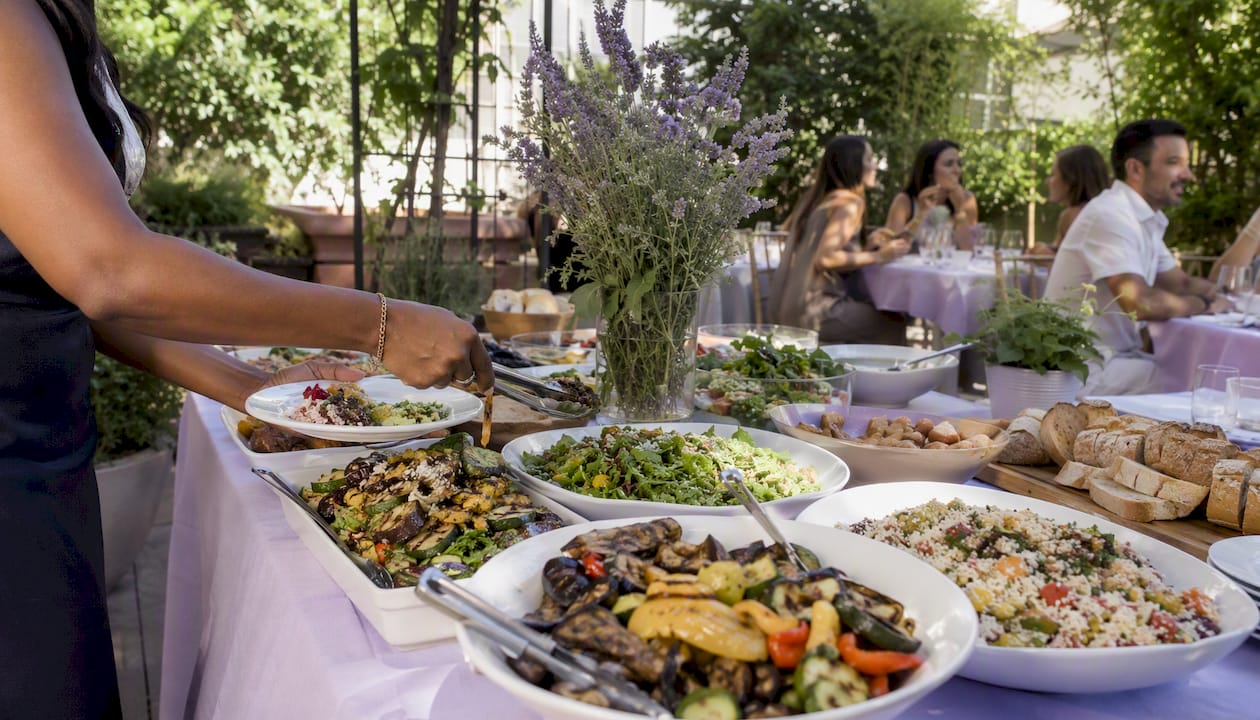
Bar plan options follow the same logic. An open bar raises per-head cost but simplifies ticketing. Beer and wine only reduces cost and liability exposure. Drink tickets cap consumption while keeping the experience festive. Always include a non-alcoholic station regardless of bar plan, and capture dietary restrictions and allergen needs in your RSVP form before you finalize any menu. For seasonal menu inspiration, Wild Foodz’s festive meal offerings list is a practical starting point for planners building catering briefs.
VenueNow’s corporate supplier checklist and Pinx Catering’s caterer question list together cover the essential confirmations per category. Here is a condensed version you can paste into your RFPs.
• Available on your date with no more than two simultaneous events
• Service style confirmed and staffing headcount in writing
• Tasting policy and timeline
• Dietary accommodations and allergen handling process
• Itemized quote with delivery, serving, and cleanup responsibilities
• Named day-of contact and late headcount change policy
Ask on the discovery call: How many staff will you have on site per 50 guests? Can you provide references from a comparable corporate event?
• Sound system requirements and stage footprint
• Power draw and load-in logistics confirmed with venue
• Mic counts, set length, and scheduled breaks
• Rider needs and on-site tech support
• Backup plan for last-minute performer issues
• General liability insurance certificate
For booking DJ services specifically, confirm AV compatibility with the venue before signing. Live bands bring a different energy to a dance floor — how live music affects guest energy is worth reviewing when choosing between a DJ and a band for your entertainment slot.
• Arrival and setup time relative to guest arrival
• Power requirements and footprint
• Props, branding overlays, and digital asset delivery timeline
• Usage rights for company communications
• Backup equipment policy
• Footprint, power draw, and cabling plan
• Mic counts and staging dimensions
• On-site tech vs. drop-and-leave service (always prefer on-site for live presentations or dancing)
• Compatibility with venue’s existing AV
• Test and sound-check schedule
• Pickup and drop windows confirmed in writing
• Vehicle counts and liability coverage
• Uniform and behavior policy
• Day-of coordinator assigned for load-in and load-out
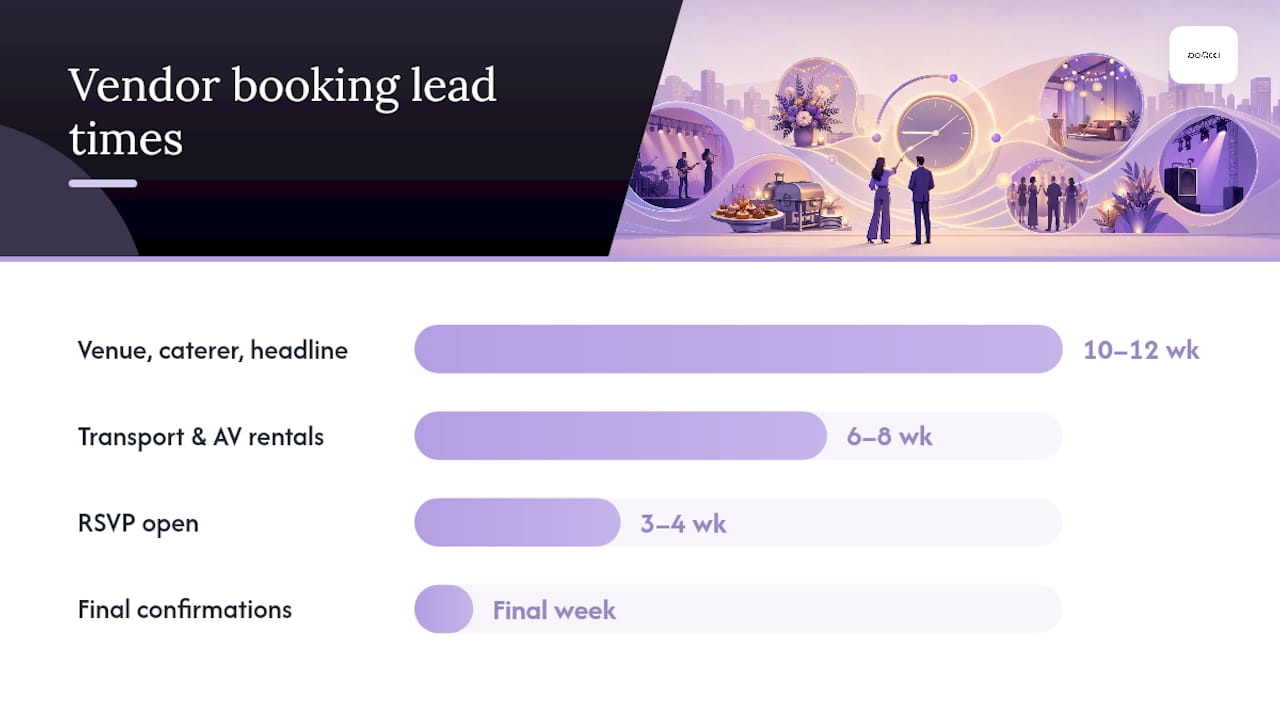
Booking order matters as much as booking timeline. Venue availability drives every other decision, so lock it first. Once the venue is confirmed, caterers and headline entertainment fill next because they book out fastest, especially in Q4.
| Window | Action |
|---|---|
| 10–12 weeks out | Finalize budget and per-head ceiling; book venue; secure caterer and headline entertainment |
| 6–8 weeks out | Send save-the-dates; finalize menu; book transportation and AV/rentals |
| 3–4 weeks out | Send formal invites; open RSVP with dietary and accessibility fields |
| Final week | Confirm final headcount with all vendors in writing; reconfirm arrival times and contacts |
| Day of | Arrive well before guests; walk the space; verify all vendor setups |
Peak-season risk: entertainment, photo booths, and AV vendors in major markets book out 8–10 weeks in advance for November and December dates. If your event falls in that window, compress the timeline and treat 12 weeks as your minimum lead time.
A single printed run-of-show shared with every vendor the day before is the most effective coordination tool available. It should list vendor arrival windows, setup sequence, food service timing, speech and entertainment slots, and teardown start time.
1. Walk the venue on arrival and confirm table layout, signage, and bar setup.
2. Check AV: test mics, confirm speaker placement, and run a sound check before guests arrive.
3. Verify staff arrival and headcount against the contract.
4. Confirm dietary items are labeled and accessible.
5. Collect a mobile number from each vendor’s day-of contact and share yours.
Pack: gaffer tape, scissors, phone chargers, stain wipes, printed run-of-show copies, extra name tags, pens, a basic first-aid kit, and a universal power adapter for AV. For last-minute headcount changes, confirm your vendor’s policy in writing before the event — most contracts allow a 5–10% variance without penalty, but overtime and additional charges above that threshold should be pre-negotiated.
We have seen what happens when a multi-vendor event loses its single source of truth: the caterer arrives at the same door as the AV crew, the DJ’s power draw trips the venue’s circuit, and the planner is fielding three calls at once during cocktail hour. Our approach at Porcci NYC is staged booking with guaranteed on-site technicians and bundled setup, delivery, and breakdown under one contract. When we handle DJ services, AV, photo booths, and staffing together, there is one escalation path, one liability umbrella, and one person you call if anything shifts. We are happy to share a sample run sheet or references from comparable corporate events on request.
When your timeline is short or your team cannot absorb daily vendor coordination, Porcci NYC acts as your single full-service supplier. For office parties across NYC and New Jersey, we provide DJ services, AV and sound system rentals, photo booth rentals, karaoke, professional lighting, event staffing, and full setup and breakdown. Every booking includes a named on-site technician, a written contract with clear cancellation terms, and general liability coverage. Request a quote at Porccinyc and we will send a line-item proposal within one business day.
• Abastio: How to Create a Vendor Shortlist for Events — shortlist construction, weighted scoring, and red-flag thresholds
• BizBash: Unexpected questions to ask before hiring an event vendor — crisis-handling questions and escalation vetting
• Pinx Catering: Questions to ask a caterer — caterer discovery call questions and contract must-haves
• VenueNow: Corporate event essentials supplier checklist — vendor categories and booking timing
• Holiday party planning checklist
• Unexpected questions to ask before hiring an event vendor
• How to Create a Vendor Shortlist for Events | Abastio
• Corporate Event Essentials: Supplier Checklist | VenueNow
Book your venue and caterer 10–12 weeks out, and entertainment and AV at the same time. For Q4 events, treat 12 weeks as the minimum for photo booths and DJ services, which fill quickly.
Cancellation and rescheduling terms matter most. Confirm the refund policy on your deposit, the notice period required, and whether force majeure language covers venue closures or public health restrictions.
Collect at least three comparable quotes per category before committing. Three quotes give you enough data to spot outliers, negotiate on price, and confirm that your scope of work is realistic.
When your event is fewer than eight weeks out, your team has no dedicated planner, or the event is high-visibility, a single vendor like Porcci NYC reduces coordination risk and gives you one contract and one day-of contact.
Drop any vendor who cannot provide an itemized quote, refuses to name the staff who will be on site, or gives vague answers about cancellation terms. Two or more red flags from your scoring criteria is a clear signal to move on.
Navigate your office party planning with this comprehensive vendor selection guide, ensuring seamless events and stress-free coordination.
For most office parties, the fastest path to a stress-free event is hiring one full-service vendor who covers entertainment, AV, and setup under a single contract. If your timeline is tight or your internal capacity is limited, that single-vendor route eliminates the coordination risk that sinks multi-vendor events. If you have 10–12 weeks and want per-category negotiating leverage, assemble a shortlist of 2–4 vetted vendors per category and follow a strict booking order.
Path A (single vendor): One contract, one day-of contact, one liability umbrella. You trade some per-item pricing flexibility for dramatically fewer moving parts.
Path B (shortlist): You collect at least three comparable quotes per category, score them against 5–7 criteria, and lock vendors in the right sequence. You may save on base costs, but you own the coordination.
Before either path, pin your total budget and translate it to a per-head number. Cvent’s holiday party planning checklist recommends building in a 10–15% contingency buffer because service charges and last-minute additions reliably appear late. For corporate event planning tips, that buffer is the single most overlooked line item.
• Choose Path A when: your event is under eight weeks out, your team has no dedicated planner, or the event is high-visibility and a vendor failure would be costly.
• Choose Path B when: you have 10–12 weeks, a clear scope per category, and someone who can own vendor communication daily.
| Point | Details |
|---|---|
| Pin budget and per-head ceiling first | Divide total spend by headcount, subtract 10–15% contingency, then allocate by category. |
| Choose your path early | Single-vendor (less coordination risk) or shortlist of 2–4 per category (more pricing leverage). |
| Book in order: venue, then caterer and entertainment | Headline entertainment and caterers fill fastest, especially in Q4. |
| Score vendors on 5–7 criteria | Use a weighted table covering experience, pricing transparency, insurance, and named day-of contact. |
| Porcci NYC as single-vendor option | Covers DJ, AV, photo booths, staffing, and breakdown under one contract for NYC and NJ events. |
• What does a solid office party vendor selection guide actually cover?
• What should you confirm with each vendor before signing?
• When should you book each vendor?
• How do you run the day of without surprises?
• A note from Porcci NYC on keeping coordination manageable
• Porcci NYC covers entertainment, AV, and setup under one contract
• Primary sources and further reading
• Sources
• FAQ
Start with scope and budget-per-head. What remains is your working per-head ceiling. A useful budget split from Gable’s event planning framework: venue at 30–40%, catering at 20–25%, and AV/production at 10–15% of total spend.
Abastio’s vendor shortlist guide recommends a weighted scoring table of 5–7 criteria so you compare vendors objectively rather than by gut feel. Use these as your columns:
1. Relevant experience — comparable event size and type in the last 12 months
2. Pricing transparency — itemized line items, not a lump-sum estimate
3. Named day-of contact — a specific person, not “our team”
4. Responsiveness — reply time during the sales process predicts day-of reliability
5. Insurance and compliance — general liability certificate, liquor liability if applicable
6. Staffing levels and hours — headcount confirmed in writing, not estimated
7. Flexibility — late headcount changes, overtime policy, force majeure language
Score each vendor 1–5 per criterion, weight the criteria by importance to your event, and drop any vendor with two or more red flags before you finalize the shortlist.
Every vendor contract should include: deliverables with itemized line items, staffing counts and scheduled hours, arrival and teardown windows, liability limits and insurance certificates, cancellation and rescheduling terms, overtime and gratuity handling, force majeure language, and a payment schedule with deposit amounts. For a deeper review, the corporate event vendor contract guide covers each clause in detail.
• Vague pricing (“we’ll send a final number closer to the date”)
• Inability to name who will be on site
• No itemized quote after two requests
• Evasive or missing cancellation terms
• Overpromising capacity without references to back it
Pro Tip: Ask every vendor: “Tell me about a specific time something went wrong at one of your events and how you handled it.” BizBash’s vendor vetting guidance confirms that a professional vendor gives a concrete past example and a clear escalation path. A vague “we always handle it” is a red flag, not reassurance.
| Service Style | Relative Per-Head Cost | Flow Impact |
|---|---|---|
| Plated dinner | Highest | Structured, slower pacing |
| Buffet | Moderate | Flexible, self-directed |
| Food stations | Moderate–high | Social, encourages mingling |
| Passed appetizers | Lower | Cocktail-hour feel, less filling |
Bar plan options follow the same logic. An open bar raises per-head cost but simplifies ticketing. Beer and wine only reduces cost and liability exposure. Drink tickets cap consumption while keeping the experience festive. Always include a non-alcoholic station regardless of bar plan, and capture dietary restrictions and allergen needs in your RSVP form before you finalize any menu. For seasonal menu inspiration, Wild Foodz’s festive meal offerings list is a practical starting point for planners building catering briefs.
VenueNow’s corporate supplier checklist and Pinx Catering’s caterer question list together cover the essential confirmations per category. Here is a condensed version you can paste into your RFPs.
• Available on your date with no more than two simultaneous events
• Service style confirmed and staffing headcount in writing
• Tasting policy and timeline
• Dietary accommodations and allergen handling process
• Itemized quote with delivery, serving, and cleanup responsibilities
• Named day-of contact and late headcount change policy
Ask on the discovery call: How many staff will you have on site per 50 guests? Can you provide references from a comparable corporate event?
• Sound system requirements and stage footprint
• Power draw and load-in logistics confirmed with venue
• Mic counts, set length, and scheduled breaks
• Rider needs and on-site tech support
• Backup plan for last-minute performer issues
• General liability insurance certificate
For booking DJ services specifically, confirm AV compatibility with the venue before signing. Live bands bring a different energy to a dance floor — how live music affects guest energy is worth reviewing when choosing between a DJ and a band for your entertainment slot.
• Arrival and setup time relative to guest arrival
• Power requirements and footprint
• Props, branding overlays, and digital asset delivery timeline
• Usage rights for company communications
• Backup equipment policy
• Footprint, power draw, and cabling plan
• Mic counts and staging dimensions
• On-site tech vs. drop-and-leave service (always prefer on-site for live presentations or dancing)
• Compatibility with venue’s existing AV
• Test and sound-check schedule
• Pickup and drop windows confirmed in writing
• Vehicle counts and liability coverage
• Uniform and behavior policy
• Day-of coordinator assigned for load-in and load-out
Booking order matters as much as booking timeline. Venue availability drives every other decision, so lock it first. Once the venue is confirmed, caterers and headline entertainment fill next because they book out fastest, especially in Q4.
| Window | Action |
|---|---|
| 10–12 weeks out | Finalize budget and per-head ceiling; book venue; secure caterer and headline entertainment |
| 6–8 weeks out | Send save-the-dates; finalize menu; book transportation and AV/rentals |
| 3–4 weeks out | Send formal invites; open RSVP with dietary and accessibility fields |
| Final week | Confirm final headcount with all vendors in writing; reconfirm arrival times and contacts |
| Day of | Arrive well before guests; walk the space; verify all vendor setups |
Peak-season risk: entertainment, photo booths, and AV vendors in major markets book out 8–10 weeks in advance for November and December dates. If your event falls in that window, compress the timeline and treat 12 weeks as your minimum lead time.
A single printed run-of-show shared with every vendor the day before is the most effective coordination tool available. It should list vendor arrival windows, setup sequence, food service timing, speech and entertainment slots, and teardown start time.
1. Walk the venue on arrival and confirm table layout, signage, and bar setup.
2. Check AV: test mics, confirm speaker placement, and run a sound check before guests arrive.
3. Verify staff arrival and headcount against the contract.
4. Confirm dietary items are labeled and accessible.
5. Collect a mobile number from each vendor’s day-of contact and share yours.
Pack: gaffer tape, scissors, phone chargers, stain wipes, printed run-of-show copies, extra name tags, pens, a basic first-aid kit, and a universal power adapter for AV. For last-minute headcount changes, confirm your vendor’s policy in writing before the event — most contracts allow a 5–10% variance without penalty, but overtime and additional charges above that threshold should be pre-negotiated.
We have seen what happens when a multi-vendor event loses its single source of truth: the caterer arrives at the same door as the AV crew, the DJ’s power draw trips the venue’s circuit, and the planner is fielding three calls at once during cocktail hour. Our approach at Porcci NYC is staged booking with guaranteed on-site technicians and bundled setup, delivery, and breakdown under one contract. When we handle DJ services, AV, photo booths, and staffing together, there is one escalation path, one liability umbrella, and one person you call if anything shifts. We are happy to share a sample run sheet or references from comparable corporate events on request.
When your timeline is short or your team cannot absorb daily vendor coordination, Porcci NYC acts as your single full-service supplier. For office parties across NYC and New Jersey, we provide DJ services, AV and sound system rentals, photo booth rentals, karaoke, professional lighting, event staffing, and full setup and breakdown. Every booking includes a named on-site technician, a written contract with clear cancellation terms, and general liability coverage. Request a quote at Porccinyc and we will send a line-item proposal within one business day.
• Abastio: How to Create a Vendor Shortlist for Events — shortlist construction, weighted scoring, and red-flag thresholds
• BizBash: Unexpected questions to ask before hiring an event vendor — crisis-handling questions and escalation vetting
• Pinx Catering: Questions to ask a caterer — caterer discovery call questions and contract must-haves
• VenueNow: Corporate event essentials supplier checklist — vendor categories and booking timing
• Holiday party planning checklist
• Unexpected questions to ask before hiring an event vendor
• How to Create a Vendor Shortlist for Events | Abastio
• Corporate Event Essentials: Supplier Checklist | VenueNow
Book your venue and caterer 10–12 weeks out, and entertainment and AV at the same time. For Q4 events, treat 12 weeks as the minimum for photo booths and DJ services, which fill quickly.
Cancellation and rescheduling terms matter most. Confirm the refund policy on your deposit, the notice period required, and whether force majeure language covers venue closures or public health restrictions.
Collect at least three comparable quotes per category before committing. Three quotes give you enough data to spot outliers, negotiate on price, and confirm that your scope of work is realistic.
When your event is fewer than eight weeks out, your team has no dedicated planner, or the event is high-visibility, a single vendor like Porcci NYC reduces coordination risk and gives you one contract and one day-of contact.
Drop any vendor who cannot provide an itemized quote, refuses to name the staff who will be on site, or gives vague answers about cancellation terms. Two or more red flags from your scoring criteria is a clear signal to move on.