Discover the vital role of event insurance for NYC & NJ planners. Protect your finances and reduce liability risks at your gatherings.
TL;DR:
• Event insurance covers third-party liability claims and reimburses hosts for event cancellations. Proper coverage requires timely Certificates of Insurance, additional insureds, and endorsements, especially in NYC and New Jersey. Using specialized brokers and contractual controls minimizes risk and ensures compliance with venue requirements.
Event insurance protects your financial exposure and legal liability at a single gathering. Its two core functions are distinct: general liability (GL) covers third-party claims if a guest is injured or property is damaged, while event cancellation insurance reimburses you for lost deposits and prepaid vendor costs when the event can’t go forward. Confusing the two is the most common and costly mistake planners make.
For hosts and rental providers in NYC and New Jersey, the stakes are especially high. Venues across Manhattan, Brooklyn, and Jersey City routinely require proof of coverage before they hand over the keys. According to the Insurance Information Institute, liability claims from a single event can run into the tens of thousands of dollars once medical costs and legal defense are included. Whether you’re booking DJ services or coordinating a 300-person corporate gala, the role of event insurance is to keep one bad night from becoming a financial crisis.
• GL covers third-party bodily injury, property damage, and legal defense costs.
• Cancellation insurance reimburses your nonrefundable deposits and prepaid vendor fees.
• Liquor liability, inland marine, and workers’ comp fill the gaps GL leaves behind.
• NYC and NJ venues commonly require a Certificate of Insurance (COI) before access is granted.
• The role event insurance actually covers
• What general liability pays for at your event
• How event cancellation insurance works
• Who is liable for damaged or lost rental equipment
• What venues require: COIs, additional insured, and endorsements
• How much event insurance costs and when to buy it
• How to buy event insurance the right way
• Practical risk-reduction steps that lower claims and premiums
• What we’ve learned running events across NYC and New Jersey
• Porcci NYC keeps your event insurance-ready from day one
• FAQ
Event insurance is not a single product. It’s a category of several policies, each addressing a different risk pool. Here’s how the main types break down:
| Policy Type | What It Covers | Annual or Per-Event |
|---|---|---|
| General Liability (GL) | Third-party bodily injury, property damage, legal defense | Both options available |
| Event Cancellation/Interruption | Lost deposits, prepaid vendor costs, relocation expenses | Per-event |
| Liquor Liability | Alcohol-related injury or damage claims | Per-event or annual add-on |
| Professional Liability (E&O) | Claims of negligence or failure to deliver services | Annual |
| Inland Marine (Equipment Floater) | Equipment in transit or staged off-site | Annual or per-event |
| Commercial Auto / Hired & Non-Owned | Vehicle liability during equipment transport | Annual |
| Workers’ Compensation | Staff injuries during setup, operation, and breakdown | Annual |

Annual policies make sense for planners and rental operators who run events year-round. A single-event GL policy is the right call for a one-time host who doesn’t need year-round coverage.
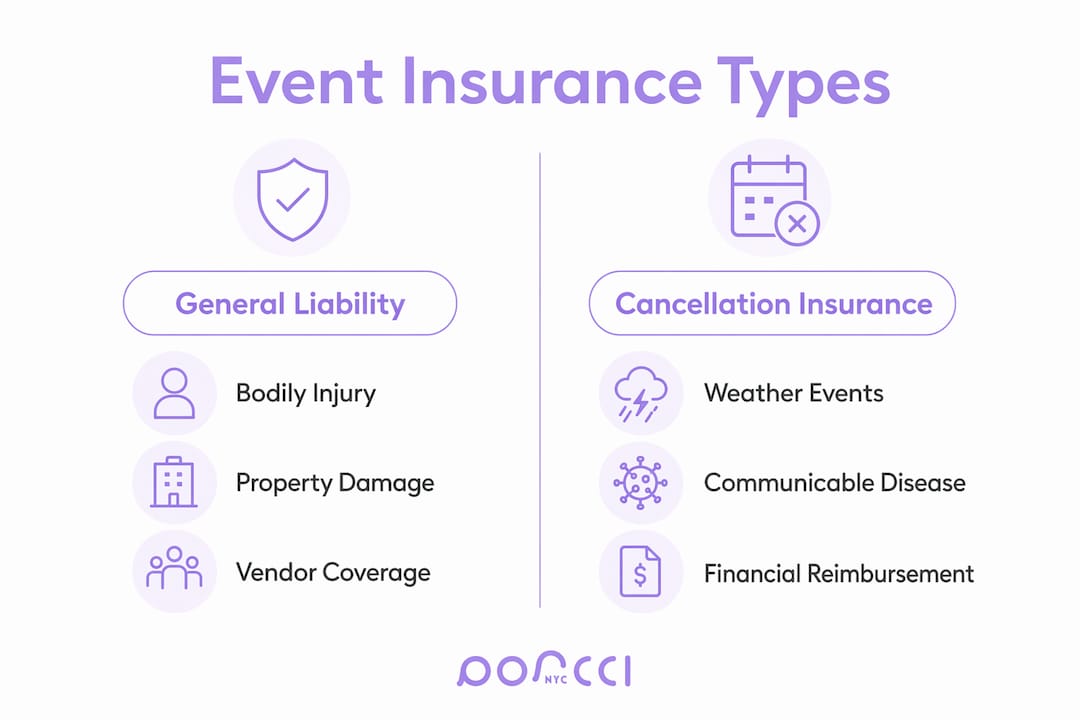
GL covers third-party bodily injury and property damage at the event itself. A guest slips on a wet dance floor and breaks a wrist — GL responds. Your setup crew knocks over a venue wall sconce during load-in — GL responds. Legal defense costs are typically included, which matters because defending a claim often costs as much as settling it.
What GL does NOT cover is just as important:
• Alcohol-related incidents (requires a separate liquor liability endorsement)
• Damage to your own equipment or rented gear
• Employee injuries on the job (that’s workers’ comp)
• Professional errors or planning mistakes (that’s E&O)
• Event cancellation losses (that’s cancellation insurance)
Pro Tip: Require every vendor you bring on-site to name you and the venue as additional insureds on their own GL policy. This shifts liability back to the party responsible for the activity, which can materially reduce your own professional-liability exposure.
Planners and rental companies also use “primary and non-contributory” endorsement language in contracts. This wording tells the venue’s insurer to step back and let the event policy respond first, which is exactly what most venue contracts demand.
Cancellation insurance reimburses you for nonrefundable deposits and prepaid vendor costs when a covered cause forces you to cancel, postpone, or relocate. GL won’t touch these losses. Cancellation insurance exists specifically for them.
Covered causes typically include:
• Severe weather (named storms vs. adverse weather — read the trigger language carefully)
• Vendor bankruptcy or sudden closure
• Key-person illness or death
• Civil authority orders (road closures, emergency declarations)
Communicable disease endorsements are available but carry a significant premium increase. Named-storm triggers are narrower than general adverse-weather language, so a policy that only pays for a named hurricane may leave you exposed to a nor’easter that shuts down your venue.
Per-event cancellation coverage commonly costs about 1–3% of the insured event budget. Buy it as soon as you pay your first deposit. Waiting until a storm is already in the forecast is too late — carriers will exclude the known event.
Standard commercial property policies typically exclude items once they leave your warehouse or office. The moment your AV rig, photo booth, or karaoke system is loaded onto a truck, that standard property policy stops responding. Inland marine (also called an equipment floater) fills that gap, covering gear in transit, during setup, and while staged at the venue.
For transit exposures, commercial auto covers the vehicle itself, but hired and non-owned auto coverage is needed if staff use personal vehicles to haul gear.
When an AV rig is damaged in transit, the inland marine policy on the rental operator’s equipment is the first line of response. The rental operator files the claim, documents the loss with photos and delivery reports, and provides the client and venue with a COI showing the equipment was insured. Without inland marine, the operator absorbs the full replacement cost out of pocket.
Porcci NYC treats rental insurance as a baseline operating standard, not an optional add-on. Clients and venues can expect documented delivery and condition reports with every booking.
Venues nearly always require a COI showing your coverage limits, effective dates, and named insured. Failing to deliver it on time can mean being turned away at the door, which is a breach of your venue contract.
Venue COI checklist:
• Limits: Most venues require at least $1M per occurrence / $2M aggregate; larger venues or NYC ballrooms may ask for $5M.
• Additional insured (AI): The venue must be named on your policy, not just listed on the COI.
• Primary and non-contributory: Confirms your policy responds before the venue’s policy.
• Waiver of subrogation: Prevents your insurer from suing the venue after paying your claim.
• Delivery timing: Submit the COI at least 30 days before the event date.
Pro Tip: Ask your carrier for the AI endorsement wording before you sign the venue contract. Some carriers use non-standard language that venues reject. Confirming the wording early avoids a last-minute scramble.
Venue insurance protects the building owner, not your operations or your vendors. The COI and AI request is the venue’s way of shifting responsibility for event-related incidents back to you.
| Coverage Type | Typical Cost Range | Notes |
|---|---|---|
| Annual GL (small operator) | $800–$2,000/year | $1M/$2M limits |
| Full operator program | $1,800–$5,500/year | GL + inland marine + auto |
| Per-event GL (single host) | $75–$300 per event | $1M limits |
| Cancellation insurance | A small percentage of the insured event budget | Buy at first deposit |
Major cost drivers include event type (concerts and tented outdoor events cost more), total event budget, equipment value, claims history, and location. NYC and NJ premiums tend to run higher than national averages due to venue density, higher liability judgments, and local regulatory requirements.
Buying timeline:
• As soon as deposits are paid: purchase cancellation insurance.
• 60 days out: confirm annual GL covers the venue and event type; add endorsements if needed.
• 30+ days out: deliver COI to the venue with AI and primary/non-contributory language.
• 7 days out: verify all vendor COIs are on file and name you as additional insured.
A specialty event and rental broker can access markets that understand tent wind-loading, generator carbon-monoxide risk, and high-value AV equipment. General carriers often exclude these exposures or price them prohibitively. Using a generalist broker for event coverage is one of the most common ways planners end up with gaps they don’t discover until a claim is denied.
Step-by-step buying checklist:
1. Estimate your total insured value: event budget, equipment value, and nonrefundable deposits.
2. Decide annual vs. per-event structure based on how many events you run per year.
3. Request COI wording from your carrier before signing any venue contract.
4. Obtain AI, primary/non-contributory, and waiver of subrogation endorsements.
5. Store all COIs in a centralized contract folder, organized by event date.
6. Collect vendor COIs and confirm you and the venue are named as additional insureds.
Ask any broker these questions: Do you write inland marine for off-site AV and photo booth equipment? Can you endorse tent wind-loading and generator CO? What’s your turnaround time for COI delivery?
Fewer claims mean lower premiums over time. These controls also make claims easier to resolve when they do happen.
Operational controls:
• Inspect all equipment before every load-out; document condition with photos.
• Follow generator placement and ventilation guidelines to prevent CO buildup.
• Treat dance floor transitions and edges to reduce slip-and-fall risk.
• Train staff on responsible alcohol service protocols if liquor is present.
• Anchor tents to manufacturer wind-load specifications; check forecasts 48 hours out.
Contractual controls:
1. Require every vendor to carry their own GL and name you as additional insured.
2. Include indemnity clauses that assign responsibility for equipment damage to the party operating it.
3. Use written delivery and condition reports signed by both parties at load-in and load-out.
Documentation controls:
• Photograph the venue before setup and after breakdown.
• Keep a signed incident-report template on-site at every event.
• Centralize all COIs, contracts, and endorsements in one folder per event.
Tent wind-loading failures, generator CO incidents, and multi-victim slip-and-fall events are the claims that produce the largest exposures for rental operators. Underwriters focus on exactly these scenarios when pricing your policy.
Event insurance protects hosts and rental providers from two distinct risks: third-party liability claims and first-party financial losses when an event can’t proceed.
| Point | Details |
|---|---|
| GL vs. cancellation | GL pays third parties for injuries; cancellation insurance reimburses your own lost deposits and prepaid costs. |
| COI timing | Deliver your COI with AI and primary/non-contributory language at least 30 days before the event. |
| Inland marine for equipment | Standard property policies exclude gear in transit; an equipment floater covers AV, photo booths, and karaoke machines off-site. |
| Use a specialty broker | Specialty event brokers access markets that cover tent wind-loading, generator CO, and high-value AV — gaps general carriers often exclude. |
| Porcci NYC | Porcci NYC provides insured equipment, documented delivery reports, and COI-ready documentation for NYC and NJ events. |
The insurance conversation is where a lot of bookings either move forward cleanly or stall out. Venues in Manhattan and Brooklyn are not flexible on COI requirements. We’ve seen clients lose their deposit on a venue because a vendor’s COI arrived with the wrong additional insured wording, three days before the event. That’s a recoverable situation if you start the process 60 days out. It’s not recoverable if you start it the week before.
What the industry undersells is how much contractual language does the heavy lifting. The right indemnity clause and a properly worded AI endorsement can shift a six-figure claim away from the event host entirely. Insurance is the backstop. Contracts are the first line of defense. Running both correctly is what separates a smooth event from a costly one.
NYC and NJ also carry higher premiums than most markets, partly because of venue density and partly because of local liability judgment trends. That’s not a reason to cut coverage. It’s a reason to use a broker who knows the market and can find the right carrier for your specific event type.
When you rent AV equipment, a photo booth, DJ services, or a karaoke system from Porcci NYC, you’re working with a provider that treats insurance compliance as part of the service. Every rental comes with documented delivery and condition reports, equipment that’s covered under an inland marine program, and staff trained to follow venue protocols. We provide COI-ready documentation so your venue gets what it needs on time, without the last-minute scramble.
For planners and hosts across NYC and New Jersey, that means one less thing to chase down before the event. Whether you need AV and sound system rentals in NYC or a full entertainment package for a corporate event or wedding, request a quote from Porcci NYC and we’ll walk you through exactly what documentation your venue will need.
Event insurance protects the host from two risks: third-party liability claims (GL) and financial losses when the event is canceled or postponed (cancellation insurance). The two policies cover different situations and are not interchangeable.
No. Venue insurance protects the building owner, not the host’s operations or vendors. Hosts need their own event liability policy, which is why venues require a separate COI from the host.
Buy cancellation insurance as soon as you pay your first deposit. Carriers exclude events where a covered cause (such as a named storm) is already known at the time of purchase.
Single-event GL policies typically run $75–$300 per event for $1M in limits, making them practical for one-time hosts who don’t need an annual program.
No. Each vendor’s policy covers their own operations. You need your own event liability policy, and you should require every vendor to name you as an additional insured on theirs.
Discover the vital role of event insurance for NYC & NJ planners. Protect your finances and reduce liability risks at your gatherings.
TL;DR:
• Event insurance covers third-party liability claims and reimburses hosts for event cancellations. Proper coverage requires timely Certificates of Insurance, additional insureds, and endorsements, especially in NYC and New Jersey. Using specialized brokers and contractual controls minimizes risk and ensures compliance with venue requirements.
Event insurance protects your financial exposure and legal liability at a single gathering. Its two core functions are distinct: general liability (GL) covers third-party claims if a guest is injured or property is damaged, while event cancellation insurance reimburses you for lost deposits and prepaid vendor costs when the event can’t go forward. Confusing the two is the most common and costly mistake planners make.
For hosts and rental providers in NYC and New Jersey, the stakes are especially high. Venues across Manhattan, Brooklyn, and Jersey City routinely require proof of coverage before they hand over the keys. According to the Insurance Information Institute, liability claims from a single event can run into the tens of thousands of dollars once medical costs and legal defense are included. Whether you’re booking DJ services or coordinating a 300-person corporate gala, the role of event insurance is to keep one bad night from becoming a financial crisis.
• GL covers third-party bodily injury, property damage, and legal defense costs.
• Cancellation insurance reimburses your nonrefundable deposits and prepaid vendor fees.
• Liquor liability, inland marine, and workers’ comp fill the gaps GL leaves behind.
• NYC and NJ venues commonly require a Certificate of Insurance (COI) before access is granted.
• The role event insurance actually covers
• What general liability pays for at your event
• How event cancellation insurance works
• Who is liable for damaged or lost rental equipment
• What venues require: COIs, additional insured, and endorsements
• How much event insurance costs and when to buy it
• How to buy event insurance the right way
• Practical risk-reduction steps that lower claims and premiums
• What we’ve learned running events across NYC and New Jersey
• Porcci NYC keeps your event insurance-ready from day one
• FAQ
Event insurance is not a single product. It’s a category of several policies, each addressing a different risk pool. Here’s how the main types break down:
| Policy Type | What It Covers | Annual or Per-Event |
|---|---|---|
| General Liability (GL) | Third-party bodily injury, property damage, legal defense | Both options available |
| Event Cancellation/Interruption | Lost deposits, prepaid vendor costs, relocation expenses | Per-event |
| Liquor Liability | Alcohol-related injury or damage claims | Per-event or annual add-on |
| Professional Liability (E&O) | Claims of negligence or failure to deliver services | Annual |
| Inland Marine (Equipment Floater) | Equipment in transit or staged off-site | Annual or per-event |
| Commercial Auto / Hired & Non-Owned | Vehicle liability during equipment transport | Annual |
| Workers’ Compensation | Staff injuries during setup, operation, and breakdown | Annual |
Annual policies make sense for planners and rental operators who run events year-round. A single-event GL policy is the right call for a one-time host who doesn’t need year-round coverage.
GL covers third-party bodily injury and property damage at the event itself. A guest slips on a wet dance floor and breaks a wrist — GL responds. Your setup crew knocks over a venue wall sconce during load-in — GL responds. Legal defense costs are typically included, which matters because defending a claim often costs as much as settling it.
What GL does NOT cover is just as important:
• Alcohol-related incidents (requires a separate liquor liability endorsement)
• Damage to your own equipment or rented gear
• Employee injuries on the job (that’s workers’ comp)
• Professional errors or planning mistakes (that’s E&O)
• Event cancellation losses (that’s cancellation insurance)
Pro Tip: Require every vendor you bring on-site to name you and the venue as additional insureds on their own GL policy. This shifts liability back to the party responsible for the activity, which can materially reduce your own professional-liability exposure.
Planners and rental companies also use “primary and non-contributory” endorsement language in contracts. This wording tells the venue’s insurer to step back and let the event policy respond first, which is exactly what most venue contracts demand.
Cancellation insurance reimburses you for nonrefundable deposits and prepaid vendor costs when a covered cause forces you to cancel, postpone, or relocate. GL won’t touch these losses. Cancellation insurance exists specifically for them.
Covered causes typically include:
• Severe weather (named storms vs. adverse weather — read the trigger language carefully)
• Vendor bankruptcy or sudden closure
• Key-person illness or death
• Civil authority orders (road closures, emergency declarations)
Communicable disease endorsements are available but carry a significant premium increase. Named-storm triggers are narrower than general adverse-weather language, so a policy that only pays for a named hurricane may leave you exposed to a nor’easter that shuts down your venue.
Per-event cancellation coverage commonly costs about 1–3% of the insured event budget. Buy it as soon as you pay your first deposit. Waiting until a storm is already in the forecast is too late — carriers will exclude the known event.
Standard commercial property policies typically exclude items once they leave your warehouse or office. The moment your AV rig, photo booth, or karaoke system is loaded onto a truck, that standard property policy stops responding. Inland marine (also called an equipment floater) fills that gap, covering gear in transit, during setup, and while staged at the venue.
For transit exposures, commercial auto covers the vehicle itself, but hired and non-owned auto coverage is needed if staff use personal vehicles to haul gear.
When an AV rig is damaged in transit, the inland marine policy on the rental operator’s equipment is the first line of response. The rental operator files the claim, documents the loss with photos and delivery reports, and provides the client and venue with a COI showing the equipment was insured. Without inland marine, the operator absorbs the full replacement cost out of pocket.
Porcci NYC treats rental insurance as a baseline operating standard, not an optional add-on. Clients and venues can expect documented delivery and condition reports with every booking.
Venues nearly always require a COI showing your coverage limits, effective dates, and named insured. Failing to deliver it on time can mean being turned away at the door, which is a breach of your venue contract.
Venue COI checklist:
• Limits: Most venues require at least $1M per occurrence / $2M aggregate; larger venues or NYC ballrooms may ask for $5M.
• Additional insured (AI): The venue must be named on your policy, not just listed on the COI.
• Primary and non-contributory: Confirms your policy responds before the venue’s policy.
• Waiver of subrogation: Prevents your insurer from suing the venue after paying your claim.
• Delivery timing: Submit the COI at least 30 days before the event date.
Pro Tip: Ask your carrier for the AI endorsement wording before you sign the venue contract. Some carriers use non-standard language that venues reject. Confirming the wording early avoids a last-minute scramble.
Venue insurance protects the building owner, not your operations or your vendors. The COI and AI request is the venue’s way of shifting responsibility for event-related incidents back to you.
| Coverage Type | Typical Cost Range | Notes |
|---|---|---|
| Annual GL (small operator) | $800–$2,000/year | $1M/$2M limits |
| Full operator program | $1,800–$5,500/year | GL + inland marine + auto |
| Per-event GL (single host) | $75–$300 per event | $1M limits |
| Cancellation insurance | A small percentage of the insured event budget | Buy at first deposit |
Major cost drivers include event type (concerts and tented outdoor events cost more), total event budget, equipment value, claims history, and location. NYC and NJ premiums tend to run higher than national averages due to venue density, higher liability judgments, and local regulatory requirements.
Buying timeline:
• As soon as deposits are paid: purchase cancellation insurance.
• 60 days out: confirm annual GL covers the venue and event type; add endorsements if needed.
• 30+ days out: deliver COI to the venue with AI and primary/non-contributory language.
• 7 days out: verify all vendor COIs are on file and name you as additional insured.
A specialty event and rental broker can access markets that understand tent wind-loading, generator carbon-monoxide risk, and high-value AV equipment. General carriers often exclude these exposures or price them prohibitively. Using a generalist broker for event coverage is one of the most common ways planners end up with gaps they don’t discover until a claim is denied.
Step-by-step buying checklist:
1. Estimate your total insured value: event budget, equipment value, and nonrefundable deposits.
2. Decide annual vs. per-event structure based on how many events you run per year.
3. Request COI wording from your carrier before signing any venue contract.
4. Obtain AI, primary/non-contributory, and waiver of subrogation endorsements.
5. Store all COIs in a centralized contract folder, organized by event date.
6. Collect vendor COIs and confirm you and the venue are named as additional insureds.
Ask any broker these questions: Do you write inland marine for off-site AV and photo booth equipment? Can you endorse tent wind-loading and generator CO? What’s your turnaround time for COI delivery?
Fewer claims mean lower premiums over time. These controls also make claims easier to resolve when they do happen.
Operational controls:
• Inspect all equipment before every load-out; document condition with photos.
• Follow generator placement and ventilation guidelines to prevent CO buildup.
• Treat dance floor transitions and edges to reduce slip-and-fall risk.
• Train staff on responsible alcohol service protocols if liquor is present.
• Anchor tents to manufacturer wind-load specifications; check forecasts 48 hours out.
Contractual controls:
1. Require every vendor to carry their own GL and name you as additional insured.
2. Include indemnity clauses that assign responsibility for equipment damage to the party operating it.
3. Use written delivery and condition reports signed by both parties at load-in and load-out.
Documentation controls:
• Photograph the venue before setup and after breakdown.
• Keep a signed incident-report template on-site at every event.
• Centralize all COIs, contracts, and endorsements in one folder per event.
Tent wind-loading failures, generator CO incidents, and multi-victim slip-and-fall events are the claims that produce the largest exposures for rental operators. Underwriters focus on exactly these scenarios when pricing your policy.
Event insurance protects hosts and rental providers from two distinct risks: third-party liability claims and first-party financial losses when an event can’t proceed.
| Point | Details |
|---|---|
| GL vs. cancellation | GL pays third parties for injuries; cancellation insurance reimburses your own lost deposits and prepaid costs. |
| COI timing | Deliver your COI with AI and primary/non-contributory language at least 30 days before the event. |
| Inland marine for equipment | Standard property policies exclude gear in transit; an equipment floater covers AV, photo booths, and karaoke machines off-site. |
| Use a specialty broker | Specialty event brokers access markets that cover tent wind-loading, generator CO, and high-value AV — gaps general carriers often exclude. |
| Porcci NYC | Porcci NYC provides insured equipment, documented delivery reports, and COI-ready documentation for NYC and NJ events. |
The insurance conversation is where a lot of bookings either move forward cleanly or stall out. Venues in Manhattan and Brooklyn are not flexible on COI requirements. We’ve seen clients lose their deposit on a venue because a vendor’s COI arrived with the wrong additional insured wording, three days before the event. That’s a recoverable situation if you start the process 60 days out. It’s not recoverable if you start it the week before.
What the industry undersells is how much contractual language does the heavy lifting. The right indemnity clause and a properly worded AI endorsement can shift a six-figure claim away from the event host entirely. Insurance is the backstop. Contracts are the first line of defense. Running both correctly is what separates a smooth event from a costly one.
NYC and NJ also carry higher premiums than most markets, partly because of venue density and partly because of local liability judgment trends. That’s not a reason to cut coverage. It’s a reason to use a broker who knows the market and can find the right carrier for your specific event type.
When you rent AV equipment, a photo booth, DJ services, or a karaoke system from Porcci NYC, you’re working with a provider that treats insurance compliance as part of the service. Every rental comes with documented delivery and condition reports, equipment that’s covered under an inland marine program, and staff trained to follow venue protocols. We provide COI-ready documentation so your venue gets what it needs on time, without the last-minute scramble.
For planners and hosts across NYC and New Jersey, that means one less thing to chase down before the event. Whether you need AV and sound system rentals in NYC or a full entertainment package for a corporate event or wedding, request a quote from Porcci NYC and we’ll walk you through exactly what documentation your venue will need.
Event insurance protects the host from two risks: third-party liability claims (GL) and financial losses when the event is canceled or postponed (cancellation insurance). The two policies cover different situations and are not interchangeable.
No. Venue insurance protects the building owner, not the host’s operations or vendors. Hosts need their own event liability policy, which is why venues require a separate COI from the host.
Buy cancellation insurance as soon as you pay your first deposit. Carriers exclude events where a covered cause (such as a named storm) is already known at the time of purchase.
Single-event GL policies typically run $75–$300 per event for $1M in limits, making them practical for one-time hosts who don’t need an annual program.
No. Each vendor’s policy covers their own operations. You need your own event liability policy, and you should require every vendor to name you as an additional insured on theirs.