Discover how to secure community event permits explained for NYC and NJ planners. Get the essential steps for a successful event approval.
TL;DR:
• Obtaining community event permits in New York City and New Jersey depends on securing all secondary approvals before the primary permit is issued. Organizers must provide vendor certificates, insurance, and safety clearances early and plan for public-safety staffing costs; permits require several weeks or months to process. Porcci NYC simplifies this process by providing necessary documentation and staffing support to ensure event approval.
Getting your community event approved in New York City or New Jersey comes down to one core fact: your primary permit (a NYC Parks special event permit, a SAPO street event permit, or a municipal community event permit in NJ) will not be issued until every required secondary approval is in place. That means NYPD or local police sign-off, FDNY or fire department clearance, health department approval, and proof of general liability insurance are all prerequisites, not afterthoughts. Holding that approved permit is your legal authorization to occupy public space and your primary defense against enforcement action.
Your three immediate actions:
• Confirm jurisdiction. Determine whether your venue falls under NYC Parks, CECM/SAPO, a county park, or a NJ municipal authority. Each has its own application portal and timeline.
• Collect vendor COIs and inspection certificates early. Request certificates of insurance and equipment inspection paperwork from every vendor at contract signing, not at delivery.
• Budget for public-safety staffing. Paid-duty police officers, mobile barricades, and traffic control are organizer-paid costs in both NYC and NJ. Plan for them as a line item, not a contingency.
• What permits do you actually need, and how does the process work?
• Porcci NYC makes permit-ready event production easier
• FAQ
Community event permit requirements follow a clear hierarchy. The primary permit is the last approval you receive, not the first thing you apply for.
| Permit Type | Issuing Agency | Minimum Lead Time | Common Organizer Costs |
|---|---|---|---|
| Street event / road closure permits require varying lead times depending on location and event scale | application fees and organizer-paid public-safety staffing costs are typical | ||
| Park special event | NYC Parks or NJ State Park Service | 21 days minimum (NYC Parks); 90 days recommended (NJ) | a processing fee applies in NYC Parks events; site walk-through fees (NJ) |
| Amplified sound | NYPD (local precinct) | Apply alongside primary permit | Sound permit fee |
| Tent / staging / inflatables | NYC Dept. of Buildings | Concurrent with primary application | DOB permit fee |
| Food vendor permits require prior application to health or consumer affairs departments | Vendor-specific | ||
| Alcohol permits require advance application through state liquor authorities | Social affairs permit fee | ||
| Generator permits require FDNY approval, with additional permits for larger units | FDNY certificate fee |
NYC’s CECM rules are explicit: the city will not issue a SAPO or Parks permit until all other required agency permits are obtained. That means you must secure NYPD sound approval, DOB tent permits, and FDNY generator certificates before your primary permit clears. In NJ, the same logic applies. Moorestown’s ordinance, for example, gives the Director of Police discretion to require paid-duty officers or mobile barricades at the organizer’s expense, and no final permit issues until those arrangements are confirmed.

NYC Parks requires applications at least 21 days before the event, and applications for the following calendar year open in early September after Labor Day. CECM requires applications several weeks in advance for many special events, but competitive dates fill fast. For NJ State Parks, the recommendation is 90 days for general events and one year for large ones. Applications are accepted up to 16 months in advance, and all fees and insurance must be completed well before the event to avoid denial. No changes are permitted within a certain time window before the event.
Pro Tip: NYC guidance explicitly warns organizers not to advertise until a permit is approved. Build at least two weeks of buffer beyond the minimum application window before you promote publicly.
NYC special events typically require a minimum of $1 million in general liability coverage, with the municipality named as additional insured. NJ municipalities mirror this requirement. Moorestown’s permit form prohibits deductibles on liability policies and requires timely submission of the COI. Every vendor you bring on, including DJ services, photo booths, and AV equipment providers, must supply their own COI and any applicable inspection certificates. Inflatables, generators, and tall staging each trigger separate documentation requirements. Require all vendor paperwork at contract signing, not at load-in.
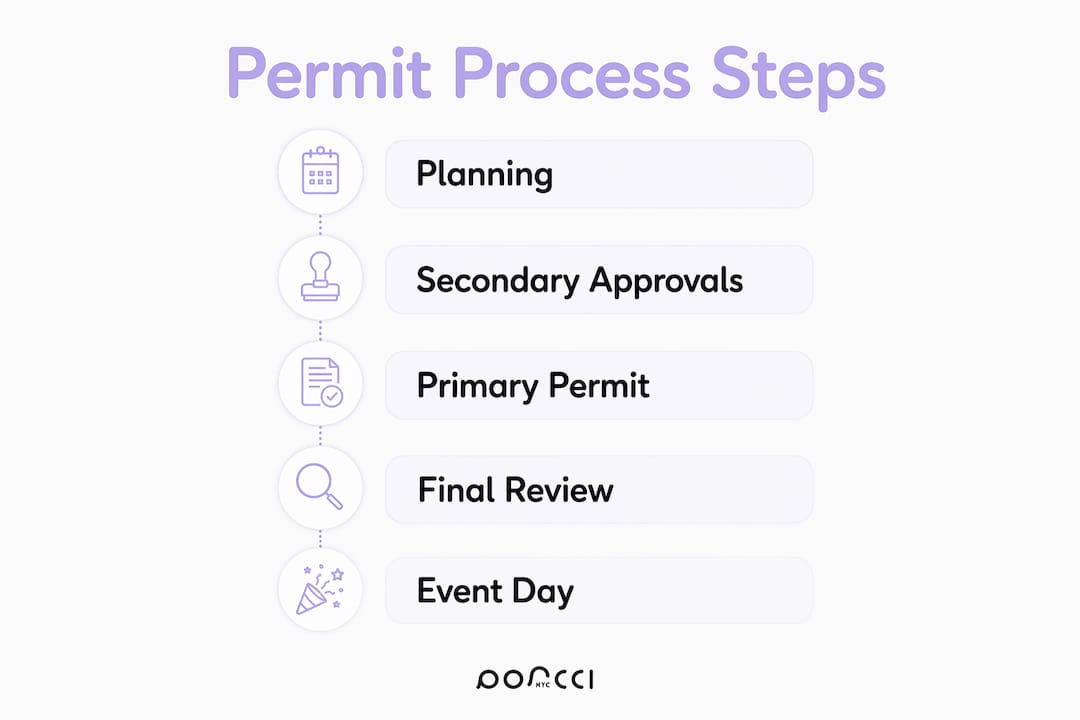
1. Confirm venue jurisdiction and identify the primary permitting agency.
2. Scout the location and prepare a site plan and run of show.
3. Apply for secondary permits concurrently: NYPD sound, DOB structures, FDNY generator, health/food vendor, ABC (NJ alcohol).
4. Secure vendor COIs and inspection certificates; confirm vendor compliance before submitting the primary application.
5. Submit the primary permit application with all secondary approvals and COIs attached.
6. Complete the operations plan (required for larger NJ State Park events, due 60 days prior).
7. Pay all fees and confirm insurance at least 30 days before the event.
8. Receive the primary permit. Only then begin public promotion.
For professional event logistics guidance that complements municipal requirements, reviewing established operational frameworks can help you anticipate coordination gaps before they become permit delays.
Planning a community event in NYC or New Jersey means managing a stack of documentation alongside the actual entertainment. Porcci NYC is built for exactly that situation. We provide vendor COIs and equipment inspection certificates as part of every booking, supply electrical and staging specs for DOB and fire department submissions, and can help you build the line-item estimates for police and barricade budgeting that municipal applications require.
Our services relevant to permit filings include DJ services, photo booth rentals, karaoke systems, AV and sound equipment, professional lighting, and event staffing, all with delivery, setup, and breakdown included. Every piece of equipment comes with the documentation your permit package needs.
Ready to get your event approved and your entertainment locked in? Request a permit-ready quote from Porcci NYC today.
Your primary event permit is the final approval in the process, not the starting point. Secure all secondary agency approvals, vendor COIs, and insurance before submitting your primary application.
| Point | Details |
|---|---|
| Primary permit is last | NYC and NJ will not issue the primary permit until all secondary approvals and COIs are in place. |
| Insurance minimums matter | NYC special events typically require $1 million in general liability coverage, with the municipality named as additional insured. |
| Lead times vary widely | NYC Parks requires a minimum 21-day lead time before the event; NJ State Parks recommends 90 days for general events and accepts applications up to 16 months in advance. |
| Vendor paperwork is critical path | Require COIs and inspection certificates from every vendor at contract signing to avoid permit delays. |
| Porcci NYC | Provides vendor COIs, equipment specs, and staffing support to help organizers meet municipal permit requirements in NYC and NJ. |
A community event permit is the official authorization from a city or municipal agency allowing you to hold a public gathering on streets, parks, or public property. In NYC, this is issued by CECM/SAPO or NYC Parks; in NJ, by the local municipality or NJ State Park Service.
NYC Parks requires a minimum application window of 21 days before the event, and CECM requires applications several weeks in advance for many special events. Competitive dates fill quickly, so applying as early as possible is strongly recommended.
Vendors do not typically need separate municipal permits, but they must supply a Certificate of Insurance naming the municipality as additional insured, plus any equipment-specific inspection certificates, before the primary permit can be issued.
Operating without an approved permit exposes organizers to enforcement action, fines, and event shutdown. The permit is your legal authorization to occupy public space and your primary liability protection.
Porcci NYC provides vendor COIs, equipment specs, and site documentation that municipal permit applications require, helping organizers in NYC and New Jersey reduce approval delays and keep their event on schedule.
Discover how to secure community event permits explained for NYC and NJ planners. Get the essential steps for a successful event approval.
TL;DR:
• Obtaining community event permits in New York City and New Jersey depends on securing all secondary approvals before the primary permit is issued. Organizers must provide vendor certificates, insurance, and safety clearances early and plan for public-safety staffing costs; permits require several weeks or months to process. Porcci NYC simplifies this process by providing necessary documentation and staffing support to ensure event approval.
Getting your community event approved in New York City or New Jersey comes down to one core fact: your primary permit (a NYC Parks special event permit, a SAPO street event permit, or a municipal community event permit in NJ) will not be issued until every required secondary approval is in place. That means NYPD or local police sign-off, FDNY or fire department clearance, health department approval, and proof of general liability insurance are all prerequisites, not afterthoughts. Holding that approved permit is your legal authorization to occupy public space and your primary defense against enforcement action.
Your three immediate actions:
• Confirm jurisdiction. Determine whether your venue falls under NYC Parks, CECM/SAPO, a county park, or a NJ municipal authority. Each has its own application portal and timeline.
• Collect vendor COIs and inspection certificates early. Request certificates of insurance and equipment inspection paperwork from every vendor at contract signing, not at delivery.
• Budget for public-safety staffing. Paid-duty police officers, mobile barricades, and traffic control are organizer-paid costs in both NYC and NJ. Plan for them as a line item, not a contingency.
• What permits do you actually need, and how does the process work?
• Porcci NYC makes permit-ready event production easier
• FAQ
Community event permit requirements follow a clear hierarchy. The primary permit is the last approval you receive, not the first thing you apply for.
| Permit Type | Issuing Agency | Minimum Lead Time | Common Organizer Costs |
|---|---|---|---|
| Street event / road closure permits require varying lead times depending on location and event scale | application fees and organizer-paid public-safety staffing costs are typical | ||
| Park special event | NYC Parks or NJ State Park Service | 21 days minimum (NYC Parks); 90 days recommended (NJ) | a processing fee applies in NYC Parks events; site walk-through fees (NJ) |
| Amplified sound | NYPD (local precinct) | Apply alongside primary permit | Sound permit fee |
| Tent / staging / inflatables | NYC Dept. of Buildings | Concurrent with primary application | DOB permit fee |
| Food vendor permits require prior application to health or consumer affairs departments | Vendor-specific | ||
| Alcohol permits require advance application through state liquor authorities | Social affairs permit fee | ||
| Generator permits require FDNY approval, with additional permits for larger units | FDNY certificate fee |
NYC’s CECM rules are explicit: the city will not issue a SAPO or Parks permit until all other required agency permits are obtained. That means you must secure NYPD sound approval, DOB tent permits, and FDNY generator certificates before your primary permit clears. In NJ, the same logic applies. Moorestown’s ordinance, for example, gives the Director of Police discretion to require paid-duty officers or mobile barricades at the organizer’s expense, and no final permit issues until those arrangements are confirmed.
NYC Parks requires applications at least 21 days before the event, and applications for the following calendar year open in early September after Labor Day. CECM requires applications several weeks in advance for many special events, but competitive dates fill fast. For NJ State Parks, the recommendation is 90 days for general events and one year for large ones. Applications are accepted up to 16 months in advance, and all fees and insurance must be completed well before the event to avoid denial. No changes are permitted within a certain time window before the event.
Pro Tip: NYC guidance explicitly warns organizers not to advertise until a permit is approved. Build at least two weeks of buffer beyond the minimum application window before you promote publicly.
NYC special events typically require a minimum of $1 million in general liability coverage, with the municipality named as additional insured. NJ municipalities mirror this requirement. Moorestown’s permit form prohibits deductibles on liability policies and requires timely submission of the COI. Every vendor you bring on, including DJ services, photo booths, and AV equipment providers, must supply their own COI and any applicable inspection certificates. Inflatables, generators, and tall staging each trigger separate documentation requirements. Require all vendor paperwork at contract signing, not at load-in.
1. Confirm venue jurisdiction and identify the primary permitting agency.
2. Scout the location and prepare a site plan and run of show.
3. Apply for secondary permits concurrently: NYPD sound, DOB structures, FDNY generator, health/food vendor, ABC (NJ alcohol).
4. Secure vendor COIs and inspection certificates; confirm vendor compliance before submitting the primary application.
5. Submit the primary permit application with all secondary approvals and COIs attached.
6. Complete the operations plan (required for larger NJ State Park events, due 60 days prior).
7. Pay all fees and confirm insurance at least 30 days before the event.
8. Receive the primary permit. Only then begin public promotion.
For professional event logistics guidance that complements municipal requirements, reviewing established operational frameworks can help you anticipate coordination gaps before they become permit delays.
Planning a community event in NYC or New Jersey means managing a stack of documentation alongside the actual entertainment. Porcci NYC is built for exactly that situation. We provide vendor COIs and equipment inspection certificates as part of every booking, supply electrical and staging specs for DOB and fire department submissions, and can help you build the line-item estimates for police and barricade budgeting that municipal applications require.
Our services relevant to permit filings include DJ services, photo booth rentals, karaoke systems, AV and sound equipment, professional lighting, and event staffing, all with delivery, setup, and breakdown included. Every piece of equipment comes with the documentation your permit package needs.
Ready to get your event approved and your entertainment locked in? Request a permit-ready quote from Porcci NYC today.
Your primary event permit is the final approval in the process, not the starting point. Secure all secondary agency approvals, vendor COIs, and insurance before submitting your primary application.
| Point | Details |
|---|---|
| Primary permit is last | NYC and NJ will not issue the primary permit until all secondary approvals and COIs are in place. |
| Insurance minimums matter | NYC special events typically require $1 million in general liability coverage, with the municipality named as additional insured. |
| Lead times vary widely | NYC Parks requires a minimum 21-day lead time before the event; NJ State Parks recommends 90 days for general events and accepts applications up to 16 months in advance. |
| Vendor paperwork is critical path | Require COIs and inspection certificates from every vendor at contract signing to avoid permit delays. |
| Porcci NYC | Provides vendor COIs, equipment specs, and staffing support to help organizers meet municipal permit requirements in NYC and NJ. |
A community event permit is the official authorization from a city or municipal agency allowing you to hold a public gathering on streets, parks, or public property. In NYC, this is issued by CECM/SAPO or NYC Parks; in NJ, by the local municipality or NJ State Park Service.
NYC Parks requires a minimum application window of 21 days before the event, and CECM requires applications several weeks in advance for many special events. Competitive dates fill quickly, so applying as early as possible is strongly recommended.
Vendors do not typically need separate municipal permits, but they must supply a Certificate of Insurance naming the municipality as additional insured, plus any equipment-specific inspection certificates, before the primary permit can be issued.
Operating without an approved permit exposes organizers to enforcement action, fines, and event shutdown. The permit is your legal authorization to occupy public space and your primary liability protection.
Porcci NYC provides vendor COIs, equipment specs, and site documentation that municipal permit applications require, helping organizers in NYC and New Jersey reduce approval delays and keep their event on schedule.