
Corporate playlist ideas by event moment, from arrival to the final song, plus the licensing catch with Spotify and when a DJ is worth hiring.
The best corporate playlist is not one list. It is a few short ones, each built for a moment: people arriving, people talking, people eating, people finally loosening up. Build it that way and the music does its job without anyone noticing it. Below you will find song ideas for each stage, a few rules for choosing them, and one legal catch that surprises a lot of planners: the streaming app on your phone is probably not allowed to play at your event.
• Split the playlist by moment: arrival, networking, dinner, awards or speeches, and the party stretch. Each needs a different energy.
• For talking time, keep vocals light and volume low. For the dance stretch, choose songs that every age group already knows.
• Consumer Spotify is for personal, non-commercial use only, so a company event needs a licensed source or a DJ.
• Send a short song-request form to staff two weeks out, and run a clean-lyrics check on every track.
• For anything beyond a small office gathering, a DJ with a proper sound system saves you from volume swings and dead air.
• TL;DR
• Start with the room, not the songs
• Song ideas by decade and vibe
• Office party music playlist: keep it simple
• Background music for corporate events: a short checklist
• Build your playlist in six steps
• The licensing catch most teams miss
• Our perspective: music is structure, not decoration
• When a playlist is enough, and when to hire a DJ
• Quick answers on common playlist snags
• FAQ
• Sources
Before you add a single track, answer three questions.
1. What is the event for? A quarterly thank-you lunch, a holiday party and a client reception want very different music.
2. Who is in the room? A team of 25 mostly in their late twenties is not the same crowd as 200 people across four decades, a few clients and someone’s visiting parents.
3. Where is the talking happening? If conversation is the point, music should sit under it. If dancing is the point, music should lead.
We set up sound for corporate rooms across NYC and New Jersey, and the pattern repeats. The playlist that fails is almost never a bad playlist. It is a good party playlist played at 11 a.m. during a networking hour, or a gentle background mix still running at 9 p.m. when people are ready to move.
Think of the event as a run of short scenes. Give each one a purpose, an energy level and a rough length.
The room is half empty and people are walking in alone. Music fills the awkward silence. Aim for warm, steady and friendly, with a mid-tempo groove.
Ideas that work:
• Soft soul and funk instrumentals
• Acoustic covers of well-known pop songs
• Light jazz with a beat, such as modern jazz-funk
• Chilled electronic with no sharp drops
Keep the volume low enough that two people can introduce themselves without leaning in.
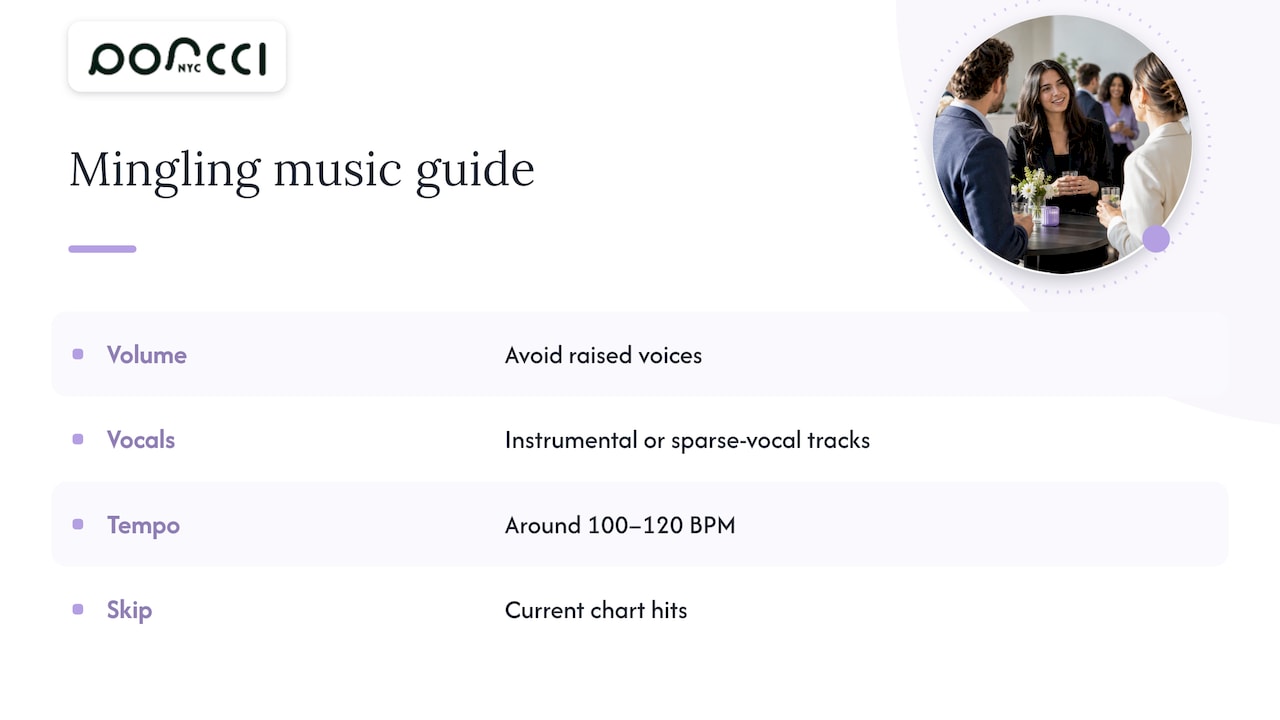
This is the stretch where most planners go wrong. If people have to raise their voices, the music is too loud or too busy. Lyrics compete with conversation, so lean toward instrumental or sparse-vocal tracks.
A tempo around 100 to 120 BPM tends to feel relaxed but not sleepy. That is a rule of thumb we use, not a law, so trust your ears in the actual room. Warm deep house, instrumental lo-fi, bossa nova and mellow Motown instrumentals all fit.
One thing we tell clients: skip the current chart hits here. People start singing along, commenting on the song, or arguing about it, and the conversation drifts away from the reason you gathered.
You want a little more polish. Think “nice restaurant”, not “club”. Piano standards, easy Latin jazz, acoustic guitar, and soft vocal jazz at low volume all work. Avoid anything with a heavy bass line; it carries across a room and tires people out.
Music here is a signal. A short walk-up track tells people it is time to look at the stage. Pick something confident and clean that lasts 20 to 40 seconds, then fades under the speaker.
• Walk-on for the CEO or host: a bright, upbeat instrumental or a short horn-driven groove
• Award winners: a punchy 10 to 15 second clip, so nobody stands awkwardly through a full verse
• Transitions between speakers: soft, neutral, quick
This is where having one person in charge of cues matters. Hand the job to someone, ideally a DJ or a tech operator, rather than leaving it to whoever is nearest the laptop.
Now the music can lead. Start by bringing the tempo up gradually rather than jumping straight to peak energy. A good rhythm is two or three recognizable crowd-pleasers, one slightly newer song, then back to a classic.

The common thread for a mixed-age corporate crowd is familiarity. Songs from the 1970s through the 2000s that nearly everyone knows will outperform an impressive but obscure list.
Here are starter picks. Treat them as a menu, not a script, and always check lyrics for your own audience.
| Vibe | Song ideas |
|---|---|
| Feel-good openers | “Happy” by Pharrell Williams, “Good as Hell” by Lizzo, “Walking on Sunshine” by Katrina and the Waves |
| Classic sing-alongs | “Dancing Queen” by ABBA, “Don’t Stop Believin’” by Journey, “Sweet Caroline” by Neil Diamond |
| Motown and soul | “Signed, Sealed, Delivered” by Stevie Wonder, “Ain’t No Mountain High Enough” by Marvin Gaye and Tammi Terrell, “September” by Earth, Wind and Fire |
| 2000s throwbacks | “Mr. Brightside” by The Killers, “Hey Ya!” by OutKast, “Crazy in Love” by Beyoncé |
| Current crowd energy | “Uptown Funk” by Mark Ronson featuring Bruno Mars, “Can’t Stop the Feeling!” by Justin Timberlake, “Levitating” by Dua Lipa |
| Latin lift | “Danza Kuduro” by Don Omar, “Suavemente” by Elvis Crespo, “Despacito” by Luis Fonsi |
| Wind-down | “Lovely Day” by Bill Withers, “Home” by Edward Sharpe and the Magnetic Zeros |
New York crowds are rarely one-genre. If your office is a real mix of backgrounds, as most NYC offices are, add a short Latin, Caribbean or Bollywood block rather than hoping one pop playlist covers everyone. Ask your team. It is the cheapest fix there is.
For a smaller in-office celebration, such as a Friday toast, a work anniversary or a team lunch, you do not need a big plan. Use this rough shape:
1. 30 minutes of easy, upbeat background (soul, indie-pop, funk)
2. A pick-me-up block of familiar hits once food is out
3. One “request round” where people nominate a song
The request round is where the energy lifts. People love hearing their pick, even if they will not admit it.
If you have a team that is shy about singing, a sing-along moment can work well too. We wrote a separate guide with corporate karaoke songs for shy teams that start easy and build.
When the music is background, the goal is that nobody comments on it. Run this quick test:
• Volume: you should be able to talk at normal level a few feet apart.
• Consistency: no sudden loud tracks, no ads, no big gaps.
• Vocals: sparse or none during networking.
• Lyrics: nothing explicit, political or awkward for a work setting.
• Speaker placement: a few small speakers spread around the room beat one big speaker blasting from the front. Everyone hears the same level, and nobody gets stuck near a wall of sound.
That last point is about equipment, not songs. If you are unsure what your room needs, our guide to party sound system options for NYC and NJ events walks through the choices.
1. Write a run sheet. List each part of the event with a start time and the energy you want. Music becomes much easier once the timeline is on paper. Our corporate gathering setup steps cover how to lay this out.
2. Collect requests. Send a two-question form: “One song that gets you moving” and “One song to skip.” Two weeks before is plenty.
3. Sort by moment. Put each song into the segment where it fits. A great song in the wrong spot is a wrong song.
4. Check the edits. Use clean or radio versions. Listen to the first minute and the chorus of every track, not just the title.
5. Plan the transitions. Overlap or fade between tracks so there is no silence. Matching tempo between neighboring songs makes the room feel smoother.
6. Test in the room. Play it at the actual venue, at event volume, before the day. Walk around. Check the corners and the entrance.
This part is easy to skip and awkward to learn the hard way. Spotify says plainly that its service is only for personal, non-commercial use, which means you cannot broadcast it publicly from a business. A company event can fall into that category even if it is private and you pay for Premium.
Separately, playing music for people outside a small circle of family and friends is a public performance. In the US, performing rights organizations such as ASCAP license that public performance, and they list business license agreements for venues and companies.
In practice, you have a few legitimate routes:
• The venue already holds the licenses. Many hotels, restaurants and event spaces do. Ask in writing, and ask whether that covers your own playlist or only what they play.
• A professional DJ or music provider who handles licensed sources.
• A business-licensed background music service for ongoing office use.
We cover who is responsible in more detail in who handles music licensing for events in NYC and NJ. If your company is large, or you play music in a public-facing space, check with your legal or facilities team before the event. We can tell you how events usually work, but we are not your lawyer, and your own counsel should answer the license question for your company.
We run music, sound and entertainment for corporate events in NYC and New Jersey, and the biggest shift we see in a good event is when a planner stops thinking of music as a playlist and starts thinking of it as part of the schedule.
Here is what we have learned works.
• One person owns the music. Not three people with three phones. When no one owns it, the volume drifts, songs repeat and the mood does not match the moment.
• Read the room beats the list. A prepared playlist is a fine start. A DJ or operator who can watch the floor and swap a song in thirty seconds is better. If the dance floor empties, change course.
• The sound system matters as much as the songs. A great mix through a weak or badly placed speaker still sounds bad. Match the system to the room size and headcount.
• Build in a shared moment. Karaoke, a photo booth or a short group song gives colleagues something to laugh about the next Monday. It is what people actually talk about afterward.
• Plan for every kind of guest. Clients, executives, new hires and plus-ones are all in the room. Familiar and clean wins.
Our team works with both large corporate groups and small private celebrations, and we set up, run and break down the gear so your focus stays on the people. If you want to see how the pieces fit together, our guide to large corporate event equipment is a good next read.
— PORCCI
Be honest about the size of your event.
| Situation | What usually works |
|---|---|
| Small team lunch, under about 25 people, no program | A licensed or venue-provided playlist and a small speaker |
| Mid-size party with food, a toast and some dancing | A DJ and a sound system sized for the room |
| Large event with speeches, awards and a party stretch | A DJ or host, a full sound system and a clear run sheet |
| Team-building evening | Karaoke with a song operator, or a DJ who can run it |
The more transitions your event has, the more a live person helps. Speeches, toasts, awards and dance sets all need cues. A playlist cannot hear that the CEO is running long.
If your plan has moved past “someone’s phone and a Bluetooth speaker,” this is where we come in.
• DJ service starts at $620, and DJ service with a sound system starts at $990. A DJ handles the mix, the cues and the volume so the room feels right from arrival to last song.
• Sound and AV packages run from $210 for the Small Party Package to $550 for the Ultimate Package, with levels in between for medium and bigger events. See the AV and sound system rentals.
• Karaoke Standard Package is $640, and a Song Operator / Tech Staff add-on is $165 if you want someone running the queue. Details are on our karaoke package page.
You can see everything we offer for offices and companies on our corporate events page. Tell us the date, headcount and venue, and we will suggest a setup that fits. A few prime dates are still open this season, so it is worth asking early.
• “Our team has very different tastes.” Build blocks by era or genre and rotate them, rather than blending everything into one stew.
• “We want a playlist for a hybrid event.” Keep the in-room music at a level that does not leak into the video call, and use instrumental tracks for anything that will be recorded or streamed.
• “We are filming content for social.” Music used in videos has its own rules, separate from playing it in a room. Use licensed or royalty-free tracks for clips, and ask your legal team.
• “The venue has its own system.” Ask what inputs it accepts and who operates it before you build anything.
Stick with songs that are familiar across ages and clean in lyrics. “Happy,” “Dancing Queen,” “September,” “Uptown Funk” and “Sweet Caroline” are safe starters. Save them for the party stretch and use quieter, mostly instrumental tracks while people are talking.
Spotify’s own help page says the service is for personal, non-commercial use, so it is not meant for playing at a business or company event. Use it to draft ideas, then play the final set through a licensed source, your venue’s licensed system or a DJ.
Loud enough to cover silence, quiet enough that two people can talk at normal volume a few feet apart. If anyone has to raise their voice, turn it down. Check the level in the room, near the bar and by the entrance, before guests arrive.
Use instrumental or sparse-vocal tracks during networking and meals, because lyrics compete with conversation. Bring in songs with strong vocals when the room is ready to dance or sing along.
Corporate playlist ideas by event moment, from arrival to the final song, plus the licensing catch with Spotify and when a DJ is worth hiring.
The best corporate playlist is not one list. It is a few short ones, each built for a moment: people arriving, people talking, people eating, people finally loosening up. Build it that way and the music does its job without anyone noticing it. Below you will find song ideas for each stage, a few rules for choosing them, and one legal catch that surprises a lot of planners: the streaming app on your phone is probably not allowed to play at your event.
• Split the playlist by moment: arrival, networking, dinner, awards or speeches, and the party stretch. Each needs a different energy.
• For talking time, keep vocals light and volume low. For the dance stretch, choose songs that every age group already knows.
• Consumer Spotify is for personal, non-commercial use only, so a company event needs a licensed source or a DJ.
• Send a short song-request form to staff two weeks out, and run a clean-lyrics check on every track.
• For anything beyond a small office gathering, a DJ with a proper sound system saves you from volume swings and dead air.
• TL;DR
• Start with the room, not the songs
• Song ideas by decade and vibe
• Office party music playlist: keep it simple
• Background music for corporate events: a short checklist
• Build your playlist in six steps
• The licensing catch most teams miss
• Our perspective: music is structure, not decoration
• When a playlist is enough, and when to hire a DJ
• Quick answers on common playlist snags
• FAQ
• Sources
Before you add a single track, answer three questions.
1. What is the event for? A quarterly thank-you lunch, a holiday party and a client reception want very different music.
2. Who is in the room? A team of 25 mostly in their late twenties is not the same crowd as 200 people across four decades, a few clients and someone’s visiting parents.
3. Where is the talking happening? If conversation is the point, music should sit under it. If dancing is the point, music should lead.
We set up sound for corporate rooms across NYC and New Jersey, and the pattern repeats. The playlist that fails is almost never a bad playlist. It is a good party playlist played at 11 a.m. during a networking hour, or a gentle background mix still running at 9 p.m. when people are ready to move.
Think of the event as a run of short scenes. Give each one a purpose, an energy level and a rough length.
The room is half empty and people are walking in alone. Music fills the awkward silence. Aim for warm, steady and friendly, with a mid-tempo groove.
Ideas that work:
• Soft soul and funk instrumentals
• Acoustic covers of well-known pop songs
• Light jazz with a beat, such as modern jazz-funk
• Chilled electronic with no sharp drops
Keep the volume low enough that two people can introduce themselves without leaning in.
This is the stretch where most planners go wrong. If people have to raise their voices, the music is too loud or too busy. Lyrics compete with conversation, so lean toward instrumental or sparse-vocal tracks.
A tempo around 100 to 120 BPM tends to feel relaxed but not sleepy. That is a rule of thumb we use, not a law, so trust your ears in the actual room. Warm deep house, instrumental lo-fi, bossa nova and mellow Motown instrumentals all fit.
One thing we tell clients: skip the current chart hits here. People start singing along, commenting on the song, or arguing about it, and the conversation drifts away from the reason you gathered.
You want a little more polish. Think “nice restaurant”, not “club”. Piano standards, easy Latin jazz, acoustic guitar, and soft vocal jazz at low volume all work. Avoid anything with a heavy bass line; it carries across a room and tires people out.
Music here is a signal. A short walk-up track tells people it is time to look at the stage. Pick something confident and clean that lasts 20 to 40 seconds, then fades under the speaker.
• Walk-on for the CEO or host: a bright, upbeat instrumental or a short horn-driven groove
• Award winners: a punchy 10 to 15 second clip, so nobody stands awkwardly through a full verse
• Transitions between speakers: soft, neutral, quick
This is where having one person in charge of cues matters. Hand the job to someone, ideally a DJ or a tech operator, rather than leaving it to whoever is nearest the laptop.
Now the music can lead. Start by bringing the tempo up gradually rather than jumping straight to peak energy. A good rhythm is two or three recognizable crowd-pleasers, one slightly newer song, then back to a classic.
The common thread for a mixed-age corporate crowd is familiarity. Songs from the 1970s through the 2000s that nearly everyone knows will outperform an impressive but obscure list.
Here are starter picks. Treat them as a menu, not a script, and always check lyrics for your own audience.
| Vibe | Song ideas |
|---|---|
| Feel-good openers | “Happy” by Pharrell Williams, “Good as Hell” by Lizzo, “Walking on Sunshine” by Katrina and the Waves |
| Classic sing-alongs | “Dancing Queen” by ABBA, “Don’t Stop Believin’” by Journey, “Sweet Caroline” by Neil Diamond |
| Motown and soul | “Signed, Sealed, Delivered” by Stevie Wonder, “Ain’t No Mountain High Enough” by Marvin Gaye and Tammi Terrell, “September” by Earth, Wind and Fire |
| 2000s throwbacks | “Mr. Brightside” by The Killers, “Hey Ya!” by OutKast, “Crazy in Love” by Beyoncé |
| Current crowd energy | “Uptown Funk” by Mark Ronson featuring Bruno Mars, “Can’t Stop the Feeling!” by Justin Timberlake, “Levitating” by Dua Lipa |
| Latin lift | “Danza Kuduro” by Don Omar, “Suavemente” by Elvis Crespo, “Despacito” by Luis Fonsi |
| Wind-down | “Lovely Day” by Bill Withers, “Home” by Edward Sharpe and the Magnetic Zeros |
New York crowds are rarely one-genre. If your office is a real mix of backgrounds, as most NYC offices are, add a short Latin, Caribbean or Bollywood block rather than hoping one pop playlist covers everyone. Ask your team. It is the cheapest fix there is.
For a smaller in-office celebration, such as a Friday toast, a work anniversary or a team lunch, you do not need a big plan. Use this rough shape:
1. 30 minutes of easy, upbeat background (soul, indie-pop, funk)
2. A pick-me-up block of familiar hits once food is out
3. One “request round” where people nominate a song
The request round is where the energy lifts. People love hearing their pick, even if they will not admit it.
If you have a team that is shy about singing, a sing-along moment can work well too. We wrote a separate guide with corporate karaoke songs for shy teams that start easy and build.
When the music is background, the goal is that nobody comments on it. Run this quick test:
• Volume: you should be able to talk at normal level a few feet apart.
• Consistency: no sudden loud tracks, no ads, no big gaps.
• Vocals: sparse or none during networking.
• Lyrics: nothing explicit, political or awkward for a work setting.
• Speaker placement: a few small speakers spread around the room beat one big speaker blasting from the front. Everyone hears the same level, and nobody gets stuck near a wall of sound.
That last point is about equipment, not songs. If you are unsure what your room needs, our guide to party sound system options for NYC and NJ events walks through the choices.
1. Write a run sheet. List each part of the event with a start time and the energy you want. Music becomes much easier once the timeline is on paper. Our corporate gathering setup steps cover how to lay this out.
2. Collect requests. Send a two-question form: “One song that gets you moving” and “One song to skip.” Two weeks before is plenty.
3. Sort by moment. Put each song into the segment where it fits. A great song in the wrong spot is a wrong song.
4. Check the edits. Use clean or radio versions. Listen to the first minute and the chorus of every track, not just the title.
5. Plan the transitions. Overlap or fade between tracks so there is no silence. Matching tempo between neighboring songs makes the room feel smoother.
6. Test in the room. Play it at the actual venue, at event volume, before the day. Walk around. Check the corners and the entrance.
This part is easy to skip and awkward to learn the hard way. Spotify says plainly that its service is only for personal, non-commercial use, which means you cannot broadcast it publicly from a business. A company event can fall into that category even if it is private and you pay for Premium.
Separately, playing music for people outside a small circle of family and friends is a public performance. In the US, performing rights organizations such as ASCAP license that public performance, and they list business license agreements for venues and companies.
In practice, you have a few legitimate routes:
• The venue already holds the licenses. Many hotels, restaurants and event spaces do. Ask in writing, and ask whether that covers your own playlist or only what they play.
• A professional DJ or music provider who handles licensed sources.
• A business-licensed background music service for ongoing office use.
We cover who is responsible in more detail in who handles music licensing for events in NYC and NJ. If your company is large, or you play music in a public-facing space, check with your legal or facilities team before the event. We can tell you how events usually work, but we are not your lawyer, and your own counsel should answer the license question for your company.
We run music, sound and entertainment for corporate events in NYC and New Jersey, and the biggest shift we see in a good event is when a planner stops thinking of music as a playlist and starts thinking of it as part of the schedule.
Here is what we have learned works.
• One person owns the music. Not three people with three phones. When no one owns it, the volume drifts, songs repeat and the mood does not match the moment.
• Read the room beats the list. A prepared playlist is a fine start. A DJ or operator who can watch the floor and swap a song in thirty seconds is better. If the dance floor empties, change course.
• The sound system matters as much as the songs. A great mix through a weak or badly placed speaker still sounds bad. Match the system to the room size and headcount.
• Build in a shared moment. Karaoke, a photo booth or a short group song gives colleagues something to laugh about the next Monday. It is what people actually talk about afterward.
• Plan for every kind of guest. Clients, executives, new hires and plus-ones are all in the room. Familiar and clean wins.
Our team works with both large corporate groups and small private celebrations, and we set up, run and break down the gear so your focus stays on the people. If you want to see how the pieces fit together, our guide to large corporate event equipment is a good next read.
— PORCCI
Be honest about the size of your event.
| Situation | What usually works |
|---|---|
| Small team lunch, under about 25 people, no program | A licensed or venue-provided playlist and a small speaker |
| Mid-size party with food, a toast and some dancing | A DJ and a sound system sized for the room |
| Large event with speeches, awards and a party stretch | A DJ or host, a full sound system and a clear run sheet |
| Team-building evening | Karaoke with a song operator, or a DJ who can run it |
The more transitions your event has, the more a live person helps. Speeches, toasts, awards and dance sets all need cues. A playlist cannot hear that the CEO is running long.
If your plan has moved past “someone’s phone and a Bluetooth speaker,” this is where we come in.
• DJ service starts at $620, and DJ service with a sound system starts at $990. A DJ handles the mix, the cues and the volume so the room feels right from arrival to last song.
• Sound and AV packages run from $210 for the Small Party Package to $550 for the Ultimate Package, with levels in between for medium and bigger events. See the AV and sound system rentals.
• Karaoke Standard Package is $640, and a Song Operator / Tech Staff add-on is $165 if you want someone running the queue. Details are on our karaoke package page.
You can see everything we offer for offices and companies on our corporate events page. Tell us the date, headcount and venue, and we will suggest a setup that fits. A few prime dates are still open this season, so it is worth asking early.
• “Our team has very different tastes.” Build blocks by era or genre and rotate them, rather than blending everything into one stew.
• “We want a playlist for a hybrid event.” Keep the in-room music at a level that does not leak into the video call, and use instrumental tracks for anything that will be recorded or streamed.
• “We are filming content for social.” Music used in videos has its own rules, separate from playing it in a room. Use licensed or royalty-free tracks for clips, and ask your legal team.
• “The venue has its own system.” Ask what inputs it accepts and who operates it before you build anything.
Stick with songs that are familiar across ages and clean in lyrics. “Happy,” “Dancing Queen,” “September,” “Uptown Funk” and “Sweet Caroline” are safe starters. Save them for the party stretch and use quieter, mostly instrumental tracks while people are talking.
Spotify’s own help page says the service is for personal, non-commercial use, so it is not meant for playing at a business or company event. Use it to draft ideas, then play the final set through a licensed source, your venue’s licensed system or a DJ.
Loud enough to cover silence, quiet enough that two people can talk at normal volume a few feet apart. If anyone has to raise their voice, turn it down. Check the level in the room, near the bar and by the entrance, before guests arrive.
Use instrumental or sparse-vocal tracks during networking and meals, because lyrics compete with conversation. Bring in songs with strong vocals when the room is ready to dance or sing along.


