
Ensure your events run smoothly with our corporate event vendor contract guide. Discover essential terms to protect your investment.
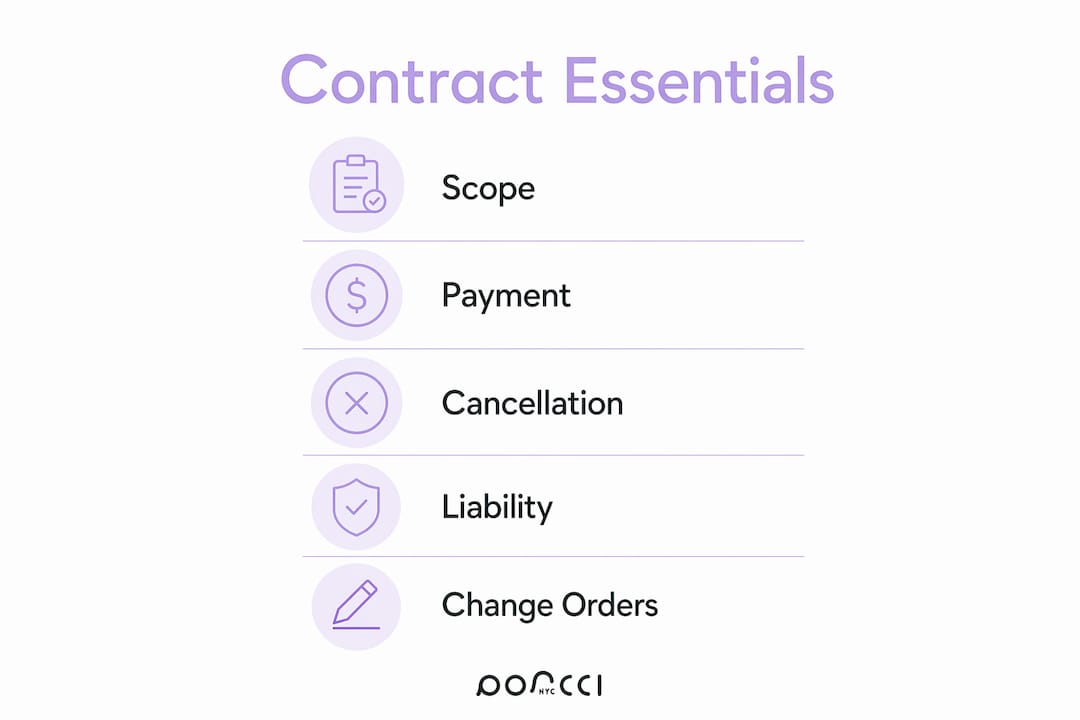
A solid vendor contract is your single strongest protection when something goes wrong at a corporate event. Every agreement should cover five core areas: a detailed scope of services with specific deliverables and timelines, payment terms with deposit amounts and milestone schedules, cancellation policies using sliding-scale refunds tied to how far out you cancel, liability insurance requirements with indemnification language, and dispute resolution procedures. Get these right before you sign anything.
Here is what a well-structured vendor agreement covers at a glance:
• Scope of services: Named personnel, equipment specs, setup and teardown windows, and staffing levels
• Payment schedule: Deposit of 25–50% at signing, remaining balance tied to milestones
• Cancellation policy: A sliding scale refund policy based on how far in advance you cancel, with earlier cancellations receiving greater refunds and later cancellations receiving reduced or no refunds
• Liability and insurance: General liability coverage of at least $1–2 million per occurrence plus indemnification clauses
• Dispute resolution: Mediation or arbitration before any litigation
• Force majeure and frustration of purpose: Excuses both parties when uncontrollable events prevent fulfillment
• Change order procedures: Written approval hierarchies for any scope or cost modifications
Preparation is what separates planners who get favorable terms from those who accept whatever the vendor sends over. Research market pricing before your first conversation so you know what fair looks like. Then separate your non-negotiables from your flexible points before you sit down.
• Request itemized proposals. A lump-sum quote hides overtime rates, delivery fees, and service charges. Line-item breakdowns let you verify every cost and spot padding before it becomes a dispute.
• Define your non-negotiables early. Payment milestones, substitution approval rights, and cancellation terms are worth holding firm on. Flexibility on things like exact setup timing costs you less.
• Negotiate beyond price. When a vendor cannot lower their fee, ask for complimentary setup and breakdown, extended service hours, or upgraded equipment. These concessions often cost the vendor little but add real value to your event.
• Put everything in writing. Verbal promises about extra staff or discounts mean nothing if they are not in the final contract. Follow up every conversation with a written summary and confirm those terms appear in the signed document.
• Watch for one-sided cancellation terms. A flat “all deposits are non-refundable” clause is a red flag. Fair contracts use sliding scales. For more warning signs to watch for, see our guide on NYC event rental vendor red flags.
Pro Tip: Insist on “frustration of purpose” and price volatility clauses as must-haves in your RFP, not after a quote comes back. Vendors resist these protections unless planners push for them from the start, and your leverage drops significantly once pricing is on the table.

Understanding each clause in detail is what keeps your event on track when plans shift. Here is how the most critical provisions work in practice.

| Clause | What it covers | Standard benchmark |
|---|---|---|
| Payment terms | Deposit, milestones, final balance | Deposit of 25–50% at signing, remaining balance tied to milestone completions |
| Cancellation policy | Refund schedule by timing | Full refund 90+ days; 50% at 60 days; none within 30 days |
| Liability insurance | Coverage minimums and indemnification | General liability insurance coverage with industry-standard minimums for vendor contracts |
| Force majeure | Uncontrollable disruptions | Excuses both parties from obligations |
| Frustration of purpose | Event purpose undermined by external factors | Requires event be outside both parties’ control |
| Change orders | Scope and cost modifications | Written approval with defined authority thresholds |
| Dispute resolution | Escalation path before litigation | Mediation or arbitration first |
Payment terms should specify a deposit of 25–50% at signing, each milestone trigger, and the final balance due date. Tying payments to deliverable completion rather than arbitrary calendar dates protects you from paying for work that has not happened yet.
Cancellation policies need a sliding scale. A contract that makes your entire deposit non-refundable regardless of timing is not standard practice. The industry-standard structure ties refunds to how far in advance you cancel.
Liability clauses require vendors to carry general liability insurance and name your organization as an additional insured. This gives you direct coverage if a vendor’s actions cause property damage or injury at your event. Always request a certificate of insurance before the contract is signed, not the day of the event.
Change order procedures should specify who has authority to approve modifications and at what cost threshold. Without this, scope creep goes undocumented and disputes follow. Written change orders signed by both parties create a clear audit trail. For events involving AV or technical equipment, understanding AV contract terminology helps you write tighter specifications from the start.
Templates save time and reduce the chance of missing a critical clause. The key is treating them as a starting point, not a finished product. A generic event services agreement template covers the structure; your job is to fill in the specifics that make it enforceable.
Core elements to customize in any template:
• Scope description: Replace generic language like “event production support” with exact deliverables, quantities, named personnel, and equipment specifications
• Timeline: State arrival time, setup window, service hours, and teardown deadline explicitly
• Payment schedule: Insert the actual deposit amount, milestone dates, and final balance due date
• Cancellation terms: Confirm the sliding scale matches the industry standard or negotiate a better one
• Insurance requirements: Specify the minimum coverage amounts and the additional insured requirement
Version control matters more than most planners expect. Number every draft and every amendment so both parties always know which version governs. When a change is agreed upon after signing, document it as a formal written amendment, not an email thread. For high-value contracts over $5,000, a one-hour review with an events attorney costs far less than a contract dispute. Templates from reputable legal platforms like LegalZoom or Rocket Lawyer provide a solid foundation, but they still benefit from professional review when the stakes are high.
A simple template layout for a corporate entertainment vendor should include: parties and event date, scope of services, payment schedule, cancellation and refund policy, liability and insurance, substitution rights, change order procedures, force majeure, and dispute resolution. That order mirrors how disputes actually unfold, starting with what was promised and ending with how disagreements get resolved.
The legal and event planning communities have grown more vocal about contract protections as global instability drives more cancellations, and the guidance from practitioners who work these disputes is specific and worth taking seriously.
“The event must be outside the parties’ control, not due to either party’s fault, and not a risk that was assumed when the contract was made,” said Jonathan Howe, president and founding partner of Howe & Hutton, on the conditions required for a frustration of purpose clause to apply. He urges planners to add these clauses proactively as political and economic disruptions continue to affect corporate events.
Attorney Joshua Grimes of Grimes Law Offices puts the negotiation reality plainly: hotels and suppliers push back on protective clauses unless planners insist on them from the start, ideally by making them must-haves in the RFP.
Beyond legal protection, industry best practices for 2026 include:
• Documenting the event’s stated purpose in a summary that covers objectives, audience, and programming. This document supports your legal counsel if cancellation or disruption occurs.
• Requiring proof of insurance before the contract is executed, not after.
• Including price volatility clauses when contracts extend months into the future.
• Reviewing any contract over $5,000 with a qualified events attorney.
For planners managing entertainment vendors specifically, defining the event staffing workflow in the contract prevents the most common day-of disputes around personnel and timing.
Signing a contract with the wrong vendor is harder to fix than negotiating better terms with the right one. Vetting vendors before the contract stage saves time and protects your budget.
Start with references and verifiable experience. Ask for two or three recent clients from events similar in size and format to yours. A vendor who hesitates to provide references is telling you something. Check online reviews on Google and industry platforms, and look specifically for comments about reliability, communication, and how the vendor handled problems.
Request proof of insurance before negotiations go far. A vendor who cannot produce a current certificate of general liability insurance is not ready to work a corporate event. Confirm the coverage limits match what your contract will require, typically $1–2 million per occurrence.
Evaluate communication during the sales process. How a vendor responds to your questions before signing is a reliable preview of how they will behave during planning. Slow responses, vague answers, or pressure to sign quickly are all warning signs worth noting. For photography vendors, a corporate event photo checklist helps you define deliverables precisely before the contract is drafted.
Finally, compare at least three vendors in each category before committing. This gives you market context for pricing, helps you spot outliers, and gives you negotiating leverage. A vendor who knows you are evaluating alternatives is more likely to offer competitive terms.
A corporate event vendor contract must define scope, payment milestones, cancellation terms, liability insurance, and dispute resolution before any work begins.
| Point | Details |
|---|---|
| Deposit structure | Require 25–50% at signing with remaining payments tied to milestones, not arbitrary dates. |
| Cancellation scale | Full refund 90+ days out, 50% at 60 days, and no refund within 30 days is the industry standard. |
| Insurance minimum | Vendors should carry at least $1–2 million in general liability coverage per occurrence. |
| Frustration of purpose | Include this clause in the RFP stage; vendors resist it after pricing is submitted. |
| Legal review threshold | Higher-value contracts generally warrant legal consultation to mitigate risks of disputes. |
Every vendor contract should cover scope of services, payment schedule, cancellation policy, liability insurance requirements, force majeure provisions, change order procedures, and dispute resolution. Missing any of these creates gaps that become expensive to resolve after the event.
A deposit of 25–50% at signing is standard, with the remaining balance tied to milestone completions rather than a single deadline payment.
Insist on it during the RFP stage, before any vendor submits pricing. Vendors are far more likely to accept protective clauses when they are presented as requirements upfront rather than negotiated after a quote is on the table.
For contracts over $5,000, a one-hour legal consultation is worth the cost. For smaller agreements, a thorough review using a contract checklist focused on pricing specifics, cancellation terms, and liability clauses is usually sufficient.
A change order is a written document that records any modification to the original contract scope, cost, or timeline, signed by both parties. Without formal change orders, verbal scope adjustments create disputes about what was actually agreed.
Planning a corporate event in New York or New Jersey? Porcci NYC offers DJ services and entertainment packages with clear, transparent agreements so you know exactly what you are getting before the contract is signed.
Ensure your events run smoothly with our corporate event vendor contract guide. Discover essential terms to protect your investment.
A solid vendor contract is your single strongest protection when something goes wrong at a corporate event. Every agreement should cover five core areas: a detailed scope of services with specific deliverables and timelines, payment terms with deposit amounts and milestone schedules, cancellation policies using sliding-scale refunds tied to how far out you cancel, liability insurance requirements with indemnification language, and dispute resolution procedures. Get these right before you sign anything.
Here is what a well-structured vendor agreement covers at a glance:
• Scope of services: Named personnel, equipment specs, setup and teardown windows, and staffing levels
• Payment schedule: Deposit of 25–50% at signing, remaining balance tied to milestones
• Cancellation policy: A sliding scale refund policy based on how far in advance you cancel, with earlier cancellations receiving greater refunds and later cancellations receiving reduced or no refunds
• Liability and insurance: General liability coverage of at least $1–2 million per occurrence plus indemnification clauses
• Dispute resolution: Mediation or arbitration before any litigation
• Force majeure and frustration of purpose: Excuses both parties when uncontrollable events prevent fulfillment
• Change order procedures: Written approval hierarchies for any scope or cost modifications
Preparation is what separates planners who get favorable terms from those who accept whatever the vendor sends over. Research market pricing before your first conversation so you know what fair looks like. Then separate your non-negotiables from your flexible points before you sit down.
• Request itemized proposals. A lump-sum quote hides overtime rates, delivery fees, and service charges. Line-item breakdowns let you verify every cost and spot padding before it becomes a dispute.
• Define your non-negotiables early. Payment milestones, substitution approval rights, and cancellation terms are worth holding firm on. Flexibility on things like exact setup timing costs you less.
• Negotiate beyond price. When a vendor cannot lower their fee, ask for complimentary setup and breakdown, extended service hours, or upgraded equipment. These concessions often cost the vendor little but add real value to your event.
• Put everything in writing. Verbal promises about extra staff or discounts mean nothing if they are not in the final contract. Follow up every conversation with a written summary and confirm those terms appear in the signed document.
• Watch for one-sided cancellation terms. A flat “all deposits are non-refundable” clause is a red flag. Fair contracts use sliding scales. For more warning signs to watch for, see our guide on NYC event rental vendor red flags.
Pro Tip: Insist on “frustration of purpose” and price volatility clauses as must-haves in your RFP, not after a quote comes back. Vendors resist these protections unless planners push for them from the start, and your leverage drops significantly once pricing is on the table.
Understanding each clause in detail is what keeps your event on track when plans shift. Here is how the most critical provisions work in practice.
| Clause | What it covers | Standard benchmark |
|---|---|---|
| Payment terms | Deposit, milestones, final balance | Deposit of 25–50% at signing, remaining balance tied to milestone completions |
| Cancellation policy | Refund schedule by timing | Full refund 90+ days; 50% at 60 days; none within 30 days |
| Liability insurance | Coverage minimums and indemnification | General liability insurance coverage with industry-standard minimums for vendor contracts |
| Force majeure | Uncontrollable disruptions | Excuses both parties from obligations |
| Frustration of purpose | Event purpose undermined by external factors | Requires event be outside both parties’ control |
| Change orders | Scope and cost modifications | Written approval with defined authority thresholds |
| Dispute resolution | Escalation path before litigation | Mediation or arbitration first |
Payment terms should specify a deposit of 25–50% at signing, each milestone trigger, and the final balance due date. Tying payments to deliverable completion rather than arbitrary calendar dates protects you from paying for work that has not happened yet.
Cancellation policies need a sliding scale. A contract that makes your entire deposit non-refundable regardless of timing is not standard practice. The industry-standard structure ties refunds to how far in advance you cancel.
Liability clauses require vendors to carry general liability insurance and name your organization as an additional insured. This gives you direct coverage if a vendor’s actions cause property damage or injury at your event. Always request a certificate of insurance before the contract is signed, not the day of the event.
Change order procedures should specify who has authority to approve modifications and at what cost threshold. Without this, scope creep goes undocumented and disputes follow. Written change orders signed by both parties create a clear audit trail. For events involving AV or technical equipment, understanding AV contract terminology helps you write tighter specifications from the start.
Templates save time and reduce the chance of missing a critical clause. The key is treating them as a starting point, not a finished product. A generic event services agreement template covers the structure; your job is to fill in the specifics that make it enforceable.
Core elements to customize in any template:
• Scope description: Replace generic language like “event production support” with exact deliverables, quantities, named personnel, and equipment specifications
• Timeline: State arrival time, setup window, service hours, and teardown deadline explicitly
• Payment schedule: Insert the actual deposit amount, milestone dates, and final balance due date
• Cancellation terms: Confirm the sliding scale matches the industry standard or negotiate a better one
• Insurance requirements: Specify the minimum coverage amounts and the additional insured requirement
Version control matters more than most planners expect. Number every draft and every amendment so both parties always know which version governs. When a change is agreed upon after signing, document it as a formal written amendment, not an email thread. For high-value contracts over $5,000, a one-hour review with an events attorney costs far less than a contract dispute. Templates from reputable legal platforms like LegalZoom or Rocket Lawyer provide a solid foundation, but they still benefit from professional review when the stakes are high.
A simple template layout for a corporate entertainment vendor should include: parties and event date, scope of services, payment schedule, cancellation and refund policy, liability and insurance, substitution rights, change order procedures, force majeure, and dispute resolution. That order mirrors how disputes actually unfold, starting with what was promised and ending with how disagreements get resolved.
The legal and event planning communities have grown more vocal about contract protections as global instability drives more cancellations, and the guidance from practitioners who work these disputes is specific and worth taking seriously.
“The event must be outside the parties’ control, not due to either party’s fault, and not a risk that was assumed when the contract was made,” said Jonathan Howe, president and founding partner of Howe & Hutton, on the conditions required for a frustration of purpose clause to apply. He urges planners to add these clauses proactively as political and economic disruptions continue to affect corporate events.
Attorney Joshua Grimes of Grimes Law Offices puts the negotiation reality plainly: hotels and suppliers push back on protective clauses unless planners insist on them from the start, ideally by making them must-haves in the RFP.
Beyond legal protection, industry best practices for 2026 include:
• Documenting the event’s stated purpose in a summary that covers objectives, audience, and programming. This document supports your legal counsel if cancellation or disruption occurs.
• Requiring proof of insurance before the contract is executed, not after.
• Including price volatility clauses when contracts extend months into the future.
• Reviewing any contract over $5,000 with a qualified events attorney.
For planners managing entertainment vendors specifically, defining the event staffing workflow in the contract prevents the most common day-of disputes around personnel and timing.
Signing a contract with the wrong vendor is harder to fix than negotiating better terms with the right one. Vetting vendors before the contract stage saves time and protects your budget.
Start with references and verifiable experience. Ask for two or three recent clients from events similar in size and format to yours. A vendor who hesitates to provide references is telling you something. Check online reviews on Google and industry platforms, and look specifically for comments about reliability, communication, and how the vendor handled problems.
Request proof of insurance before negotiations go far. A vendor who cannot produce a current certificate of general liability insurance is not ready to work a corporate event. Confirm the coverage limits match what your contract will require, typically $1–2 million per occurrence.
Evaluate communication during the sales process. How a vendor responds to your questions before signing is a reliable preview of how they will behave during planning. Slow responses, vague answers, or pressure to sign quickly are all warning signs worth noting. For photography vendors, a corporate event photo checklist helps you define deliverables precisely before the contract is drafted.
Finally, compare at least three vendors in each category before committing. This gives you market context for pricing, helps you spot outliers, and gives you negotiating leverage. A vendor who knows you are evaluating alternatives is more likely to offer competitive terms.
A corporate event vendor contract must define scope, payment milestones, cancellation terms, liability insurance, and dispute resolution before any work begins.
| Point | Details |
|---|---|
| Deposit structure | Require 25–50% at signing with remaining payments tied to milestones, not arbitrary dates. |
| Cancellation scale | Full refund 90+ days out, 50% at 60 days, and no refund within 30 days is the industry standard. |
| Insurance minimum | Vendors should carry at least $1–2 million in general liability coverage per occurrence. |
| Frustration of purpose | Include this clause in the RFP stage; vendors resist it after pricing is submitted. |
| Legal review threshold | Higher-value contracts generally warrant legal consultation to mitigate risks of disputes. |
Every vendor contract should cover scope of services, payment schedule, cancellation policy, liability insurance requirements, force majeure provisions, change order procedures, and dispute resolution. Missing any of these creates gaps that become expensive to resolve after the event.
A deposit of 25–50% at signing is standard, with the remaining balance tied to milestone completions rather than a single deadline payment.
Insist on it during the RFP stage, before any vendor submits pricing. Vendors are far more likely to accept protective clauses when they are presented as requirements upfront rather than negotiated after a quote is on the table.
For contracts over $5,000, a one-hour legal consultation is worth the cost. For smaller agreements, a thorough review using a contract checklist focused on pricing specifics, cancellation terms, and liability clauses is usually sufficient.
A change order is a written document that records any modification to the original contract scope, cost, or timeline, signed by both parties. Without formal change orders, verbal scope adjustments create disputes about what was actually agreed.
Planning a corporate event in New York or New Jersey? Porcci NYC offers DJ services and entertainment packages with clear, transparent agreements so you know exactly what you are getting before the contract is signed.