
Send three event ready string quartet song lists with ceremony timelines, an arrangement checklist, and AV tips to brief your musicians.
This page gives you three ready-to-send string quartet song lists, classical staples, popular covers, and modern cinematic picks, plus moment-by-moment suggestions for a full ceremony timeline. You’ll also find a short checklist to brief your musicians and avoid the most common booking mistakes. We built it so you can copy, paste, and send.
TL;DR:
• Most wedding ceremonies benefit from classical staples like Canon in D and Clair de Lune, which are reliable, easy to resonate with, and familiar to guests.
• Modern cover songs such as A Thousand Years or All of Me translate well for strings and remain among the most requested choices for processions and first dances.
• Outdoor or large indoor venues often require subtle amplification, and careful sound planning is crucial to maintain quality tone and volume without overpowering the space.
• A typical ceremony involves multiple performance blocks, including prelude, processional, recessional, and cocktail hour, usually totaling one to two hours of music.
• Coordinating technical logistics and timing with vendors is essential, as even the best repertoire can falter if transitions, power, or staging are not properly managed.
• Popular String Quartet Songs and Classical Staples Worth Knowing
• Building a Ceremony Music Timeline Moment by Moment
• How to Choose the Right Songs for a String Quartet
• What to Send Your Quartet When Requesting an Arrangement
• Creative String Quartet Covers Worth Hearing
• How Long a String Quartet Actually Plays
• Do String Quartets Need Amplification?
• Coordinating Live Strings With Your Bigger Event Plan
• Playlists and Arranging Resources to Explore
• Sources
• FAQ
• Coordinating the Music So the Day Actually Flows
Every strong repertoire list mixes reliability with a little personality. Classical staples earn their spot because they’re tested across thousands of ceremonies and reception rooms; they sit in comfortable keys, they don’t rely on lyrics to land emotionally, and quartets already know them cold. Popular covers and modern picks add the personal touch that makes a set feel like your event instead of a template. Contemporary repertoire trends increasingly blend the two, pairing Pachelbel’s Canon or Bach’s Air with pop hits by Taylor Swift, Bruno Mars, Ed Sheeran, and Coldplay arranged for strings.
Classical staples that never miss:
• Canon in D (Pachelbel) — the default processional for a reason: steady tempo, open harmonic movement, works in nearly any venue.
• Jesu, Joy of Man’s Desiring (Bach) — bright, buoyant, and short enough to loop without dragging.
• Clair de Lune (Debussy) — a prelude favorite; its shifting dynamics reward a quiet room.
• Wedding March (Mendelssohn) — traditional and instantly recognizable, best for a formal processional.
• Air on the G String (Bach) — slow, warm, ideal for seating guests or a reflective moment.
• La Réjouissance (Handel) — celebratory and brisk, a strong recessional option.
• Spring, from The Four Seasons (Vivaldi) — lively and rhythmic, good for cocktail hour.
Popular covers that translate well to strings:
• A Thousand Years (Christina Perri) — arguably the most requested modern processional; the melody sits perfectly in a violin’s range.
• All of Me (John Legend) — piano-driven original, but the melody carries cleanly without it.
• Can’t Help Falling in Love (Elvis Presley) — simple chord movement, easy for a quartet to make lush.
• Viva La Vida (Coldplay) — the string line is practically written for quartet already.
• Halo (Beyoncé) — a strong vocal hook that survives the transition to instrumental.
• Thinking Out Loud (Ed Sheeran) — steady tempo and a memorable melody, popular for first dances or cocktail sets.
Bridal and event guides consistently point to A Thousand Years, All of Me, Can’t Help Falling in Love, Canon in D, and At Last as the most-requested crossover picks, alongside classical favorites like Clair de Lune.
Modern and cinematic picks for a different mood:
• A Sky Full of Stars (Coldplay) — energetic, great for cocktail hour or recessional.
• Your Song (Elton John) — sparse and lyrical, works for a unity moment.
• Skyfall (Adele) — dramatic and cinematic, a striking cocktail-hour surprise.
• La Vie en Rose — timeless, romantic, and quartet arrangements are widely available.
• River Flows in You (Yiruma) — technically a piano piece, but arrangers adapt it often for its melodic simplicity.
Most of these have existing quartet arrangements you can find through sheet-music marketplaces. The rest are common enough requests that a working quartet can typically source or build a chart with reasonable lead time.
Matching songs to ceremony moments is less about taste and more about function. Each moment asks something different of the music, whether it’s filling time gracefully or cueing an emotional beat.
1. Prelude (15 to 30 minutes before guests are seated): Choose soothing, low-intensity pieces that create ambiance without demanding attention. Air on the G String, Clair de Lune, or a soft modern instrumental work well because guests are still arriving and talking.
2. Processional and bridal party entrance: Pick a moderate, steady tempo that gives people a clear walking pace. Canon in D remains the standard because its pulse is unmistakable even from the back row.
3. Bridal entrance: This is the emotional peak of the walk, so many couples choose a slightly slower or more dramatic piece than the bridal party processional. Mendelssohn’s Wedding March or A Thousand Years both cue the shift in energy.
4. Unity or reflective moments: Keep it sparse. A piece with too much movement competes with vows or a reading. Your Song or a stripped-down arrangement of All of Me stays present without pulling focus.
5. Recessional: Go upbeat and celebratory. La Réjouissance or Viva La Vida signal the ceremony is over and the party’s starting.
6. Cocktail hour: This is where variety pays off. Mix a classical piece like Spring with a modern cover like A Sky Full of Stars to keep the mood moving without feeling repetitive.
Not every favorite song works on four strings. A few criteria separate a song that translates beautifully from one that falls flat.
• Melodic clarity matters most. Choose songs whose tune is memorable and singable on its own, since strong standalone melodies translate far better into instrumental arrangements than songs built around production tricks or spoken-word delivery.
• Watch for drum dependence. Tracks built on a heavy beat rather than melody often need a backing track or amplification to feel complete, which adds cost and complexity.
• Favor open-string keys. Pieces in D, G, A, or E major let the instruments ring more fully, since strings resonate best when open strings can vibrate freely in an unamplified setting.
• Match the venue’s acoustics. Classical arrangements tend to thrive in high-reverb rooms like churches or stone halls, while rhythmic contemporary arrangements often sound clearer in drier, modern spaces.
• Budget for realistic set lengths. Most quartets perform in manageable blocks with breaks, and pricing is generally based on hourly rates or combined ceremony and cocktail hour packages.
Pro Tip: Don’t chase only the most-streamed songs on your list. Wedding violinists report that personally meaningful tracks, a song from a first date or a parent’s favorite, often land harder emotionally than a generic top-40 hit chosen for its popularity alone.
A clear brief saves you money and saves your musicians from guesswork. Send this checklist when you reach out:
• A reference recording with a link, plus your preferred section (verse, bridge, or the full hook) if you only want part of the song.
• Your target tempo and approximate duration, especially for processionals where pace matters.
• A direct question: does an arrangement already exist, or does it need to be custom-built? Custom charts often carry longer lead times and separate fees.
• Your preferred key, ideally one favoring open strings (D, G, A, E) for better resonance in a live, unamplified room.
• Any special technique requests, like pizzicato for a playful moment or mutes for a softer dynamic.
• A licensing question. Ask whether the arrangement fee covers usage rights or whether that’s billed separately.
A well-run arrangement follows a simple structure: melody sits with Violin 1, inner harmony and texture fall to Violin 2 and viola, and the cello grounds the bass line. Knowing this helps you ask better questions, like which instrument will carry your song’s vocal hook.
Some of the most memorable quartet performances aren’t the expected picks. Arrangers who thin out a dense pop or rock production while preserving its melodic core can turn an unlikely song into a showstopper. A driving rock anthem stripped to its melodic line and reset for four strings often surprises guests more than another Canon in D ever could.
Look for quartet covers of songs built on strong riffs rather than vocals, like instrumental rock tracks or synth-heavy pop songs with a clear melodic hook. Film scores translate especially well since they’re often written with orchestral texture in mind already. Some couples request a quartet cover of their favorite karaoke song or a track tied to a specific memory, which turns an ordinary moment like guest seating into a personal touch nobody else’s wedding has.
The best creative covers usually keep one foot in familiarity. A recognizable melody, even filtered through unexpected instrumentation, keeps guests engaged rather than confused. Ask your quartet if they’ve built any signature arrangements they’re proud of. Working musicians often carry a handful of covers they’ve refined over dozens of events, and those tend to be tighter and more polished than something arranged from scratch for your date alone.
A typical quartet performs in several blocks rather than one continuous set. Ceremony music generally covers the key moments including prelude, processional, and recessional, while cocktail hour sets often last around an hour with breaks due to the physical demands on players.
If you’re booking a quartet for an entire reception, expect them to structure the evening in sets of 30 to 45 minutes with brief breaks between, similar to how a live band would pace itself. Most quartets can comfortably prepare 15 to 25 songs for a full event when you account for ceremony, cocktail hour, and any dinner background music. Trying to stretch beyond that without added rehearsal time usually means sacrificing polish, so it’s worth being upfront with your musicians about how many hours of coverage you actually need.
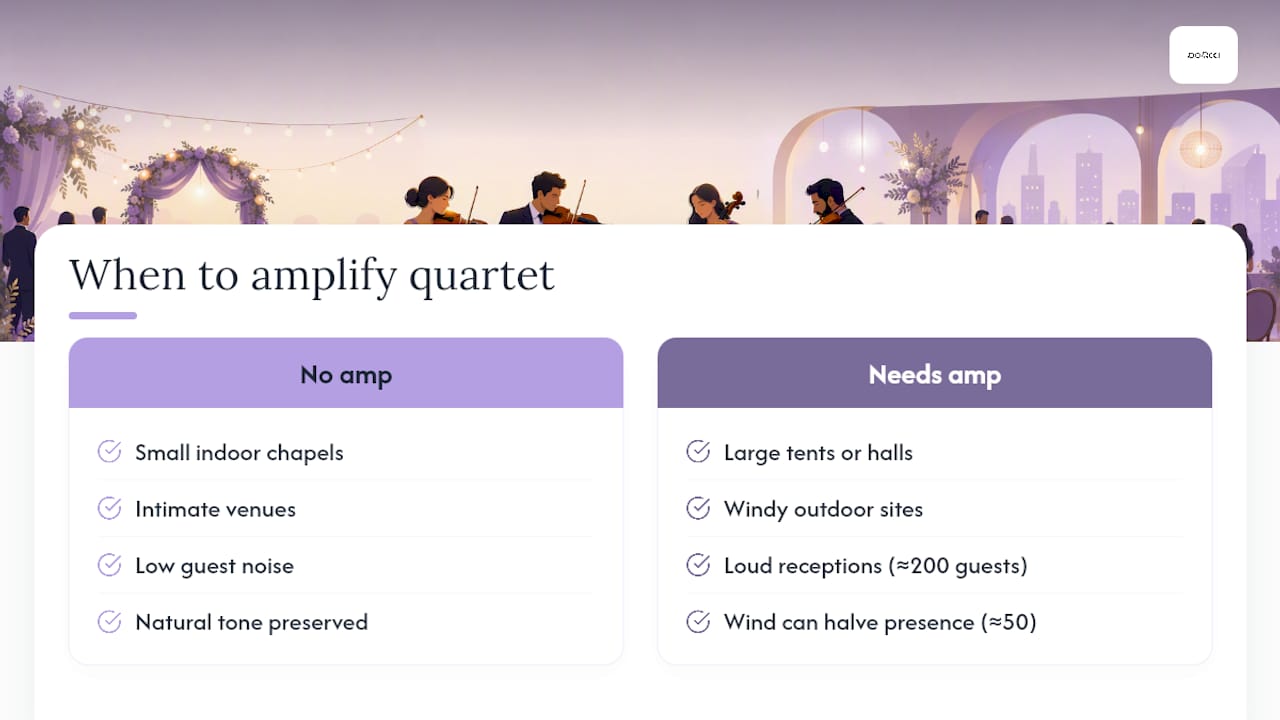
It depends entirely on the space. A string quartet in a small indoor chapel or intimate venue rarely needs any amplification. Put that same quartet in a large outdoor tent, a windy backyard, or a reception hall with 200 guests talking over cocktail hour, and the sound gets swallowed fast.
Amplification and staging should be part of your planning conversation early, not an afterthought, since some venues require light miking for a quartet to be heard clearly across a large or noisy space. Outdoor ceremonies are the most common culprit. Wind alone can cut a quartet’s presence in half, even at a modest 50-guest gathering.
If amplification is needed, subtlety matters. Over-amplified strings sound harsh and lose the warmth that makes a live quartet worth hiring in the first place. A light touch, just enough to carry the sound to the back row, preserves the natural tone while solving the volume problem. This is where sound equipment matters as much as the musicians themselves, and it’s worth asking your quartet or your event coordinator whether they have access to appropriate AV and sound system equipment built for live acoustic performance rather than DJ setups.
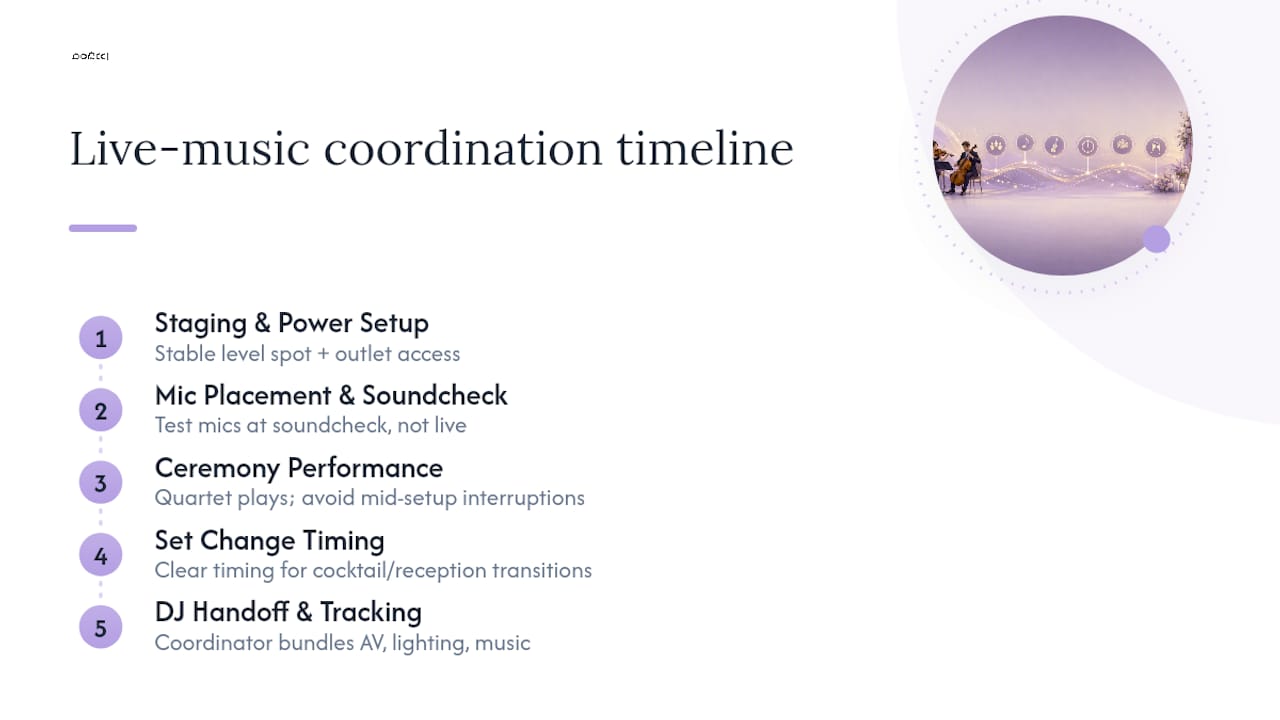
A quartet is one moving piece in a much larger production. Staging and power need to be sorted before the ceremony, not during it: musicians need a stable, level spot with enough room to bow freely, plus access to outlets if any amplification is planned. Mic placement, if used, should be tested at soundcheck, not guessed at live.
Schedule coordination matters just as much. Set changes between ceremony, cocktail hour, and reception need clear timing so there’s no dead air while a DJ sets up or the band tunes. Bundling AV, lighting, and live music under one coordinator closes those gaps. We’ve found that events run smoother when someone is tracking the whole timeline, not just the music, especially when live music and DJ sets need to hand off seamlessly later in the evening.
Hear these picks in action before you book anything. Curated classical and pop string collections on streaming platforms let you audition arrangements, and Songscription’s arranging guide explains what to expect from custom charts.
• Apple Music — curated classical/pop string collections
• How to arrange a song for strings — Songscription blog
Pachelbel’s Canon in D is the most widely recognized string quartet piece, especially for wedding processionals, thanks to its steady tempo and unmistakable melodic pattern.
A Thousand Years, All of Me, Can’t Help Falling in Love, Viva La Vida, and Thinking Out Loud are among the most requested modern songs arranged for string quartet performance.
There’s no single best piece since it depends on the moment. Canon in D suits a processional, Clair de Lune fits a prelude, and La Réjouissance works well as a recessional.
Strong wedding picks include Canon in D, A Thousand Years, All of Me, At Last, and Clair de Lune, all of which pair recognizable melodies with arrangements that translate cleanly to strings.
Not necessarily special songs, but outdoor settings often call for light amplification since wind and open space can weaken a quartet’s natural volume.
Most couples spend weeks picking songs and almost no time thinking about how those songs connect to everything else happening around them, the lighting cues, the DJ handoff, the moment a mic gets passed for a toast. That gap is where weddings actually go sideways, not in the song choice itself.
Here’s the part people underestimate: a beautifully chosen quartet set can still fall apart if nobody’s coordinating the technical handoff. A quartet finishing a cocktail hour set needs to know exactly when the DJ takes over, and that DJ needs power and staging sorted before the transition, not during it. We’ve seen strong repertoire choices undercut by a five-minute dead-air gap because two vendors assumed someone else was tracking the timeline.
Our honest take is that the song list matters less than the plan around it. A generic Canon in D played on schedule beats a perfectly curated, personally meaningful set that starts late because nobody miked the officiant properly. If you’re bundling live strings with a DJ, photo booth, or full AV setup, put one person in charge of the whole sequence, not just the music.
— PORCCI
Send three event ready string quartet song lists with ceremony timelines, an arrangement checklist, and AV tips to brief your musicians.
This page gives you three ready-to-send string quartet song lists, classical staples, popular covers, and modern cinematic picks, plus moment-by-moment suggestions for a full ceremony timeline. You’ll also find a short checklist to brief your musicians and avoid the most common booking mistakes. We built it so you can copy, paste, and send.
TL;DR:
• Most wedding ceremonies benefit from classical staples like Canon in D and Clair de Lune, which are reliable, easy to resonate with, and familiar to guests.
• Modern cover songs such as A Thousand Years or All of Me translate well for strings and remain among the most requested choices for processions and first dances.
• Outdoor or large indoor venues often require subtle amplification, and careful sound planning is crucial to maintain quality tone and volume without overpowering the space.
• A typical ceremony involves multiple performance blocks, including prelude, processional, recessional, and cocktail hour, usually totaling one to two hours of music.
• Coordinating technical logistics and timing with vendors is essential, as even the best repertoire can falter if transitions, power, or staging are not properly managed.
• Popular String Quartet Songs and Classical Staples Worth Knowing
• Building a Ceremony Music Timeline Moment by Moment
• How to Choose the Right Songs for a String Quartet
• What to Send Your Quartet When Requesting an Arrangement
• Creative String Quartet Covers Worth Hearing
• How Long a String Quartet Actually Plays
• Do String Quartets Need Amplification?
• Coordinating Live Strings With Your Bigger Event Plan
• Playlists and Arranging Resources to Explore
• Sources
• FAQ
• Coordinating the Music So the Day Actually Flows
Every strong repertoire list mixes reliability with a little personality. Classical staples earn their spot because they’re tested across thousands of ceremonies and reception rooms; they sit in comfortable keys, they don’t rely on lyrics to land emotionally, and quartets already know them cold. Popular covers and modern picks add the personal touch that makes a set feel like your event instead of a template. Contemporary repertoire trends increasingly blend the two, pairing Pachelbel’s Canon or Bach’s Air with pop hits by Taylor Swift, Bruno Mars, Ed Sheeran, and Coldplay arranged for strings.
Classical staples that never miss:
• Canon in D (Pachelbel) — the default processional for a reason: steady tempo, open harmonic movement, works in nearly any venue.
• Jesu, Joy of Man’s Desiring (Bach) — bright, buoyant, and short enough to loop without dragging.
• Clair de Lune (Debussy) — a prelude favorite; its shifting dynamics reward a quiet room.
• Wedding March (Mendelssohn) — traditional and instantly recognizable, best for a formal processional.
• Air on the G String (Bach) — slow, warm, ideal for seating guests or a reflective moment.
• La Réjouissance (Handel) — celebratory and brisk, a strong recessional option.
• Spring, from The Four Seasons (Vivaldi) — lively and rhythmic, good for cocktail hour.
Popular covers that translate well to strings:
• A Thousand Years (Christina Perri) — arguably the most requested modern processional; the melody sits perfectly in a violin’s range.
• All of Me (John Legend) — piano-driven original, but the melody carries cleanly without it.
• Can’t Help Falling in Love (Elvis Presley) — simple chord movement, easy for a quartet to make lush.
• Viva La Vida (Coldplay) — the string line is practically written for quartet already.
• Halo (Beyoncé) — a strong vocal hook that survives the transition to instrumental.
• Thinking Out Loud (Ed Sheeran) — steady tempo and a memorable melody, popular for first dances or cocktail sets.
Bridal and event guides consistently point to A Thousand Years, All of Me, Can’t Help Falling in Love, Canon in D, and At Last as the most-requested crossover picks, alongside classical favorites like Clair de Lune.
Modern and cinematic picks for a different mood:
• A Sky Full of Stars (Coldplay) — energetic, great for cocktail hour or recessional.
• Your Song (Elton John) — sparse and lyrical, works for a unity moment.
• Skyfall (Adele) — dramatic and cinematic, a striking cocktail-hour surprise.
• La Vie en Rose — timeless, romantic, and quartet arrangements are widely available.
• River Flows in You (Yiruma) — technically a piano piece, but arrangers adapt it often for its melodic simplicity.
Most of these have existing quartet arrangements you can find through sheet-music marketplaces. The rest are common enough requests that a working quartet can typically source or build a chart with reasonable lead time.
Matching songs to ceremony moments is less about taste and more about function. Each moment asks something different of the music, whether it’s filling time gracefully or cueing an emotional beat.
1. Prelude (15 to 30 minutes before guests are seated): Choose soothing, low-intensity pieces that create ambiance without demanding attention. Air on the G String, Clair de Lune, or a soft modern instrumental work well because guests are still arriving and talking.
2. Processional and bridal party entrance: Pick a moderate, steady tempo that gives people a clear walking pace. Canon in D remains the standard because its pulse is unmistakable even from the back row.
3. Bridal entrance: This is the emotional peak of the walk, so many couples choose a slightly slower or more dramatic piece than the bridal party processional. Mendelssohn’s Wedding March or A Thousand Years both cue the shift in energy.
4. Unity or reflective moments: Keep it sparse. A piece with too much movement competes with vows or a reading. Your Song or a stripped-down arrangement of All of Me stays present without pulling focus.
5. Recessional: Go upbeat and celebratory. La Réjouissance or Viva La Vida signal the ceremony is over and the party’s starting.
6. Cocktail hour: This is where variety pays off. Mix a classical piece like Spring with a modern cover like A Sky Full of Stars to keep the mood moving without feeling repetitive.
Not every favorite song works on four strings. A few criteria separate a song that translates beautifully from one that falls flat.
• Melodic clarity matters most. Choose songs whose tune is memorable and singable on its own, since strong standalone melodies translate far better into instrumental arrangements than songs built around production tricks or spoken-word delivery.
• Watch for drum dependence. Tracks built on a heavy beat rather than melody often need a backing track or amplification to feel complete, which adds cost and complexity.
• Favor open-string keys. Pieces in D, G, A, or E major let the instruments ring more fully, since strings resonate best when open strings can vibrate freely in an unamplified setting.
• Match the venue’s acoustics. Classical arrangements tend to thrive in high-reverb rooms like churches or stone halls, while rhythmic contemporary arrangements often sound clearer in drier, modern spaces.
• Budget for realistic set lengths. Most quartets perform in manageable blocks with breaks, and pricing is generally based on hourly rates or combined ceremony and cocktail hour packages.
Pro Tip: Don’t chase only the most-streamed songs on your list. Wedding violinists report that personally meaningful tracks, a song from a first date or a parent’s favorite, often land harder emotionally than a generic top-40 hit chosen for its popularity alone.
A clear brief saves you money and saves your musicians from guesswork. Send this checklist when you reach out:
• A reference recording with a link, plus your preferred section (verse, bridge, or the full hook) if you only want part of the song.
• Your target tempo and approximate duration, especially for processionals where pace matters.
• A direct question: does an arrangement already exist, or does it need to be custom-built? Custom charts often carry longer lead times and separate fees.
• Your preferred key, ideally one favoring open strings (D, G, A, E) for better resonance in a live, unamplified room.
• Any special technique requests, like pizzicato for a playful moment or mutes for a softer dynamic.
• A licensing question. Ask whether the arrangement fee covers usage rights or whether that’s billed separately.
A well-run arrangement follows a simple structure: melody sits with Violin 1, inner harmony and texture fall to Violin 2 and viola, and the cello grounds the bass line. Knowing this helps you ask better questions, like which instrument will carry your song’s vocal hook.
Some of the most memorable quartet performances aren’t the expected picks. Arrangers who thin out a dense pop or rock production while preserving its melodic core can turn an unlikely song into a showstopper. A driving rock anthem stripped to its melodic line and reset for four strings often surprises guests more than another Canon in D ever could.
Look for quartet covers of songs built on strong riffs rather than vocals, like instrumental rock tracks or synth-heavy pop songs with a clear melodic hook. Film scores translate especially well since they’re often written with orchestral texture in mind already. Some couples request a quartet cover of their favorite karaoke song or a track tied to a specific memory, which turns an ordinary moment like guest seating into a personal touch nobody else’s wedding has.
The best creative covers usually keep one foot in familiarity. A recognizable melody, even filtered through unexpected instrumentation, keeps guests engaged rather than confused. Ask your quartet if they’ve built any signature arrangements they’re proud of. Working musicians often carry a handful of covers they’ve refined over dozens of events, and those tend to be tighter and more polished than something arranged from scratch for your date alone.
A typical quartet performs in several blocks rather than one continuous set. Ceremony music generally covers the key moments including prelude, processional, and recessional, while cocktail hour sets often last around an hour with breaks due to the physical demands on players.
If you’re booking a quartet for an entire reception, expect them to structure the evening in sets of 30 to 45 minutes with brief breaks between, similar to how a live band would pace itself. Most quartets can comfortably prepare 15 to 25 songs for a full event when you account for ceremony, cocktail hour, and any dinner background music. Trying to stretch beyond that without added rehearsal time usually means sacrificing polish, so it’s worth being upfront with your musicians about how many hours of coverage you actually need.
It depends entirely on the space. A string quartet in a small indoor chapel or intimate venue rarely needs any amplification. Put that same quartet in a large outdoor tent, a windy backyard, or a reception hall with 200 guests talking over cocktail hour, and the sound gets swallowed fast.
Amplification and staging should be part of your planning conversation early, not an afterthought, since some venues require light miking for a quartet to be heard clearly across a large or noisy space. Outdoor ceremonies are the most common culprit. Wind alone can cut a quartet’s presence in half, even at a modest 50-guest gathering.
If amplification is needed, subtlety matters. Over-amplified strings sound harsh and lose the warmth that makes a live quartet worth hiring in the first place. A light touch, just enough to carry the sound to the back row, preserves the natural tone while solving the volume problem. This is where sound equipment matters as much as the musicians themselves, and it’s worth asking your quartet or your event coordinator whether they have access to appropriate AV and sound system equipment built for live acoustic performance rather than DJ setups.
A quartet is one moving piece in a much larger production. Staging and power need to be sorted before the ceremony, not during it: musicians need a stable, level spot with enough room to bow freely, plus access to outlets if any amplification is planned. Mic placement, if used, should be tested at soundcheck, not guessed at live.
Schedule coordination matters just as much. Set changes between ceremony, cocktail hour, and reception need clear timing so there’s no dead air while a DJ sets up or the band tunes. Bundling AV, lighting, and live music under one coordinator closes those gaps. We’ve found that events run smoother when someone is tracking the whole timeline, not just the music, especially when live music and DJ sets need to hand off seamlessly later in the evening.
Hear these picks in action before you book anything. Curated classical and pop string collections on streaming platforms let you audition arrangements, and Songscription’s arranging guide explains what to expect from custom charts.
• Apple Music — curated classical/pop string collections
• How to arrange a song for strings — Songscription blog
Pachelbel’s Canon in D is the most widely recognized string quartet piece, especially for wedding processionals, thanks to its steady tempo and unmistakable melodic pattern.
A Thousand Years, All of Me, Can’t Help Falling in Love, Viva La Vida, and Thinking Out Loud are among the most requested modern songs arranged for string quartet performance.
There’s no single best piece since it depends on the moment. Canon in D suits a processional, Clair de Lune fits a prelude, and La Réjouissance works well as a recessional.
Strong wedding picks include Canon in D, A Thousand Years, All of Me, At Last, and Clair de Lune, all of which pair recognizable melodies with arrangements that translate cleanly to strings.
Not necessarily special songs, but outdoor settings often call for light amplification since wind and open space can weaken a quartet’s natural volume.
Most couples spend weeks picking songs and almost no time thinking about how those songs connect to everything else happening around them, the lighting cues, the DJ handoff, the moment a mic gets passed for a toast. That gap is where weddings actually go sideways, not in the song choice itself.
Here’s the part people underestimate: a beautifully chosen quartet set can still fall apart if nobody’s coordinating the technical handoff. A quartet finishing a cocktail hour set needs to know exactly when the DJ takes over, and that DJ needs power and staging sorted before the transition, not during it. We’ve seen strong repertoire choices undercut by a five-minute dead-air gap because two vendors assumed someone else was tracking the timeline.
Our honest take is that the song list matters less than the plan around it. A generic Canon in D played on schedule beats a perfectly curated, personally meaningful set that starts late because nobody miked the officiant properly. If you’re bundling live strings with a DJ, photo booth, or full AV setup, put one person in charge of the whole sequence, not just the music.
— PORCCI


