Master the steps to arrange corporate event transportation with our complete guide, ensuring timely arrivals and smooth operations for every guest.
Arranging corporate event transportation means planning early, building a live manifest, and running just-in-time operations so every guest, from the keynote speaker to the last shuttle rider, arrives on schedule. Providers commonly recommend booking corporate transportation 2–4 weeks in advance for routine transfers, and significantly earlier for large conferences or peak travel seasons. Start here:
• Lock your dates first. Confirm the event agenda before booking any vehicle.
• Build a manifest immediately. Collect names, flight numbers, pickup locations, and VIP flags from day one.
• Assign a single transportation lead. One person approves all manifest changes.
• Reserve staging areas. Confirm curbside permits and loading zones before vehicles are booked.
• Set a lock date. Finalize baseline vehicle counts 30–45 days before the event.
• Brief every driver. Send a written driver brief 48 hours before the first pickup.
Pro Tip: Book your highest-demand vehicle types (charter coaches, executive SUVs) first. They sell out fastest during conference season and major holidays.
Effective corporate event transportation requires treating every guest movement as part of a single, orchestrated passenger-flow system, not a collection of individual bookings.
| Point | Details |
|---|---|
| Set a lock date early | Finalize baseline vehicle counts 30–45 days before the event to avoid last-minute premium rates. |
| Build one live manifest | Assign a single decision-maker for updates; include flight data, VIP flags, and accessibility needs. |
| Match vehicles to guest types | Use executive SUVs for VIPs, Sprinters for small teams, and charter coaches for large attendee groups. |
| Plan for the peak window | Calculate your vehicle mix around the single busiest 60-minute demand window, not total guest count. |
| Porcci NYC for on-site support | Porcci NYC coordinates AV, staffing, and entertainment in NYC and NJ to align with your transport schedule. |
• How to arrange corporate event transportation: start with objectives
• Build a live transportation manifest before anything else
• Map every guest movement and build your run-sheets
• Which vehicle type fits each guest and group size?
• Booking timeline, budgeting, and what your contract must include
• What does your guest and internal communication plan look like?
• How to handle airports, venue curbs, and traffic patterns
• How do you evaluate and select a transportation partner?
• Contingency planning and real-time operations on event day
• How do you handle accessibility and special needs requests?
• What goes beyond mobility: dietary, medical, and other special accommodations
• Templates and tools every planner should have ready
• What the best planners know that most guides skip
• Porcci NYC can support your event logistics from the ground up
• Sources
• FAQ
This guide is written for corporate meeting planners, conference logistics leads, roadshow coordinators, and in-house events teams who are responsible for getting people where they need to be, on time, without drama. It covers single-boardroom VIP transfers and multi-thousand-attendee conferences alike.
What you will find here: practical operations guidance, manifest templates, vehicle selection logic, and on-the-day contingency processes. What this guide does not cover: rate shopping between specific vendors or negotiating individual contracts line by line. The goal is to give you a repeatable process, not a price list.
Before you book a single vehicle, answer these questions in writing:
1. What does “on time” mean for this event? Define it in minutes, not feelings. Is a VIP considered late if they arrive 10 minutes after doors open, or 2 minutes before their session starts?
2. Who are your highest-priority passengers? Speakers, C-suite guests, and media contacts need different handling than general attendees.
3. What are your luggage and equipment requirements? AV cases, display materials, and oversized bags change vehicle selection entirely.
4. What are the venue’s curb rules? Some venues allow a 3-minute drop-off maximum. Others have dedicated loading docks.
5. Are there security constraints? Some events require credentialed drivers, advance vehicle registration, or escort vehicles.
6. What is your allowable wait time at the curb? This determines whether you need remote staging.
Once you have answers, translate them into measurable KPIs. PCMA’s event-planning resources offer objective-setting frameworks that help translate these answers into formal success metrics.
Your objectives will directly shape your vehicle mix. A large-group objective means coach buses with fixed departure windows, not on-demand rides.
A single, shared transportation manifest with passenger contact details, flight information, luggage notes, vehicle assignments, and a single decision-maker for updates prevents the majority of avoidable day-of errors. Think of it as your operational source of truth.
Every manifest must include these fields:
• Full passenger name and mobile number
• Flight number, airline, arrival terminal, and scheduled landing time
• Pickup location (address, terminal, hotel name and room block)
• Drop-off location
• VIP status flag (Y/N, with tier if applicable)
• Luggage count and any oversized items
• Accessibility requirements
• Vehicle assignment and driver name
• Billing code or cost center
• Notes field for exceptions
Version control matters as much as the data itself. Assign one person, your transportation lead, as the only person authorized to update the master manifest. Everyone else submits change requests to that person. Use a shared Google Sheet or a dedicated event-management platform with edit history enabled. Never circulate static PDFs as the working document; they go stale within hours on a busy event day.
On the back end, the manifest doubles as your invoicing verification tool. After the event, cross-reference completed trips against the manifest to confirm SLA compliance and catch billing discrepancies before you approve vendor invoices.
Mapping guest movements converts your manifest into a timed operational plan. Here is how to do it:
1. List every touchpoint. Airport arrivals, hotel pickups, venue arrivals, off-site dinner transfers, and return airport drops. Every leg gets its own row.
2. Assign a time window to each leg. Include a departure time, an expected travel time, and an arrival buffer. For keynote arrivals, build in at least 20 minutes of buffer. For airport drop-offs, add 30 minutes beyond the standard check-in recommendation.
3. Identify loading and unloading points. Note the exact address, the curb or dock number, and who greets the vehicle.
4. Assign a responsible contact to each leg. This is the person who calls the driver if the vehicle is late and who escalates if the guest does not appear.
5. Define your escalation nodes. If a driver is 10 minutes late, who gets the call? If a guest misses a pickup, what is the next step?
Buffer-time guidelines worth keeping: add 15–20 minutes before any keynote or panel session, 30 minutes for airport drop-offs during peak hours, and a full hour of flex time built into the final departure window for large groups. Remote staging combined with just-in-time dispatch keeps public curbs clear and improves on-time performance significantly during peak windows.
A basic run-sheet row looks like this: Time | Leg | Vehicle | Driver | Pickup | Drop-off | Contact | Notes. Keep it in the same shared file as your manifest so the transportation lead can update both simultaneously.
Matching the vehicle to the guest type is where event transport logistics either earns trust or loses it. Here is a practical breakdown:
| Vehicle Type | Capacity | Best For | Lead Time | Key Amenities |
|---|---|---|---|---|
| Private sedan / executive SUV | 1–4 passengers | VIPs, speakers, C-suite | 2–4 weeks | Privacy, climate control, luggage space |
| Limousine | 6–10 passengers | VIP groups, award arrivals | 3–4 weeks | Bar, premium interior, prestige factor |
| Sprinter van | 10 passengers | Small teams, speaker groups | 1–2 weeks | Luggage capacity, flexible seating |
| Passenger van | 7–12 passengers | Staff transfers, breakout groups | 1–2 weeks | Cost-effective, moderate luggage |
| Event shuttle (coach) | 24 passengers | General attendee transfers | 3–6 weeks | Fixed routes, high volume |
| Charter / motorcoach | 40–60 passengers | Large conference groups | 4–8 weeks | Wi-Fi, power outlets, restroom |
| Rideshare (supplement) | 1–4 passengers | Overflow, late departures | On-demand | Flexibility, no pre-booking |
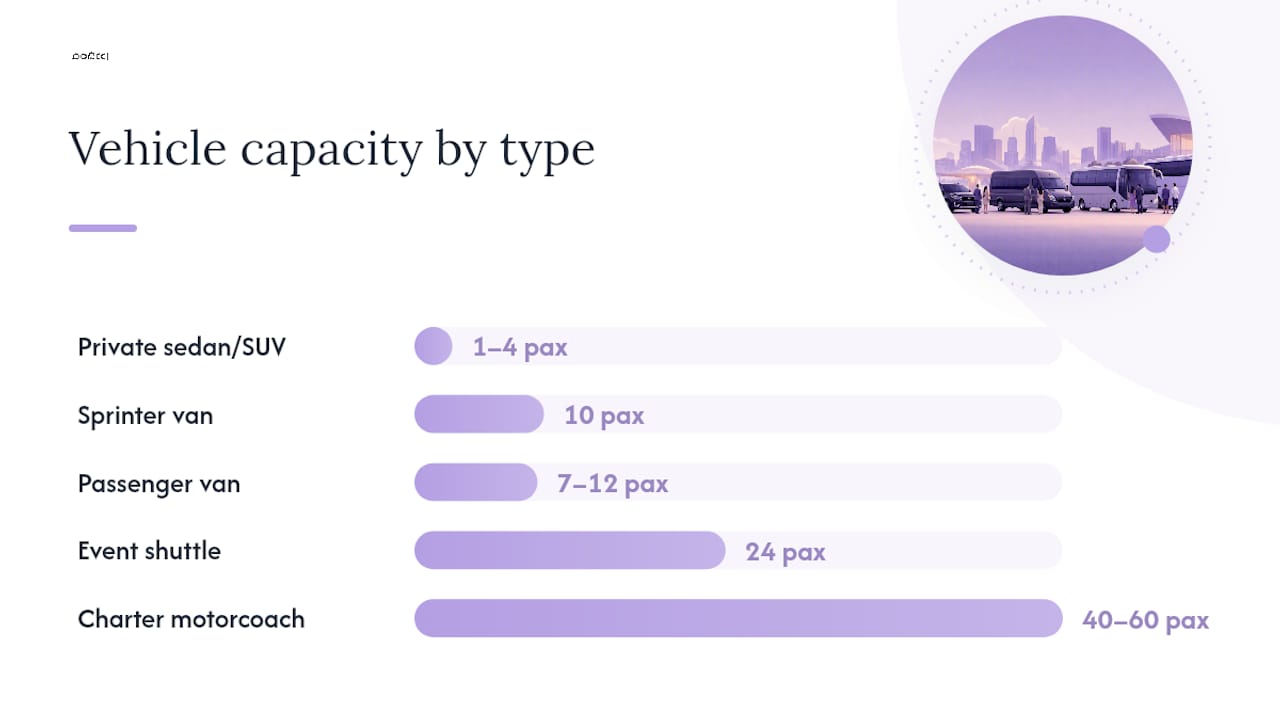
A few practical notes on this table. Sprinter vans are underused for speaker groups because planners default to sedans, but a Sprinter comfortably moves a speaker plus a handler, two AV cases, and a rolling wardrobe bag. Charter coaches need the longest lead time and the earliest staging confirmation because their size creates the most curb friction. Rideshare platforms work as a supplement for overflow and late-night departures, but they are not reliable as a primary option for VIPs or time-sensitive transfers.
For AV equipment transport, always confirm interior dimensions before booking. A standard sedan trunk will not fit a 48-inch road case. A Sprinter or cargo van is the right call for large corporate event equipment that needs to arrive with the team.
Industry guidance recommends establishing a firm lock date 30–45 days before the event and calculating your vehicle asset mix based on the single busiest 60-minute demand window. That peak window, usually the 45 minutes before your first general session, is what determines how many vehicles you need on the curb simultaneously.
For large conferences, start vendor conversations 8–12 weeks out. For multi-city roadshows, 12–16 weeks is safer. Routine single-day corporate transfers can be arranged 2–4 weeks in advance, but expect limited vehicle availability if you wait until the week before.
• Vehicle rental fees (per vehicle, per hour or per day)
• Driver hours, including pre-event staging time and post-event wait time
• Fuel surcharges and tolls
• Staging lot fees or remote parking costs
• Permit fees for curbside loading zones
• Overtime charges (most vendors charge 1.5x after the contracted window)
• Gratuity (typically 15–20% of the base vehicle fee)
GBTA’s industry benchmarks are a useful reference point when setting per-vehicle budget expectations and evaluating whether a vendor quote is within normal range for corporate programs.
• Insurance minimums. Commercial auto liability of at least $1.5 million per occurrence is standard for corporate programs. Require a certificate of insurance naming your organization as an additional insured.
• Cancellation and substitution policy. Know the cancellation window (typically 48–72 hours) and what happens if the vendor substitutes a vehicle type.
• On-site staffing. Confirm whether the vendor provides a ground coordinator or whether that role falls to your team.
• SLA items. Define on-time performance expectations, maximum wait times, and the remedy if the vendor misses them.
• Driver vetting. Require confirmation that all drivers hold valid commercial licenses and have passed background checks.
Guests need four things in writing before they travel: their exact pickup time, the precise pickup location (not just “the hotel lobby”), a description of the vehicle or driver identifier, and a direct contact number for the day of the event.
Keep guest-facing messages short. A pickup confirmation SMS should be under 80 words. Include the driver’s name, the vehicle color and plate number, and a single contact number. Avoid attaching PDFs to text messages; they rarely open cleanly on mobile.
For internal communication, the manifest is the backbone. Define who has read access (everyone on the logistics team) and who has write access (the transportation lead only). Set up a group chat or a dedicated Slack channel for day-of escalations, and make sure every team member knows the escalation flow: driver issue goes to the transportation lead, guest complaint goes to the event director, medical issue goes to venue security.
Driver briefs deserve more attention than most planners give them. A good driver brief includes the full run-sheet for that driver’s assignments, the guest names and VIP flags for each leg, the escalation contact number, venue curbside rules, and a note on any accessibility requirements. Send it 48 hours before the first pickup and confirm receipt.
Pro Tip: Assign a dedicated “transportation concierge” phone number for the event day. Route it to the transportation lead’s cell. Guests and drivers call one number, not five.

Airport pickups are where corporate event transportation most often breaks down. Plan for these specifics:
• Monitor flights in real time. Use FlightAware or a similar tool to track arrivals. Brief your drivers to check flight status 90 minutes before scheduled landing, not at the scheduled landing time.
• Know the terminal. Domestic and international arrivals are often in different terminals or even different buildings. Confirm in advance and note it in the manifest.
• International arrivals take longer. Budget 45–90 minutes from wheels-down to curbside for international passengers clearing customs. Do not schedule a pickup 20 minutes after an international flight lands.
• Use cell phone lots. Instruct drivers to wait in the cell phone lot and pull to the curb only when the guest confirms they are outside. This avoids traffic officer conflicts and unnecessary circling.
For venue curbside management, check Transportation and your local municipality’s permit office for large-vehicle staging rules before finalizing your plan. Most urban venues have strict curb-time limits (often 3–5 minutes for drop-off), and violations can result in vehicles being moved by traffic enforcement mid-event.
A practical venue curbside checklist:
• Confirm permitted loading zones and their hours of operation.
• Identify whether a permit is required for coach buses or staging vehicles.
• Locate the nearest remote staging area (a parking lot or side street within 5 minutes of the venue).
• Position a greeter at the curb with a sign or a branded identifier.
• Establish a radio or phone link between the greeter and the staging dispatcher.
Traffic timing matters more than most planners account for. In dense urban markets like New York City, a 2-mile trip can take 8 minutes at 10 AM and 35 minutes at 5:30 PM. Build your run-sheet around worst-case traffic, not average traffic.
The right vendor for a corporate program is not necessarily the largest fleet in your city. It is the one with documented processes for multi-vehicle, multi-day events. Convenience and reliability are the top priorities in business travel, and your transportation partner’s operational depth is what delivers both.
Vendor vetting checklist:
• Valid USDOT number and state operating authority (confirm on FMCSA’s website)
• Commercial auto liability insurance certificate (minimum $1.5M per occurrence)
• Fleet depth: can they provide backup vehicles within 30 minutes?
• References from at least two corporate events of comparable size
• Technology: do they offer GPS tracking, a live dashboard, or a passenger-invite app?
• Driver background check policy in writing
• Cancellation and substitution policy in the contract
Interview questions worth asking: “What happens if a vehicle breaks down during an event?” “How do you handle a flight delay that pushes a pickup 3 hours?” “Who is my single point of contact on event day?” A vendor who cannot answer these questions clearly is an operational risk.
Red flags: no backup fleet, no written cancellation policy, resistance to providing an insurance certificate, and drivers who are independent contractors with no vetting documentation.
Even a well-built plan encounters flight delays, no-shows, and last-minute VIP schedule changes. The difference between a smooth event and a chaotic one is whether your contingency process is written down before the event starts.
1. Assign roles before the event. You need a ground coordinator (at the venue), a staging lead (at the remote lot or airport), and a driver dispatcher (on the phone with all drivers). These can be the same person at a small event, but the roles must be defined.
2. Reserve at least one standby vehicle. For events with 10 or more vehicles, keep one unassigned vehicle on standby within 15 minutes of the venue.
3. Set up a live manifest view. Use a shared Google Sheet or a ride-management app that allows real-time updates so every team member sees the same current picture.
4. Define your exception-handling triggers. A flight delayed by 30 minutes triggers a driver hold. A delay of 90 minutes triggers a vehicle reassignment and a guest notification. A no-show after 15 minutes triggers a call to the guest’s emergency contact.
5. Run a pre-event briefing. Gather all drivers and on-site staff 60 minutes before the first pickup. Review the run-sheet, confirm radio or phone protocols, and walk the curbside staging area together.
Industry surveys indicate that nearly 71% of event managers identify transportation delays or misrouting as a top operational risk. A written contingency plan with assigned roles is the single most effective way to reduce that risk.
Pro Tip: Keep a printed copy of the full run-sheet and manifest in every vehicle. Technology fails; paper does not.
Accessibility planning starts at registration, not on event day. Build these fields into your RSVP or registration form:
• Does the guest require a vehicle with a wheelchair lift or ramp?
• Will a service animal be traveling with the guest?
• Does the guest need a stretcher-capable vehicle?
• Are there any assistance needs the driver should be aware of?
Confirm ADA requirements with your vendor in writing. A short confirmation script: “We have [N] guests requiring wheelchair-accessible vehicles. Please confirm that [N] lift-equipped vehicles are included in our contract and that drivers are trained in wheelchair securement.” Get that confirmation in an email, not just a verbal assurance.
For medical emergencies, coordinate with venue security in advance. Know the location of the nearest emergency room, have the venue’s on-site medical contact in your run-sheet, and brief your ground coordinator on the protocol for calling emergency services versus handling a situation internally.
Accessibility in corporate event transportation extends past wheelchair lifts. Planners often overlook a category of needs that affect the transport experience itself.
Dietary transport requests come up when events include catered vehicles, hospitality coaches, or long-distance transfers with onboard refreshments. If your charter coach includes a catering service, collect dietary restrictions alongside your standard manifest fields. A guest with a severe allergy who boards a vehicle stocked with their allergen is a liability, not just an inconvenience.

Medical needs beyond mobility include guests who require temperature-controlled medication storage during transit, guests with anxiety or sensory sensitivities who need a quieter vehicle environment, and guests who are post-surgical and need extra boarding time or a specific seat configuration. These details belong in the manifest notes field and should be flagged to the driver in the written brief.
Emergency protocols should be documented for every event. Your ground coordinator needs to know: who to call if a guest has a medical episode in a vehicle, whether your vendor’s drivers are CPR-certified, and what the nearest hospital is to each major pickup and drop-off point. Your corporate gathering setup process should include a medical protocol review as a standard checklist item alongside AV and catering.
A practical template library saves hours on every event. Here is what to build and keep on file:
• Manifest CSV template. Columns: Name, Mobile, Flight Number, Airline, Terminal, Arrival Time, Pickup Location, Drop-off Location, VIP Flag, Luggage Count, Accessibility Notes, Vehicle Assignment, Driver Name, Billing Code, Notes. Use this as your starting point for every event and customize from there.
• Run-sheet template. Columns: Time, Leg Description, Vehicle Type, Driver Name/Number, Pickup Address, Drop-off Address, Responsible Contact, Buffer Notes. One row per trip leg.
• Guest pickup SMS template. “Hi [Name], your pickup is at [Time] at [Exact Location]. Your driver is [Driver Name] in a [Vehicle Color/Type], plate [XXX-XXX]. Questions? Call [Number].”
• Driver brief template. One page per driver: their full run-sheet for the day, guest names and VIP flags, curbside rules for each venue, escalation contact, and accessibility notes for their assigned passengers.
• Vendor confirmation email template. Summarizes vehicle count, types, pickup times, staging location, driver brief deadline, and insurance certificate request.
For single-day events, the manifest and run-sheet can live in the same spreadsheet tab. For multi-day events, create a separate run-sheet tab for each day and use a master manifest tab that feeds all of them. RSVP management workflows that collect guest data early make manifest population significantly faster.
The conventional wisdom in corporate event transportation is to book early, confirm often, and have a backup plan. That advice is correct but incomplete. The real failure mode we see repeatedly is not a missing backup vehicle. It is a planner who treats transportation as a series of individual bookings rather than a single passenger-flow system.
When you think in flows, you ask different questions. Instead of “Did I book enough cars?” you ask “What happens to the curb at 8:45 AM when three coaches, two SUVs, and a shuttle all arrive in the same 10-minute window?” That question leads you to remote staging, staggered departure times, and a dispatcher who controls when each vehicle pulls forward. This is the difference between a curbside that works and one that locks up.
We have seen events where the vehicle count was perfect and the event still ran 40 minutes late because no one mapped the peak window. We have also seen events with half the vehicles anyone expected, running on time, because the planner built a tight run-sheet and staged everything 3 blocks away.
One rule of thumb worth keeping: calculate your vehicle asset mix around the single busiest 60-minute demand window, not the total guest count. That one shift in thinking changes everything about how you stage, dispatch, and recover from delays.
When your transportation plan is locked, the next challenge is making sure everything else at the venue is equally ready. Porcci NYC works with corporate event planners across New York City and New Jersey to coordinate the on-site elements that transportation delivers guests to: professional AV and sound systems, DJ services, photo booths, lighting, and event staffing. We handle setup, delivery, and breakdown so your team is free to manage arrivals and run-sheets without splitting attention.
Before you reach out, have your manifest started, your key dates confirmed, and your VIP list identified. That information helps us align staffing and equipment delivery windows with your transportation schedule. Request a quote at Porccinyc and tell us your event date, guest count, and venue location.
• Corporate Event Logistics Guide for Leaders - DA Executive Service
• Corporate Event Transportation Planning Guide:
• Gbta
Book charter coaches and executive vehicles several weeks out for large conferences, and earlier for routine corporate transfers. Peak travel seasons and major conference dates require even earlier reservations.
Start by defining your transportation objectives and KPIs, then build a live manifest with all passenger and flight data, map every guest movement into a timed run-sheet, and assign a single transportation lead to own all updates and day-of decisions.
The core options are private sedans and executive SUVs for VIPs, limousines for prestige group arrivals, Sprinter vans for small teams, event shuttles for mid-size groups, and charter motorcoaches for large attendee transfers. Rideshare platforms work as overflow supplements, not primary options for time-sensitive guests.
Costs vary by vehicle type, market, and duration. Permit fees for curbside loading zones add to the total in dense urban markets.
A complete manifest includes each passenger’s full name, mobile number, flight number, arrival terminal, pickup and drop-off locations, VIP status, luggage count, accessibility requirements, vehicle assignment, driver name, and a billing code. One designated person should control all updates to prevent conflicting versions.
Master the steps to arrange corporate event transportation with our complete guide, ensuring timely arrivals and smooth operations for every guest.
Arranging corporate event transportation means planning early, building a live manifest, and running just-in-time operations so every guest, from the keynote speaker to the last shuttle rider, arrives on schedule. Providers commonly recommend booking corporate transportation 2–4 weeks in advance for routine transfers, and significantly earlier for large conferences or peak travel seasons. Start here:
• Lock your dates first. Confirm the event agenda before booking any vehicle.
• Build a manifest immediately. Collect names, flight numbers, pickup locations, and VIP flags from day one.
• Assign a single transportation lead. One person approves all manifest changes.
• Reserve staging areas. Confirm curbside permits and loading zones before vehicles are booked.
• Set a lock date. Finalize baseline vehicle counts 30–45 days before the event.
• Brief every driver. Send a written driver brief 48 hours before the first pickup.
Pro Tip: Book your highest-demand vehicle types (charter coaches, executive SUVs) first. They sell out fastest during conference season and major holidays.
Effective corporate event transportation requires treating every guest movement as part of a single, orchestrated passenger-flow system, not a collection of individual bookings.
| Point | Details |
|---|---|
| Set a lock date early | Finalize baseline vehicle counts 30–45 days before the event to avoid last-minute premium rates. |
| Build one live manifest | Assign a single decision-maker for updates; include flight data, VIP flags, and accessibility needs. |
| Match vehicles to guest types | Use executive SUVs for VIPs, Sprinters for small teams, and charter coaches for large attendee groups. |
| Plan for the peak window | Calculate your vehicle mix around the single busiest 60-minute demand window, not total guest count. |
| Porcci NYC for on-site support | Porcci NYC coordinates AV, staffing, and entertainment in NYC and NJ to align with your transport schedule. |
• How to arrange corporate event transportation: start with objectives
• Build a live transportation manifest before anything else
• Map every guest movement and build your run-sheets
• Which vehicle type fits each guest and group size?
• Booking timeline, budgeting, and what your contract must include
• What does your guest and internal communication plan look like?
• How to handle airports, venue curbs, and traffic patterns
• How do you evaluate and select a transportation partner?
• Contingency planning and real-time operations on event day
• How do you handle accessibility and special needs requests?
• What goes beyond mobility: dietary, medical, and other special accommodations
• Templates and tools every planner should have ready
• What the best planners know that most guides skip
• Porcci NYC can support your event logistics from the ground up
• Sources
• FAQ
This guide is written for corporate meeting planners, conference logistics leads, roadshow coordinators, and in-house events teams who are responsible for getting people where they need to be, on time, without drama. It covers single-boardroom VIP transfers and multi-thousand-attendee conferences alike.
What you will find here: practical operations guidance, manifest templates, vehicle selection logic, and on-the-day contingency processes. What this guide does not cover: rate shopping between specific vendors or negotiating individual contracts line by line. The goal is to give you a repeatable process, not a price list.
Before you book a single vehicle, answer these questions in writing:
1. What does “on time” mean for this event? Define it in minutes, not feelings. Is a VIP considered late if they arrive 10 minutes after doors open, or 2 minutes before their session starts?
2. Who are your highest-priority passengers? Speakers, C-suite guests, and media contacts need different handling than general attendees.
3. What are your luggage and equipment requirements? AV cases, display materials, and oversized bags change vehicle selection entirely.
4. What are the venue’s curb rules? Some venues allow a 3-minute drop-off maximum. Others have dedicated loading docks.
5. Are there security constraints? Some events require credentialed drivers, advance vehicle registration, or escort vehicles.
6. What is your allowable wait time at the curb? This determines whether you need remote staging.
Once you have answers, translate them into measurable KPIs. PCMA’s event-planning resources offer objective-setting frameworks that help translate these answers into formal success metrics.
Your objectives will directly shape your vehicle mix. A large-group objective means coach buses with fixed departure windows, not on-demand rides.
A single, shared transportation manifest with passenger contact details, flight information, luggage notes, vehicle assignments, and a single decision-maker for updates prevents the majority of avoidable day-of errors. Think of it as your operational source of truth.
Every manifest must include these fields:
• Full passenger name and mobile number
• Flight number, airline, arrival terminal, and scheduled landing time
• Pickup location (address, terminal, hotel name and room block)
• Drop-off location
• VIP status flag (Y/N, with tier if applicable)
• Luggage count and any oversized items
• Accessibility requirements
• Vehicle assignment and driver name
• Billing code or cost center
• Notes field for exceptions
Version control matters as much as the data itself. Assign one person, your transportation lead, as the only person authorized to update the master manifest. Everyone else submits change requests to that person. Use a shared Google Sheet or a dedicated event-management platform with edit history enabled. Never circulate static PDFs as the working document; they go stale within hours on a busy event day.
On the back end, the manifest doubles as your invoicing verification tool. After the event, cross-reference completed trips against the manifest to confirm SLA compliance and catch billing discrepancies before you approve vendor invoices.
Mapping guest movements converts your manifest into a timed operational plan. Here is how to do it:
1. List every touchpoint. Airport arrivals, hotel pickups, venue arrivals, off-site dinner transfers, and return airport drops. Every leg gets its own row.
2. Assign a time window to each leg. Include a departure time, an expected travel time, and an arrival buffer. For keynote arrivals, build in at least 20 minutes of buffer. For airport drop-offs, add 30 minutes beyond the standard check-in recommendation.
3. Identify loading and unloading points. Note the exact address, the curb or dock number, and who greets the vehicle.
4. Assign a responsible contact to each leg. This is the person who calls the driver if the vehicle is late and who escalates if the guest does not appear.
5. Define your escalation nodes. If a driver is 10 minutes late, who gets the call? If a guest misses a pickup, what is the next step?
Buffer-time guidelines worth keeping: add 15–20 minutes before any keynote or panel session, 30 minutes for airport drop-offs during peak hours, and a full hour of flex time built into the final departure window for large groups. Remote staging combined with just-in-time dispatch keeps public curbs clear and improves on-time performance significantly during peak windows.
A basic run-sheet row looks like this: Time | Leg | Vehicle | Driver | Pickup | Drop-off | Contact | Notes. Keep it in the same shared file as your manifest so the transportation lead can update both simultaneously.
Matching the vehicle to the guest type is where event transport logistics either earns trust or loses it. Here is a practical breakdown:
| Vehicle Type | Capacity | Best For | Lead Time | Key Amenities |
|---|---|---|---|---|
| Private sedan / executive SUV | 1–4 passengers | VIPs, speakers, C-suite | 2–4 weeks | Privacy, climate control, luggage space |
| Limousine | 6–10 passengers | VIP groups, award arrivals | 3–4 weeks | Bar, premium interior, prestige factor |
| Sprinter van | 10 passengers | Small teams, speaker groups | 1–2 weeks | Luggage capacity, flexible seating |
| Passenger van | 7–12 passengers | Staff transfers, breakout groups | 1–2 weeks | Cost-effective, moderate luggage |
| Event shuttle (coach) | 24 passengers | General attendee transfers | 3–6 weeks | Fixed routes, high volume |
| Charter / motorcoach | 40–60 passengers | Large conference groups | 4–8 weeks | Wi-Fi, power outlets, restroom |
| Rideshare (supplement) | 1–4 passengers | Overflow, late departures | On-demand | Flexibility, no pre-booking |
A few practical notes on this table. Sprinter vans are underused for speaker groups because planners default to sedans, but a Sprinter comfortably moves a speaker plus a handler, two AV cases, and a rolling wardrobe bag. Charter coaches need the longest lead time and the earliest staging confirmation because their size creates the most curb friction. Rideshare platforms work as a supplement for overflow and late-night departures, but they are not reliable as a primary option for VIPs or time-sensitive transfers.
For AV equipment transport, always confirm interior dimensions before booking. A standard sedan trunk will not fit a 48-inch road case. A Sprinter or cargo van is the right call for large corporate event equipment that needs to arrive with the team.
Industry guidance recommends establishing a firm lock date 30–45 days before the event and calculating your vehicle asset mix based on the single busiest 60-minute demand window. That peak window, usually the 45 minutes before your first general session, is what determines how many vehicles you need on the curb simultaneously.
For large conferences, start vendor conversations 8–12 weeks out. For multi-city roadshows, 12–16 weeks is safer. Routine single-day corporate transfers can be arranged 2–4 weeks in advance, but expect limited vehicle availability if you wait until the week before.
• Vehicle rental fees (per vehicle, per hour or per day)
• Driver hours, including pre-event staging time and post-event wait time
• Fuel surcharges and tolls
• Staging lot fees or remote parking costs
• Permit fees for curbside loading zones
• Overtime charges (most vendors charge 1.5x after the contracted window)
• Gratuity (typically 15–20% of the base vehicle fee)
GBTA’s industry benchmarks are a useful reference point when setting per-vehicle budget expectations and evaluating whether a vendor quote is within normal range for corporate programs.
• Insurance minimums. Commercial auto liability of at least $1.5 million per occurrence is standard for corporate programs. Require a certificate of insurance naming your organization as an additional insured.
• Cancellation and substitution policy. Know the cancellation window (typically 48–72 hours) and what happens if the vendor substitutes a vehicle type.
• On-site staffing. Confirm whether the vendor provides a ground coordinator or whether that role falls to your team.
• SLA items. Define on-time performance expectations, maximum wait times, and the remedy if the vendor misses them.
• Driver vetting. Require confirmation that all drivers hold valid commercial licenses and have passed background checks.
Guests need four things in writing before they travel: their exact pickup time, the precise pickup location (not just “the hotel lobby”), a description of the vehicle or driver identifier, and a direct contact number for the day of the event.
Keep guest-facing messages short. A pickup confirmation SMS should be under 80 words. Include the driver’s name, the vehicle color and plate number, and a single contact number. Avoid attaching PDFs to text messages; they rarely open cleanly on mobile.
For internal communication, the manifest is the backbone. Define who has read access (everyone on the logistics team) and who has write access (the transportation lead only). Set up a group chat or a dedicated Slack channel for day-of escalations, and make sure every team member knows the escalation flow: driver issue goes to the transportation lead, guest complaint goes to the event director, medical issue goes to venue security.
Driver briefs deserve more attention than most planners give them. A good driver brief includes the full run-sheet for that driver’s assignments, the guest names and VIP flags for each leg, the escalation contact number, venue curbside rules, and a note on any accessibility requirements. Send it 48 hours before the first pickup and confirm receipt.
Pro Tip: Assign a dedicated “transportation concierge” phone number for the event day. Route it to the transportation lead’s cell. Guests and drivers call one number, not five.
Airport pickups are where corporate event transportation most often breaks down. Plan for these specifics:
• Monitor flights in real time. Use FlightAware or a similar tool to track arrivals. Brief your drivers to check flight status 90 minutes before scheduled landing, not at the scheduled landing time.
• Know the terminal. Domestic and international arrivals are often in different terminals or even different buildings. Confirm in advance and note it in the manifest.
• International arrivals take longer. Budget 45–90 minutes from wheels-down to curbside for international passengers clearing customs. Do not schedule a pickup 20 minutes after an international flight lands.
• Use cell phone lots. Instruct drivers to wait in the cell phone lot and pull to the curb only when the guest confirms they are outside. This avoids traffic officer conflicts and unnecessary circling.
For venue curbside management, check Transportation and your local municipality’s permit office for large-vehicle staging rules before finalizing your plan. Most urban venues have strict curb-time limits (often 3–5 minutes for drop-off), and violations can result in vehicles being moved by traffic enforcement mid-event.
A practical venue curbside checklist:
• Confirm permitted loading zones and their hours of operation.
• Identify whether a permit is required for coach buses or staging vehicles.
• Locate the nearest remote staging area (a parking lot or side street within 5 minutes of the venue).
• Position a greeter at the curb with a sign or a branded identifier.
• Establish a radio or phone link between the greeter and the staging dispatcher.
Traffic timing matters more than most planners account for. In dense urban markets like New York City, a 2-mile trip can take 8 minutes at 10 AM and 35 minutes at 5:30 PM. Build your run-sheet around worst-case traffic, not average traffic.
The right vendor for a corporate program is not necessarily the largest fleet in your city. It is the one with documented processes for multi-vehicle, multi-day events. Convenience and reliability are the top priorities in business travel, and your transportation partner’s operational depth is what delivers both.
Vendor vetting checklist:
• Valid USDOT number and state operating authority (confirm on FMCSA’s website)
• Commercial auto liability insurance certificate (minimum $1.5M per occurrence)
• Fleet depth: can they provide backup vehicles within 30 minutes?
• References from at least two corporate events of comparable size
• Technology: do they offer GPS tracking, a live dashboard, or a passenger-invite app?
• Driver background check policy in writing
• Cancellation and substitution policy in the contract
Interview questions worth asking: “What happens if a vehicle breaks down during an event?” “How do you handle a flight delay that pushes a pickup 3 hours?” “Who is my single point of contact on event day?” A vendor who cannot answer these questions clearly is an operational risk.
Red flags: no backup fleet, no written cancellation policy, resistance to providing an insurance certificate, and drivers who are independent contractors with no vetting documentation.
Even a well-built plan encounters flight delays, no-shows, and last-minute VIP schedule changes. The difference between a smooth event and a chaotic one is whether your contingency process is written down before the event starts.
1. Assign roles before the event. You need a ground coordinator (at the venue), a staging lead (at the remote lot or airport), and a driver dispatcher (on the phone with all drivers). These can be the same person at a small event, but the roles must be defined.
2. Reserve at least one standby vehicle. For events with 10 or more vehicles, keep one unassigned vehicle on standby within 15 minutes of the venue.
3. Set up a live manifest view. Use a shared Google Sheet or a ride-management app that allows real-time updates so every team member sees the same current picture.
4. Define your exception-handling triggers. A flight delayed by 30 minutes triggers a driver hold. A delay of 90 minutes triggers a vehicle reassignment and a guest notification. A no-show after 15 minutes triggers a call to the guest’s emergency contact.
5. Run a pre-event briefing. Gather all drivers and on-site staff 60 minutes before the first pickup. Review the run-sheet, confirm radio or phone protocols, and walk the curbside staging area together.
Industry surveys indicate that nearly 71% of event managers identify transportation delays or misrouting as a top operational risk. A written contingency plan with assigned roles is the single most effective way to reduce that risk.
Pro Tip: Keep a printed copy of the full run-sheet and manifest in every vehicle. Technology fails; paper does not.
Accessibility planning starts at registration, not on event day. Build these fields into your RSVP or registration form:
• Does the guest require a vehicle with a wheelchair lift or ramp?
• Will a service animal be traveling with the guest?
• Does the guest need a stretcher-capable vehicle?
• Are there any assistance needs the driver should be aware of?
Confirm ADA requirements with your vendor in writing. A short confirmation script: “We have [N] guests requiring wheelchair-accessible vehicles. Please confirm that [N] lift-equipped vehicles are included in our contract and that drivers are trained in wheelchair securement.” Get that confirmation in an email, not just a verbal assurance.
For medical emergencies, coordinate with venue security in advance. Know the location of the nearest emergency room, have the venue’s on-site medical contact in your run-sheet, and brief your ground coordinator on the protocol for calling emergency services versus handling a situation internally.
Accessibility in corporate event transportation extends past wheelchair lifts. Planners often overlook a category of needs that affect the transport experience itself.
Dietary transport requests come up when events include catered vehicles, hospitality coaches, or long-distance transfers with onboard refreshments. If your charter coach includes a catering service, collect dietary restrictions alongside your standard manifest fields. A guest with a severe allergy who boards a vehicle stocked with their allergen is a liability, not just an inconvenience.
Medical needs beyond mobility include guests who require temperature-controlled medication storage during transit, guests with anxiety or sensory sensitivities who need a quieter vehicle environment, and guests who are post-surgical and need extra boarding time or a specific seat configuration. These details belong in the manifest notes field and should be flagged to the driver in the written brief.
Emergency protocols should be documented for every event. Your ground coordinator needs to know: who to call if a guest has a medical episode in a vehicle, whether your vendor’s drivers are CPR-certified, and what the nearest hospital is to each major pickup and drop-off point. Your corporate gathering setup process should include a medical protocol review as a standard checklist item alongside AV and catering.
A practical template library saves hours on every event. Here is what to build and keep on file:
• Manifest CSV template. Columns: Name, Mobile, Flight Number, Airline, Terminal, Arrival Time, Pickup Location, Drop-off Location, VIP Flag, Luggage Count, Accessibility Notes, Vehicle Assignment, Driver Name, Billing Code, Notes. Use this as your starting point for every event and customize from there.
• Run-sheet template. Columns: Time, Leg Description, Vehicle Type, Driver Name/Number, Pickup Address, Drop-off Address, Responsible Contact, Buffer Notes. One row per trip leg.
• Guest pickup SMS template. “Hi [Name], your pickup is at [Time] at [Exact Location]. Your driver is [Driver Name] in a [Vehicle Color/Type], plate [XXX-XXX]. Questions? Call [Number].”
• Driver brief template. One page per driver: their full run-sheet for the day, guest names and VIP flags, curbside rules for each venue, escalation contact, and accessibility notes for their assigned passengers.
• Vendor confirmation email template. Summarizes vehicle count, types, pickup times, staging location, driver brief deadline, and insurance certificate request.
For single-day events, the manifest and run-sheet can live in the same spreadsheet tab. For multi-day events, create a separate run-sheet tab for each day and use a master manifest tab that feeds all of them. RSVP management workflows that collect guest data early make manifest population significantly faster.
The conventional wisdom in corporate event transportation is to book early, confirm often, and have a backup plan. That advice is correct but incomplete. The real failure mode we see repeatedly is not a missing backup vehicle. It is a planner who treats transportation as a series of individual bookings rather than a single passenger-flow system.
When you think in flows, you ask different questions. Instead of “Did I book enough cars?” you ask “What happens to the curb at 8:45 AM when three coaches, two SUVs, and a shuttle all arrive in the same 10-minute window?” That question leads you to remote staging, staggered departure times, and a dispatcher who controls when each vehicle pulls forward. This is the difference between a curbside that works and one that locks up.
We have seen events where the vehicle count was perfect and the event still ran 40 minutes late because no one mapped the peak window. We have also seen events with half the vehicles anyone expected, running on time, because the planner built a tight run-sheet and staged everything 3 blocks away.
One rule of thumb worth keeping: calculate your vehicle asset mix around the single busiest 60-minute demand window, not the total guest count. That one shift in thinking changes everything about how you stage, dispatch, and recover from delays.
When your transportation plan is locked, the next challenge is making sure everything else at the venue is equally ready. Porcci NYC works with corporate event planners across New York City and New Jersey to coordinate the on-site elements that transportation delivers guests to: professional AV and sound systems, DJ services, photo booths, lighting, and event staffing. We handle setup, delivery, and breakdown so your team is free to manage arrivals and run-sheets without splitting attention.
Before you reach out, have your manifest started, your key dates confirmed, and your VIP list identified. That information helps us align staffing and equipment delivery windows with your transportation schedule. Request a quote at Porccinyc and tell us your event date, guest count, and venue location.
• Corporate Event Logistics Guide for Leaders - DA Executive Service
• Corporate Event Transportation Planning Guide:
• Gbta
Book charter coaches and executive vehicles several weeks out for large conferences, and earlier for routine corporate transfers. Peak travel seasons and major conference dates require even earlier reservations.
Start by defining your transportation objectives and KPIs, then build a live manifest with all passenger and flight data, map every guest movement into a timed run-sheet, and assign a single transportation lead to own all updates and day-of decisions.
The core options are private sedans and executive SUVs for VIPs, limousines for prestige group arrivals, Sprinter vans for small teams, event shuttles for mid-size groups, and charter motorcoaches for large attendee transfers. Rideshare platforms work as overflow supplements, not primary options for time-sensitive guests.
Costs vary by vehicle type, market, and duration. Permit fees for curbside loading zones add to the total in dense urban markets.
A complete manifest includes each passenger’s full name, mobile number, flight number, arrival terminal, pickup and drop-off locations, VIP status, luggage count, accessibility requirements, vehicle assignment, driver name, and a billing code. One designated person should control all updates to prevent conflicting versions.