Learn how to successfully organize a corporate dinner dance with our essential planner checklist, ensuring a memorable event from start to finish.
Start six months out. Lock the date, define your objectives, and shortlist venues in the first two weeks.
Here’s what deserves your attention this week:
• Objectives: recognition, team building, or client entertainment each demand a different format.
• Headcount band: get a working range now, even before RSVPs open, so venue capacity isn’t guesswork.
• Per head budget: set a floor and ceiling before you call a single vendor.
Venue and food and beverage typically eat up 50 to 60 percent of a Dinner & Dance budget, so that’s the number to anchor your whole spreadsheet around.
Pro Tip: Book your venue before you finalize the guest list. Popular rooms disappear faster than headcount estimates firm up, and you can always adjust catering counts later.
A successful corporate dinner dance depends on locking objectives, venue, and budget in the first two weeks, then following a strict week-by-week timeline through event day.
| Point | Details |
|---|---|
| Start with objectives | Recognition, team building, or client entertainment each dictate format, formality, and budget allocation. |
| Budget venue and F&B first | These two line items typically consume 50 to 60 percent of total spend. |
| Cap the formal programme | Keep speeches, awards, and entertainment highlights to 60 to 75 minutes total. |
| Build a written run-of-show | Minute-by-minute cues keep the event lead, MC, and AV team synchronized on the night. |
| Consider a turnkey provider | Porcci NYC bundles AV, DJ services, and photo booth rentals under one contract for planners managing tight timelines. |
• Key Decisions to Settle Before You Plan a Corporate Dinner Dance
• Planning Timeline: What to Do 12 Weeks Out vs. 12 Months Out
• How Do You Structure the Programme and Entertainment?
• Catering, Service Style, and Dietary Accommodations
• What Should Be on Your Venue and AV Checklist?
• Run-of-Show and Day-of Staffing Roles
• How Do You Measure Whether the Event Succeeded?
• What Does a Turnkey Package Actually Include?
• Transportation and Parking Logistics for Guests
• Safety and Emergency Protocols Planning
• Communication Plan for Internal Stakeholders and Attendees
• Tips for Engaging Remote or Hybrid Participants
• When Should You Hire a Turnkey Event Provider?
• Sources
• FAQ
Every downstream choice, from venue square footage to whether you hire a live band, traces back to a handful of decisions you should nail down first. Skip this step and you’ll find yourself redoing a floorplan three weeks before the event.
• Objectives first: a night meant to reward top performers looks different from one meant to build cross-department relationships. Recognition-focused events often need a stage, an awards segment, and tighter run-of-show control. Team-building nights lean toward informal seating and more dance floor time.
• Audience mix: leadership, plus-ones, and rank-and-file employees together change your formality level and seating logic.
• Budget ceiling: decide it before venue tours, not after. Once you fall for a ballroom you can’t afford, every later decision compromises to fit that mistake.
• F&B and entertainment follow objectives: a formal recognition dinner justifies plated service and a live band; a casual team celebration works fine with stations and a DJ.
Pro Tip: Write your objectives on the RFP you send vendors. A caterer or AV company that understands the event’s purpose will make better recommendations than one just quoting a generic package.
The single biggest driver of event-day chaos is a compressed timeline. Popular venues for Q4 events often book six to twelve months in advance, so if you’re targeting a November or December date, your search needs to start well before summer.
If you’re starting later than that, a condensed 12-week window still works, provided you follow a strict week-by-week checklist that locks headcount, finalizes the run-of-show by week three, and schedules a full technical rehearsal the day before doors open.
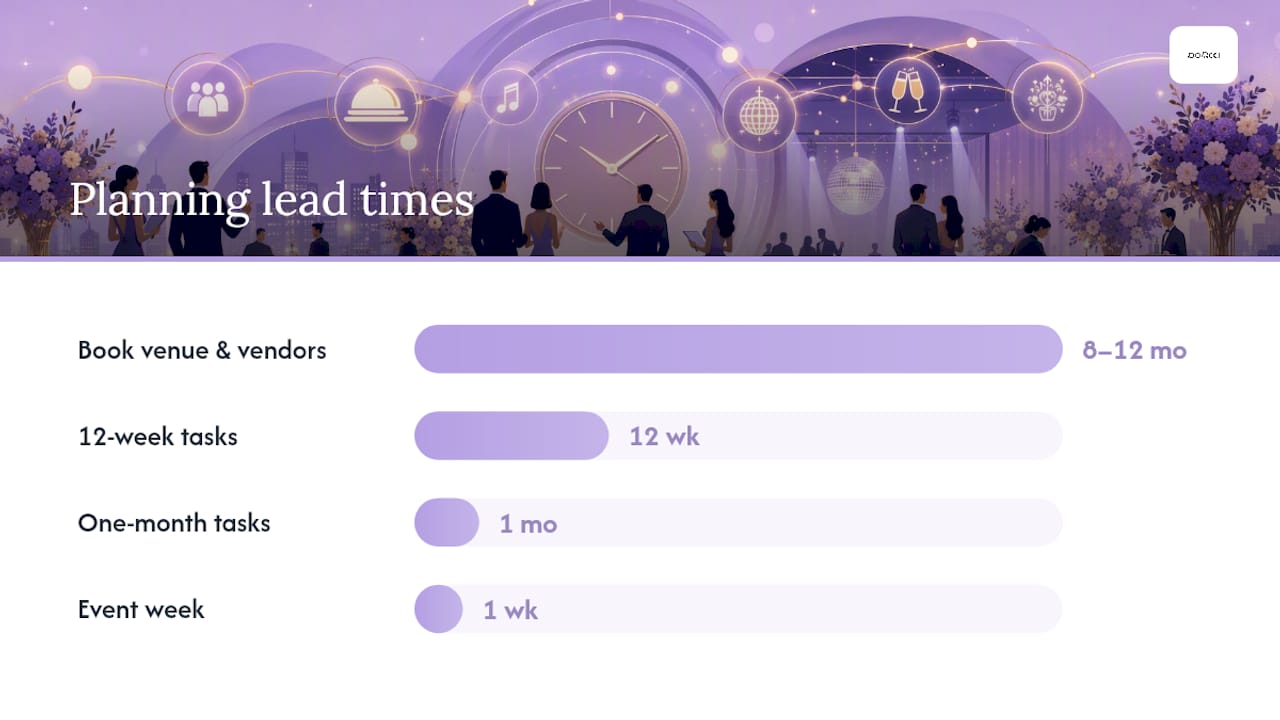
| Timeframe | Key milestones |
|---|---|
| 8 to 12 months out | Confirm objectives, lock venue, set budget ceiling |
| — | Book entertainment, caterer, AV vendor; send save-the-dates |
| 12 weeks out | Finalize menu, confirm dietary collection process, draft run-of-show |
| one-month mark | Confirm headcount, send vendor briefs, review floorplan |
| Week of event | Technical rehearsal, staff briefing, final vendor confirmations |
For a standard 4-hour dinner dance, build your evening around this rough shape:
• Arrival and cocktail hour: 30 to 45 minutes
• Dinner service: 60 to 75 minutes
• Programme (speeches, awards, entertainment highlight): 60 to 75 minutes
• Open dance floor and social time: remainder of the evening
Keep formal programming tight. Guidance from Get Out! Events recommends capping the structured portion at 60 to 75 minutes total, leaving the rest of the night for dancing and mingling. Tie vendor payment schedules to these same milestones: deposit at booking, balance due at the one-month mark, and a final walkthrough signoff the week of.
The programme lives or dies on pacing, not production value. An MC who keeps transitions tight and a first dance or formal opening that lands at the right moment will do more for guest energy than an expensive stage building.
• MC role: a good emcee moves the room through transitions in seconds, not minutes, and never lets dead air build between segments.
• Entertainment set lengths: live bands typically play in 45 to 60 minute sets with breaks; DJs run continuous but should build in a planned high-energy segment before the natural post-dinner lull.
• First dance or formal opening: place it right after dinner service, before speeches drag energy down, so the room transitions from eating to celebrating without a cold stretch.
• Music pacing: live music programming that builds from mid-tempo to high-energy tracks fills a dance floor far more reliably than starting at full intensity and hoping guests catch up.
Pro Tip: Brief your MC on speech order and length in writing. Business dinner etiquette experts note that keeping remarks brief and sequenced prevents the programme from bloating past its allotted window.
Plated service gives you tighter timing control and a more formal feel, but it costs more and needs more waitstaff. Buffets and stations move guests around, extend service time, and can actually work better for team-building events where mingling is the goal.
• Collect dietary requirements at RSVP, not at check-in. Categorize them (vegetarian, allergies, religious restrictions) in a shared spreadsheet.
• Submit a consolidated dietary brief to your caterer by week three, not the week of the event.
• Watch for venue food and beverage minimums. These catch planners off guard more than any other line item.
• Brief servers on which tables have dietary needs before doors open, not mid-service.
Food and beverage combined with venue costs typically consume 50 to 60 percent of a total dinner dance budget, with AV and staging running 10 to 15 percent and entertainment another 8 to 12 percent.
Venue selection isn’t just about capacity. Load-in access, in-house AV capabilities, and parking logistics determine whether your production runs smoothly or whether your AV vendor spends an hour just getting gear through a service elevator.
• Confirm load-in windows and freight elevator access before signing a contract.
• Ask what AV is already in-house versus what you’ll need to rent separately.
• Check food and beverage minimums against your projected headcount and budget.
• Verify parking availability and proximity for guest and vendor vehicles.
| Checklist item | Why it matters |
|---|---|
| Load-in access | Determines how much lead time your AV and décor vendors need |
| In-house AV | Avoids double-renting equipment the venue already has |
| Dance floor placement | Affects sightlines, sound bleed, and traffic flow |
| Backup power/redundancy | Prevents a blown fuse from killing the DJ set mid-song |
Décor choices that require extensive rigging or custom lighting extend your load-in window, so coordinate décor and AV timelines together rather than treating them as separate vendor conversations. A well-planned floorplan keeps dance floor placement central enough to draw people in without blocking service paths.
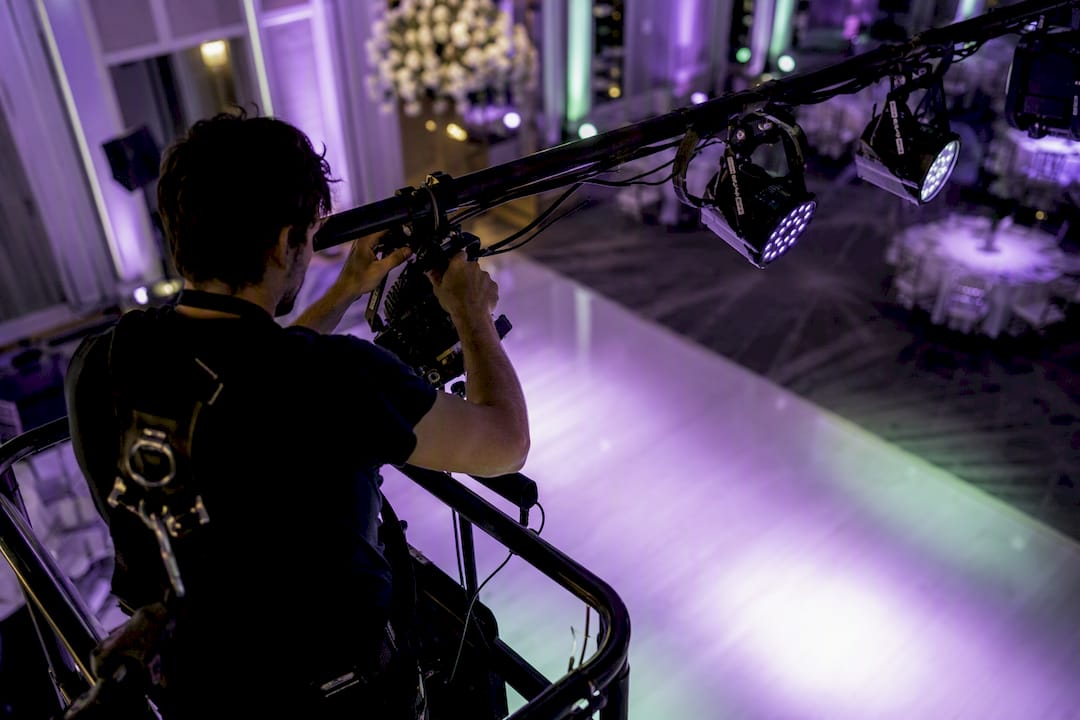
A minute-by-minute run-of-show is the single document that keeps your event lead, AV team, and MC synchronized. Without it, even well-planned events drift.
| Role | Primary responsibility |
|---|---|
| Event lead | Overall timeline ownership and vendor coordination |
| Stage manager | Cues speakers, manages transitions |
| AV lead | Sound, lighting, and technical troubleshooting |
| Emcee | Guides the room through the programme |
| Floor manager(s) | Guest flow, seating issues, on-the-ground fixes |
• Schedule your technical rehearsal the day before, not the morning of.
• Circulate a vendor contact list and emergency contacts to every staffer, not just the event lead.
• Confirm load-in windows with every vendor 48 hours ahead to catch scheduling conflicts early.
A short post-event report tells you whether the money was well spent and gives HR or leadership something concrete for next year’s planning.
• Track attendance rate against RSVPs, budget variance against your original ceiling, and a simple satisfaction score from a post-event survey.
• Ask three pointed questions: what worked, what should change, and would they recommend the venue or vendors again.
• Compile findings into a one-page report with a clear recommendation for next year.
A full-service package typically bundles venue coordination, AV and sound, DJ or live entertainment, photo booth rentals, and setup and breakdown into one scope of work. That bundling matters most when you’re managing a large guest list on a tight timeline with limited internal staff.
• Ask any vendor for a written scope of work covering delivery windows, setup time, and breakdown responsibility.
• Confirm who owns technical troubleshooting during the event, not just who delivers the equipment.
• Verify insurance coverage and a named on-site point of contact for the night.
Porcci NYC’s approach to bundling entertainment and AV reflects how most turnkey providers structure their packages: one point of contact instead of five separate vendor relationships.
Pro Tip: Ask any turnkey provider what happens if a piece of equipment fails mid-event. A vendor with backup gear on-site is worth more than one offering the lowest quote.
Guests arriving late or frustrated before they’ve even found a seat sets the wrong tone for the entire night, and transportation is where that first impression gets made or broken.
Confirm parking capacity with your venue well before you finalize the guest list. A venue with 150 seats and 40 parking spots forces guests into a scramble for street parking or nearby garages, and that friction shows up in your post-event feedback even when the programme itself goes flawlessly.
If your venue sits in a dense urban area, coordinate with nearby parking garages for discounted or validated rates and communicate those details in your event invitation, not as a last-minute email. For larger events, chartered shuttle service from a central pickup point, such as your office or a nearby transit hub, removes the parking question entirely and gives you control over arrival timing.
Build a buffer into your run-of-show for staggered arrivals. Guests using rideshare services or public transit rarely arrive in a tight window, and cocktail hour naturally absorbs that spread if you’ve planned for it. Assign a staffer near the entrance during the first 30 to 45 minutes specifically to direct arriving guests, whether that means pointing them to valet, a shuttle drop-off, or the coat check.
Don’t overlook accessibility. Confirm accessible parking spots and a step-free entrance path with your venue contact, and note this on your event communications so guests who need it know what to expect before they arrive. Vendors delivering AV or décor equipment need their own loading window too, ideally scheduled before guest parking opens, so trucks and guest vehicles never compete for the same curb space.
Every corporate event, regardless of size, needs a basic safety plan that staff can execute without hesitation if something goes wrong.
Start with the venue’s own emergency procedures. Every venue has fire exits, evacuation routes, and an emergency contact for building management, and your event lead should walk that route personally during the site visit rather than relying on a floor plan alone. Share this information with your stage manager, floor managers, and MC so at least three people on your team know the evacuation plan cold.
Build a printed emergency contact sheet that includes venue security, building management, the nearest hospital, and local emergency services, and distribute it to every staffer working the event, not just the event lead. Digital documents fail when phones die or WiFi drops; a laminated card in every staffer’s pocket does not.
Assign a designated first-aid contact, whether that’s a staff member with training or confirmation that venue security has a certified responder on-site. For events serving alcohol, brief bartenders and floor managers on your protocol for overserved guests, including how to arrange safe transportation home.
Weather matters more than most planners assume, particularly for events with outdoor components like a terrace cocktail hour. Have a covered backup space identified and communicated to catering and AV vendors in advance, not improvised in the moment.
Finally, walk through your AV setup for basic electrical safety. Taped-down cables, clear paths around staging, and a backup power source protect against the kind of small incident that can derail an otherwise perfect night.
Two audiences need two different communication tracks, and conflating them is one of the most common planning mistakes.
Internal stakeholders, meaning your executive sponsor, HR, and finance contact, need regular checkpoints tied to your planning timeline rather than one big update at the end. A brief email at each major milestone (venue locked, budget confirmed, entertainment booked, final headcount) keeps leadership informed without requiring meetings you don’t have time for. If your event ties to specific business objectives like recognition or retention, loop HR in early enough that they can align messaging around awards or milestones being celebrated.
Attendee communication follows a different rhythm. Save-the-dates should go out as soon as the venue and date are locked, ideally alongside your entertainment booking window. The formal invitation, sent roughly six to eight weeks out, should include the dress code, parking or transportation details, RSVP deadline, and a dietary accommodations request built directly into the RSVP form rather than as a follow-up email.
Send a reminder communication one week before the event confirming start time, address, and any last details like weather contingencies or a shuttle schedule. This is also the moment to flag any changes, such as a venue room swap or updated parking instructions, so no guest arrives working from outdated information.
For the day itself, a short text or email the morning of with venue address, parking notes, and a point-of-contact phone number reduces the volume of last-minute questions your event lead has to field while also trying to manage vendor load-in.
Not every corporate dinner dance is fully in-person anymore, especially for companies with distributed teams who can’t justify flying everyone in for one night.
If you’re including remote participants, decide early whether their involvement is a live stream of the formal programme or a separate, standalone virtual component. Trying to livestream the entire evening, including open dancing, rarely works. It’s awkward for remote viewers and distracting for in-person guests. Instead, stream the segments with real content value: awards, leadership remarks, or a video tribute reel, and let the dance floor portion stay an in-person-only experience.
Send remote participants a small care package ahead of time, timed to arrive the same week as the event, so they have something tangible tied to the celebration even if they’re watching from home. A branded item paired with a small treat goes further than a generic Zoom link.
If your programme includes an awards segment, find a way to name remote team members alongside in-person recognition rather than treating them as an afterthought mentioned separately. Reading names aloud, whether the person is in the room or watching a stream, matters more to morale than the format of how they’re included.
Keep the virtual segment’s runtime tight, under 20 minutes if possible. Remote attendees watching a livestream lose engagement fast once the content shifts to open dancing and informal mingling that doesn’t translate well on screen.
Late venue booking, weak AV choices, and overloaded programmes sink more events than bad weather ever does. Book the room first, budget AV properly, and protect dance floor time over cramming in one more speech.
If you’re managing a large headcount on a tight timeline, or if your AV and entertainment needs are complex enough to require multiple vendors talking to each other, hiring a turnkey provider saves both time and risk. Coordinating a DJ, a photo booth company, an AV rental house, and event staff separately means five contracts, five delivery windows, and five points of potential failure on the same night.
Porcci NYC handles this differently by consolidating DJ services, AV and sound system rentals, and photo booth rentals under one point of contact, with delivery, setup, and breakdown included rather than negotiated separately with each vendor. That means one contract, one insurance certificate, and one team accountable for the whole night’s production, instead of you playing project manager between five companies who’ve never worked together.
If you’re planning a corporate dinner dance in NYC or New Jersey and want a straightforward quote, request pricing for your event date and include your headcount, venue, and target date so the quote comes back accurate the first time.
For building your own timeline, the 12-week planning checklist and sample run-of-show breakdown referenced above work as adaptable templates rather than rigid scripts. If your organization operates outside the timelines cited here, adjust booking lead times to your local venue market but keep the milestone sequence itself intact.
• Dinner and Dance Singapore Guide 2026: Themes, Venues, Costs
• How to Plan a Corporate Dinner and Dance in Singapore | Venuerific
• Blog
Start by setting objectives and budget, lock a venue six to twelve months out for popular dates, then build a week-by-week checklist covering catering, entertainment, and AV through a final technical rehearsal the day before.
Place the first dance or formal opening right after dinner service and before lengthy speeches, so the room transitions from eating into celebration mode without losing energy.
Venue and food and beverage typically account for 50 to 60 percent of a total dinner dance budget, with AV, décor, and entertainment splitting most of the remainder.
Keep speeches, awards, and entertainment highlights to roughly 60 to 75 minutes within a 4-hour event, leaving the rest of the night for dinner service and open dancing.
A turnkey provider like Porcci NYC works best for large headcounts or tight timelines, since bundling DJ services, AV, and photo booth rentals under one contact reduces coordination risk versus managing several vendors independently.
Learn how to successfully organize a corporate dinner dance with our essential planner checklist, ensuring a memorable event from start to finish.
Start six months out. Lock the date, define your objectives, and shortlist venues in the first two weeks.
Here’s what deserves your attention this week:
• Objectives: recognition, team building, or client entertainment each demand a different format.
• Headcount band: get a working range now, even before RSVPs open, so venue capacity isn’t guesswork.
• Per head budget: set a floor and ceiling before you call a single vendor.
Venue and food and beverage typically eat up 50 to 60 percent of a Dinner & Dance budget, so that’s the number to anchor your whole spreadsheet around.
Pro Tip: Book your venue before you finalize the guest list. Popular rooms disappear faster than headcount estimates firm up, and you can always adjust catering counts later.
A successful corporate dinner dance depends on locking objectives, venue, and budget in the first two weeks, then following a strict week-by-week timeline through event day.
| Point | Details |
|---|---|
| Start with objectives | Recognition, team building, or client entertainment each dictate format, formality, and budget allocation. |
| Budget venue and F&B first | These two line items typically consume 50 to 60 percent of total spend. |
| Cap the formal programme | Keep speeches, awards, and entertainment highlights to 60 to 75 minutes total. |
| Build a written run-of-show | Minute-by-minute cues keep the event lead, MC, and AV team synchronized on the night. |
| Consider a turnkey provider | Porcci NYC bundles AV, DJ services, and photo booth rentals under one contract for planners managing tight timelines. |
• Key Decisions to Settle Before You Plan a Corporate Dinner Dance
• Planning Timeline: What to Do 12 Weeks Out vs. 12 Months Out
• How Do You Structure the Programme and Entertainment?
• Catering, Service Style, and Dietary Accommodations
• What Should Be on Your Venue and AV Checklist?
• Run-of-Show and Day-of Staffing Roles
• How Do You Measure Whether the Event Succeeded?
• What Does a Turnkey Package Actually Include?
• Transportation and Parking Logistics for Guests
• Safety and Emergency Protocols Planning
• Communication Plan for Internal Stakeholders and Attendees
• Tips for Engaging Remote or Hybrid Participants
• When Should You Hire a Turnkey Event Provider?
• Sources
• FAQ
Every downstream choice, from venue square footage to whether you hire a live band, traces back to a handful of decisions you should nail down first. Skip this step and you’ll find yourself redoing a floorplan three weeks before the event.
• Objectives first: a night meant to reward top performers looks different from one meant to build cross-department relationships. Recognition-focused events often need a stage, an awards segment, and tighter run-of-show control. Team-building nights lean toward informal seating and more dance floor time.
• Audience mix: leadership, plus-ones, and rank-and-file employees together change your formality level and seating logic.
• Budget ceiling: decide it before venue tours, not after. Once you fall for a ballroom you can’t afford, every later decision compromises to fit that mistake.
• F&B and entertainment follow objectives: a formal recognition dinner justifies plated service and a live band; a casual team celebration works fine with stations and a DJ.
Pro Tip: Write your objectives on the RFP you send vendors. A caterer or AV company that understands the event’s purpose will make better recommendations than one just quoting a generic package.
The single biggest driver of event-day chaos is a compressed timeline. Popular venues for Q4 events often book six to twelve months in advance, so if you’re targeting a November or December date, your search needs to start well before summer.
If you’re starting later than that, a condensed 12-week window still works, provided you follow a strict week-by-week checklist that locks headcount, finalizes the run-of-show by week three, and schedules a full technical rehearsal the day before doors open.
| Timeframe | Key milestones |
|---|---|
| 8 to 12 months out | Confirm objectives, lock venue, set budget ceiling |
| — | Book entertainment, caterer, AV vendor; send save-the-dates |
| 12 weeks out | Finalize menu, confirm dietary collection process, draft run-of-show |
| one-month mark | Confirm headcount, send vendor briefs, review floorplan |
| Week of event | Technical rehearsal, staff briefing, final vendor confirmations |
For a standard 4-hour dinner dance, build your evening around this rough shape:
• Arrival and cocktail hour: 30 to 45 minutes
• Dinner service: 60 to 75 minutes
• Programme (speeches, awards, entertainment highlight): 60 to 75 minutes
• Open dance floor and social time: remainder of the evening
Keep formal programming tight. Guidance from Get Out! Events recommends capping the structured portion at 60 to 75 minutes total, leaving the rest of the night for dancing and mingling. Tie vendor payment schedules to these same milestones: deposit at booking, balance due at the one-month mark, and a final walkthrough signoff the week of.
The programme lives or dies on pacing, not production value. An MC who keeps transitions tight and a first dance or formal opening that lands at the right moment will do more for guest energy than an expensive stage building.
• MC role: a good emcee moves the room through transitions in seconds, not minutes, and never lets dead air build between segments.
• Entertainment set lengths: live bands typically play in 45 to 60 minute sets with breaks; DJs run continuous but should build in a planned high-energy segment before the natural post-dinner lull.
• First dance or formal opening: place it right after dinner service, before speeches drag energy down, so the room transitions from eating to celebrating without a cold stretch.
• Music pacing: live music programming that builds from mid-tempo to high-energy tracks fills a dance floor far more reliably than starting at full intensity and hoping guests catch up.
Pro Tip: Brief your MC on speech order and length in writing. Business dinner etiquette experts note that keeping remarks brief and sequenced prevents the programme from bloating past its allotted window.
Plated service gives you tighter timing control and a more formal feel, but it costs more and needs more waitstaff. Buffets and stations move guests around, extend service time, and can actually work better for team-building events where mingling is the goal.
• Collect dietary requirements at RSVP, not at check-in. Categorize them (vegetarian, allergies, religious restrictions) in a shared spreadsheet.
• Submit a consolidated dietary brief to your caterer by week three, not the week of the event.
• Watch for venue food and beverage minimums. These catch planners off guard more than any other line item.
• Brief servers on which tables have dietary needs before doors open, not mid-service.
Food and beverage combined with venue costs typically consume 50 to 60 percent of a total dinner dance budget, with AV and staging running 10 to 15 percent and entertainment another 8 to 12 percent.
Venue selection isn’t just about capacity. Load-in access, in-house AV capabilities, and parking logistics determine whether your production runs smoothly or whether your AV vendor spends an hour just getting gear through a service elevator.
• Confirm load-in windows and freight elevator access before signing a contract.
• Ask what AV is already in-house versus what you’ll need to rent separately.
• Check food and beverage minimums against your projected headcount and budget.
• Verify parking availability and proximity for guest and vendor vehicles.
| Checklist item | Why it matters |
|---|---|
| Load-in access | Determines how much lead time your AV and décor vendors need |
| In-house AV | Avoids double-renting equipment the venue already has |
| Dance floor placement | Affects sightlines, sound bleed, and traffic flow |
| Backup power/redundancy | Prevents a blown fuse from killing the DJ set mid-song |
Décor choices that require extensive rigging or custom lighting extend your load-in window, so coordinate décor and AV timelines together rather than treating them as separate vendor conversations. A well-planned floorplan keeps dance floor placement central enough to draw people in without blocking service paths.
A minute-by-minute run-of-show is the single document that keeps your event lead, AV team, and MC synchronized. Without it, even well-planned events drift.
| Role | Primary responsibility |
|---|---|
| Event lead | Overall timeline ownership and vendor coordination |
| Stage manager | Cues speakers, manages transitions |
| AV lead | Sound, lighting, and technical troubleshooting |
| Emcee | Guides the room through the programme |
| Floor manager(s) | Guest flow, seating issues, on-the-ground fixes |
• Schedule your technical rehearsal the day before, not the morning of.
• Circulate a vendor contact list and emergency contacts to every staffer, not just the event lead.
• Confirm load-in windows with every vendor 48 hours ahead to catch scheduling conflicts early.
A short post-event report tells you whether the money was well spent and gives HR or leadership something concrete for next year’s planning.
• Track attendance rate against RSVPs, budget variance against your original ceiling, and a simple satisfaction score from a post-event survey.
• Ask three pointed questions: what worked, what should change, and would they recommend the venue or vendors again.
• Compile findings into a one-page report with a clear recommendation for next year.
A full-service package typically bundles venue coordination, AV and sound, DJ or live entertainment, photo booth rentals, and setup and breakdown into one scope of work. That bundling matters most when you’re managing a large guest list on a tight timeline with limited internal staff.
• Ask any vendor for a written scope of work covering delivery windows, setup time, and breakdown responsibility.
• Confirm who owns technical troubleshooting during the event, not just who delivers the equipment.
• Verify insurance coverage and a named on-site point of contact for the night.
Porcci NYC’s approach to bundling entertainment and AV reflects how most turnkey providers structure their packages: one point of contact instead of five separate vendor relationships.
Pro Tip: Ask any turnkey provider what happens if a piece of equipment fails mid-event. A vendor with backup gear on-site is worth more than one offering the lowest quote.
Guests arriving late or frustrated before they’ve even found a seat sets the wrong tone for the entire night, and transportation is where that first impression gets made or broken.
Confirm parking capacity with your venue well before you finalize the guest list. A venue with 150 seats and 40 parking spots forces guests into a scramble for street parking or nearby garages, and that friction shows up in your post-event feedback even when the programme itself goes flawlessly.
If your venue sits in a dense urban area, coordinate with nearby parking garages for discounted or validated rates and communicate those details in your event invitation, not as a last-minute email. For larger events, chartered shuttle service from a central pickup point, such as your office or a nearby transit hub, removes the parking question entirely and gives you control over arrival timing.
Build a buffer into your run-of-show for staggered arrivals. Guests using rideshare services or public transit rarely arrive in a tight window, and cocktail hour naturally absorbs that spread if you’ve planned for it. Assign a staffer near the entrance during the first 30 to 45 minutes specifically to direct arriving guests, whether that means pointing them to valet, a shuttle drop-off, or the coat check.
Don’t overlook accessibility. Confirm accessible parking spots and a step-free entrance path with your venue contact, and note this on your event communications so guests who need it know what to expect before they arrive. Vendors delivering AV or décor equipment need their own loading window too, ideally scheduled before guest parking opens, so trucks and guest vehicles never compete for the same curb space.
Every corporate event, regardless of size, needs a basic safety plan that staff can execute without hesitation if something goes wrong.
Start with the venue’s own emergency procedures. Every venue has fire exits, evacuation routes, and an emergency contact for building management, and your event lead should walk that route personally during the site visit rather than relying on a floor plan alone. Share this information with your stage manager, floor managers, and MC so at least three people on your team know the evacuation plan cold.
Build a printed emergency contact sheet that includes venue security, building management, the nearest hospital, and local emergency services, and distribute it to every staffer working the event, not just the event lead. Digital documents fail when phones die or WiFi drops; a laminated card in every staffer’s pocket does not.
Assign a designated first-aid contact, whether that’s a staff member with training or confirmation that venue security has a certified responder on-site. For events serving alcohol, brief bartenders and floor managers on your protocol for overserved guests, including how to arrange safe transportation home.
Weather matters more than most planners assume, particularly for events with outdoor components like a terrace cocktail hour. Have a covered backup space identified and communicated to catering and AV vendors in advance, not improvised in the moment.
Finally, walk through your AV setup for basic electrical safety. Taped-down cables, clear paths around staging, and a backup power source protect against the kind of small incident that can derail an otherwise perfect night.
Two audiences need two different communication tracks, and conflating them is one of the most common planning mistakes.
Internal stakeholders, meaning your executive sponsor, HR, and finance contact, need regular checkpoints tied to your planning timeline rather than one big update at the end. A brief email at each major milestone (venue locked, budget confirmed, entertainment booked, final headcount) keeps leadership informed without requiring meetings you don’t have time for. If your event ties to specific business objectives like recognition or retention, loop HR in early enough that they can align messaging around awards or milestones being celebrated.
Attendee communication follows a different rhythm. Save-the-dates should go out as soon as the venue and date are locked, ideally alongside your entertainment booking window. The formal invitation, sent roughly six to eight weeks out, should include the dress code, parking or transportation details, RSVP deadline, and a dietary accommodations request built directly into the RSVP form rather than as a follow-up email.
Send a reminder communication one week before the event confirming start time, address, and any last details like weather contingencies or a shuttle schedule. This is also the moment to flag any changes, such as a venue room swap or updated parking instructions, so no guest arrives working from outdated information.
For the day itself, a short text or email the morning of with venue address, parking notes, and a point-of-contact phone number reduces the volume of last-minute questions your event lead has to field while also trying to manage vendor load-in.
Not every corporate dinner dance is fully in-person anymore, especially for companies with distributed teams who can’t justify flying everyone in for one night.
If you’re including remote participants, decide early whether their involvement is a live stream of the formal programme or a separate, standalone virtual component. Trying to livestream the entire evening, including open dancing, rarely works. It’s awkward for remote viewers and distracting for in-person guests. Instead, stream the segments with real content value: awards, leadership remarks, or a video tribute reel, and let the dance floor portion stay an in-person-only experience.
Send remote participants a small care package ahead of time, timed to arrive the same week as the event, so they have something tangible tied to the celebration even if they’re watching from home. A branded item paired with a small treat goes further than a generic Zoom link.
If your programme includes an awards segment, find a way to name remote team members alongside in-person recognition rather than treating them as an afterthought mentioned separately. Reading names aloud, whether the person is in the room or watching a stream, matters more to morale than the format of how they’re included.
Keep the virtual segment’s runtime tight, under 20 minutes if possible. Remote attendees watching a livestream lose engagement fast once the content shifts to open dancing and informal mingling that doesn’t translate well on screen.
Late venue booking, weak AV choices, and overloaded programmes sink more events than bad weather ever does. Book the room first, budget AV properly, and protect dance floor time over cramming in one more speech.
If you’re managing a large headcount on a tight timeline, or if your AV and entertainment needs are complex enough to require multiple vendors talking to each other, hiring a turnkey provider saves both time and risk. Coordinating a DJ, a photo booth company, an AV rental house, and event staff separately means five contracts, five delivery windows, and five points of potential failure on the same night.
Porcci NYC handles this differently by consolidating DJ services, AV and sound system rentals, and photo booth rentals under one point of contact, with delivery, setup, and breakdown included rather than negotiated separately with each vendor. That means one contract, one insurance certificate, and one team accountable for the whole night’s production, instead of you playing project manager between five companies who’ve never worked together.
If you’re planning a corporate dinner dance in NYC or New Jersey and want a straightforward quote, request pricing for your event date and include your headcount, venue, and target date so the quote comes back accurate the first time.
For building your own timeline, the 12-week planning checklist and sample run-of-show breakdown referenced above work as adaptable templates rather than rigid scripts. If your organization operates outside the timelines cited here, adjust booking lead times to your local venue market but keep the milestone sequence itself intact.
• Dinner and Dance Singapore Guide 2026: Themes, Venues, Costs
• How to Plan a Corporate Dinner and Dance in Singapore | Venuerific
• Blog
Start by setting objectives and budget, lock a venue six to twelve months out for popular dates, then build a week-by-week checklist covering catering, entertainment, and AV through a final technical rehearsal the day before.
Place the first dance or formal opening right after dinner service and before lengthy speeches, so the room transitions from eating into celebration mode without losing energy.
Venue and food and beverage typically account for 50 to 60 percent of a total dinner dance budget, with AV, décor, and entertainment splitting most of the remainder.
Keep speeches, awards, and entertainment highlights to roughly 60 to 75 minutes within a 4-hour event, leaving the rest of the night for dinner service and open dancing.
A turnkey provider like Porcci NYC works best for large headcounts or tight timelines, since bundling DJ services, AV, and photo booth rentals under one contact reduces coordination risk versus managing several vendors independently.