Discover the key difference between indoor and outdoor events. Learn how each venue type impacts planning, logistics, and guest experiences.
TL;DR:
• Indoor events benefit from climate control and built-in infrastructure, offering predictability and comfort. Outdoor events require extensive contingency planning, additional equipment, and often higher costs due to environmental variables. Success depends on early preparation, matching environment demands, and thorough risk management.
The primary difference between indoor and outdoor events is environment control. Indoor events take place in enclosed, climate-regulated spaces with built-in infrastructure, while outdoor events occur in open-air settings where weather, terrain, and power supply become active planning variables. Understanding this distinction shapes every decision you make, from your AV equipment list to your contingency budget. Whether you are planning a corporate gala at a Manhattan ballroom or a summer festival in a New Jersey park, the venue type determines your logistics, your costs, and your guest experience.
The core distinction is control. Indoor venues protect events from rain, wind, and temperature extremes, enabling reliable scheduling and predictable setup conditions. Outdoor venues offer natural scenery and open space, but they introduce variables that require contingency planning at every stage.
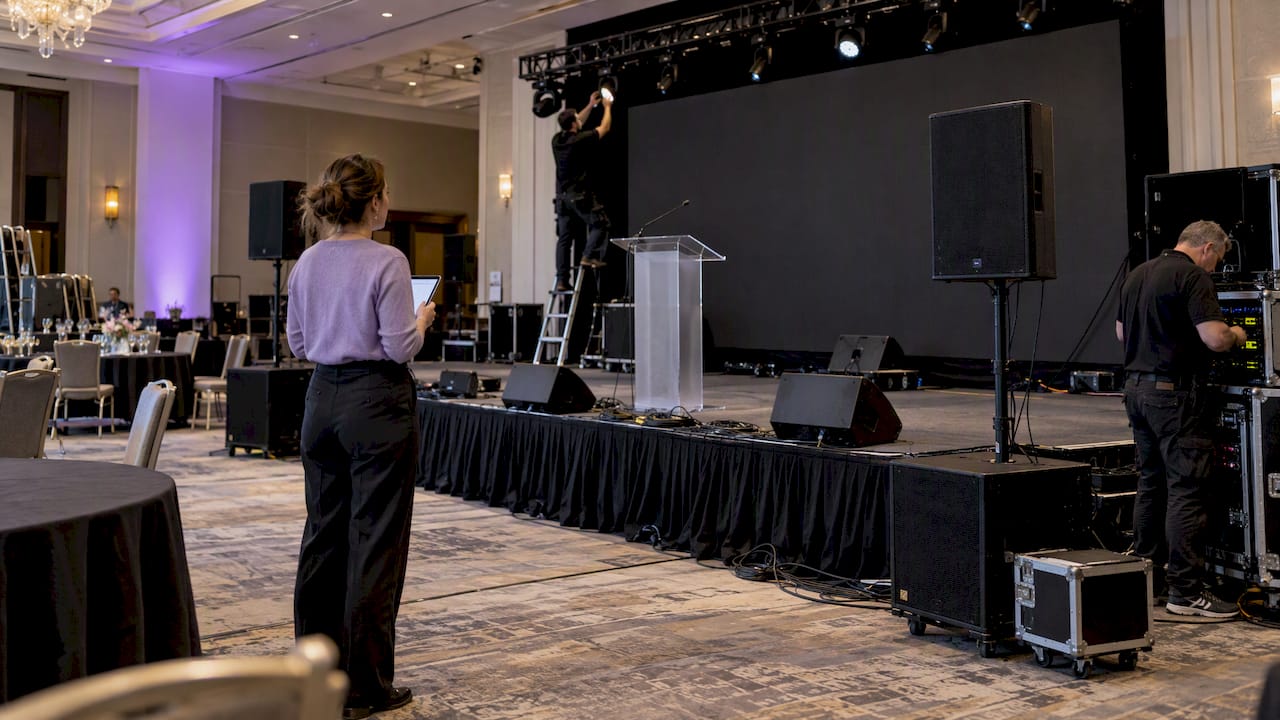
Indoor events operate within fixed walls, ceilings, and floors. That structure provides acoustic containment, electrical access, and climate control. Outdoor events rely on temporary infrastructure for all three. The planning effort required outdoors is fundamentally higher, not because outdoor events are harder to enjoy, but because the environment does not cooperate automatically.
Sound regulations also differ by setting. Many urban locations, including areas across New York City and New Jersey, enforce noise ordinances that limit amplified music outdoors after 11 PM. Indoor venues typically operate within building codes that already account for sound containment, reducing compliance risk.
Weather is the most consequential variable separating indoor and outdoor event planning. Indoors, climate control is a given. Outdoors, you plan around it or plan for failure.
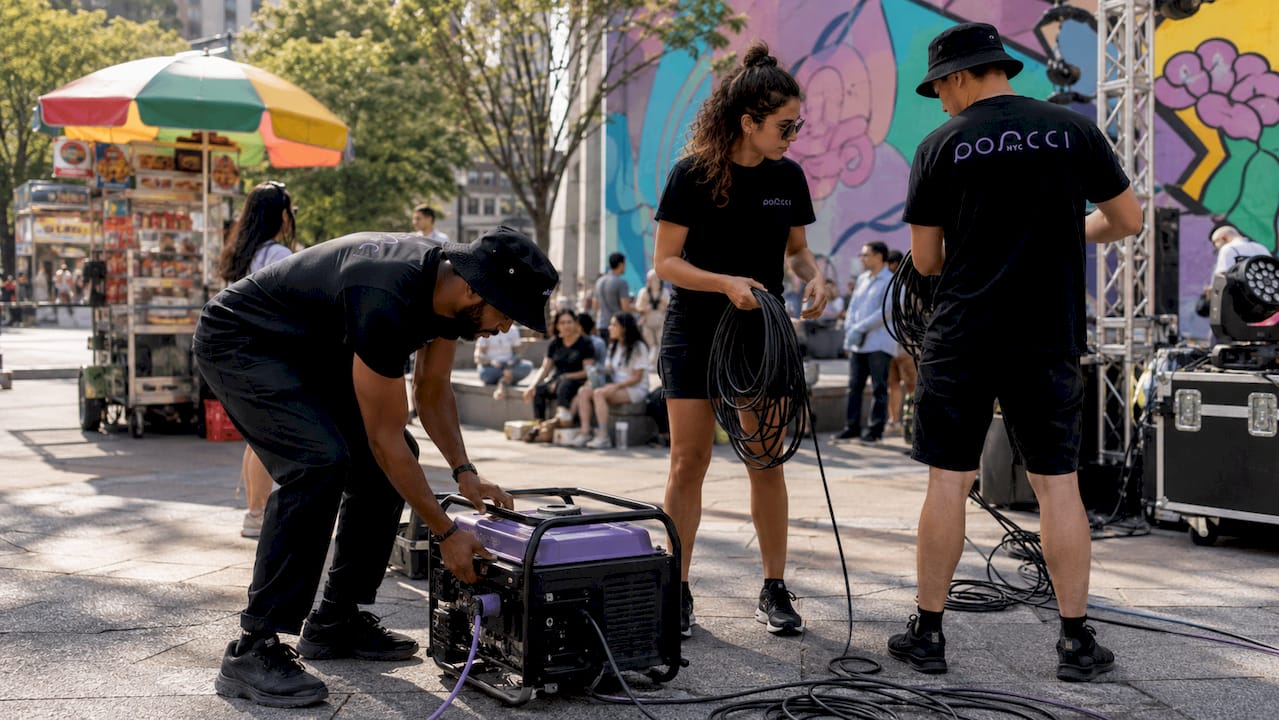
Sound behaves differently in each setting. Enclosed spaces reflect and contain audio, so a standard PA system covers the room efficiently. Open-air environments absorb and scatter sound. Outdoor PA systems require 2 to 3 times the power of indoor setups to achieve comparable coverage. That difference alone changes your equipment rental budget significantly.

Lighting control follows the same pattern. Indoor venues give you a blank canvas: blackout curtains, fixed rigging points, and consistent ambient conditions. Outdoor events compete with sunlight, shifting shadows, and sunset timing. For detailed guidance on adapting lighting to both settings, Porcci NYC’s event lighting tips cover venue-specific approaches across NYC and New Jersey.
Power access is another dividing line. Indoor venues provide hardwired electrical panels. Outdoor venues often require generator rentals, fuel logistics, and load calculations. Outdoor venues frequently prohibit tent-staking in the ground, requiring heavier ballast systems that increase both rental costs and setup time.
| Factor | Indoor events | Outdoor events |
|---|---|---|
| Weather exposure | None | Full exposure, contingency required |
| Sound containment | Natural acoustic reflection | Requires 2–3x PA power |
| Lighting control | Full control, fixed rigging | Competes with natural light |
| Power supply | Hardwired panels | Generator rental needed |
| Ground anchoring | Standard staking | Ballast systems required |
| Setup time | Fixed move-in windows | Weather delays add 30%+ time |
Pro Tip: Book your generator and ballast equipment at least six weeks before an outdoor event. Both items run short in peak summer season across the NYC and New Jersey market.
Outdoor events often appear cheaper at first glance because open-air site fees are lower than ballroom or conference center rates. That gap closes fast once you account for the infrastructure you must bring in yourself.
Weather contingency plans add $3,000 to $15,000 to outdoor event budgets. Tenting, heating and cooling units, portable flooring, and generator fuel are all line items that indoor venues absorb into their base rate. For a realistic view of total costs, Porcci NYC’s event budget planning guide walks through both indoor and outdoor scenarios with full infrastructure breakdowns.
Indoor setups require union labor coordination in many venues, including inspections and strict move-in windows. That adds predictability to your schedule but limits flexibility. Outdoor setups allow more flexible labor arrangements, though weather delays add over 30% to setup time compared to fixed indoor move-in windows.
| Cost category | Indoor events | Outdoor events |
|---|---|---|
| Venue site fee | Higher base rate | Lower base rate |
| Tenting and flooring | Not needed | $2,000–$10,000+ |
| Power infrastructure | Included | Generator rental required |
| Weather contingency | Minimal | $3,000–$15,000 |
| Labor structure | Union-regulated, predictable | Flexible but weather-dependent |
Modeling both scenarios early is the most effective way to avoid budget overruns. Planners who compare indoor and outdoor budgets side by side before committing to a venue consistently make more informed decisions.
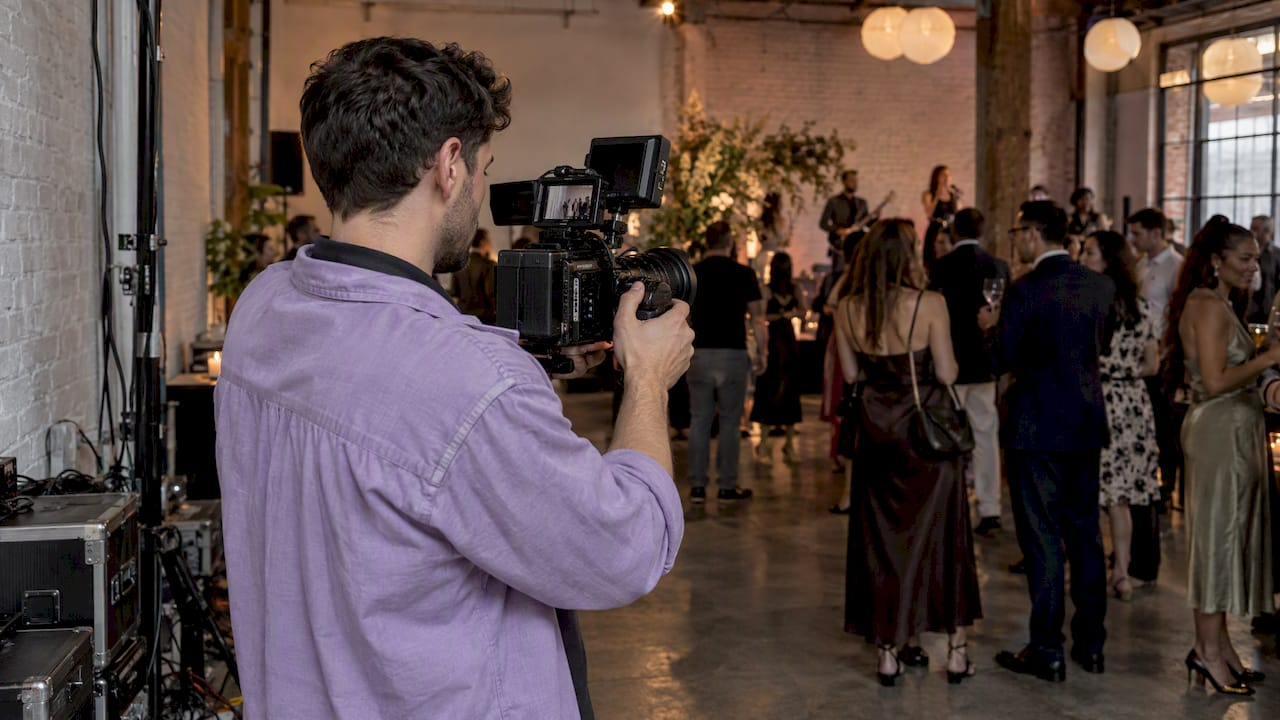
Guest comfort and event atmosphere vary sharply between the two settings. Indoor events deliver consistent temperature, controlled acoustics, and predictable flow. Guests move through corridors, find seating easily, and stay comfortable regardless of the season.
Outdoor events offer natural ambiance and open-air energy that no indoor environment can replicate. That quality makes outdoor settings the preferred choice for social celebrations, cultural festivals, and community gatherings. The trade-off is exposure. Sun, wind, insects, and uneven terrain all affect attendee comfort and require active mitigation through shade structures, cooling stations, heaters, and blankets.
Scale also affects perception differently indoors versus outdoors. Indoor events over 500 attendees can feel institutional rather than refined, while outdoor events at the same size tend to feel more open and social. Corporate meetings and formal presentations favor indoor settings for focus and control. Team-building events, product launches, and celebrations often benefit from the energy of an outdoor venue.
• Corporate meetings and conferences: indoor settings provide focus and formality
• Weddings and social celebrations: outdoor settings deliver atmosphere and natural beauty
• Team-building events: outdoor venues encourage movement and informal bonding
• Bar and bat mitzvahs, private parties: indoor venues offer reliable comfort and AV control
Pro Tip: At outdoor events, perceived walking distance feels longer than it measures on a map due to terrain and the absence of corridors. Place signage, water stations, and rest areas more frequently than you think you need to.
Entertainment production is where the indoor versus outdoor gap becomes most technical. Indoor venues typically include built-in AV infrastructure: rigging points, electrical panels, and acoustic treatment. You plug in, calibrate, and perform.
Outdoor events require you to build that infrastructure from scratch. Sound systems need significantly more power to compensate for open-air dissipation. Lighting rigs must account for daylight competition and shifting sunset angles. For a full breakdown of outdoor staging requirements, Porcci NYC’s guide to outdoor stage setup covers everything from ballast anchoring to power load planning.
Key technical differences to plan for:
• Sound: Outdoor PA systems require 2–3x the power of indoor equivalents
• Lighting: Outdoor rigs must account for natural light and sunset timing
• Staging: Ballast systems replace ground stakes, increasing weight and rental cost
• Power: Generators replace hardwired panels, requiring fuel and load management
• Noise compliance: Urban noise ordinances cap outdoor amplified sound, often at 11 PM
The difference between indoor and outdoor events comes down to one principle: indoor venues provide the infrastructure, while outdoor venues require you to bring it.
| Point | Details |
|---|---|
| Environment control | Indoor venues eliminate weather risk; outdoor events require full contingency planning from day one. |
| Sound and power | Outdoor PA systems need 2–3x more power, and generators replace hardwired panels at open-air venues. |
| Budget reality | Outdoor site fees appear lower but weather contingency alone can add $3,000–$15,000 to total costs. |
| Guest experience | Indoor settings favor focus and comfort; outdoor settings deliver atmosphere but require active comfort management. |
| Technical setup | Indoor venues include built-in AV infrastructure; outdoor events require temporary staging and ballast systems. |
The most common mistake planners make with outdoor events is treating weather as a risk to manage rather than a condition to design around. We’ve seen well-funded outdoor events fall apart not because of rain, but because the contingency plan was an afterthought added two weeks before the date.
The planners who succeed outdoors build their weather call strategy, backup layout, and tenting plan on day one of production. They don’t wait for a forecast. They design the event to function in two weather scenarios from the start. That mindset shift changes everything, from how you position the stage to how you schedule vendor arrivals.
Indoor events carry their own underestimated challenge: union labor timelines and venue move-in windows are rigid. If your AV team arrives 30 minutes late, you may lose your load-in slot entirely. We’ve watched technically flawless events get compressed into half the setup time because the planner assumed flexibility that the venue contract did not allow.
The honest truth is that neither venue type is universally better. Success in both settings comes from preparation that matches the environment’s actual demands, not the environment you wish you had booked.
— PORCCI
Whether your next event is in a Manhattan ballroom or an open-air venue in New Jersey, Porcci NYC provides the technical equipment and staffing to handle both settings. Our AV and sound system rentals include PA systems scaled for both indoor acoustics and outdoor dissipation, with generator-compatible configurations available for open-air setups. We handle delivery, setup, and breakdown so your focus stays on your guests. From corporate conferences to outdoor festivals, Porcci NYC’s team brings the right equipment for the right environment. Request a quote and tell us your venue type. We’ll build the right package from there.
Indoor events take place in enclosed, climate-controlled spaces with built-in power and AV infrastructure. Outdoor events occur in open-air settings where weather, power supply, and sound dissipation require additional planning and equipment.
Outdoor events often have lower site fees but higher total costs. Weather contingency planning, tenting, generators, and ballast systems can add $3,000 to $15,000 to an outdoor event budget.
Outdoor PA systems require roughly 2 to 3 times the power of indoor setups because open-air environments dissipate sound rather than containing it within walls.
Indoor venues are the stronger choice for corporate meetings. They provide controlled acoustics, consistent temperature, and predictable AV setups that support presentations and focused discussion.
Build your weather contingency plan, tenting layout, and backup schedule from the first day of production planning. Waiting until the week of the event leaves too little time to adjust vendor contracts and equipment orders.
Discover the key difference between indoor and outdoor events. Learn how each venue type impacts planning, logistics, and guest experiences.
TL;DR:
• Indoor events benefit from climate control and built-in infrastructure, offering predictability and comfort. Outdoor events require extensive contingency planning, additional equipment, and often higher costs due to environmental variables. Success depends on early preparation, matching environment demands, and thorough risk management.
The primary difference between indoor and outdoor events is environment control. Indoor events take place in enclosed, climate-regulated spaces with built-in infrastructure, while outdoor events occur in open-air settings where weather, terrain, and power supply become active planning variables. Understanding this distinction shapes every decision you make, from your AV equipment list to your contingency budget. Whether you are planning a corporate gala at a Manhattan ballroom or a summer festival in a New Jersey park, the venue type determines your logistics, your costs, and your guest experience.
The core distinction is control. Indoor venues protect events from rain, wind, and temperature extremes, enabling reliable scheduling and predictable setup conditions. Outdoor venues offer natural scenery and open space, but they introduce variables that require contingency planning at every stage.
Indoor events operate within fixed walls, ceilings, and floors. That structure provides acoustic containment, electrical access, and climate control. Outdoor events rely on temporary infrastructure for all three. The planning effort required outdoors is fundamentally higher, not because outdoor events are harder to enjoy, but because the environment does not cooperate automatically.
Sound regulations also differ by setting. Many urban locations, including areas across New York City and New Jersey, enforce noise ordinances that limit amplified music outdoors after 11 PM. Indoor venues typically operate within building codes that already account for sound containment, reducing compliance risk.
Weather is the most consequential variable separating indoor and outdoor event planning. Indoors, climate control is a given. Outdoors, you plan around it or plan for failure.
Sound behaves differently in each setting. Enclosed spaces reflect and contain audio, so a standard PA system covers the room efficiently. Open-air environments absorb and scatter sound. Outdoor PA systems require 2 to 3 times the power of indoor setups to achieve comparable coverage. That difference alone changes your equipment rental budget significantly.
Lighting control follows the same pattern. Indoor venues give you a blank canvas: blackout curtains, fixed rigging points, and consistent ambient conditions. Outdoor events compete with sunlight, shifting shadows, and sunset timing. For detailed guidance on adapting lighting to both settings, Porcci NYC’s event lighting tips cover venue-specific approaches across NYC and New Jersey.
Power access is another dividing line. Indoor venues provide hardwired electrical panels. Outdoor venues often require generator rentals, fuel logistics, and load calculations. Outdoor venues frequently prohibit tent-staking in the ground, requiring heavier ballast systems that increase both rental costs and setup time.
| Factor | Indoor events | Outdoor events |
|---|---|---|
| Weather exposure | None | Full exposure, contingency required |
| Sound containment | Natural acoustic reflection | Requires 2–3x PA power |
| Lighting control | Full control, fixed rigging | Competes with natural light |
| Power supply | Hardwired panels | Generator rental needed |
| Ground anchoring | Standard staking | Ballast systems required |
| Setup time | Fixed move-in windows | Weather delays add 30%+ time |
Pro Tip: Book your generator and ballast equipment at least six weeks before an outdoor event. Both items run short in peak summer season across the NYC and New Jersey market.
Outdoor events often appear cheaper at first glance because open-air site fees are lower than ballroom or conference center rates. That gap closes fast once you account for the infrastructure you must bring in yourself.
Weather contingency plans add $3,000 to $15,000 to outdoor event budgets. Tenting, heating and cooling units, portable flooring, and generator fuel are all line items that indoor venues absorb into their base rate. For a realistic view of total costs, Porcci NYC’s event budget planning guide walks through both indoor and outdoor scenarios with full infrastructure breakdowns.
Indoor setups require union labor coordination in many venues, including inspections and strict move-in windows. That adds predictability to your schedule but limits flexibility. Outdoor setups allow more flexible labor arrangements, though weather delays add over 30% to setup time compared to fixed indoor move-in windows.
| Cost category | Indoor events | Outdoor events |
|---|---|---|
| Venue site fee | Higher base rate | Lower base rate |
| Tenting and flooring | Not needed | $2,000–$10,000+ |
| Power infrastructure | Included | Generator rental required |
| Weather contingency | Minimal | $3,000–$15,000 |
| Labor structure | Union-regulated, predictable | Flexible but weather-dependent |
Modeling both scenarios early is the most effective way to avoid budget overruns. Planners who compare indoor and outdoor budgets side by side before committing to a venue consistently make more informed decisions.
Guest comfort and event atmosphere vary sharply between the two settings. Indoor events deliver consistent temperature, controlled acoustics, and predictable flow. Guests move through corridors, find seating easily, and stay comfortable regardless of the season.
Outdoor events offer natural ambiance and open-air energy that no indoor environment can replicate. That quality makes outdoor settings the preferred choice for social celebrations, cultural festivals, and community gatherings. The trade-off is exposure. Sun, wind, insects, and uneven terrain all affect attendee comfort and require active mitigation through shade structures, cooling stations, heaters, and blankets.
Scale also affects perception differently indoors versus outdoors. Indoor events over 500 attendees can feel institutional rather than refined, while outdoor events at the same size tend to feel more open and social. Corporate meetings and formal presentations favor indoor settings for focus and control. Team-building events, product launches, and celebrations often benefit from the energy of an outdoor venue.
• Corporate meetings and conferences: indoor settings provide focus and formality
• Weddings and social celebrations: outdoor settings deliver atmosphere and natural beauty
• Team-building events: outdoor venues encourage movement and informal bonding
• Bar and bat mitzvahs, private parties: indoor venues offer reliable comfort and AV control
Pro Tip: At outdoor events, perceived walking distance feels longer than it measures on a map due to terrain and the absence of corridors. Place signage, water stations, and rest areas more frequently than you think you need to.
Entertainment production is where the indoor versus outdoor gap becomes most technical. Indoor venues typically include built-in AV infrastructure: rigging points, electrical panels, and acoustic treatment. You plug in, calibrate, and perform.
Outdoor events require you to build that infrastructure from scratch. Sound systems need significantly more power to compensate for open-air dissipation. Lighting rigs must account for daylight competition and shifting sunset angles. For a full breakdown of outdoor staging requirements, Porcci NYC’s guide to outdoor stage setup covers everything from ballast anchoring to power load planning.
Key technical differences to plan for:
• Sound: Outdoor PA systems require 2–3x the power of indoor equivalents
• Lighting: Outdoor rigs must account for natural light and sunset timing
• Staging: Ballast systems replace ground stakes, increasing weight and rental cost
• Power: Generators replace hardwired panels, requiring fuel and load management
• Noise compliance: Urban noise ordinances cap outdoor amplified sound, often at 11 PM
The difference between indoor and outdoor events comes down to one principle: indoor venues provide the infrastructure, while outdoor venues require you to bring it.
| Point | Details |
|---|---|
| Environment control | Indoor venues eliminate weather risk; outdoor events require full contingency planning from day one. |
| Sound and power | Outdoor PA systems need 2–3x more power, and generators replace hardwired panels at open-air venues. |
| Budget reality | Outdoor site fees appear lower but weather contingency alone can add $3,000–$15,000 to total costs. |
| Guest experience | Indoor settings favor focus and comfort; outdoor settings deliver atmosphere but require active comfort management. |
| Technical setup | Indoor venues include built-in AV infrastructure; outdoor events require temporary staging and ballast systems. |
The most common mistake planners make with outdoor events is treating weather as a risk to manage rather than a condition to design around. We’ve seen well-funded outdoor events fall apart not because of rain, but because the contingency plan was an afterthought added two weeks before the date.
The planners who succeed outdoors build their weather call strategy, backup layout, and tenting plan on day one of production. They don’t wait for a forecast. They design the event to function in two weather scenarios from the start. That mindset shift changes everything, from how you position the stage to how you schedule vendor arrivals.
Indoor events carry their own underestimated challenge: union labor timelines and venue move-in windows are rigid. If your AV team arrives 30 minutes late, you may lose your load-in slot entirely. We’ve watched technically flawless events get compressed into half the setup time because the planner assumed flexibility that the venue contract did not allow.
The honest truth is that neither venue type is universally better. Success in both settings comes from preparation that matches the environment’s actual demands, not the environment you wish you had booked.
— PORCCI
Whether your next event is in a Manhattan ballroom or an open-air venue in New Jersey, Porcci NYC provides the technical equipment and staffing to handle both settings. Our AV and sound system rentals include PA systems scaled for both indoor acoustics and outdoor dissipation, with generator-compatible configurations available for open-air setups. We handle delivery, setup, and breakdown so your focus stays on your guests. From corporate conferences to outdoor festivals, Porcci NYC’s team brings the right equipment for the right environment. Request a quote and tell us your venue type. We’ll build the right package from there.
Indoor events take place in enclosed, climate-controlled spaces with built-in power and AV infrastructure. Outdoor events occur in open-air settings where weather, power supply, and sound dissipation require additional planning and equipment.
Outdoor events often have lower site fees but higher total costs. Weather contingency planning, tenting, generators, and ballast systems can add $3,000 to $15,000 to an outdoor event budget.
Outdoor PA systems require roughly 2 to 3 times the power of indoor setups because open-air environments dissipate sound rather than containing it within walls.
Indoor venues are the stronger choice for corporate meetings. They provide controlled acoustics, consistent temperature, and predictable AV setups that support presentations and focused discussion.
Build your weather contingency plan, tenting layout, and backup schedule from the first day of production planning. Waiting until the week of the event leaves too little time to adjust vendor contracts and equipment orders.