Use a 15 minute interview script to vet wedding DJs for a named performer, insurance, backup gear, and playlist control. One page checklist included.
Ask a categorized checklist that tests three things: reliability (insurance, backup gear, a named-performer contract), crowd control (music skill and read-the-room ability), and logistics (setup, timing, pricing). We built this interviewer script from what actually goes wrong at weddings, so you can run a 15-minute call and know within the first few answers whether a DJ deserves your deposit.
TL;DR:
• Confirm the DJ has significant wedding experience and will perform personally, not send an assistant, with proof of insurance and relevant samples.
• Ensure they can handle crowd fluctuations by sharing specific examples of reading the room and adjusting playlists in real time.
• Clarify all costs upfront, including base fee, extra charges, and contractual protections for illness or equipment failure, with written confirmation.
• Verify technical logistics like equipment brand, backup plans, outdoor power options, arrival times, and whether a vendor meal is required.
• Ask about the DJ’s emcee experience, name pronunciation, and communication process with the planner or couple to ensure smooth event coordination.
• Questions to Ask a DJ About Background and Wedding Experience
• Questions to Test Music Style and Playlist Control
• Budget, Packages, and Contract Terms to Nail Down
• Logistics, Equipment, and Backup Plans to Confirm
• Emcee Duties and Vendor Coordination
• Red Flags and a Fast Interviewer Script
• Your One-Page DJ Interview Checklist
• What We’ve Learned Running Weddings Ourselves
• Booking a DJ Who Also Handles Sound, Lighting, and Backup
• Sources
• FAQ
Before you talk playlists, confirm the DJ has actually done this before, and that the person on the call is the person showing up. A DJ who has spun 200 weddings reads a room differently than one who mostly works bars. And a company that sends “one of our team” instead of naming a performer is telling you something about how it runs its business.
Ask directly whether the DJ has significant wedding experience and how long they have worked as a DJ, without specifying exact numbers.
• Will you be the DJ performing at my wedding, or could someone else on your roster be assigned?
• Can I see full-length videos or sample mixes from real weddings, not just a highlight reel?
• Can you connect me with two references, and can I ask them how you handled timing or problems that day?
• Can you provide proof of liability insurance? Most premium venues require it, and a professional DJ should produce it on request.
A vendor who hesitates on any of these five is worth a second look before you go further.
A great wedding DJ isn’t a human jukebox. They’re reading 150 guests in real time and adjusting the next ten songs based on who’s actually dancing. That skill separates a DJ from someone who just presses play on a Spotify queue, and it’s exactly what standard wedding DJ question lists are built to surface.
Ask these to test it:
• Tell me about a time the dance floor died. What did you do, and how fast did it recover?
• How do you handle must-play and do-not-play lists, and what happens when a guest requests something off the list?
• Can I see a sample ceremony playlist and a sample reception set list from a past event?
• Do you play open-format across genres, or do you specialize in one style?
Pro Tip: Ask for the story, not the theory. Any DJ can claim they “read the room.” Only an experienced one can tell you the exact song that turned a quiet floor around at 9:45 PM.
Cost surprises usually come from what’s left unwritten, not what’s written wrong. Get every dollar figure and every protection on paper before you sign anything.
1. What’s included in the base fee? Confirm hours of coverage, setup and breakdown time, microphones, and basic lighting, then ask what triggers extra charges like overtime, travel, or special song requests.
2. What’s the deposit and refund policy? Get the deposit amount, the cancellation and refund terms, and the date the final balance is due, plus whether a payment plan is available.
3. Does the contract name your specific DJ? Insist on an itemized scope of work and a contingency clause covering illness, equipment failure, or a no-show, so you know exactly who performs and what happens if plans change.
Standard planning guides from The Knot and Zola list dozens of variations on these three questions, but they all boil down to the same goal: no ambiguity between what you paid for and what shows up.
This is where good intentions meet bad Wi-Fi, a tripped breaker, or a venue that’s stricter about power drops than anyone expected. Ask specific, technical questions here, not vague ones.
• What speaker, mixer, and microphone brands do you use, and how much floor space and power do you need?
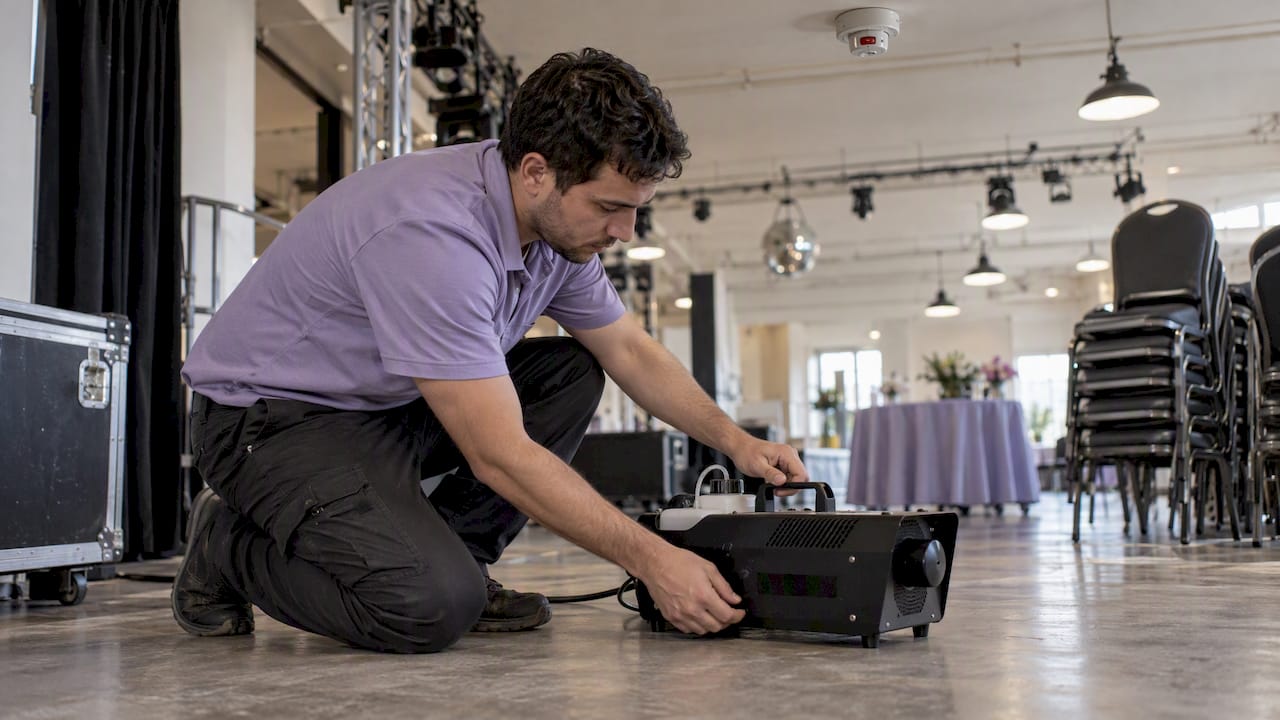
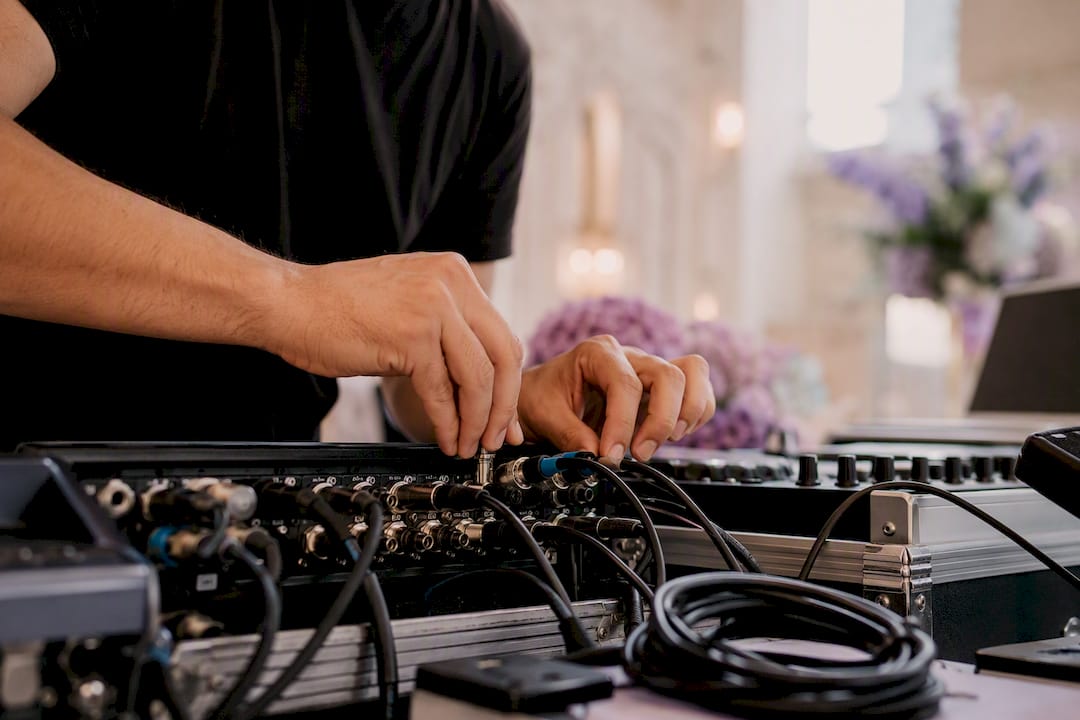
• What’s your backup equipment policy? A zero-failure standard means a spare mixer, spare cables, and a backup PA travel to every gig, not just the big ones.
• Do you have battery-powered options for an outdoor ceremony without accessible power?
• What time do you arrive for setup and soundcheck, and when do you break down?
• Do you require a vendor meal, and does that need to be arranged with the caterer in advance?
Vague answers here (“we’ve got professional gear”) are the biggest tell that a DJ hasn’t thought through your specific venue.
Your DJ is often also your emcee, which means they’re the voice guiding 150 people through your entire timeline. That’s a different skill than mixing tracks, and it deserves its own set of questions.
• Do you provide emcee services, and can you describe your announcement style?
• How do you confirm correct pronunciations for names, and how do you cue the bridal party for entrances?
• Who’s your point of contact on the timeline (planner, coordinator, or the couple), and how do you adjust if things run long or short?
A DJ who has run these logistics before will have a clear, specific process. One who hasn’t will describe things in generalities.
Some answers should end the conversation immediately. A DJ who describes their setup only as “professional equipment,” can’t name a backup plan, refuses to guarantee who performs, or gets evasive about the contract is a risk you don’t need to take on your wedding day.
Here’s a fast script for the first ten minutes of any call:
1. Is my date available, and how far out do you typically book?
2. How many weddings have you played, and will you personally be there?
3. Can you send sample video and two references?
4. What’s your insurance and backup equipment situation?
5. What’s included in the base package, and what triggers extra fees?
6. Does the contract name you specifically, with a contingency clause?
A confident, specific answer to each of these six should take under two minutes total.
Pro Tip: If any answer is vague, ask “can you give me a specific example?” once. A good DJ has a story ready. A weak one repeats the same vague sentence.
Print this, bring it to every call, and check items off in real time instead of relying on memory afterward.
• Availability: Confirmed for your date, booked how far in advance
• Named performer: The specific DJ who will show up, confirmed in writing
• Insurance and backup: Proof of liability coverage, spare equipment plan
• Proof of skill: Video samples, references, sample playlists
• Pricing: Base fee, overtime rate, deposit, refund terms
• Logistics: Arrival time, power needs, footprint, vendor meal
• Music control: Must-play, do-not-play, request-handling process
• Contract: Contingency clause, itemized scope, payment schedule
Run this in a 15 to 30 minute call, and if anything feels unclear, ask for a written follow-up before you request contract edits. Save every written answer and attach it as an addendum to the contract before the deposit changes hands. Our step-by-step DJ booking guide walks through gathering this information before your first call.
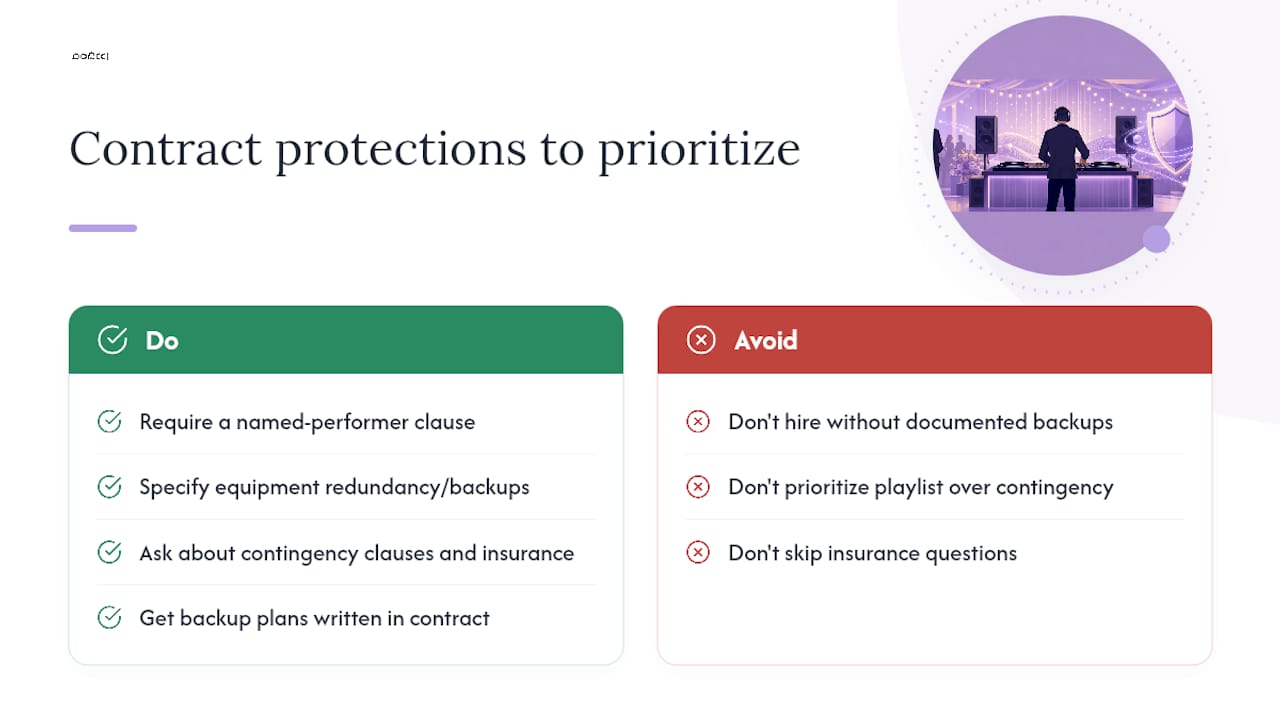
We’ve watched a backup mixer save a reception when a main unit overheated mid dance floor, and we’ve watched a named-performer clause prevent a bait-and-switch when a DJ got double-booked. Neither of those saves happened by luck. They happened because the contract specified exactly who was showing up and what equipment redundancy looked like on paper, not just in a sales pitch.
That’s why we push couples toward asking about contingency clauses and insurance before they ask about song lists. A DJ with a great playlist and no backup plan is a bigger risk than one with a solid but simple set and triple-redundant gear. For more on reading a room and building a set that actually works, our DJ tips for NYC and NJ weddings covers the technique side in more depth. If you’re weighing a DJ against a live band, our DJ versus live band guide is a useful next stop.
— PORCCI
Porcci NYC solves the exact problem this checklist is built around: one accountable provider instead of five separate vendors to vet separately. Our DJ services come paired with sound systems, lighting, and staffing, backed by a named-performer contract, proof of insurance, and backup equipment on every booking across NYC and New Jersey. If you also need microphones, uplighting, or a photo booth on the same date, our AV equipment rental in Manhattan bundles it under one contract rather than three. Ready to check a date? Request a quote and have your event date, venue, estimated guest count, and a few must-play songs ready. We’ll walk you through package options and contract terms on the first call, no pressure to decide on the spot.
• Questions to ask before hiring a wedding DJ | ADJA
• 33 Crucial Questions to Ask a Wedding DJ Before You Hire Them | The Knot
• 50 Questions to Ask Wedding DJs and Bands Before Booking | Zola
• What Is the Rule of 32 in DJing? | DJKit
The rule of 32 refers to the 32-beat phrase structure common in dance and pop music. DJs who mix on these phrase boundaries create transitions that feel natural instead of abrupt.
Prioritize experience (how many weddings, will they personally perform), proof (insurance, videos, references), and protections (contract naming the DJ, contingency clause, backup equipment). Those three categories catch almost every problem before it happens.
Pricing varies widely by market, season, and what’s included (lighting, emcee services, ceremony sound), so get a written quote rather than relying on a general figure. Ask specifically what the base fee covers and what triggers overtime charges before comparing quotes across vendors.
“Open format” means the DJ mixes across genres rather than sticking to one style, and “reading the room” describes adjusting song choice in real time based on crowd response. Ask your DJ to define their approach to both in their own words during the interview.
Use a 15 minute interview script to vet wedding DJs for a named performer, insurance, backup gear, and playlist control. One page checklist included.
Ask a categorized checklist that tests three things: reliability (insurance, backup gear, a named-performer contract), crowd control (music skill and read-the-room ability), and logistics (setup, timing, pricing). We built this interviewer script from what actually goes wrong at weddings, so you can run a 15-minute call and know within the first few answers whether a DJ deserves your deposit.
TL;DR:
• Confirm the DJ has significant wedding experience and will perform personally, not send an assistant, with proof of insurance and relevant samples.
• Ensure they can handle crowd fluctuations by sharing specific examples of reading the room and adjusting playlists in real time.
• Clarify all costs upfront, including base fee, extra charges, and contractual protections for illness or equipment failure, with written confirmation.
• Verify technical logistics like equipment brand, backup plans, outdoor power options, arrival times, and whether a vendor meal is required.
• Ask about the DJ’s emcee experience, name pronunciation, and communication process with the planner or couple to ensure smooth event coordination.
• Questions to Ask a DJ About Background and Wedding Experience
• Questions to Test Music Style and Playlist Control
• Budget, Packages, and Contract Terms to Nail Down
• Logistics, Equipment, and Backup Plans to Confirm
• Emcee Duties and Vendor Coordination
• Red Flags and a Fast Interviewer Script
• Your One-Page DJ Interview Checklist
• What We’ve Learned Running Weddings Ourselves
• Booking a DJ Who Also Handles Sound, Lighting, and Backup
• Sources
• FAQ
Before you talk playlists, confirm the DJ has actually done this before, and that the person on the call is the person showing up. A DJ who has spun 200 weddings reads a room differently than one who mostly works bars. And a company that sends “one of our team” instead of naming a performer is telling you something about how it runs its business.
Ask directly whether the DJ has significant wedding experience and how long they have worked as a DJ, without specifying exact numbers.
• Will you be the DJ performing at my wedding, or could someone else on your roster be assigned?
• Can I see full-length videos or sample mixes from real weddings, not just a highlight reel?
• Can you connect me with two references, and can I ask them how you handled timing or problems that day?
• Can you provide proof of liability insurance? Most premium venues require it, and a professional DJ should produce it on request.
A vendor who hesitates on any of these five is worth a second look before you go further.
A great wedding DJ isn’t a human jukebox. They’re reading 150 guests in real time and adjusting the next ten songs based on who’s actually dancing. That skill separates a DJ from someone who just presses play on a Spotify queue, and it’s exactly what standard wedding DJ question lists are built to surface.
Ask these to test it:
• Tell me about a time the dance floor died. What did you do, and how fast did it recover?
• How do you handle must-play and do-not-play lists, and what happens when a guest requests something off the list?
• Can I see a sample ceremony playlist and a sample reception set list from a past event?
• Do you play open-format across genres, or do you specialize in one style?
Pro Tip: Ask for the story, not the theory. Any DJ can claim they “read the room.” Only an experienced one can tell you the exact song that turned a quiet floor around at 9:45 PM.
Cost surprises usually come from what’s left unwritten, not what’s written wrong. Get every dollar figure and every protection on paper before you sign anything.
1. What’s included in the base fee? Confirm hours of coverage, setup and breakdown time, microphones, and basic lighting, then ask what triggers extra charges like overtime, travel, or special song requests.
2. What’s the deposit and refund policy? Get the deposit amount, the cancellation and refund terms, and the date the final balance is due, plus whether a payment plan is available.
3. Does the contract name your specific DJ? Insist on an itemized scope of work and a contingency clause covering illness, equipment failure, or a no-show, so you know exactly who performs and what happens if plans change.
Standard planning guides from The Knot and Zola list dozens of variations on these three questions, but they all boil down to the same goal: no ambiguity between what you paid for and what shows up.
This is where good intentions meet bad Wi-Fi, a tripped breaker, or a venue that’s stricter about power drops than anyone expected. Ask specific, technical questions here, not vague ones.
• What speaker, mixer, and microphone brands do you use, and how much floor space and power do you need?
• What’s your backup equipment policy? A zero-failure standard means a spare mixer, spare cables, and a backup PA travel to every gig, not just the big ones.
• Do you have battery-powered options for an outdoor ceremony without accessible power?
• What time do you arrive for setup and soundcheck, and when do you break down?
• Do you require a vendor meal, and does that need to be arranged with the caterer in advance?
Vague answers here (“we’ve got professional gear”) are the biggest tell that a DJ hasn’t thought through your specific venue.
Your DJ is often also your emcee, which means they’re the voice guiding 150 people through your entire timeline. That’s a different skill than mixing tracks, and it deserves its own set of questions.
• Do you provide emcee services, and can you describe your announcement style?
• How do you confirm correct pronunciations for names, and how do you cue the bridal party for entrances?
• Who’s your point of contact on the timeline (planner, coordinator, or the couple), and how do you adjust if things run long or short?
A DJ who has run these logistics before will have a clear, specific process. One who hasn’t will describe things in generalities.
Some answers should end the conversation immediately. A DJ who describes their setup only as “professional equipment,” can’t name a backup plan, refuses to guarantee who performs, or gets evasive about the contract is a risk you don’t need to take on your wedding day.
Here’s a fast script for the first ten minutes of any call:
1. Is my date available, and how far out do you typically book?
2. How many weddings have you played, and will you personally be there?
3. Can you send sample video and two references?
4. What’s your insurance and backup equipment situation?
5. What’s included in the base package, and what triggers extra fees?
6. Does the contract name you specifically, with a contingency clause?
A confident, specific answer to each of these six should take under two minutes total.
Pro Tip: If any answer is vague, ask “can you give me a specific example?” once. A good DJ has a story ready. A weak one repeats the same vague sentence.
Print this, bring it to every call, and check items off in real time instead of relying on memory afterward.
• Availability: Confirmed for your date, booked how far in advance
• Named performer: The specific DJ who will show up, confirmed in writing
• Insurance and backup: Proof of liability coverage, spare equipment plan
• Proof of skill: Video samples, references, sample playlists
• Pricing: Base fee, overtime rate, deposit, refund terms
• Logistics: Arrival time, power needs, footprint, vendor meal
• Music control: Must-play, do-not-play, request-handling process
• Contract: Contingency clause, itemized scope, payment schedule
Run this in a 15 to 30 minute call, and if anything feels unclear, ask for a written follow-up before you request contract edits. Save every written answer and attach it as an addendum to the contract before the deposit changes hands. Our step-by-step DJ booking guide walks through gathering this information before your first call.
We’ve watched a backup mixer save a reception when a main unit overheated mid dance floor, and we’ve watched a named-performer clause prevent a bait-and-switch when a DJ got double-booked. Neither of those saves happened by luck. They happened because the contract specified exactly who was showing up and what equipment redundancy looked like on paper, not just in a sales pitch.
That’s why we push couples toward asking about contingency clauses and insurance before they ask about song lists. A DJ with a great playlist and no backup plan is a bigger risk than one with a solid but simple set and triple-redundant gear. For more on reading a room and building a set that actually works, our DJ tips for NYC and NJ weddings covers the technique side in more depth. If you’re weighing a DJ against a live band, our DJ versus live band guide is a useful next stop.
— PORCCI
Porcci NYC solves the exact problem this checklist is built around: one accountable provider instead of five separate vendors to vet separately. Our DJ services come paired with sound systems, lighting, and staffing, backed by a named-performer contract, proof of insurance, and backup equipment on every booking across NYC and New Jersey. If you also need microphones, uplighting, or a photo booth on the same date, our AV equipment rental in Manhattan bundles it under one contract rather than three. Ready to check a date? Request a quote and have your event date, venue, estimated guest count, and a few must-play songs ready. We’ll walk you through package options and contract terms on the first call, no pressure to decide on the spot.
• Questions to ask before hiring a wedding DJ | ADJA
• 33 Crucial Questions to Ask a Wedding DJ Before You Hire Them | The Knot
• 50 Questions to Ask Wedding DJs and Bands Before Booking | Zola
• What Is the Rule of 32 in DJing? | DJKit
The rule of 32 refers to the 32-beat phrase structure common in dance and pop music. DJs who mix on these phrase boundaries create transitions that feel natural instead of abrupt.
Prioritize experience (how many weddings, will they personally perform), proof (insurance, videos, references), and protections (contract naming the DJ, contingency clause, backup equipment). Those three categories catch almost every problem before it happens.
Pricing varies widely by market, season, and what’s included (lighting, emcee services, ceremony sound), so get a written quote rather than relying on a general figure. Ask specifically what the base fee covers and what triggers overtime charges before comparing quotes across vendors.
“Open format” means the DJ mixes across genres rather than sticking to one style, and “reading the room” describes adjusting song choice in real time based on crowd response. Ask your DJ to define their approach to both in their own words during the interview.