Build a corporate karaoke playlist with familiar singalongs, group numbers, inclusive hosting tips, and a simple setup checklist for your next team event.
The best corporate karaoke night runs on a short, familiar playlist grouped by energy and type, not a random song list. Pick songs everyone already knows the chorus to, mix in a few group numbers, and set two or three simple hosting rules. Below, we’ve built a copyable playlist and the quick setup steps that get even your quietest coworkers to grab the mic.
TL;DR:
• Choose clean songs with familiar, repeatable choruses and comfortable vocal ranges; alternate faster and slower tracks, and check unfamiliar requests before adding them.
• Add familiar songs in colleagues’ home languages, and offer group numbers or a side room for anyone reluctant to sing alone.
• Test the lyric screen and backup audio before guests arrive, then use a host to manage the queue and pace the night in three acts.
• Karaoke suits teams with existing rapport better than new groups or rooms split by rank; asking a manager to sing first can lower the pressure.
• 1. A Playlist You Can Copy for Your Next Karaoke Night
• 2. How to Pick the Right Songs for Your Office Crowd
• 3. Setup and Hosting Tips That Get More People Singing
• 4. How a Managed Karaoke Setup Keeps Things Running Smoothly
• Why Karaoke Works as a Team Building Tool, and When to Skip It
• Book a Karaoke Setup That Takes the Guesswork Out
• FAQ
• Sources
A good corporate karaoke setlist has three jobs: open warm, build energy, and close loud. Here’s a playlist built around those three jobs, pulled from the songs that consistently top corporate karaoke lists and global karaoke charts.
Universal crowd-pleasers (openers and anytime picks):
1. “Don’t Stop Believin’” by Journey, a near-guaranteed singalong and a safe opener for any group.
2. “Sweet Caroline” by Neil Diamond, built for the “so good, so good, so good” shout-back.
3. “Dancing Queen” by ABBA, upbeat without being hard to hit the notes.
4. “I Want It That Way” by Backstreet Boys, a nostalgic favorite that pulls in casual singers.
5. “Livin’ on a Prayer” by Bon Jovi, big chorus energy that works at any point in the night.
6. “Mr. Brightside” by The Killers, a modern classic that younger and older staff both know.
7. “Shallow” by Lady Gaga and Bradley Cooper, strong as a duet when two coworkers team up.
8. “Bohemian Rhapsody” by Queen, best saved for a confident singer or a group that wants a challenge.
9. “I’m Gonna Be (500 Miles)” by The Proclaimers, simple, repetitive, and easy to join mid-song.
10. “Build Me Up Buttercup” by The Foundations, a feel-good throwback that rarely misses.
Group, duet, and call-and-response picks: 11. “Don’t Stop Me Now” by Queen, great for a group that wants to shout rather than sing precisely. 12. “Summer Nights” from Grease, built for two singers trading lines. 13. “Wannabe” by Spice Girls, best for groups of three or more. 14. “We Are Family” by Sister Sledge, an easy pick when a whole table wants to go up together. 15. “I Will Survive” by Gloria Gaynor, strong solo or group energy. 16. “Africa” by Toto, a chorus everyone can hum even if they don’t know the verses. 17. “Shut Up and Dance” by Walk the Moon, works well as a duet. 18. “Lean on Me” by Bill Withers, a slower group song that still gets voices in the room. 19. “ABC” by Jackson 5, playful and easy to split between singers. 20. “Islands in the Stream” by Kenny Rogers and Dolly Parton, the original corporate duet.
Ballads, dance hits, and nostalgic throwbacks: 21. “Hey Jude” by The Beatles, a slow build that’s great mid-set. 22. “Billie Jean” by Michael Jackson, a reliable dance pick. 23. “Uptown Funk” by Bruno Mars, high energy for later in the set. 24. “Dancing in the Moonlight” by King Harvest, light and easy. 25. “Total Eclipse of the Heart” by Bonnie Tyler, a dramatic favorite for confident singers. 26. “Can’t Stop the Feeling!” by Justin Timberlake, a strong closer candidate. 27. “September” by Earth, Wind and Fire, good for a dance break between songs. 28. “I Wanna Dance with Somebody” by Whitney Houston, great finish energy. 29. “Country Roads” by John Denver, a quieter singalong that still gets everyone humming. 30. “Y.M.C.A.” by Village People, almost always the best finish of the night.
Pro Tip: Save “Y.M.C.A.” or “Don’t Stop Believin’” for last. Ending on a song everyone can shout together sends people home talking about the party, not the awkward silence before someone volunteered to sing.
Picking songs for a mixed-age office is different from picking for a birthday party. You’re trying to lower the bar to participate, not showcase vocal talent.
• Familiarity first: choose songs most people can hum within the first five seconds.
• Chorus over verses: a strong, repeatable chorus matters more than clever lyrics.
• Comfortable range: avoid songs that require hitting very high or very low notes.
• Keep it workplace-appropriate: skip anything with explicit lyrics or heavy romantic or political content.
• Pace the energy: alternate upbeat and slower songs so no one gets vocally worn out.
When requests come in, pre-vet anything unfamiliar by checking the lyrics for workplace fit and confirming someone actually knows the song before it’s queued. If your team includes colleagues who speak other languages at home, add a couple of well-known non-English hits so the night doesn’t feel one-note; our multilingual karaoke systems make that easy to pull off without extra equipment. For non-singers, group numbers and a private side room take the pressure off and still let them feel part of the night.
Logistics make or break participation. A few deliberate choices go a long way.
1. Put someone in charge of the mic. A host or MC who keeps the queue moving and makes a quick, warm introduction for each singer keeps energy up and awkward gaps out.
2. Test lyric display and backup audio before guests arrive. Run a full tech check, confirm the screen is visible from the back row, and have a backup playlist ready in case the system glitches.
3. Build the set in three acts. Start with easy singalongs, bring in group numbers in the middle, and close with a high-energy anthem everyone knows.
4. Present drink options equally. Setting out mocktails and nonalcoholic beer right alongside the alcoholic options signals that everyone’s comfort matters, which tends to loosen up more of the room for the mic.
Good sound system and lyric display setup solves most of the technical headaches before they start.
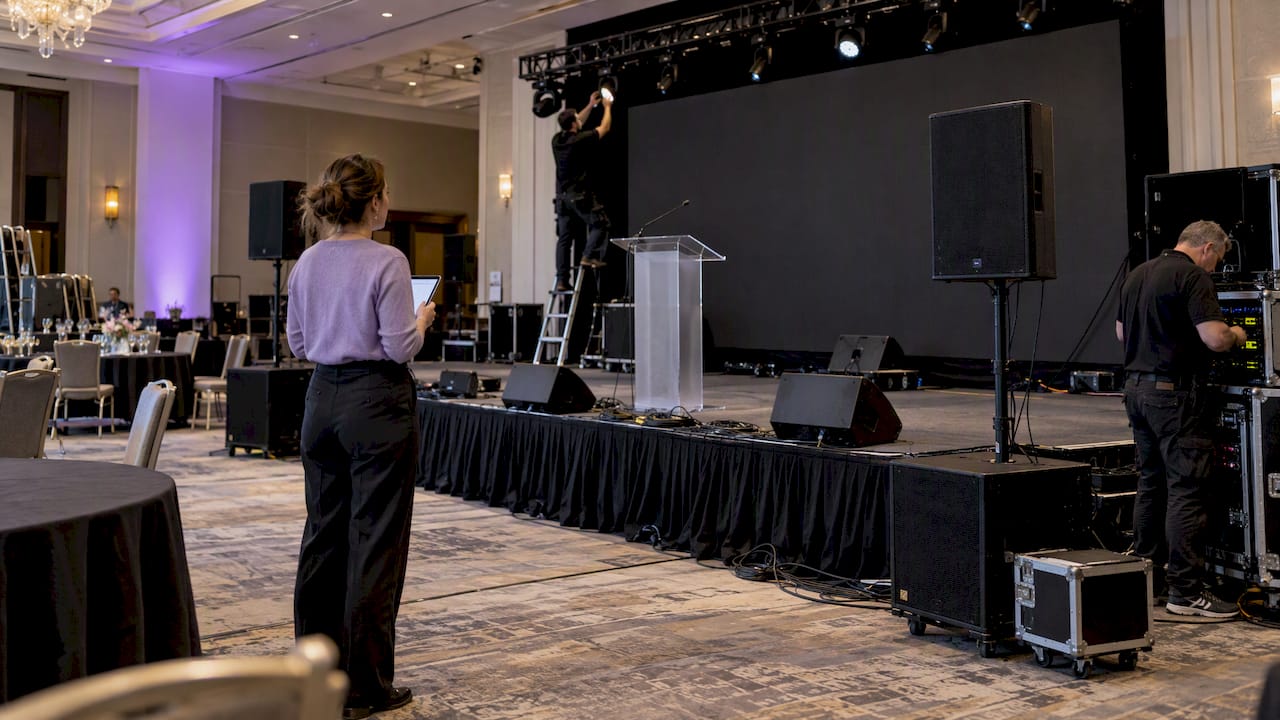
A staffed operator changes the whole feel of a corporate karaoke night. Instead of coworkers fumbling with a remote or waiting through dead air, someone is cueing lyrics, managing the queue, and keeping the energy steady between singers. This can be handled through curated packages, multilingual song libraries, and trained song operators who work the room so the host can focus on hyping people up instead of troubleshooting a screen.
A smooth mic queue and quick cueing between songs means more coworkers get a turn in the same amount of time, which is the whole point of a short event window.
We’ve run this setup for offices with wildly different tastes in the room, from classic rock fans to K-pop devotees, and the multilingual libraries consistently get people singing who’d otherwise sit out, as we cover in how we keep corporate karaoke polished and on-brand.

Karaoke works best when a team already has some rapport and wants a low-stakes way to loosen up together. Informal social moments like this tend to support workplace satisfaction, especially when the format makes it easy for quieter employees to join without pressure.
It’s a weaker fit for a brand-new team that hasn’t built trust yet, or for a crowd that’s mostly senior leadership and junior staff with little informal interaction. The simplest fix either way: get a manager to sing first. Watch for people requesting songs unprompted or sticking around after the official event ends. Those are the real signs it worked.
— PORCCI
A great karaoke night for your office doesn’t need five separate vendors. Our Karaoke Standard Package bundles the machine, song library, and setup in one booking, and our song operator and tech staff keep the queue moving so your host can focus on the room, not the remote.
• Want a full party vibe instead of just karaoke? Our Karaoke DJ option blends DJ sets with karaoke breaks.
• Need someone to run the mic and keep the night on schedule? Our tech staff add-on covers that.
• Not sure what fits your office size or budget? Get a quote and we’ll walk through it with you.
One vendor, one setup, one point of contact for the whole night. A few prime dates are still open this season if you want to lock one in early.
“Don’t Stop Believin’” or “Sweet Caroline” are strong go-to picks because the chorus is familiar enough for the whole room to join in, which takes pressure off a nervous singer. Group numbers like “We Are Family” are an even gentler entry point since no one is singing alone.
Office-friendly karaoke songs skew toward widely known, upbeat choices with clean lyrics, such as “Dancing Queen,” “Livin’ on a Prayer,” and “I Want It That Way.” Corporate event karaoke lists consistently favor these kinds of evergreen singalong tracks over niche or explicit songs.
Pick a song with a well-known, repeatable chorus like “Y.M.C.A.” or “I’m Gonna Be (500 Miles),” since both invite the room to shout along even if they don’t know every verse. Songs built around a hook rather than complex lyrics almost always get more of the crowd singing.
“Bohemian Rhapsody” is widely considered one of the hardest karaoke songs because of its shifting tempo, vocal range, and multiple distinct sections. It can work well with a confident singer or a group splitting the parts, but it’s a risky pick as a general crowd song.
• Here’s how managers can make office holiday party recovery-friendly
Build a corporate karaoke playlist with familiar singalongs, group numbers, inclusive hosting tips, and a simple setup checklist for your next team event.
The best corporate karaoke night runs on a short, familiar playlist grouped by energy and type, not a random song list. Pick songs everyone already knows the chorus to, mix in a few group numbers, and set two or three simple hosting rules. Below, we’ve built a copyable playlist and the quick setup steps that get even your quietest coworkers to grab the mic.
TL;DR:
• Choose clean songs with familiar, repeatable choruses and comfortable vocal ranges; alternate faster and slower tracks, and check unfamiliar requests before adding them.
• Add familiar songs in colleagues’ home languages, and offer group numbers or a side room for anyone reluctant to sing alone.
• Test the lyric screen and backup audio before guests arrive, then use a host to manage the queue and pace the night in three acts.
• Karaoke suits teams with existing rapport better than new groups or rooms split by rank; asking a manager to sing first can lower the pressure.
• 1. A Playlist You Can Copy for Your Next Karaoke Night
• 2. How to Pick the Right Songs for Your Office Crowd
• 3. Setup and Hosting Tips That Get More People Singing
• 4. How a Managed Karaoke Setup Keeps Things Running Smoothly
• Why Karaoke Works as a Team Building Tool, and When to Skip It
• Book a Karaoke Setup That Takes the Guesswork Out
• FAQ
• Sources
A good corporate karaoke setlist has three jobs: open warm, build energy, and close loud. Here’s a playlist built around those three jobs, pulled from the songs that consistently top corporate karaoke lists and global karaoke charts.
Universal crowd-pleasers (openers and anytime picks):
1. “Don’t Stop Believin’” by Journey, a near-guaranteed singalong and a safe opener for any group.
2. “Sweet Caroline” by Neil Diamond, built for the “so good, so good, so good” shout-back.
3. “Dancing Queen” by ABBA, upbeat without being hard to hit the notes.
4. “I Want It That Way” by Backstreet Boys, a nostalgic favorite that pulls in casual singers.
5. “Livin’ on a Prayer” by Bon Jovi, big chorus energy that works at any point in the night.
6. “Mr. Brightside” by The Killers, a modern classic that younger and older staff both know.
7. “Shallow” by Lady Gaga and Bradley Cooper, strong as a duet when two coworkers team up.
8. “Bohemian Rhapsody” by Queen, best saved for a confident singer or a group that wants a challenge.
9. “I’m Gonna Be (500 Miles)” by The Proclaimers, simple, repetitive, and easy to join mid-song.
10. “Build Me Up Buttercup” by The Foundations, a feel-good throwback that rarely misses.
Group, duet, and call-and-response picks: 11. “Don’t Stop Me Now” by Queen, great for a group that wants to shout rather than sing precisely. 12. “Summer Nights” from Grease, built for two singers trading lines. 13. “Wannabe” by Spice Girls, best for groups of three or more. 14. “We Are Family” by Sister Sledge, an easy pick when a whole table wants to go up together. 15. “I Will Survive” by Gloria Gaynor, strong solo or group energy. 16. “Africa” by Toto, a chorus everyone can hum even if they don’t know the verses. 17. “Shut Up and Dance” by Walk the Moon, works well as a duet. 18. “Lean on Me” by Bill Withers, a slower group song that still gets voices in the room. 19. “ABC” by Jackson 5, playful and easy to split between singers. 20. “Islands in the Stream” by Kenny Rogers and Dolly Parton, the original corporate duet.
Ballads, dance hits, and nostalgic throwbacks: 21. “Hey Jude” by The Beatles, a slow build that’s great mid-set. 22. “Billie Jean” by Michael Jackson, a reliable dance pick. 23. “Uptown Funk” by Bruno Mars, high energy for later in the set. 24. “Dancing in the Moonlight” by King Harvest, light and easy. 25. “Total Eclipse of the Heart” by Bonnie Tyler, a dramatic favorite for confident singers. 26. “Can’t Stop the Feeling!” by Justin Timberlake, a strong closer candidate. 27. “September” by Earth, Wind and Fire, good for a dance break between songs. 28. “I Wanna Dance with Somebody” by Whitney Houston, great finish energy. 29. “Country Roads” by John Denver, a quieter singalong that still gets everyone humming. 30. “Y.M.C.A.” by Village People, almost always the best finish of the night.
Pro Tip: Save “Y.M.C.A.” or “Don’t Stop Believin’” for last. Ending on a song everyone can shout together sends people home talking about the party, not the awkward silence before someone volunteered to sing.
Picking songs for a mixed-age office is different from picking for a birthday party. You’re trying to lower the bar to participate, not showcase vocal talent.
• Familiarity first: choose songs most people can hum within the first five seconds.
• Chorus over verses: a strong, repeatable chorus matters more than clever lyrics.
• Comfortable range: avoid songs that require hitting very high or very low notes.
• Keep it workplace-appropriate: skip anything with explicit lyrics or heavy romantic or political content.
• Pace the energy: alternate upbeat and slower songs so no one gets vocally worn out.
When requests come in, pre-vet anything unfamiliar by checking the lyrics for workplace fit and confirming someone actually knows the song before it’s queued. If your team includes colleagues who speak other languages at home, add a couple of well-known non-English hits so the night doesn’t feel one-note; our multilingual karaoke systems make that easy to pull off without extra equipment. For non-singers, group numbers and a private side room take the pressure off and still let them feel part of the night.
Logistics make or break participation. A few deliberate choices go a long way.
1. Put someone in charge of the mic. A host or MC who keeps the queue moving and makes a quick, warm introduction for each singer keeps energy up and awkward gaps out.
2. Test lyric display and backup audio before guests arrive. Run a full tech check, confirm the screen is visible from the back row, and have a backup playlist ready in case the system glitches.
3. Build the set in three acts. Start with easy singalongs, bring in group numbers in the middle, and close with a high-energy anthem everyone knows.
4. Present drink options equally. Setting out mocktails and nonalcoholic beer right alongside the alcoholic options signals that everyone’s comfort matters, which tends to loosen up more of the room for the mic.
Good sound system and lyric display setup solves most of the technical headaches before they start.
A staffed operator changes the whole feel of a corporate karaoke night. Instead of coworkers fumbling with a remote or waiting through dead air, someone is cueing lyrics, managing the queue, and keeping the energy steady between singers. This can be handled through curated packages, multilingual song libraries, and trained song operators who work the room so the host can focus on hyping people up instead of troubleshooting a screen.
A smooth mic queue and quick cueing between songs means more coworkers get a turn in the same amount of time, which is the whole point of a short event window.
We’ve run this setup for offices with wildly different tastes in the room, from classic rock fans to K-pop devotees, and the multilingual libraries consistently get people singing who’d otherwise sit out, as we cover in how we keep corporate karaoke polished and on-brand.
Karaoke works best when a team already has some rapport and wants a low-stakes way to loosen up together. Informal social moments like this tend to support workplace satisfaction, especially when the format makes it easy for quieter employees to join without pressure.
It’s a weaker fit for a brand-new team that hasn’t built trust yet, or for a crowd that’s mostly senior leadership and junior staff with little informal interaction. The simplest fix either way: get a manager to sing first. Watch for people requesting songs unprompted or sticking around after the official event ends. Those are the real signs it worked.
— PORCCI
A great karaoke night for your office doesn’t need five separate vendors. Our Karaoke Standard Package bundles the machine, song library, and setup in one booking, and our song operator and tech staff keep the queue moving so your host can focus on the room, not the remote.
• Want a full party vibe instead of just karaoke? Our Karaoke DJ option blends DJ sets with karaoke breaks.
• Need someone to run the mic and keep the night on schedule? Our tech staff add-on covers that.
• Not sure what fits your office size or budget? Get a quote and we’ll walk through it with you.
One vendor, one setup, one point of contact for the whole night. A few prime dates are still open this season if you want to lock one in early.
“Don’t Stop Believin’” or “Sweet Caroline” are strong go-to picks because the chorus is familiar enough for the whole room to join in, which takes pressure off a nervous singer. Group numbers like “We Are Family” are an even gentler entry point since no one is singing alone.
Office-friendly karaoke songs skew toward widely known, upbeat choices with clean lyrics, such as “Dancing Queen,” “Livin’ on a Prayer,” and “I Want It That Way.” Corporate event karaoke lists consistently favor these kinds of evergreen singalong tracks over niche or explicit songs.
Pick a song with a well-known, repeatable chorus like “Y.M.C.A.” or “I’m Gonna Be (500 Miles),” since both invite the room to shout along even if they don’t know every verse. Songs built around a hook rather than complex lyrics almost always get more of the crowd singing.
“Bohemian Rhapsody” is widely considered one of the hardest karaoke songs because of its shifting tempo, vocal range, and multiple distinct sections. It can work well with a confident singer or a group splitting the parts, but it’s a risky pick as a general crowd song.
• Here’s how managers can make office holiday party recovery-friendly