Master sound system basics explained for flawless events. Learn how to choose and connect microphones, mixers, amplifiers, and speakers.
TL;DR:
• A sound system connects microphones, mixers, amplifiers, and speakers to deliver clear audio for events. Proper setup and operation prevent issues like distortion, feedback, and uneven sound coverage. Hiring an on-site technician and choosing equipment suited to event size ensures reliable, high-quality sound.
A sound system is a chain of microphones, mixers, amplifiers, and speakers designed to capture, process, and project audio clearly for any audience. Understanding audio system basics is the difference between a wedding speech everyone hears and one that gets swallowed by the room. Whether you’re planning a corporate dinner for 30 or a dance party for 300, every component in the chain has a job. Get one wrong, and the whole system suffers. This guide walks you through what each part does, how they connect, and how to size the right setup for your event.
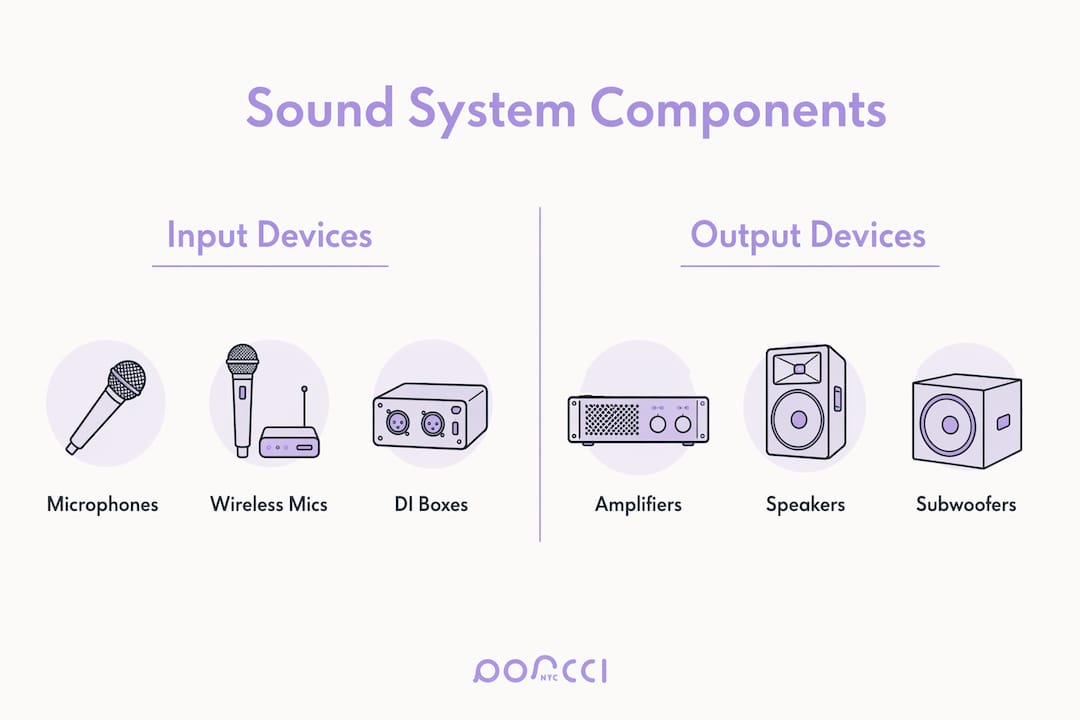
Sound system basics explained start with four core components: microphones, mixers, amplifiers, and speakers. Each one handles a specific stage of the audio journey, and none of them work well in isolation.
• Microphones capture sound and convert it into an electrical signal. Dynamic microphones handle loud sources like live vocals and drums. Condenser microphones pick up detail and work well for speeches and acoustic instruments. Wireless handheld and lavalier microphones give speakers freedom to move, which matters at weddings and corporate events.
• Mixers receive signals from all input sources, including microphones, DJ controllers, and playback devices. The mixer lets you control volume, tone, and balance for each source independently. A 12-channel analog mixer covers most private events; larger productions often need digital mixers with built-in processing.
• Power amplifiers boost the mixer’s output signal to a level strong enough to drive speakers. Passive speakers require a separate amplifier. Active (powered) speakers have the amplifier built in, which simplifies setup and reduces cabling.
• Speakers and subwoofers convert the amplified signal back into sound. Full-range speakers handle vocals and mid-range frequencies. Subwoofers reproduce bass frequencies below 80 Hz. A system without subwoofers sounds thin in crowded rooms because bodies absorb high frequencies and the low-end punch disappears. Subwoofers make a space feel alive, not just loud.
• Cables and connectors carry signal between every component. XLR cables are the standard for balanced audio connections between microphones, mixers, and amplifiers. Speakon connectors link amplifiers to passive speakers. Poor or damaged cables cause hum, dropouts, and signal loss.
Pro Tip: Label every cable at both ends before your event. A 30-second task at setup saves 10 minutes of troubleshooting mid-event.
Signal flow is the path audio travels from its source to your audience’s ears. Understanding this path helps you diagnose problems fast and set up correctly the first time.
1. Sound enters a source device. A vocalist sings into a microphone, a DJ plays a track through a controller, or a presenter connects a laptop. Each source generates an audio signal.
2. Signals route to the mixer. Every source plugs into a separate channel on the mixer. The mixer combines them, lets you adjust levels independently, and applies EQ to shape the tone of each input.
3. The mixer sends its output to the amplifier. The main output of the mixer connects to the power amplifier via XLR or balanced TRS cables. This is where gain staging matters: setting each stage at the right level prevents distortion and preserves headroom.
4. The amplifier drives the speakers. The amplified signal travels to full-range speakers for vocals and music, and to subwoofers for bass. Crossovers, either built into the speakers or set in the mixer, split frequencies so each speaker handles only what it’s designed for.
5. Sound reaches the audience. Proper speaker placement and aiming determine whether every guest hears clearly or only those standing in front of the stack.
Real-Time Analyzers (RTAs) help technicians calibrate the system at this final stage. Real-time gain staging with an RTA prevents distortion and keeps the system performing consistently as the room fills and conditions change.
Matching your system to your guest count and venue is the most practical decision in any sound system setup guide. Bigger is not always better. An oversized system in a small room creates harsh reflections and ear fatigue. An undersized system forces you to push equipment past its limits, which causes distortion.
| Guest count | Recommended speakers | Subwoofers |
|---|---|---|
| 10–40 guests | 2x 12-inch full-range | Optional |
| 50–120 guests | 2x 15-inch full-range | 2x 18-inch |
| 200–300+ guests | 4x 15-inch full-range | 4x 18-inch |
These speaker sizing guidelines give you a reliable starting point for most event formats. Adjust based on music type and venue acoustics.
Venue type changes the math significantly. Outdoor events require 30–40% more sound power than indoor events with the same guest count. Open air has no reflective surfaces to reinforce the sound, so it dissipates faster. Plan for that gap when renting or purchasing equipment.
Speaker placement is just as important as speaker count. Optimal dance floor coverage comes from positioning speakers at 1.5 to 2 meters high, aimed toward the audience. Speakers pointed at walls or ceilings scatter sound unevenly and create dead zones. For dance events with 100 to 300 guests, target 95 to 105 dB peak SPL on the floor to maintain energy without causing fatigue.
Pro Tip: If you’re working with an in-house venue system, test it with your actual content before guests arrive. In-house venue systems often lack the coverage and control needed for live entertainment, and a supplemental rental system can fill the gaps.
Good equipment alone does not guarantee good sound. The operational side of running a system matters just as much as the gear itself.
• Assign a dedicated audio technician. Even high-quality equipment fails without someone managing soundchecks, monitoring wireless frequencies, and adjusting levels as the room fills. A technician catches problems before guests notice them.
• Prevent microphone feedback. Feedback happens when a microphone picks up its own amplified signal from a speaker. Keep microphones in front of speakers, not behind them. Lower the gain on unused channels and use a high-pass filter to cut low-frequency rumble.
• Manage wireless microphone frequencies. Wireless systems operate on specific radio frequencies. Scan for clear frequencies before the event and keep backup channels assigned. Interference from other wireless devices causes dropouts at the worst moments.
• Check your power supply and cabling. Run audio equipment on dedicated circuits where possible. Shared circuits with lighting or catering equipment introduce electrical noise. Tape down all floor cables to prevent trips and accidental disconnections.
• Adjust EQ to the room. An empty room sounds very different from a full one. Bodies absorb high frequencies, which makes the mix sound duller. Meticulous planning that includes tuning to the room and audience produces consistently clear sound throughout the event.
A properly sized and operated sound system, matched to the room and guest count, delivers clear audio at every event regardless of scale.
| Point | Details |
|---|---|
| Core components | Every system needs a microphone, mixer, amplifier, and speakers working in sequence. |
| Signal flow matters | Audio travels source to mixer to amplifier to speaker; clean gain staging at each step prevents distortion. |
| Size to the room | Use speaker sizing guidelines by guest count and add 30–40% more power for outdoor venues. |
| Subwoofers are not optional | Rooms with 50 or more guests need subwoofers to prevent thin, hollow sound on the dance floor. |
| Technicians prevent failure | On-site audio management is the single biggest factor separating smooth events from those with feedback and dropouts. |
The most common mistake we see is not undersizing a system. It’s oversizing one and then wondering why the room sounds harsh. A 15,000-watt rig in a 200-person ballroom does not sound better than a well-tuned 4,000-watt system. It sounds worse, because the room’s reflections amplify every flaw in the mix.
Matching equipment to the room’s acoustics and the guest experience you want to create is more critical than maximizing budget or speaker count. We’ve seen events with modest rental systems outperform events with expensive in-house rigs, simply because someone took the time to aim the speakers correctly and run a proper soundcheck.
The other thing most planners underestimate is the value of a live technician. You can set up a perfect system at 3:00 PM and have it sound completely different by 8:00 PM when 200 people fill the room. A technician adjusts in real time. No preset or automated system replaces that. If your event matters, budget for the person behind the board, not just the gear in front of it.
— PORCCI
Porcci NYC provides full AV and sound system rentals for events across New York City, Brooklyn, and Jersey City, with expert setup and on-site technician support included. Every rental package covers delivery, installation, and breakdown, so your focus stays on your guests. Whether you need a compact two-speaker setup for a private dinner or a full subwoofer array for a 300-person dance event, Porcci NYC sizes and configures the system to your specific venue and guest count. Our team handles the soundcheck, manages the equipment during the event, and packs everything out when the night ends. Get a custom quote for your event at porccinyc.com.
A sound system consists of microphones, a mixer, a power amplifier, and speakers. Each component handles a separate stage of capturing, combining, boosting, and projecting audio.
Subwoofers are recommended for any event with 50 or more guests or a dance floor. Without them, the system sounds thin because bodies in the room absorb high frequencies and the bass disappears.
Outdoor events require 30–40% more sound power than indoor events with the same guest count, because open air lacks reflective surfaces that reinforce sound indoors.
Feedback occurs when a microphone picks up its own amplified signal from a nearby speaker. Keeping microphones positioned in front of speakers and lowering unused channel gain eliminates most feedback issues.
A dedicated audio technician is the most reliable way to prevent feedback, manage wireless frequencies, and adjust the mix as room conditions change throughout the event.
Master sound system basics explained for flawless events. Learn how to choose and connect microphones, mixers, amplifiers, and speakers.
TL;DR:
• A sound system connects microphones, mixers, amplifiers, and speakers to deliver clear audio for events. Proper setup and operation prevent issues like distortion, feedback, and uneven sound coverage. Hiring an on-site technician and choosing equipment suited to event size ensures reliable, high-quality sound.
A sound system is a chain of microphones, mixers, amplifiers, and speakers designed to capture, process, and project audio clearly for any audience. Understanding audio system basics is the difference between a wedding speech everyone hears and one that gets swallowed by the room. Whether you’re planning a corporate dinner for 30 or a dance party for 300, every component in the chain has a job. Get one wrong, and the whole system suffers. This guide walks you through what each part does, how they connect, and how to size the right setup for your event.
Sound system basics explained start with four core components: microphones, mixers, amplifiers, and speakers. Each one handles a specific stage of the audio journey, and none of them work well in isolation.
• Microphones capture sound and convert it into an electrical signal. Dynamic microphones handle loud sources like live vocals and drums. Condenser microphones pick up detail and work well for speeches and acoustic instruments. Wireless handheld and lavalier microphones give speakers freedom to move, which matters at weddings and corporate events.
• Mixers receive signals from all input sources, including microphones, DJ controllers, and playback devices. The mixer lets you control volume, tone, and balance for each source independently. A 12-channel analog mixer covers most private events; larger productions often need digital mixers with built-in processing.
• Power amplifiers boost the mixer’s output signal to a level strong enough to drive speakers. Passive speakers require a separate amplifier. Active (powered) speakers have the amplifier built in, which simplifies setup and reduces cabling.
• Speakers and subwoofers convert the amplified signal back into sound. Full-range speakers handle vocals and mid-range frequencies. Subwoofers reproduce bass frequencies below 80 Hz. A system without subwoofers sounds thin in crowded rooms because bodies absorb high frequencies and the low-end punch disappears. Subwoofers make a space feel alive, not just loud.
• Cables and connectors carry signal between every component. XLR cables are the standard for balanced audio connections between microphones, mixers, and amplifiers. Speakon connectors link amplifiers to passive speakers. Poor or damaged cables cause hum, dropouts, and signal loss.
Pro Tip: Label every cable at both ends before your event. A 30-second task at setup saves 10 minutes of troubleshooting mid-event.
Signal flow is the path audio travels from its source to your audience’s ears. Understanding this path helps you diagnose problems fast and set up correctly the first time.
1. Sound enters a source device. A vocalist sings into a microphone, a DJ plays a track through a controller, or a presenter connects a laptop. Each source generates an audio signal.
2. Signals route to the mixer. Every source plugs into a separate channel on the mixer. The mixer combines them, lets you adjust levels independently, and applies EQ to shape the tone of each input.
3. The mixer sends its output to the amplifier. The main output of the mixer connects to the power amplifier via XLR or balanced TRS cables. This is where gain staging matters: setting each stage at the right level prevents distortion and preserves headroom.
4. The amplifier drives the speakers. The amplified signal travels to full-range speakers for vocals and music, and to subwoofers for bass. Crossovers, either built into the speakers or set in the mixer, split frequencies so each speaker handles only what it’s designed for.
5. Sound reaches the audience. Proper speaker placement and aiming determine whether every guest hears clearly or only those standing in front of the stack.
Real-Time Analyzers (RTAs) help technicians calibrate the system at this final stage. Real-time gain staging with an RTA prevents distortion and keeps the system performing consistently as the room fills and conditions change.
Matching your system to your guest count and venue is the most practical decision in any sound system setup guide. Bigger is not always better. An oversized system in a small room creates harsh reflections and ear fatigue. An undersized system forces you to push equipment past its limits, which causes distortion.
| Guest count | Recommended speakers | Subwoofers |
|---|---|---|
| 10–40 guests | 2x 12-inch full-range | Optional |
| 50–120 guests | 2x 15-inch full-range | 2x 18-inch |
| 200–300+ guests | 4x 15-inch full-range | 4x 18-inch |
These speaker sizing guidelines give you a reliable starting point for most event formats. Adjust based on music type and venue acoustics.
Venue type changes the math significantly. Outdoor events require 30–40% more sound power than indoor events with the same guest count. Open air has no reflective surfaces to reinforce the sound, so it dissipates faster. Plan for that gap when renting or purchasing equipment.
Speaker placement is just as important as speaker count. Optimal dance floor coverage comes from positioning speakers at 1.5 to 2 meters high, aimed toward the audience. Speakers pointed at walls or ceilings scatter sound unevenly and create dead zones. For dance events with 100 to 300 guests, target 95 to 105 dB peak SPL on the floor to maintain energy without causing fatigue.
Pro Tip: If you’re working with an in-house venue system, test it with your actual content before guests arrive. In-house venue systems often lack the coverage and control needed for live entertainment, and a supplemental rental system can fill the gaps.
Good equipment alone does not guarantee good sound. The operational side of running a system matters just as much as the gear itself.
• Assign a dedicated audio technician. Even high-quality equipment fails without someone managing soundchecks, monitoring wireless frequencies, and adjusting levels as the room fills. A technician catches problems before guests notice them.
• Prevent microphone feedback. Feedback happens when a microphone picks up its own amplified signal from a speaker. Keep microphones in front of speakers, not behind them. Lower the gain on unused channels and use a high-pass filter to cut low-frequency rumble.
• Manage wireless microphone frequencies. Wireless systems operate on specific radio frequencies. Scan for clear frequencies before the event and keep backup channels assigned. Interference from other wireless devices causes dropouts at the worst moments.
• Check your power supply and cabling. Run audio equipment on dedicated circuits where possible. Shared circuits with lighting or catering equipment introduce electrical noise. Tape down all floor cables to prevent trips and accidental disconnections.
• Adjust EQ to the room. An empty room sounds very different from a full one. Bodies absorb high frequencies, which makes the mix sound duller. Meticulous planning that includes tuning to the room and audience produces consistently clear sound throughout the event.
A properly sized and operated sound system, matched to the room and guest count, delivers clear audio at every event regardless of scale.
| Point | Details |
|---|---|
| Core components | Every system needs a microphone, mixer, amplifier, and speakers working in sequence. |
| Signal flow matters | Audio travels source to mixer to amplifier to speaker; clean gain staging at each step prevents distortion. |
| Size to the room | Use speaker sizing guidelines by guest count and add 30–40% more power for outdoor venues. |
| Subwoofers are not optional | Rooms with 50 or more guests need subwoofers to prevent thin, hollow sound on the dance floor. |
| Technicians prevent failure | On-site audio management is the single biggest factor separating smooth events from those with feedback and dropouts. |
The most common mistake we see is not undersizing a system. It’s oversizing one and then wondering why the room sounds harsh. A 15,000-watt rig in a 200-person ballroom does not sound better than a well-tuned 4,000-watt system. It sounds worse, because the room’s reflections amplify every flaw in the mix.
Matching equipment to the room’s acoustics and the guest experience you want to create is more critical than maximizing budget or speaker count. We’ve seen events with modest rental systems outperform events with expensive in-house rigs, simply because someone took the time to aim the speakers correctly and run a proper soundcheck.
The other thing most planners underestimate is the value of a live technician. You can set up a perfect system at 3:00 PM and have it sound completely different by 8:00 PM when 200 people fill the room. A technician adjusts in real time. No preset or automated system replaces that. If your event matters, budget for the person behind the board, not just the gear in front of it.
— PORCCI
Porcci NYC provides full AV and sound system rentals for events across New York City, Brooklyn, and Jersey City, with expert setup and on-site technician support included. Every rental package covers delivery, installation, and breakdown, so your focus stays on your guests. Whether you need a compact two-speaker setup for a private dinner or a full subwoofer array for a 300-person dance event, Porcci NYC sizes and configures the system to your specific venue and guest count. Our team handles the soundcheck, manages the equipment during the event, and packs everything out when the night ends. Get a custom quote for your event at porccinyc.com.
A sound system consists of microphones, a mixer, a power amplifier, and speakers. Each component handles a separate stage of capturing, combining, boosting, and projecting audio.
Subwoofers are recommended for any event with 50 or more guests or a dance floor. Without them, the system sounds thin because bodies in the room absorb high frequencies and the bass disappears.
Outdoor events require 30–40% more sound power than indoor events with the same guest count, because open air lacks reflective surfaces that reinforce sound indoors.
Feedback occurs when a microphone picks up its own amplified signal from a nearby speaker. Keeping microphones positioned in front of speakers and lowering unused channel gain eliminates most feedback issues.
A dedicated audio technician is the most reliable way to prevent feedback, manage wireless frequencies, and adjust the mix as room conditions change throughout the event.