Discover what is event mood lighting and how to enhance guest experiences. Learn effective techniques to elevate any occasion today!
TL;DR:
• Event mood lighting uses color, intensity, and placement to influence guest emotions at any event. It plays a central role in shaping atmosphere, engagement, and focus through layered lighting types and dynamic transitions.
Event mood lighting is the deliberate use of light color, intensity, and placement to shape the emotional atmosphere guests experience at any event. Known in the industry as architectural or experiential lighting design, it goes far beyond basic illumination. Strategic lighting drives up to 70% of audience engagement through dynamic shifts in color, intensity, and direction. That single fact reframes lighting from a logistical checkbox into one of the most powerful tools in your event planning toolkit. Whether you are producing a corporate summit, a wedding reception, or a bar mitzvah in New Jersey, understanding what is event mood lighting gives you direct control over how guests feel from the moment they walk in.
Event lighting falls into three core categories: ambient, accent, and task lighting. Each plays a distinct role in building the layered atmosphere that defines professional event design.
Ambient lighting is the base layer. It fills the room with general illumination and sets the overall tone before any other element is introduced. Think of it as the emotional temperature of the space.
Accent lighting draws attention to specific features: a floral centerpiece, a stage backdrop, or a branded installation. It creates visual hierarchy and tells guests where to look.
Task lighting serves a functional purpose, illuminating areas where guests need to read menus, sign documents, or navigate safely. It should never compete with the mood you have built.
Beyond these categories, specific techniques add depth and dimension:
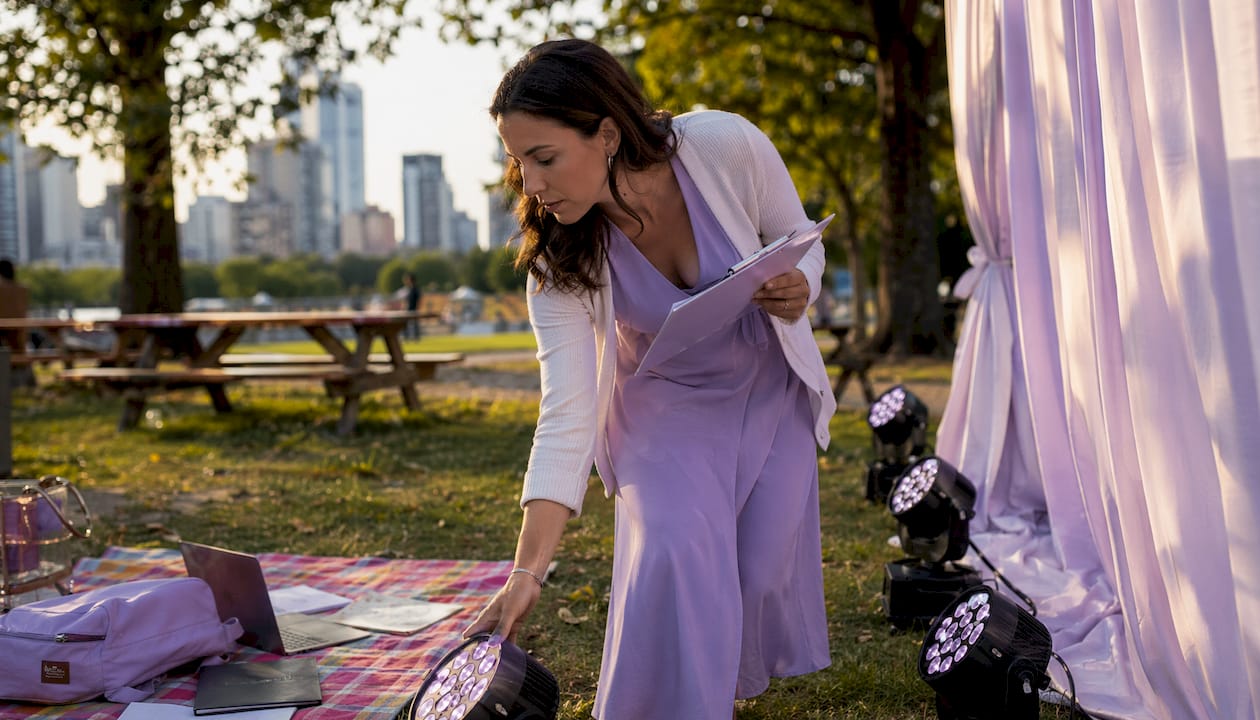
• Uplighting places fixtures at floor level and washes walls or columns with color. Uplighting remains one of the most cost-effective techniques for transforming a plain venue into a fully branded environment.
• Spotlighting focuses a tight beam on a single subject, such as a speaker or a wedding cake, creating a natural focal point.
• Gobo projection casts patterned or logo-shaped light onto floors and walls, adding texture without physical décor.
• Pin spotting uses narrow beams to highlight table centerpieces, making them appear to glow from within.
| Lighting type | Primary effect | Best use case |
|---|---|---|
| Ambient | Sets overall tone and warmth | Cocktail hours, receptions, galas |
| Uplighting | Transforms walls and architecture | Weddings, corporate dinners |
| Spotlighting | Creates focal points | Keynote stages, award ceremonies |
| Gobo projection | Adds pattern and brand texture | Brand activations, mitzvahs |
| Pin spotting | Highlights décor details | Table centerpieces, product displays |
For a deeper look at how these types apply to specific venues, the essential event lighting types guide from Porcci NYC covers NYC and NJ venues in detail.
Color temperature is the most direct lever you have over guest psychology. Warm amber tones promote intimacy and hospitality, while cool blue lighting signals professionalism and focus. That distinction alone should drive your color choices before you select a single fixture.
Audience response to lighting is biological. Color temperature influences hormones that regulate alertness and mood, which means your lighting choices are not just aesthetic. They are physiological. A warm, low-intensity wash at a wedding dinner slows guests down and encourages conversation. A cool, high-intensity wash at a product launch keeps people alert and attentive.
Here is how specific color choices map to emotional outcomes:
• Warm white and amber: Relaxation, romance, and social connection. Ideal for weddings and private dinners.
• Cool white and blue: Focus, trust, and professionalism. Ideal for corporate presentations and panel discussions.
• Deep red and magenta: Energy and excitement. Effective for dance floors and entertainment segments.
• Soft green and lavender: Calm and creativity. Works well for wellness events and networking receptions.
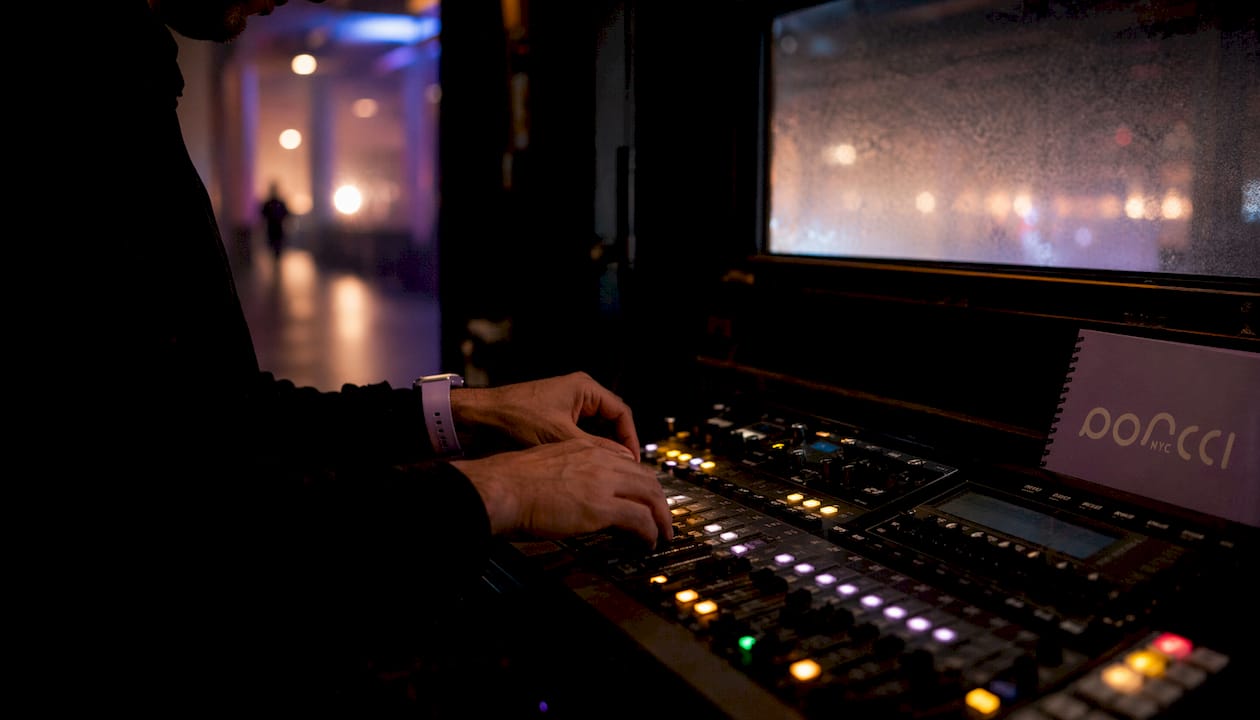
Dynamic lighting shifts sustain guest attention across long events. A static color held for three hours loses its emotional impact. Programmed transitions, even subtle ones, keep the atmosphere feeling alive.
Pro Tip: Color psychology in lighting lets you reinforce brand identity through ambient washes without placing a single logo on the wall. Use your brand’s primary color at 20–30% saturation as a base wash. Guests absorb the association subconsciously.
The most common mistake event planners make is treating lighting as a single decision rather than a program. Lighting should evolve with your event’s energy arc, not stay fixed from arrival to departure.
A corporate conference has three distinct phases: arrival and networking, main stage programming, and post-session reception. Each phase calls for a different lighting state. Bright, neutral white during sessions keeps attendees focused. A warmer, dimmer wash during networking encourages conversation. Transitioning between these states signals the shift without an announcement.
Social events like weddings follow a similar logic. Ceremony lighting should feel reverent and focused. Cocktail hour calls for warmth and movement. The reception dance floor demands energy and color saturation.
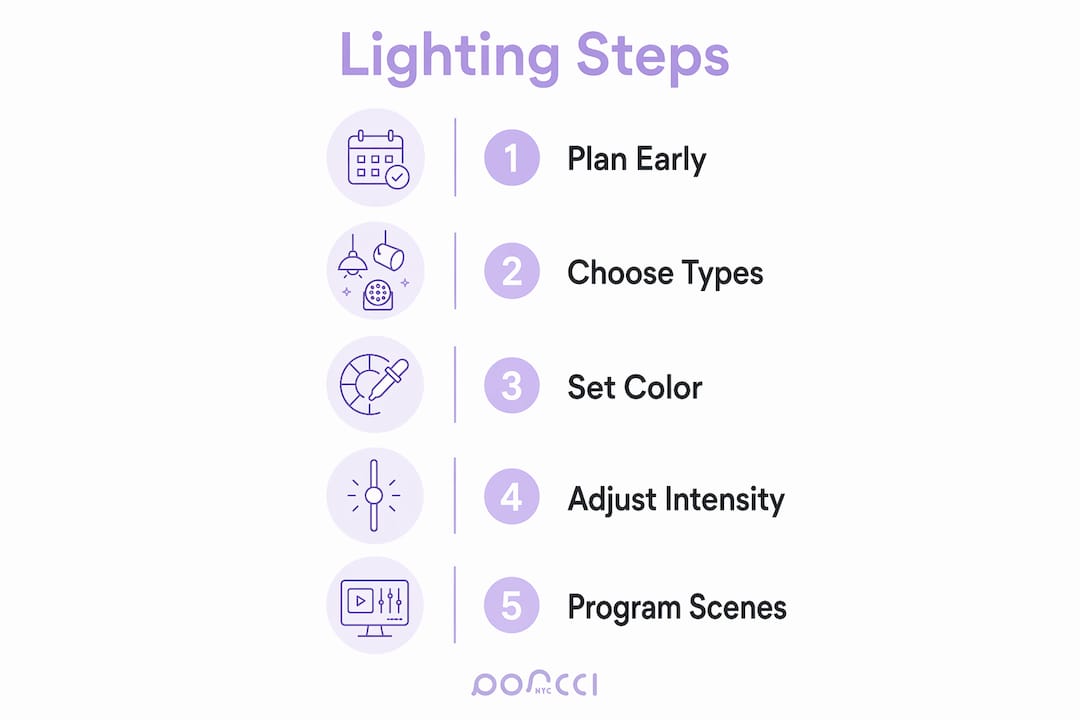
Follow these steps to plan your lighting setup:
1. Map your event timeline. Identify every segment and its intended energy level.
2. Assign a lighting state to each segment. Define color, intensity, and key fixtures for each phase.
3. Program transitions, not just states. Gradual lighting transitions signal event phase changes without disrupting guest comfort.
4. Test in the venue before guests arrive. Lighting behaves differently in every space depending on ceiling height, wall color, and natural light.
5. Avoid overlighting. Overlighting causes guest fatigue and reduces perceived event quality. Lighting should feel invisible, not intrusive.
Pro Tip: Flat, uniform lighting is the fastest way to make a venue feel like a conference room. Break it up with at least two distinct lighting zones, even at small events. The contrast alone creates depth and visual interest.
For practical setup advice specific to the New York and New Jersey area, the event lighting tips for NYC and NJ resource from Porcci NYC covers venue-specific considerations in detail.
The highest level of event lighting design treats light as an invisible narrative. Lighting acts as an invisible narrative that guides focus and shapes energy flow dynamically throughout an event. Guests never consciously notice it. They simply feel more engaged, more present, and more emotionally connected to the experience.
Professional lighting designers use contrast ratios and shadow management rather than uniform brightness to create architectural focal points. Lighting designers use contrast ratios and shadow management to build depth and direct attention. A single well-placed shadow can make a stage feel three times larger than it is.
Lighting is more than illumination. It is emotional architecture. Attendees remember events for how the space made them feel, not for the wattage of the fixtures. The most effective lighting design is the kind guests never consciously notice but would immediately miss if it were gone.
Lighting designed like a musical score, with programmed changes at key moments, actively guides guest attention and sustains engagement across the full event duration. This approach works especially well for galas, product launches, and entertainment events where emotional peaks matter.
| Advanced technique | Effect on guests | Best application |
|---|---|---|
| Contrast ratio management | Creates depth and focal hierarchy | Stage design, keynote presentations |
| Slow fade transitions | Smooth segment shifts without disruption | Weddings, multi-segment galas |
| Shadow layering | Adds architectural dimension | Venue transformation, brand activations |
| Programmed color sequences | Sustains energy and attention | Entertainment events, dance receptions |
Effective event lighting combines technical mastery with creative storytelling to shape the full guest experience. For planners who want to integrate lighting with broader event branding, the event branding concepts resource from Porcci NYC shows how light and identity work together. You can also explore mood lighting hire options from production partners for additional equipment and creative references.
Event mood lighting is the single most cost-effective tool for shaping guest emotion, guiding attention, and building a memorable atmosphere at any event type.
| Point | Details |
|---|---|
| Lighting drives engagement | Strategic lighting influences up to 70% of audience engagement through color, intensity, and direction. |
| Color temperature sets emotion | Warm tones create intimacy; cool tones signal focus and professionalism. |
| Lighting must evolve with the event | Program transitions for each segment to sustain energy and guide guest attention naturally. |
| Overlighting harms the experience | Lighting should feel invisible and supportive, never harsh or distracting. |
| Advanced design uses contrast, not brightness | Shadow management and contrast ratios create depth and focal points more effectively than uniform light. |
We have worked on events where the venue was unremarkable and the budget was tight, but the lighting made guests feel like they had walked into something special. We have also seen expensive venues fall flat because the lighting was an afterthought, flat and uniform from start to finish.
The insight most planners miss is this: lighting should be the first creative decision, not the last logistical one. By the time you are placing fixtures the day before the event, you have already lost the opportunity to design the emotional arc. The best lighting plans are built alongside the event timeline, not after it.
We also push back on the idea that mood lighting is only for large-scale productions. A single uplighting rig and two pin spots can completely transform a private dining room for a corporate dinner. The technique matters more than the budget. Slow fades, intentional color choices, and at least two distinct lighting zones will outperform an expensive but static setup every time.
The goal is always the same: guests should feel the lighting without ever seeing it.
— PORCCI
Porcci NYC provides full-service event lighting for weddings, corporate events, private parties, and community gatherings across New York City and New Jersey. Our team handles equipment selection, setup, programming, and breakdown so your focus stays on the event itself. We pair lighting with DJ services, sound systems, and photo booths to create a fully coordinated production. Every setup is customized to your venue, timeline, and event goals. To get started, visit our booking process page and request a personalized quote. We will match the right lighting approach to your event type and budget.
Event mood lighting is the use of light color, brightness, and placement to create a specific emotional atmosphere at an event. It shapes how guests feel throughout the experience without them consciously noticing the fixtures.
The core types are ambient, accent, and task lighting, supported by techniques like uplighting, spotlighting, gobo projection, and pin spotting. Each type serves a different role in building a layered, emotionally resonant atmosphere.
Warm amber tones promote relaxation and intimacy, while cool blue tones signal focus and professionalism. Color temperature influences hormones that regulate alertness and mood, making it a direct tool for shaping guest behavior.
Overlighting is the most common error. Excessive brightness causes guest fatigue and reduces perceived event quality. Lighting should feel invisible and supportive, enhancing the atmosphere without drawing attention to itself.
Lighting should be planned at the same time as the event timeline, not added at the end. Building lighting states and transitions around each event segment produces a far more cohesive and emotionally effective result.
Discover what is event mood lighting and how to enhance guest experiences. Learn effective techniques to elevate any occasion today!
TL;DR:
• Event mood lighting uses color, intensity, and placement to influence guest emotions at any event. It plays a central role in shaping atmosphere, engagement, and focus through layered lighting types and dynamic transitions.
Event mood lighting is the deliberate use of light color, intensity, and placement to shape the emotional atmosphere guests experience at any event. Known in the industry as architectural or experiential lighting design, it goes far beyond basic illumination. Strategic lighting drives up to 70% of audience engagement through dynamic shifts in color, intensity, and direction. That single fact reframes lighting from a logistical checkbox into one of the most powerful tools in your event planning toolkit. Whether you are producing a corporate summit, a wedding reception, or a bar mitzvah in New Jersey, understanding what is event mood lighting gives you direct control over how guests feel from the moment they walk in.
Event lighting falls into three core categories: ambient, accent, and task lighting. Each plays a distinct role in building the layered atmosphere that defines professional event design.
Ambient lighting is the base layer. It fills the room with general illumination and sets the overall tone before any other element is introduced. Think of it as the emotional temperature of the space.
Accent lighting draws attention to specific features: a floral centerpiece, a stage backdrop, or a branded installation. It creates visual hierarchy and tells guests where to look.
Task lighting serves a functional purpose, illuminating areas where guests need to read menus, sign documents, or navigate safely. It should never compete with the mood you have built.
Beyond these categories, specific techniques add depth and dimension:
• Uplighting places fixtures at floor level and washes walls or columns with color. Uplighting remains one of the most cost-effective techniques for transforming a plain venue into a fully branded environment.
• Spotlighting focuses a tight beam on a single subject, such as a speaker or a wedding cake, creating a natural focal point.
• Gobo projection casts patterned or logo-shaped light onto floors and walls, adding texture without physical décor.
• Pin spotting uses narrow beams to highlight table centerpieces, making them appear to glow from within.
| Lighting type | Primary effect | Best use case |
|---|---|---|
| Ambient | Sets overall tone and warmth | Cocktail hours, receptions, galas |
| Uplighting | Transforms walls and architecture | Weddings, corporate dinners |
| Spotlighting | Creates focal points | Keynote stages, award ceremonies |
| Gobo projection | Adds pattern and brand texture | Brand activations, mitzvahs |
| Pin spotting | Highlights décor details | Table centerpieces, product displays |
For a deeper look at how these types apply to specific venues, the essential event lighting types guide from Porcci NYC covers NYC and NJ venues in detail.
Color temperature is the most direct lever you have over guest psychology. Warm amber tones promote intimacy and hospitality, while cool blue lighting signals professionalism and focus. That distinction alone should drive your color choices before you select a single fixture.
Audience response to lighting is biological. Color temperature influences hormones that regulate alertness and mood, which means your lighting choices are not just aesthetic. They are physiological. A warm, low-intensity wash at a wedding dinner slows guests down and encourages conversation. A cool, high-intensity wash at a product launch keeps people alert and attentive.
Here is how specific color choices map to emotional outcomes:
• Warm white and amber: Relaxation, romance, and social connection. Ideal for weddings and private dinners.
• Cool white and blue: Focus, trust, and professionalism. Ideal for corporate presentations and panel discussions.
• Deep red and magenta: Energy and excitement. Effective for dance floors and entertainment segments.
• Soft green and lavender: Calm and creativity. Works well for wellness events and networking receptions.
Dynamic lighting shifts sustain guest attention across long events. A static color held for three hours loses its emotional impact. Programmed transitions, even subtle ones, keep the atmosphere feeling alive.
Pro Tip: Color psychology in lighting lets you reinforce brand identity through ambient washes without placing a single logo on the wall. Use your brand’s primary color at 20–30% saturation as a base wash. Guests absorb the association subconsciously.
The most common mistake event planners make is treating lighting as a single decision rather than a program. Lighting should evolve with your event’s energy arc, not stay fixed from arrival to departure.
A corporate conference has three distinct phases: arrival and networking, main stage programming, and post-session reception. Each phase calls for a different lighting state. Bright, neutral white during sessions keeps attendees focused. A warmer, dimmer wash during networking encourages conversation. Transitioning between these states signals the shift without an announcement.
Social events like weddings follow a similar logic. Ceremony lighting should feel reverent and focused. Cocktail hour calls for warmth and movement. The reception dance floor demands energy and color saturation.
Follow these steps to plan your lighting setup:
1. Map your event timeline. Identify every segment and its intended energy level.
2. Assign a lighting state to each segment. Define color, intensity, and key fixtures for each phase.
3. Program transitions, not just states. Gradual lighting transitions signal event phase changes without disrupting guest comfort.
4. Test in the venue before guests arrive. Lighting behaves differently in every space depending on ceiling height, wall color, and natural light.
5. Avoid overlighting. Overlighting causes guest fatigue and reduces perceived event quality. Lighting should feel invisible, not intrusive.
Pro Tip: Flat, uniform lighting is the fastest way to make a venue feel like a conference room. Break it up with at least two distinct lighting zones, even at small events. The contrast alone creates depth and visual interest.
For practical setup advice specific to the New York and New Jersey area, the event lighting tips for NYC and NJ resource from Porcci NYC covers venue-specific considerations in detail.
The highest level of event lighting design treats light as an invisible narrative. Lighting acts as an invisible narrative that guides focus and shapes energy flow dynamically throughout an event. Guests never consciously notice it. They simply feel more engaged, more present, and more emotionally connected to the experience.
Professional lighting designers use contrast ratios and shadow management rather than uniform brightness to create architectural focal points. Lighting designers use contrast ratios and shadow management to build depth and direct attention. A single well-placed shadow can make a stage feel three times larger than it is.
Lighting is more than illumination. It is emotional architecture. Attendees remember events for how the space made them feel, not for the wattage of the fixtures. The most effective lighting design is the kind guests never consciously notice but would immediately miss if it were gone.
Lighting designed like a musical score, with programmed changes at key moments, actively guides guest attention and sustains engagement across the full event duration. This approach works especially well for galas, product launches, and entertainment events where emotional peaks matter.
| Advanced technique | Effect on guests | Best application |
|---|---|---|
| Contrast ratio management | Creates depth and focal hierarchy | Stage design, keynote presentations |
| Slow fade transitions | Smooth segment shifts without disruption | Weddings, multi-segment galas |
| Shadow layering | Adds architectural dimension | Venue transformation, brand activations |
| Programmed color sequences | Sustains energy and attention | Entertainment events, dance receptions |
Effective event lighting combines technical mastery with creative storytelling to shape the full guest experience. For planners who want to integrate lighting with broader event branding, the event branding concepts resource from Porcci NYC shows how light and identity work together. You can also explore mood lighting hire options from production partners for additional equipment and creative references.
Event mood lighting is the single most cost-effective tool for shaping guest emotion, guiding attention, and building a memorable atmosphere at any event type.
| Point | Details |
|---|---|
| Lighting drives engagement | Strategic lighting influences up to 70% of audience engagement through color, intensity, and direction. |
| Color temperature sets emotion | Warm tones create intimacy; cool tones signal focus and professionalism. |
| Lighting must evolve with the event | Program transitions for each segment to sustain energy and guide guest attention naturally. |
| Overlighting harms the experience | Lighting should feel invisible and supportive, never harsh or distracting. |
| Advanced design uses contrast, not brightness | Shadow management and contrast ratios create depth and focal points more effectively than uniform light. |
We have worked on events where the venue was unremarkable and the budget was tight, but the lighting made guests feel like they had walked into something special. We have also seen expensive venues fall flat because the lighting was an afterthought, flat and uniform from start to finish.
The insight most planners miss is this: lighting should be the first creative decision, not the last logistical one. By the time you are placing fixtures the day before the event, you have already lost the opportunity to design the emotional arc. The best lighting plans are built alongside the event timeline, not after it.
We also push back on the idea that mood lighting is only for large-scale productions. A single uplighting rig and two pin spots can completely transform a private dining room for a corporate dinner. The technique matters more than the budget. Slow fades, intentional color choices, and at least two distinct lighting zones will outperform an expensive but static setup every time.
The goal is always the same: guests should feel the lighting without ever seeing it.
— PORCCI
Porcci NYC provides full-service event lighting for weddings, corporate events, private parties, and community gatherings across New York City and New Jersey. Our team handles equipment selection, setup, programming, and breakdown so your focus stays on the event itself. We pair lighting with DJ services, sound systems, and photo booths to create a fully coordinated production. Every setup is customized to your venue, timeline, and event goals. To get started, visit our booking process page and request a personalized quote. We will match the right lighting approach to your event type and budget.
Event mood lighting is the use of light color, brightness, and placement to create a specific emotional atmosphere at an event. It shapes how guests feel throughout the experience without them consciously noticing the fixtures.
The core types are ambient, accent, and task lighting, supported by techniques like uplighting, spotlighting, gobo projection, and pin spotting. Each type serves a different role in building a layered, emotionally resonant atmosphere.
Warm amber tones promote relaxation and intimacy, while cool blue tones signal focus and professionalism. Color temperature influences hormones that regulate alertness and mood, making it a direct tool for shaping guest behavior.
Overlighting is the most common error. Excessive brightness causes guest fatigue and reduces perceived event quality. Lighting should feel invisible and supportive, enhancing the atmosphere without drawing attention to itself.
Lighting should be planned at the same time as the event timeline, not added at the end. Building lighting states and transitions around each event segment produces a far more cohesive and emotionally effective result.