
Discover what is hybrid event planning and how to create a seamless experience for both in-person and remote attendees. Elevate your events!
Hybrid event planning is the process of designing and managing one unified event experience that delivers equal value to both in-person and remote audiences at the same time. The key word is unified. A hybrid event is not a physical event with a livestream bolted on as an afterthought. It is a fully integrated experience where messaging, branding, content, and interaction are built to work simultaneously for people in the room and people on a screen.
Think of it this way: every content piece, every interactive moment, and every technical setup gets evaluated by one standard. Does it work for both audiences at once? If the answer is no, the design needs to change.
The core elements of hybrid event planning include:
• Dual audience journeys: Separate but equally considered experience paths for in-person and virtual attendees
• Content designed for both formats: Sessions structured so they translate clearly to a screen, not just a stage
• Technology integration: Streaming platforms, AV systems, and reliable internet infrastructure working together
• Dedicated virtual host: A person whose sole job is to engage, represent, and activate the online audience
• Engagement strategies: Live polls, moderated Q&A, chat monitoring, and breakout rooms built into the program
• Coordinated team structure: Distinct roles for in-room production and remote audience management
Getting these elements right from the start is what separates a hybrid event that feels cohesive from one where virtual attendees quietly drop off after the first 20 minutes.
• What is hybrid event planning?
• Hybrid events explained: what they are and what they are not
• Why hybrid events matter now more than ever
• When should you choose a hybrid event format?
• Common challenges in hybrid event planning and how to solve them
• How to plan a hybrid event step by step
• Best practices for inclusion and engagement across both audiences
• What does hybrid event tech actually require?
• How Porcci NYC supports hybrid event entertainment and rentals
• Porcci NYC makes hybrid event entertainment straightforward
• FAQ
A hybrid event is not two separate events running in parallel. It is not a conference where someone presses “go live” on a phone and calls it done. Those approaches create two disconnected experiences, and virtual attendees always feel like the secondary audience.
A well-executed hybrid event treats online participants as full partners in the experience. Here is how the formats compare:
Hybrid events:
• One cohesive program designed for both audiences simultaneously
• Virtual attendees can interact, ask questions, and participate in real time
• Branding, content flow, and speaker delivery are calibrated for screen and stage
• Technical production is purpose-built, not improvised
Virtual-only events:
• All attendees join remotely; no physical venue component
• Simpler production requirements and lower AV costs
• No in-room energy or networking dimension
In-person-only events:
• All attendees are physically present; no remote access
• Maximum in-room atmosphere and spontaneous interaction
• Geographic and accessibility limitations restrict who can attend
Practical examples of well-executed hybrid formats include annual corporate conferences where executives present from a main stage while global teams join via a dedicated streaming platform, medical association meetings where specialists attend in person while practitioners in rural areas participate remotely, and product launches where a live audience at a venue shares the moment with a global online community watching and reacting in real time.
The common thread in all of these is intentional design. The virtual experience is planned as a primary product, not an add-on, and the in-person experience is layered on top of that foundation.
Hybrid events moved from niche to mainstream over a relatively short period, driven by a combination of global connectivity, rising accessibility expectations, and advances in streaming technology. What began as a workaround has become a preferred format for organizations that want to reach wider audiences without sacrificing the energy of a live event.
Many event organizers report higher overall attendance with hybrid formats compared to in-person-only events. That reach advantage is real, but it comes with a condition: retention of remote participants beyond the first hour often fails without a dedicated virtual host actively managing the online experience.
Several forces are sustaining hybrid event growth:
• Global workforces and distributed teams that cannot all travel to one location
• Accessibility requirements for attendees with disabilities, caregiving responsibilities, or travel constraints
• Budget pressures that make it impractical for every stakeholder to attend in person
• Sustainability goals that favor reducing travel footprints without cutting participation
• Audience data and analytics that digital platforms provide, giving organizers richer post-event insight than in-room attendance alone
The event technology supporting hybrid formats has matured considerably. Streaming platforms, interactive polling tools, and professional AV systems are now accessible to planners at a wide range of budget levels, not just enterprise organizations with large production teams.
Hybrid is not always the right choice. It adds complexity and cost, and for some events, a simpler format serves the goal better. The decision comes down to your objectives, your audience, and your resources.
Choose hybrid when:
• Your audience is geographically distributed and travel is not practical for everyone
• Key speakers or executives are presenting from different locations
• Accessibility needs require remote participation options
• You want to extend your event’s reach and grow your audience beyond venue capacity
• Post-event content and on-demand viewing are part of your strategy
• Sponsors or stakeholders require broader visibility than an in-person audience provides
Stick with in-person only when:
• The event’s value is primarily experiential, hands-on, or relationship-driven in ways that do not translate to a screen
• Your audience is entirely local and attendance barriers are low
• Your budget cannot support the additional AV and production investment hybrid requires
Stick with virtual only when:
• Your entire audience is remote and there is no meaningful reason to anchor the event to a physical venue
• Speed and cost efficiency are the primary constraints
The clearest signal that hybrid is right for your event is when excluding remote participants would meaningfully reduce the event’s impact or reach. If the answer to “who can’t be there in person?” is a long list of people who matter, hybrid is worth the investment. A solid event planning checklist can help you work through these decisions systematically before committing to a format.
Hybrid events are genuinely more complex to produce than either in-person or virtual events alone. Planners who go in without a clear picture of the obstacles tend to discover them at the worst possible moment, usually during the live event itself.
The most common challenges include:
• Audio failure: Echo, feedback, or inaudible speech are the fastest ways to lose a virtual audience. Audio quality is the single most critical technical factor in hybrid events. Poor audio kills engagement even when the video feed looks perfect.
• Engagement disparity: In-room energy is visible and contagious. Virtual attendees do not feel it, and without deliberate design, they disengage. Virtual attendee engagement typically drops after some time without interaction, while in-person attendees can sustain focus for longer periods.
• Coordination complexity: Managing two simultaneous production environments, one physical and one digital, requires more staff, more communication, and more rehearsal than a single-format event.
• Technology failure points: Internet outages, streaming platform crashes, and AV misconfigurations can derail the virtual experience entirely while the in-room event continues unaffected.
• Unequal attendee experience: When planners focus primarily on the in-room audience, virtual participants feel like observers rather than participants.
Practical solutions:
• Hire a dedicated AV engineer focused exclusively on the streaming output
• Build interactive touchpoints every 10–15 minutes to keep virtual attendees engaged
• Assign a virtual host whose only responsibility is the online audience
• Run a full technical rehearsal with all speakers, moderators, and production staff before the event day
• Test your internet connection with a load simulation that mirrors live event traffic
Pro Tip: Prioritize audio over everything else in your tech budget. A crisp audio feed with average video quality will hold a virtual audience far longer than stunning visuals with muddy or inconsistent sound.
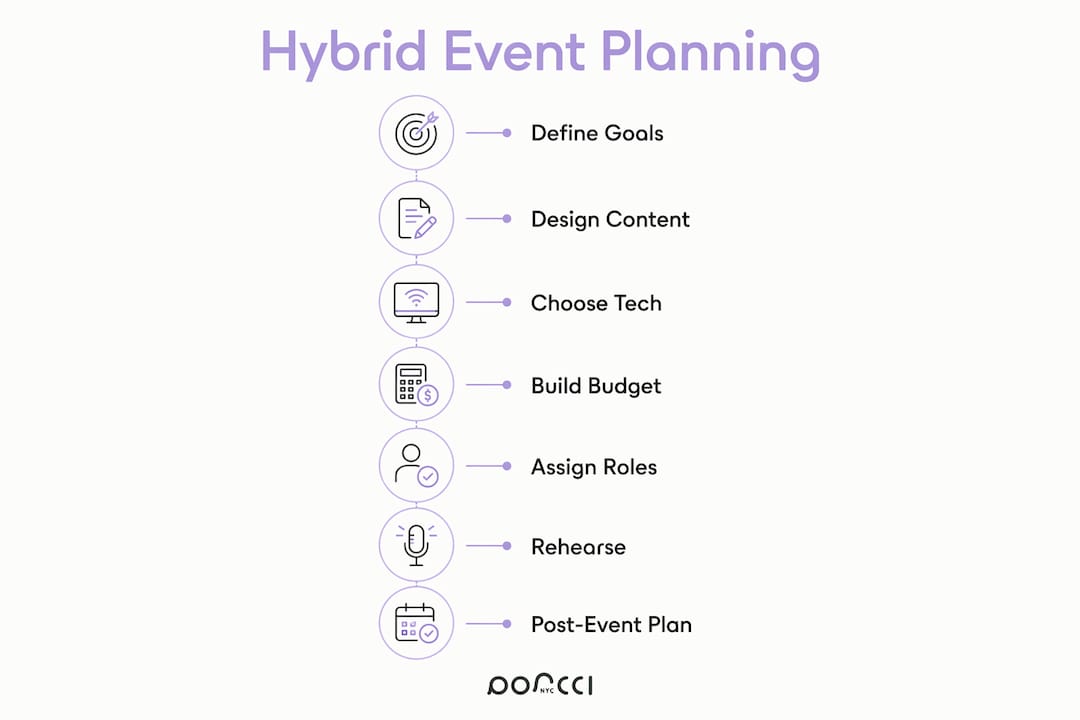
Successful hybrid event production follows a clear sequence. Skipping steps early in the process creates problems that are expensive and stressful to fix later.
Start by writing separate but connected goals for your in-person and virtual attendees. What do you want each group to know, feel, or do by the end of the event? These objectives drive every content and technology decision that follows.
Every session, presentation, and interactive moment needs to be evaluated for how it reads on camera, not just how it plays in the room. Speakers should be coached on camera awareness: looking directly at the lens, repeating in-room questions aloud for virtual attendees, and acknowledging remote audiences by name during Q&A.

Choose a streaming platform that supports the interactive features your virtual audience needs, including live chat, polling, and Q&A. Confirm that your venue’s internet infrastructure can handle the bandwidth your production requires, and arrange a dedicated connection separate from general venue Wi-Fi.
Experts recommend allocating 35–40% of your total hybrid event budget to audiovisual and streaming technology, which is significantly higher than the 10–15% typically allocated to traditional in-person events. Plan for this from the start rather than trying to cut AV costs after other line items are set.
A hybrid event needs at minimum:
• Event director: Overall program and logistics ownership
• In-room production lead: Stage management, lighting, and in-person AV
• Virtual host: Dedicated engagement and moderation for the online audience
• Technical producer: Streaming quality, platform management, and troubleshooting
• Content coordinator: Speaker support, slide management, and session transitions
For guidance on structuring these roles effectively, the corporate event staffing workflow framework is a practical starting point.
Rehearsal aligns speakers, moderators, and production teams, reducing the risk of technical glitches and ensuring both audiences experience a cohesive program. Run the rehearsal exactly as you would run the live event, including transitions, Q&A segments, and any interactive elements.
Hybrid events generate recording assets that extend the event’s value well beyond the live day. Plan how you will edit, distribute, and repurpose session recordings before the event, not after.
The most common failure in hybrid event design is treating the virtual audience as a passive viewing group rather than active participants. Inclusive design means actively making remote attendees visible through moderated Q&A, chat integration, and dedicated hosts who represent them in the room.
Engagement techniques that work for virtual attendees:
• Live polls launched every 10–15 minutes to maintain attention and gather input
• Chat monitoring by a dedicated moderator who surfaces online questions to speakers
• Breakout rooms for virtual networking between sessions
• On-screen acknowledgment of virtual participants during Q&A and discussions
• Shared digital resources, such as slide decks and resource links, delivered in real time
For in-person attendees:
• Physical networking time that is not replicated online, giving in-room attendance a distinct value
• Interactive elements like photo booth activations or live entertainment that create shareable moments
• Clear sight lines and room acoustics that support speaker visibility and engagement
The virtual host role is the single biggest lever for online engagement. A dedicated producer or moderator whose sole responsibility is managing the remote audience experience can monitor technical quality, facilitate online interactions, and keep virtual attendees from feeling like they are watching a recording rather than attending a live event.
Pro Tip: Design the virtual experience as the primary product first, then layer in-person elements on top of that foundation. This mindset shift forces you to give the online audience equal attention from the start, rather than retrofitting their experience at the end.
Accessibility planning belongs in this conversation too. Closed captions, screen-reader-compatible platforms, and clear audio descriptions for visual content are not optional extras. They are part of inclusive event planning that makes your event genuinely open to everyone.
The technology stack for a hybrid event is more demanding than most planners expect the first time they produce one. Getting it right requires decisions across several interconnected systems, and a weak link in any one of them affects the entire virtual experience.
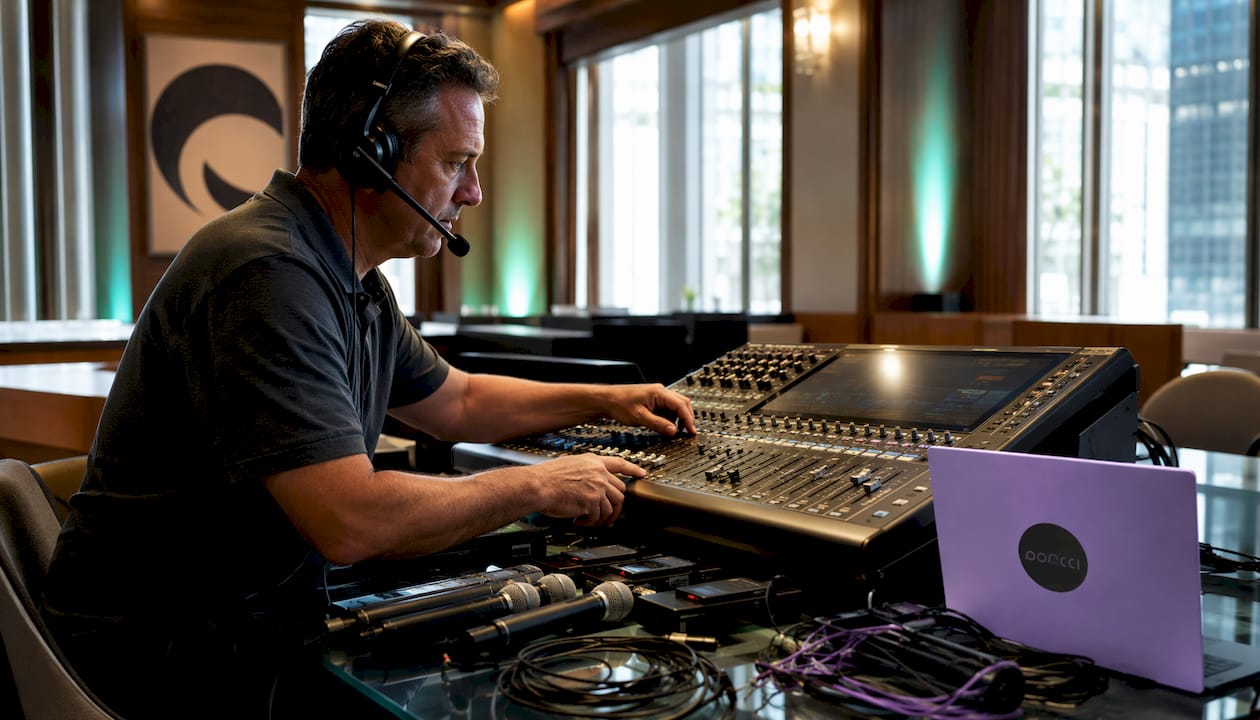
Audio is the foundation. Echo, feedback, or inaudible speech instantly reduce engagement for virtual attendees, even when the video feed is clean. You need directional microphones, a dedicated audio mixer for the streaming output, and an engineer monitoring the feed in real time throughout the event.
Streaming platforms and venue internet infrastructure must be selected to support stable, high-quality live broadcasts. The streaming production area should be physically separate from the in-room event space to avoid interference and allow independent troubleshooting.
| Component | Purpose | Common failure point |
|---|---|---|
| Dedicated internet line | Stable streaming bandwidth | Shared venue Wi-Fi drops under load |
| Professional audio mixer | Clean feed to streaming platform | Room audio bleeds into stream |
| PTZ or broadcast cameras | Clear speaker and stage capture | Auto-focus lag during movement |
| Streaming encoder | Converts AV signal to online format | Software crashes without backup |
| Interactive platform | Polls, Q&A, chat for virtual attendees | Platform latency delays responses |
| Backup 4G/5G connection | Failover if primary internet fails | Not tested before event day |
Hybrid event production typically requires allocating 35–40% of the total budget to AV and streaming technology, compared to just 10–15% for a traditional in-person event. That gap reflects the cost of a second production environment running simultaneously. Planners who underestimate this line item tend to compromise on audio or streaming quality, which is exactly where the virtual experience suffers most visibly.
Porcci NYC brings a practical advantage to hybrid event planning: a single source for professional entertainment and equipment rentals across New York City and New Jersey, with setup, delivery, and breakdown included. For planners managing the complexity of a hybrid format, reducing the number of vendors you are coordinating is a real operational benefit.
The services Porcci NYC provides that are directly relevant to hybrid event setups include:
• Professional sound systems: High-quality speakers and audio equipment that support clear in-room sound, which feeds directly into streaming quality
• DJ services: Live DJ entertainment that energizes the in-person audience while creating a dynamic atmosphere captured on the stream
• Multilingual karaoke systems: Interactive entertainment that engages in-room guests and can be shared with virtual attendees watching the live feed
• Photo booths: Physical activations including 360-degree and mirror photo booths that create shareable moments and add a distinct in-person value
• Lighting systems: Professional event lighting that improves both the in-room experience and the visual quality of the camera feed
• Event staffing: Experienced staff who handle setup and breakdown, freeing your team to focus on program management
Porcci NYC’s coverage spans NYC neighborhoods and key areas in New Jersey, and every package includes professional delivery and setup. For planners who need interactive entertainment options that work across both in-person and virtual audiences, the catalog covers the full range of what a hybrid event activation typically requires.
Planning a hybrid event is already a significant production undertaking. The entertainment and AV equipment side of it does not need to add to that complexity. Porcci NYC offers planners in New York City and New Jersey a direct path to professional-grade sound systems, DJ services, photo booths, lighting, and staffing, all coordinated through one booking process with setup and breakdown handled for you.
Whether you are producing a corporate hybrid conference, a private celebration with remote guests, or a large-scale community event, Porcci NYC’s equipment and entertainment packages are built to support the in-room experience that your virtual audience will see and hear on the stream. The DJ services and sound systems are particularly relevant for hybrid setups where audio quality directly determines how well the event lands for online participants.
Ready to lock in your entertainment and equipment? Start your booking with Porcci NYC and get your hybrid event production moving in the right direction.
Hybrid event planning succeeds when every content, technology, and staffing decision is evaluated against one standard: does it work equally well for both in-person and virtual attendees at the same time?
| Point | Details |
|---|---|
| Equal audience design | Build the virtual experience as the primary product, then layer in-person elements on top. |
| Audio is the priority | Audio quality is the single most critical technical factor; poor audio loses virtual attendees faster than any other failure. |
| Budget for AV seriously | Allocate 35–40% of your total hybrid event budget to AV and streaming technology. |
| Staff the virtual role | Assign a dedicated virtual host whose only job is managing and engaging the online audience. |
| Porcci NYC for entertainment | Porcci NYC provides sound systems, DJ services, photo booths, and staffing across NYC and New Jersey for hybrid event setups. |
A hybrid event is a single, unified experience designed to deliver equal value to both in-person attendees at a physical venue and remote participants joining online at the same time.
Start by defining separate but connected objectives for each audience, then design content, technology, and staffing to serve both simultaneously, rather than treating the virtual component as a secondary add-on.
The primary advantage is significantly broader reach, with 83% of organizers reporting higher overall attendance. The main drawback is increased production complexity and higher AV costs, typically requiring 35–40% of the total budget for technology.
The three core formats are in-person events, virtual events, and hybrid events. Each serves different audience needs, budget levels, and logistical requirements.
A dedicated virtual host monitors the online audience in real time, surfaces chat questions to speakers, and keeps remote participants actively involved, which is critical because virtual attendee engagement tends to drop after 20–25 minutes without direct interaction.
Discover what is hybrid event planning and how to create a seamless experience for both in-person and remote attendees. Elevate your events!
Hybrid event planning is the process of designing and managing one unified event experience that delivers equal value to both in-person and remote audiences at the same time. The key word is unified. A hybrid event is not a physical event with a livestream bolted on as an afterthought. It is a fully integrated experience where messaging, branding, content, and interaction are built to work simultaneously for people in the room and people on a screen.
Think of it this way: every content piece, every interactive moment, and every technical setup gets evaluated by one standard. Does it work for both audiences at once? If the answer is no, the design needs to change.
The core elements of hybrid event planning include:
• Dual audience journeys: Separate but equally considered experience paths for in-person and virtual attendees
• Content designed for both formats: Sessions structured so they translate clearly to a screen, not just a stage
• Technology integration: Streaming platforms, AV systems, and reliable internet infrastructure working together
• Dedicated virtual host: A person whose sole job is to engage, represent, and activate the online audience
• Engagement strategies: Live polls, moderated Q&A, chat monitoring, and breakout rooms built into the program
• Coordinated team structure: Distinct roles for in-room production and remote audience management
Getting these elements right from the start is what separates a hybrid event that feels cohesive from one where virtual attendees quietly drop off after the first 20 minutes.
• What is hybrid event planning?
• Hybrid events explained: what they are and what they are not
• Why hybrid events matter now more than ever
• When should you choose a hybrid event format?
• Common challenges in hybrid event planning and how to solve them
• How to plan a hybrid event step by step
• Best practices for inclusion and engagement across both audiences
• What does hybrid event tech actually require?
• How Porcci NYC supports hybrid event entertainment and rentals
• Porcci NYC makes hybrid event entertainment straightforward
• FAQ
A hybrid event is not two separate events running in parallel. It is not a conference where someone presses “go live” on a phone and calls it done. Those approaches create two disconnected experiences, and virtual attendees always feel like the secondary audience.
A well-executed hybrid event treats online participants as full partners in the experience. Here is how the formats compare:
Hybrid events:
• One cohesive program designed for both audiences simultaneously
• Virtual attendees can interact, ask questions, and participate in real time
• Branding, content flow, and speaker delivery are calibrated for screen and stage
• Technical production is purpose-built, not improvised
Virtual-only events:
• All attendees join remotely; no physical venue component
• Simpler production requirements and lower AV costs
• No in-room energy or networking dimension
In-person-only events:
• All attendees are physically present; no remote access
• Maximum in-room atmosphere and spontaneous interaction
• Geographic and accessibility limitations restrict who can attend
Practical examples of well-executed hybrid formats include annual corporate conferences where executives present from a main stage while global teams join via a dedicated streaming platform, medical association meetings where specialists attend in person while practitioners in rural areas participate remotely, and product launches where a live audience at a venue shares the moment with a global online community watching and reacting in real time.
The common thread in all of these is intentional design. The virtual experience is planned as a primary product, not an add-on, and the in-person experience is layered on top of that foundation.
Hybrid events moved from niche to mainstream over a relatively short period, driven by a combination of global connectivity, rising accessibility expectations, and advances in streaming technology. What began as a workaround has become a preferred format for organizations that want to reach wider audiences without sacrificing the energy of a live event.
Many event organizers report higher overall attendance with hybrid formats compared to in-person-only events. That reach advantage is real, but it comes with a condition: retention of remote participants beyond the first hour often fails without a dedicated virtual host actively managing the online experience.
Several forces are sustaining hybrid event growth:
• Global workforces and distributed teams that cannot all travel to one location
• Accessibility requirements for attendees with disabilities, caregiving responsibilities, or travel constraints
• Budget pressures that make it impractical for every stakeholder to attend in person
• Sustainability goals that favor reducing travel footprints without cutting participation
• Audience data and analytics that digital platforms provide, giving organizers richer post-event insight than in-room attendance alone
The event technology supporting hybrid formats has matured considerably. Streaming platforms, interactive polling tools, and professional AV systems are now accessible to planners at a wide range of budget levels, not just enterprise organizations with large production teams.
Hybrid is not always the right choice. It adds complexity and cost, and for some events, a simpler format serves the goal better. The decision comes down to your objectives, your audience, and your resources.
Choose hybrid when:
• Your audience is geographically distributed and travel is not practical for everyone
• Key speakers or executives are presenting from different locations
• Accessibility needs require remote participation options
• You want to extend your event’s reach and grow your audience beyond venue capacity
• Post-event content and on-demand viewing are part of your strategy
• Sponsors or stakeholders require broader visibility than an in-person audience provides
Stick with in-person only when:
• The event’s value is primarily experiential, hands-on, or relationship-driven in ways that do not translate to a screen
• Your audience is entirely local and attendance barriers are low
• Your budget cannot support the additional AV and production investment hybrid requires
Stick with virtual only when:
• Your entire audience is remote and there is no meaningful reason to anchor the event to a physical venue
• Speed and cost efficiency are the primary constraints
The clearest signal that hybrid is right for your event is when excluding remote participants would meaningfully reduce the event’s impact or reach. If the answer to “who can’t be there in person?” is a long list of people who matter, hybrid is worth the investment. A solid event planning checklist can help you work through these decisions systematically before committing to a format.
Hybrid events are genuinely more complex to produce than either in-person or virtual events alone. Planners who go in without a clear picture of the obstacles tend to discover them at the worst possible moment, usually during the live event itself.
The most common challenges include:
• Audio failure: Echo, feedback, or inaudible speech are the fastest ways to lose a virtual audience. Audio quality is the single most critical technical factor in hybrid events. Poor audio kills engagement even when the video feed looks perfect.
• Engagement disparity: In-room energy is visible and contagious. Virtual attendees do not feel it, and without deliberate design, they disengage. Virtual attendee engagement typically drops after some time without interaction, while in-person attendees can sustain focus for longer periods.
• Coordination complexity: Managing two simultaneous production environments, one physical and one digital, requires more staff, more communication, and more rehearsal than a single-format event.
• Technology failure points: Internet outages, streaming platform crashes, and AV misconfigurations can derail the virtual experience entirely while the in-room event continues unaffected.
• Unequal attendee experience: When planners focus primarily on the in-room audience, virtual participants feel like observers rather than participants.
Practical solutions:
• Hire a dedicated AV engineer focused exclusively on the streaming output
• Build interactive touchpoints every 10–15 minutes to keep virtual attendees engaged
• Assign a virtual host whose only responsibility is the online audience
• Run a full technical rehearsal with all speakers, moderators, and production staff before the event day
• Test your internet connection with a load simulation that mirrors live event traffic
Pro Tip: Prioritize audio over everything else in your tech budget. A crisp audio feed with average video quality will hold a virtual audience far longer than stunning visuals with muddy or inconsistent sound.
Successful hybrid event production follows a clear sequence. Skipping steps early in the process creates problems that are expensive and stressful to fix later.
Start by writing separate but connected goals for your in-person and virtual attendees. What do you want each group to know, feel, or do by the end of the event? These objectives drive every content and technology decision that follows.
Every session, presentation, and interactive moment needs to be evaluated for how it reads on camera, not just how it plays in the room. Speakers should be coached on camera awareness: looking directly at the lens, repeating in-room questions aloud for virtual attendees, and acknowledging remote audiences by name during Q&A.
Choose a streaming platform that supports the interactive features your virtual audience needs, including live chat, polling, and Q&A. Confirm that your venue’s internet infrastructure can handle the bandwidth your production requires, and arrange a dedicated connection separate from general venue Wi-Fi.
Experts recommend allocating 35–40% of your total hybrid event budget to audiovisual and streaming technology, which is significantly higher than the 10–15% typically allocated to traditional in-person events. Plan for this from the start rather than trying to cut AV costs after other line items are set.
A hybrid event needs at minimum:
• Event director: Overall program and logistics ownership
• In-room production lead: Stage management, lighting, and in-person AV
• Virtual host: Dedicated engagement and moderation for the online audience
• Technical producer: Streaming quality, platform management, and troubleshooting
• Content coordinator: Speaker support, slide management, and session transitions
For guidance on structuring these roles effectively, the corporate event staffing workflow framework is a practical starting point.
Rehearsal aligns speakers, moderators, and production teams, reducing the risk of technical glitches and ensuring both audiences experience a cohesive program. Run the rehearsal exactly as you would run the live event, including transitions, Q&A segments, and any interactive elements.
Hybrid events generate recording assets that extend the event’s value well beyond the live day. Plan how you will edit, distribute, and repurpose session recordings before the event, not after.
The most common failure in hybrid event design is treating the virtual audience as a passive viewing group rather than active participants. Inclusive design means actively making remote attendees visible through moderated Q&A, chat integration, and dedicated hosts who represent them in the room.
Engagement techniques that work for virtual attendees:
• Live polls launched every 10–15 minutes to maintain attention and gather input
• Chat monitoring by a dedicated moderator who surfaces online questions to speakers
• Breakout rooms for virtual networking between sessions
• On-screen acknowledgment of virtual participants during Q&A and discussions
• Shared digital resources, such as slide decks and resource links, delivered in real time
For in-person attendees:
• Physical networking time that is not replicated online, giving in-room attendance a distinct value
• Interactive elements like photo booth activations or live entertainment that create shareable moments
• Clear sight lines and room acoustics that support speaker visibility and engagement
The virtual host role is the single biggest lever for online engagement. A dedicated producer or moderator whose sole responsibility is managing the remote audience experience can monitor technical quality, facilitate online interactions, and keep virtual attendees from feeling like they are watching a recording rather than attending a live event.
Pro Tip: Design the virtual experience as the primary product first, then layer in-person elements on top of that foundation. This mindset shift forces you to give the online audience equal attention from the start, rather than retrofitting their experience at the end.
Accessibility planning belongs in this conversation too. Closed captions, screen-reader-compatible platforms, and clear audio descriptions for visual content are not optional extras. They are part of inclusive event planning that makes your event genuinely open to everyone.
The technology stack for a hybrid event is more demanding than most planners expect the first time they produce one. Getting it right requires decisions across several interconnected systems, and a weak link in any one of them affects the entire virtual experience.
Audio is the foundation. Echo, feedback, or inaudible speech instantly reduce engagement for virtual attendees, even when the video feed is clean. You need directional microphones, a dedicated audio mixer for the streaming output, and an engineer monitoring the feed in real time throughout the event.
Streaming platforms and venue internet infrastructure must be selected to support stable, high-quality live broadcasts. The streaming production area should be physically separate from the in-room event space to avoid interference and allow independent troubleshooting.
| Component | Purpose | Common failure point |
|---|---|---|
| Dedicated internet line | Stable streaming bandwidth | Shared venue Wi-Fi drops under load |
| Professional audio mixer | Clean feed to streaming platform | Room audio bleeds into stream |
| PTZ or broadcast cameras | Clear speaker and stage capture | Auto-focus lag during movement |
| Streaming encoder | Converts AV signal to online format | Software crashes without backup |
| Interactive platform | Polls, Q&A, chat for virtual attendees | Platform latency delays responses |
| Backup 4G/5G connection | Failover if primary internet fails | Not tested before event day |
Hybrid event production typically requires allocating 35–40% of the total budget to AV and streaming technology, compared to just 10–15% for a traditional in-person event. That gap reflects the cost of a second production environment running simultaneously. Planners who underestimate this line item tend to compromise on audio or streaming quality, which is exactly where the virtual experience suffers most visibly.
Porcci NYC brings a practical advantage to hybrid event planning: a single source for professional entertainment and equipment rentals across New York City and New Jersey, with setup, delivery, and breakdown included. For planners managing the complexity of a hybrid format, reducing the number of vendors you are coordinating is a real operational benefit.
The services Porcci NYC provides that are directly relevant to hybrid event setups include:
• Professional sound systems: High-quality speakers and audio equipment that support clear in-room sound, which feeds directly into streaming quality
• DJ services: Live DJ entertainment that energizes the in-person audience while creating a dynamic atmosphere captured on the stream
• Multilingual karaoke systems: Interactive entertainment that engages in-room guests and can be shared with virtual attendees watching the live feed
• Photo booths: Physical activations including 360-degree and mirror photo booths that create shareable moments and add a distinct in-person value
• Lighting systems: Professional event lighting that improves both the in-room experience and the visual quality of the camera feed
• Event staffing: Experienced staff who handle setup and breakdown, freeing your team to focus on program management
Porcci NYC’s coverage spans NYC neighborhoods and key areas in New Jersey, and every package includes professional delivery and setup. For planners who need interactive entertainment options that work across both in-person and virtual audiences, the catalog covers the full range of what a hybrid event activation typically requires.
Planning a hybrid event is already a significant production undertaking. The entertainment and AV equipment side of it does not need to add to that complexity. Porcci NYC offers planners in New York City and New Jersey a direct path to professional-grade sound systems, DJ services, photo booths, lighting, and staffing, all coordinated through one booking process with setup and breakdown handled for you.
Whether you are producing a corporate hybrid conference, a private celebration with remote guests, or a large-scale community event, Porcci NYC’s equipment and entertainment packages are built to support the in-room experience that your virtual audience will see and hear on the stream. The DJ services and sound systems are particularly relevant for hybrid setups where audio quality directly determines how well the event lands for online participants.
Ready to lock in your entertainment and equipment? Start your booking with Porcci NYC and get your hybrid event production moving in the right direction.
Hybrid event planning succeeds when every content, technology, and staffing decision is evaluated against one standard: does it work equally well for both in-person and virtual attendees at the same time?
| Point | Details |
|---|---|
| Equal audience design | Build the virtual experience as the primary product, then layer in-person elements on top. |
| Audio is the priority | Audio quality is the single most critical technical factor; poor audio loses virtual attendees faster than any other failure. |
| Budget for AV seriously | Allocate 35–40% of your total hybrid event budget to AV and streaming technology. |
| Staff the virtual role | Assign a dedicated virtual host whose only job is managing and engaging the online audience. |
| Porcci NYC for entertainment | Porcci NYC provides sound systems, DJ services, photo booths, and staffing across NYC and New Jersey for hybrid event setups. |
A hybrid event is a single, unified experience designed to deliver equal value to both in-person attendees at a physical venue and remote participants joining online at the same time.
Start by defining separate but connected objectives for each audience, then design content, technology, and staffing to serve both simultaneously, rather than treating the virtual component as a secondary add-on.
The primary advantage is significantly broader reach, with 83% of organizers reporting higher overall attendance. The main drawback is increased production complexity and higher AV costs, typically requiring 35–40% of the total budget for technology.
The three core formats are in-person events, virtual events, and hybrid events. Each serves different audience needs, budget levels, and logistical requirements.
A dedicated virtual host monitors the online audience in real time, surfaces chat questions to speakers, and keeps remote participants actively involved, which is critical because virtual attendee engagement tends to drop after 20–25 minutes without direct interaction.