Discover why flexibility in event services is crucial for success. Learn how adaptability can turn challenges into opportunities for your events.
Flexibility in event services is the ability to respond to sudden changes quickly and at low cost, and it is now the single most critical factor separating successful events from costly failures. Whether you are managing a corporate gala in Midtown Manhattan or a private celebration in New Jersey, something will change after you finalize the plan. Attendance shifts, a vendor cancels, the weather turns, or a client calls with a last-minute request at 9 PM. The planners who handle those moments without losing composure are not lucky. They built adaptability into their process from the start.
Operations flexibility is defined in event management research as the ability to take action in response to change in a short period and with low expense. That definition matters because it frames flexibility not as a personality trait but as a measurable operational capability. Here is why it has become the new currency for event organizers:
• Attendance can shift dramatically even after RSVPs are confirmed, requiring real-time staffing and catering adjustments.
• Vendor cancellations or equipment failures demand immediate substitution without disrupting the guest experience.
• Weather disruptions, venue access issues, and permit delays force rapid format changes.
• Client expectations evolve up to the day of the event, making rigid contracts a liability.
• Hybrid and virtual attendance options have created a new layer of logistical complexity that only adaptable teams can manage.
• Flexible staffing and operations reduce financial exposure when plans change, protecting your budget and your reputation.
Operational flexibility is not improvisation. It is a structured capability that event organizations build deliberately into their workflows, staffing models, and vendor relationships so that disruptions do not cascade into failures.
Research published in Tourism Management studied six Brazilian event-organizing entities and found that operations flexibility allows a system to remain stable amid variability by drawing on resources already embedded in an organization’s structure. The study identified two distinct sources of variability that event planners must manage.
| Variability Type | Source | Example Scenarios |
|---|---|---|
| External variability | Market and competitive forces | Attendance demand shifts, sponsor withdrawals, competitor events |
| Internal variability | Organizational processes and structure | Workflow breakdowns, communication failures, staff scheduling gaps |
External variability is largely outside your control. Internal variability is not. That distinction is where most event organizations have the most room to improve. When your internal workflows are rigid, a single point of failure, such as one key staff member calling out sick, can unravel an entire event. When those workflows are designed for change, the same disruption becomes a manageable inconvenience.
The same research proposed the concept of “internal infrastructure flexibility,” which covers the ability to change workflows, communication protocols, and data management processes without rebuilding operations from scratch. Think of it as the difference between a team that panics when the run-of-show changes and one that simply updates the shared document and keeps moving. Highly responsive organizations, the research notes, keep participants unaware of operational disruptions entirely. Service quality appears stable even when the system is actively adjusting underneath.
Staffing is where operational flexibility becomes most visible, and most expensive when it goes wrong. Fixed staffing models, where you commit to a set headcount weeks in advance, create two problems: you overstaff quiet periods and understaff surges. Neither is cheap.
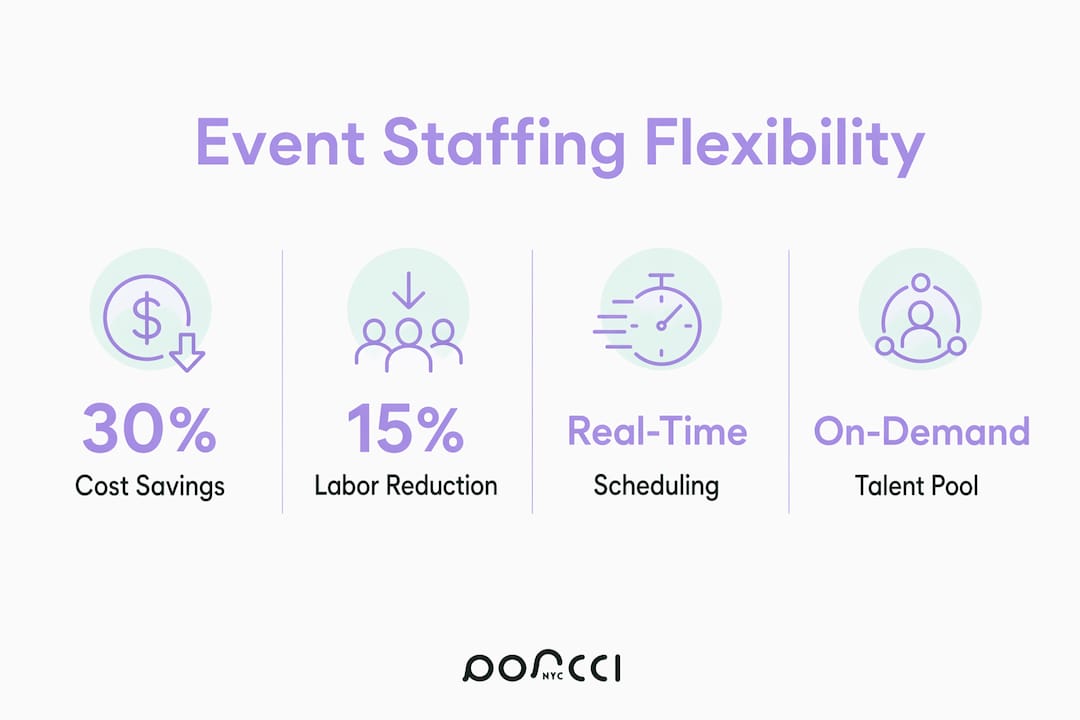
Flexible staffing models can reduce labor costs by 15–30% compared to fixed staffing, while enabling workforce adjustments that match actual event demand. That range reflects real savings across industries that rely on contingent labor, and the event sector is one of the clearest examples of where those savings materialize.

The workforce itself is moving in this direction. A substantial portion of the U.S. workforce now engages in independent work, which means the talent pool for on-demand event staffing is larger and more experienced than it has ever been. At the same time, 77% of workers now prefer flexible schedules, which means offering that flexibility is also a retention tool. The annual churn rate for event staff is 63%, but this figure drops when workers have schedule autonomy and feel less burned out by rigid shift structures.
Key advantages of flexible staffing models:
• On-demand talent pools let you scale up for a 500-person gala and scale back for a 50-person corporate dinner without carrying excess payroll.
• Reduced burnout risk comes from matching workloads to actual demand rather than forcing fixed staff through seasonal surges.
• Lower overhead results from eliminating benefits, training, and administrative costs tied to full-time headcount you only need occasionally.
• Better coverage across multiple simultaneous events becomes possible when you draw from a broad, pre-vetted worker pool.
• Alignment with gig economy trends makes your organization more attractive to skilled freelance talent who prioritize autonomy.
Technology is what makes flexible staffing operationally practical at scale. Automated scheduling tools improve shift fill rates and cut the administrative overhead that manual scheduling creates. Platforms with real-time workforce management capabilities let managers fill open shifts instantly, reduce no-shows, and push venue instructions directly to workers’ phones. For planners managing corporate event staffing workflows, that kind of real-time visibility is the difference between a smooth event and a scramble.
Pro Tip: Build your on-demand talent pool before you need it. Pre-vet workers, collect availability data, and run a small test event with your flexible staff roster so you know exactly who shows up and performs before a high-stakes event depends on them.
The best event planners do not just react to surprises. They design their planning process so that surprises cost less and resolve faster. These strategies are the ones that consistently hold up when conditions change.
Tactical delayed commitments are one of the most underused tools in event planning. Rather than locking in every contract as early as possible, delaying final commitments on non-critical elements until closer to the event date reduces risk exposure significantly. If attendance projections shift or a geopolitical event affects travel, you have not already paid for 300 catered meals you cannot use.
Contingency buffers should be built into every budget and timeline. A buffer is not a sign of poor planning. It is the acknowledgment that events are project-based operations with inherent variability, and that absorbing a disruption without a financial cushion is far more damaging than the cost of the buffer itself.
Integrated event management technology unifies your workflows across planning, staffing, and execution. Connected platforms that handle on-site and virtual attendee management together allow you to pivot between formats without rebuilding your operational structure. For hybrid events especially, virtual tour integrations and digital venue previews help planners anticipate layout changes before they become day-of problems.

Vendor-to-partner mindset shift: Treating suppliers as partners rather than interchangeable vendors removes friction from scale-ups and rapid changes. A partner who understands your event goals will find a solution when something goes wrong. A vendor who is fulfilling a contract will hand you a change-order invoice. The difference in how you structure those relationships upfront determines which one you get under pressure.
Key strategies for building adaptability into your events:
• Design your event format with change in mind from the first planning session, not as an afterthought.
• Establish clear communication protocols so that field staff, vendors, and clients receive updates through a single channel.
• Use an event planning checklist that includes contingency triggers, not just task completion milestones.
• Pre-negotiate flexibility clauses with venues and suppliers so that format changes do not require full contract renegotiation.
• Assign decision-making authority to on-site team leads so that field adjustments happen in real time without waiting for approval chains.
Pro Tip: Treat your event plan as a living document with version control. Every time a key variable changes, update the plan and redistribute it. Teams that work from the same current version make faster, better decisions under pressure.
Porcci NYC operates as a one-stop event services provider across New York City and New Jersey, and the flexibility of its model is not incidental. It is built into how the company structures its packages, staffing, and equipment offerings from the start.
The core of Porcci NYC’s approach is a fully integrated service model that covers entertainment, equipment, and staffing under one roof. When a client’s headcount doubles two weeks before a corporate event, Porcci NYC can scale its DJ services and sound system setup to match without the client having to coordinate three separate vendors. When a private party shifts from an outdoor rooftop to an indoor venue the morning of the event, the team adjusts the lighting and AV configuration on-site. That kind of responsiveness is only possible when the service provider controls the full stack of equipment and staffing.
Flexibility in event services means your provider can absorb the change so your guests never feel it. At Porcci NYC, we build every package with adjustment room built in, because we know from experience that the plan on paper and the event on the day are rarely identical. Our job is to make sure the difference is invisible to your guests.
Key features of Porcci NYC’s flexible service model include:
• Customizable packages covering karaoke systems, photo booths, DJ services, lighting, and sound, configurable for events from intimate gatherings to large-scale productions.
• On-demand staffing that scales with your event size, with experienced team members who handle setup, operation, and breakdown.
• Multilingual karaoke systems that adapt to diverse guest demographics, a practical example of inclusive event planning built into the product offering.
• Full delivery, setup, and breakdown service that removes logistical pressure from the planner and keeps the focus on the guest experience.
• Coverage across NYC neighborhoods and key New Jersey markets, including Edison, Manhattan, and surrounding areas, so that venue changes within the region do not require a new vendor search.
The flexible event spaces that Porcci NYC serves range from corporate boardrooms to outdoor festivals, and the company’s equipment inventory is selected specifically to work across that range. A photo booth that fits a 200-square-foot cocktail hour space and a 10,000-square-foot ballroom is a genuinely flexible asset. That kind of operational range is what allows Porcci NYC to serve weddings, bar and bat mitzvahs, corporate gatherings, and community events without treating each as a completely separate operational challenge.
Planners who want to see how this works in practice can start with the booking process to discuss package options and get a quote tailored to their specific event parameters.
Flexibility in event services is a designed operational capability, not a reactive habit, and it directly determines whether your event holds together when conditions change.
| Point | Details |
|---|---|
| Flexibility is a defined capability | It means responding to change quickly and at low cost, built into workflows and staffing from the start. |
| Flexible staffing cuts labor costs | Models that use on-demand talent reduce labor expenses by 15–30% compared to fixed staffing. |
| Internal variability is controllable | Workflow design, communication protocols, and staffing structures are within your control and determine resilience. |
| Tactical delayed commitments reduce risk | Finalizing non-critical contracts closer to the event date limits financial exposure when conditions shift. |
| Integrated technology enables real-time pivots | Connected platforms unify staffing, scheduling, and attendee management so format changes do not require rebuilding operations. |
Flexibility allows event planners to respond to last-minute changes, such as attendance shifts, vendor issues, or weather disruptions, without losing service quality or incurring major costs. Research confirms that operations flexibility is one of the most critical objectives in event management because disruptions are not exceptions; they are a standard feature of live events.
The phases of event management are commonly listed as concept, coordination, control, culmination, and closeout. Definitions vary across industry frameworks, but these five phases cover the full lifecycle from initial idea through post-event evaluation.
Adaptable planning reduces financial risk, improves client satisfaction, lowers staff burnout, and keeps the guest experience intact when conditions change. Flexible staffing models alone can reduce labor costs by 15–30%, and 77% of workers prefer the schedule autonomy that flexible models provide, which also improves retention.
Workforce management platforms enable real-time scheduling adjustments, instant shift notifications, and centralized visibility into staff availability, all of which are critical when event conditions change quickly. Integrated digital tools also allow planners to manage on-site and virtual attendees through a single system, making hybrid format pivots far less disruptive.
Maintaining consistency across a rotating pool of temporary and freelance staff is the primary challenge. Structured onboarding, standardized training, and centralized communication platforms address this directly by ensuring every worker arrives with the same baseline knowledge regardless of when they were added to the roster.
Discover why flexibility in event services is crucial for success. Learn how adaptability can turn challenges into opportunities for your events.
Flexibility in event services is the ability to respond to sudden changes quickly and at low cost, and it is now the single most critical factor separating successful events from costly failures. Whether you are managing a corporate gala in Midtown Manhattan or a private celebration in New Jersey, something will change after you finalize the plan. Attendance shifts, a vendor cancels, the weather turns, or a client calls with a last-minute request at 9 PM. The planners who handle those moments without losing composure are not lucky. They built adaptability into their process from the start.
Operations flexibility is defined in event management research as the ability to take action in response to change in a short period and with low expense. That definition matters because it frames flexibility not as a personality trait but as a measurable operational capability. Here is why it has become the new currency for event organizers:
• Attendance can shift dramatically even after RSVPs are confirmed, requiring real-time staffing and catering adjustments.
• Vendor cancellations or equipment failures demand immediate substitution without disrupting the guest experience.
• Weather disruptions, venue access issues, and permit delays force rapid format changes.
• Client expectations evolve up to the day of the event, making rigid contracts a liability.
• Hybrid and virtual attendance options have created a new layer of logistical complexity that only adaptable teams can manage.
• Flexible staffing and operations reduce financial exposure when plans change, protecting your budget and your reputation.
Operational flexibility is not improvisation. It is a structured capability that event organizations build deliberately into their workflows, staffing models, and vendor relationships so that disruptions do not cascade into failures.
Research published in Tourism Management studied six Brazilian event-organizing entities and found that operations flexibility allows a system to remain stable amid variability by drawing on resources already embedded in an organization’s structure. The study identified two distinct sources of variability that event planners must manage.
| Variability Type | Source | Example Scenarios |
|---|---|---|
| External variability | Market and competitive forces | Attendance demand shifts, sponsor withdrawals, competitor events |
| Internal variability | Organizational processes and structure | Workflow breakdowns, communication failures, staff scheduling gaps |
External variability is largely outside your control. Internal variability is not. That distinction is where most event organizations have the most room to improve. When your internal workflows are rigid, a single point of failure, such as one key staff member calling out sick, can unravel an entire event. When those workflows are designed for change, the same disruption becomes a manageable inconvenience.
The same research proposed the concept of “internal infrastructure flexibility,” which covers the ability to change workflows, communication protocols, and data management processes without rebuilding operations from scratch. Think of it as the difference between a team that panics when the run-of-show changes and one that simply updates the shared document and keeps moving. Highly responsive organizations, the research notes, keep participants unaware of operational disruptions entirely. Service quality appears stable even when the system is actively adjusting underneath.
Staffing is where operational flexibility becomes most visible, and most expensive when it goes wrong. Fixed staffing models, where you commit to a set headcount weeks in advance, create two problems: you overstaff quiet periods and understaff surges. Neither is cheap.
Flexible staffing models can reduce labor costs by 15–30% compared to fixed staffing, while enabling workforce adjustments that match actual event demand. That range reflects real savings across industries that rely on contingent labor, and the event sector is one of the clearest examples of where those savings materialize.
The workforce itself is moving in this direction. A substantial portion of the U.S. workforce now engages in independent work, which means the talent pool for on-demand event staffing is larger and more experienced than it has ever been. At the same time, 77% of workers now prefer flexible schedules, which means offering that flexibility is also a retention tool. The annual churn rate for event staff is 63%, but this figure drops when workers have schedule autonomy and feel less burned out by rigid shift structures.
Key advantages of flexible staffing models:
• On-demand talent pools let you scale up for a 500-person gala and scale back for a 50-person corporate dinner without carrying excess payroll.
• Reduced burnout risk comes from matching workloads to actual demand rather than forcing fixed staff through seasonal surges.
• Lower overhead results from eliminating benefits, training, and administrative costs tied to full-time headcount you only need occasionally.
• Better coverage across multiple simultaneous events becomes possible when you draw from a broad, pre-vetted worker pool.
• Alignment with gig economy trends makes your organization more attractive to skilled freelance talent who prioritize autonomy.
Technology is what makes flexible staffing operationally practical at scale. Automated scheduling tools improve shift fill rates and cut the administrative overhead that manual scheduling creates. Platforms with real-time workforce management capabilities let managers fill open shifts instantly, reduce no-shows, and push venue instructions directly to workers’ phones. For planners managing corporate event staffing workflows, that kind of real-time visibility is the difference between a smooth event and a scramble.
Pro Tip: Build your on-demand talent pool before you need it. Pre-vet workers, collect availability data, and run a small test event with your flexible staff roster so you know exactly who shows up and performs before a high-stakes event depends on them.
The best event planners do not just react to surprises. They design their planning process so that surprises cost less and resolve faster. These strategies are the ones that consistently hold up when conditions change.
Tactical delayed commitments are one of the most underused tools in event planning. Rather than locking in every contract as early as possible, delaying final commitments on non-critical elements until closer to the event date reduces risk exposure significantly. If attendance projections shift or a geopolitical event affects travel, you have not already paid for 300 catered meals you cannot use.
Contingency buffers should be built into every budget and timeline. A buffer is not a sign of poor planning. It is the acknowledgment that events are project-based operations with inherent variability, and that absorbing a disruption without a financial cushion is far more damaging than the cost of the buffer itself.
Integrated event management technology unifies your workflows across planning, staffing, and execution. Connected platforms that handle on-site and virtual attendee management together allow you to pivot between formats without rebuilding your operational structure. For hybrid events especially, virtual tour integrations and digital venue previews help planners anticipate layout changes before they become day-of problems.
Vendor-to-partner mindset shift: Treating suppliers as partners rather than interchangeable vendors removes friction from scale-ups and rapid changes. A partner who understands your event goals will find a solution when something goes wrong. A vendor who is fulfilling a contract will hand you a change-order invoice. The difference in how you structure those relationships upfront determines which one you get under pressure.
Key strategies for building adaptability into your events:
• Design your event format with change in mind from the first planning session, not as an afterthought.
• Establish clear communication protocols so that field staff, vendors, and clients receive updates through a single channel.
• Use an event planning checklist that includes contingency triggers, not just task completion milestones.
• Pre-negotiate flexibility clauses with venues and suppliers so that format changes do not require full contract renegotiation.
• Assign decision-making authority to on-site team leads so that field adjustments happen in real time without waiting for approval chains.
Pro Tip: Treat your event plan as a living document with version control. Every time a key variable changes, update the plan and redistribute it. Teams that work from the same current version make faster, better decisions under pressure.
Porcci NYC operates as a one-stop event services provider across New York City and New Jersey, and the flexibility of its model is not incidental. It is built into how the company structures its packages, staffing, and equipment offerings from the start.
The core of Porcci NYC’s approach is a fully integrated service model that covers entertainment, equipment, and staffing under one roof. When a client’s headcount doubles two weeks before a corporate event, Porcci NYC can scale its DJ services and sound system setup to match without the client having to coordinate three separate vendors. When a private party shifts from an outdoor rooftop to an indoor venue the morning of the event, the team adjusts the lighting and AV configuration on-site. That kind of responsiveness is only possible when the service provider controls the full stack of equipment and staffing.
Flexibility in event services means your provider can absorb the change so your guests never feel it. At Porcci NYC, we build every package with adjustment room built in, because we know from experience that the plan on paper and the event on the day are rarely identical. Our job is to make sure the difference is invisible to your guests.
Key features of Porcci NYC’s flexible service model include:
• Customizable packages covering karaoke systems, photo booths, DJ services, lighting, and sound, configurable for events from intimate gatherings to large-scale productions.
• On-demand staffing that scales with your event size, with experienced team members who handle setup, operation, and breakdown.
• Multilingual karaoke systems that adapt to diverse guest demographics, a practical example of inclusive event planning built into the product offering.
• Full delivery, setup, and breakdown service that removes logistical pressure from the planner and keeps the focus on the guest experience.
• Coverage across NYC neighborhoods and key New Jersey markets, including Edison, Manhattan, and surrounding areas, so that venue changes within the region do not require a new vendor search.
The flexible event spaces that Porcci NYC serves range from corporate boardrooms to outdoor festivals, and the company’s equipment inventory is selected specifically to work across that range. A photo booth that fits a 200-square-foot cocktail hour space and a 10,000-square-foot ballroom is a genuinely flexible asset. That kind of operational range is what allows Porcci NYC to serve weddings, bar and bat mitzvahs, corporate gatherings, and community events without treating each as a completely separate operational challenge.
Planners who want to see how this works in practice can start with the booking process to discuss package options and get a quote tailored to their specific event parameters.
Flexibility in event services is a designed operational capability, not a reactive habit, and it directly determines whether your event holds together when conditions change.
| Point | Details |
|---|---|
| Flexibility is a defined capability | It means responding to change quickly and at low cost, built into workflows and staffing from the start. |
| Flexible staffing cuts labor costs | Models that use on-demand talent reduce labor expenses by 15–30% compared to fixed staffing. |
| Internal variability is controllable | Workflow design, communication protocols, and staffing structures are within your control and determine resilience. |
| Tactical delayed commitments reduce risk | Finalizing non-critical contracts closer to the event date limits financial exposure when conditions shift. |
| Integrated technology enables real-time pivots | Connected platforms unify staffing, scheduling, and attendee management so format changes do not require rebuilding operations. |
Flexibility allows event planners to respond to last-minute changes, such as attendance shifts, vendor issues, or weather disruptions, without losing service quality or incurring major costs. Research confirms that operations flexibility is one of the most critical objectives in event management because disruptions are not exceptions; they are a standard feature of live events.
The phases of event management are commonly listed as concept, coordination, control, culmination, and closeout. Definitions vary across industry frameworks, but these five phases cover the full lifecycle from initial idea through post-event evaluation.
Adaptable planning reduces financial risk, improves client satisfaction, lowers staff burnout, and keeps the guest experience intact when conditions change. Flexible staffing models alone can reduce labor costs by 15–30%, and 77% of workers prefer the schedule autonomy that flexible models provide, which also improves retention.
Workforce management platforms enable real-time scheduling adjustments, instant shift notifications, and centralized visibility into staff availability, all of which are critical when event conditions change quickly. Integrated digital tools also allow planners to manage on-site and virtual attendees through a single system, making hybrid format pivots far less disruptive.
Maintaining consistency across a rotating pool of temporary and freelance staff is the primary challenge. Structured onboarding, standardized training, and centralized communication platforms address this directly by ensuring every worker arrives with the same baseline knowledge regardless of when they were added to the roster.