Discover how multilingual karaoke systems boost guest participation and inclusion at NYC and NJ weddings, corporate events, and private parties.
TL;DR:
• Multilingual karaoke enhances guest participation and event energy across diverse audiences.
• Upgrading to multilingual systems increases event memorability and positive feedback.
• Proper planning and equipment ensure seamless integration, creating inclusive, high-energy events.
Many events fall flat for guests who don’t speak the primary language, and most planners never realize it’s happening. Guests smile politely, skip the mic, and disengage quietly. The fix is simpler than you think. Multilingual karaoke systems give every guest a song they recognize, lyrics they can read, and a moment to shine. This guide walks you through why these systems matter, how to set them up, and how to turn a diverse crowd into a fully connected, high-energy room.
• Why multilingual karaoke is essential for modern events
• Key benefits of multilingual karaoke systems for events
• How to integrate multilingual karaoke seamlessly at your event
• Overcoming common challenges and maximizing impact
• The real ROI of multilingual karaoke: beyond language, toward true connection
• Ready to transform your event? Rent the right multilingual karaoke system
| Point | Details |
|---|---|
| Enhance inclusion | Multilingual karaoke ensures all guests feel welcome and excited to participate. |
| Boost engagement | Events gain energy and memorability when everyone can join in the fun. |
| Solve common event challenges | The right setup and song list help overcome language and participation barriers. |
| Easy event integration | Multilingual systems can be tailored for weddings, corporate events, and parties of any size. |
New York City and New Jersey are two of the most culturally rich regions in the country. Walk into any wedding reception in Queens or a corporate dinner in Jersey City, and you’ll find guests speaking Spanish, Mandarin, Korean, Tagalog, Hindi, and more, often all in the same room. NYC is one of the most linguistically diverse cities in the world, with over 200 languages spoken across its five boroughs. That’s not a niche detail. It’s your guest list.
When an event only offers songs in English, a large portion of attendees can’t fully participate. They watch others sing. They feel like spectators rather than guests. That quiet disengagement is one of the most common reasons events feel flat despite great food, great venues, and solid planning.
Multilingual karaoke solves this directly. Here’s what changes when you include it:
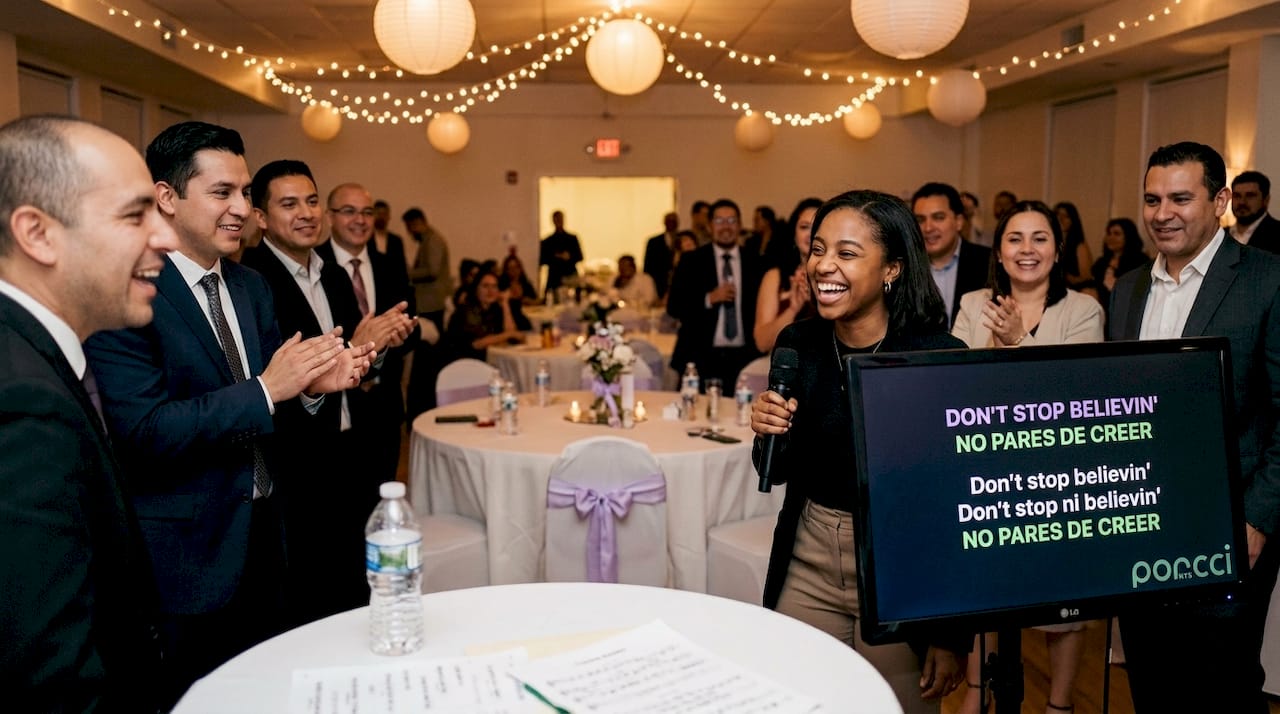
• Guests recognize songs in their native language and feel invited to participate
• Energy stays high because more people are actively involved throughout the night
• Connections form across language groups when guests cheer for each other’s performances
• The event feels personalized, which guests remember and talk about afterward
Understanding the history of karaoke technology helps put this in perspective. Karaoke was always designed to lower barriers to participation. Multilingual systems simply extend that original purpose to match today’s diverse audiences. For planners in NYC and NJ, this isn’t optional anymore. It’s the standard your guests expect.
Let’s look at what actually changes when you upgrade from a single-language setup to a multilingual one.

| Feature | Single-language system | Multilingual system |
|---|---|---|
| Guest participation rate | Limited to English speakers | Open to all language groups |
| Song library size | Typically 5,000 to 10,000 songs | Often 20,000+ across 10 to 20 languages |
| Guest satisfaction | Moderate | Consistently higher |
| Event memorability | Average | Strongly positive |
Karaoke boosts audience participation and enjoyment at events of all sizes, and multilingual systems amplify that effect significantly. The top three outcomes planners report after switching are:
1. Increased energy on the floor: More guests singing means more guests cheering, and the room feeds off that momentum
2. More memorable events: Guests who perform in their native language create standout moments that people talk about for months
3. Positive feedback and repeat bookings: Attendees notice when an event was planned with them in mind
For corporate event enhancements, this matters even more. Employee engagement and client relations both improve when people feel seen and included.

Pro Tip: During your pre-event planning calls, ask guests or team leads which languages are represented in the group. Then call out those language options on the night’s program. This small step dramatically increases first-time participation.
Knowing the benefits is one thing. Executing it cleanly is another. Here’s how to make it work without adding stress to your planning process.
Multilingual song lists can be curated based on attendee demographics, so start there. Gather your guest list data early and identify the top three to five language groups represented. Build your song catalog around those languages first, then fill in the rest.
When evaluating equipment, look for these features:
• Real-time lyrics display with language selector visible to the performer
• On-screen language toggle so guests can switch without needing staff help
• Large, readable fonts for guests who may not be familiar with romanized versions of their language
• Stable song search by language, artist, or title in native script
| Event type | Recommended languages | Song style focus |
|---|---|---|
| Wedding reception | Match guest demographics | Romantic ballads, pop classics |
| Corporate dinner | English plus top 2 guest languages | Upbeat, crowd-pleasing hits |
| Community celebration | All represented languages | Folk, pop, regional favorites |
For wedding karaoke planning, we recommend assigning a host or emcee who can introduce songs in more than one language. This keeps the flow moving and encourages shy guests to step up.
Pro Tip: For non-native speakers who are hesitant, pair them with a confident guest for a duet. It lowers the pressure and almost always gets the biggest reaction from the crowd.
No event is without its hurdles, but with a few smart strategies, you can sidestep typical issues and make your event a standout.
Here are the most common challenges planners face and how to handle each one:
1. Tech hiccups during the event: Test the system at least two hours before guests arrive. Run through the language selector, check lyrics display on all screens, and confirm audio levels for each mic
2. Limited song availability in certain languages: Work with your rental provider at least two weeks out to request specific songs or language packs. Most providers can accommodate custom requests with enough notice
3. Shy guests who won’t take the mic: Use a host to guide the first few performances. Opening with a group sing-along in a popular language breaks the ice fast
4. Pacing issues during the event: Pre-queue a rotation of songs across languages so there’s no dead air between performers
“We had guests from five different countries at our company event, and the multilingual karaoke was the highlight of the night. People who never sing got up and performed. It brought the whole team together in a way nothing else could have.”
Well-executed multilingual experiences boost positive reviews and repeat bookings, and that’s exactly what planners in competitive markets like NYC and NJ need. Check out our rental tips for events to get the most from your setup.
Most planners still think of karaoke as a fun add-on. We’d push back on that. When you look at what multilingual karaoke actually does, it functions as a strategic inclusion tool. It signals to every guest that they were considered before the event even started.
For karaoke for company culture, the ROI shows up in employee engagement scores, client retention, and post-event sentiment. For weddings and private parties, it shows up in the photos, the stories, and the reviews. These aren’t soft outcomes. They’re the metrics your clients measure success by. Treat multilingual karaoke as a touchpoint for belonging, not just a playlist feature, and you’ll deliver events that people genuinely remember.
If you’re planning an event in New York City or New Jersey and want every guest to feel included, we make it simple. Explore our karaoke rental in NYC and NJ options to find the right system for your event size and language needs. Pair it with our audio-visual solutions for a complete, professional setup. Need a full planning walkthrough? Our full karaoke rental guide covers everything from equipment selection to day-of logistics so you can focus on your guests.
Most modern systems support English, Spanish, Chinese, Korean, Tagalog, and dozens of other languages. NYC karaoke rentals typically offer song libraries spanning 10 to 20 or more languages to match the city’s diverse guest profiles.
Pricing is generally comparable to standard systems. Rental cost varies mainly by event size and equipment features, with only minor fees for expanded song libraries or specialty language packs.
Yes, most vendors allow you to request or pre-select songs in multiple languages. Playlists can be curated based on your guest demographics, so share your attendee breakdown with your rental provider early in the process.
Booking two to four weeks in advance is ideal to ensure availability, especially for large events. Advance booking is advised to secure specialized equipment and allow time for custom song library requests.
Basic operation is straightforward, but for large events, on-site tech support is strongly recommended. Professional support is available with most premium rentals to handle transitions, troubleshoot quickly, and keep the energy moving all night.
Discover how multilingual karaoke systems boost guest participation and inclusion at NYC and NJ weddings, corporate events, and private parties.
TL;DR:
• Multilingual karaoke enhances guest participation and event energy across diverse audiences.
• Upgrading to multilingual systems increases event memorability and positive feedback.
• Proper planning and equipment ensure seamless integration, creating inclusive, high-energy events.
Many events fall flat for guests who don’t speak the primary language, and most planners never realize it’s happening. Guests smile politely, skip the mic, and disengage quietly. The fix is simpler than you think. Multilingual karaoke systems give every guest a song they recognize, lyrics they can read, and a moment to shine. This guide walks you through why these systems matter, how to set them up, and how to turn a diverse crowd into a fully connected, high-energy room.
• Why multilingual karaoke is essential for modern events
• Key benefits of multilingual karaoke systems for events
• How to integrate multilingual karaoke seamlessly at your event
• Overcoming common challenges and maximizing impact
• The real ROI of multilingual karaoke: beyond language, toward true connection
• Ready to transform your event? Rent the right multilingual karaoke system
| Point | Details |
|---|---|
| Enhance inclusion | Multilingual karaoke ensures all guests feel welcome and excited to participate. |
| Boost engagement | Events gain energy and memorability when everyone can join in the fun. |
| Solve common event challenges | The right setup and song list help overcome language and participation barriers. |
| Easy event integration | Multilingual systems can be tailored for weddings, corporate events, and parties of any size. |
New York City and New Jersey are two of the most culturally rich regions in the country. Walk into any wedding reception in Queens or a corporate dinner in Jersey City, and you’ll find guests speaking Spanish, Mandarin, Korean, Tagalog, Hindi, and more, often all in the same room. NYC is one of the most linguistically diverse cities in the world, with over 200 languages spoken across its five boroughs. That’s not a niche detail. It’s your guest list.
When an event only offers songs in English, a large portion of attendees can’t fully participate. They watch others sing. They feel like spectators rather than guests. That quiet disengagement is one of the most common reasons events feel flat despite great food, great venues, and solid planning.
Multilingual karaoke solves this directly. Here’s what changes when you include it:
• Guests recognize songs in their native language and feel invited to participate
• Energy stays high because more people are actively involved throughout the night
• Connections form across language groups when guests cheer for each other’s performances
• The event feels personalized, which guests remember and talk about afterward
Understanding the history of karaoke technology helps put this in perspective. Karaoke was always designed to lower barriers to participation. Multilingual systems simply extend that original purpose to match today’s diverse audiences. For planners in NYC and NJ, this isn’t optional anymore. It’s the standard your guests expect.
Let’s look at what actually changes when you upgrade from a single-language setup to a multilingual one.
| Feature | Single-language system | Multilingual system |
|---|---|---|
| Guest participation rate | Limited to English speakers | Open to all language groups |
| Song library size | Typically 5,000 to 10,000 songs | Often 20,000+ across 10 to 20 languages |
| Guest satisfaction | Moderate | Consistently higher |
| Event memorability | Average | Strongly positive |
Karaoke boosts audience participation and enjoyment at events of all sizes, and multilingual systems amplify that effect significantly. The top three outcomes planners report after switching are:
1. Increased energy on the floor: More guests singing means more guests cheering, and the room feeds off that momentum
2. More memorable events: Guests who perform in their native language create standout moments that people talk about for months
3. Positive feedback and repeat bookings: Attendees notice when an event was planned with them in mind
For corporate event enhancements, this matters even more. Employee engagement and client relations both improve when people feel seen and included.
Pro Tip: During your pre-event planning calls, ask guests or team leads which languages are represented in the group. Then call out those language options on the night’s program. This small step dramatically increases first-time participation.
Knowing the benefits is one thing. Executing it cleanly is another. Here’s how to make it work without adding stress to your planning process.
Multilingual song lists can be curated based on attendee demographics, so start there. Gather your guest list data early and identify the top three to five language groups represented. Build your song catalog around those languages first, then fill in the rest.
When evaluating equipment, look for these features:
• Real-time lyrics display with language selector visible to the performer
• On-screen language toggle so guests can switch without needing staff help
• Large, readable fonts for guests who may not be familiar with romanized versions of their language
• Stable song search by language, artist, or title in native script
| Event type | Recommended languages | Song style focus |
|---|---|---|
| Wedding reception | Match guest demographics | Romantic ballads, pop classics |
| Corporate dinner | English plus top 2 guest languages | Upbeat, crowd-pleasing hits |
| Community celebration | All represented languages | Folk, pop, regional favorites |
For wedding karaoke planning, we recommend assigning a host or emcee who can introduce songs in more than one language. This keeps the flow moving and encourages shy guests to step up.
Pro Tip: For non-native speakers who are hesitant, pair them with a confident guest for a duet. It lowers the pressure and almost always gets the biggest reaction from the crowd.
No event is without its hurdles, but with a few smart strategies, you can sidestep typical issues and make your event a standout.
Here are the most common challenges planners face and how to handle each one:
1. Tech hiccups during the event: Test the system at least two hours before guests arrive. Run through the language selector, check lyrics display on all screens, and confirm audio levels for each mic
2. Limited song availability in certain languages: Work with your rental provider at least two weeks out to request specific songs or language packs. Most providers can accommodate custom requests with enough notice
3. Shy guests who won’t take the mic: Use a host to guide the first few performances. Opening with a group sing-along in a popular language breaks the ice fast
4. Pacing issues during the event: Pre-queue a rotation of songs across languages so there’s no dead air between performers
“We had guests from five different countries at our company event, and the multilingual karaoke was the highlight of the night. People who never sing got up and performed. It brought the whole team together in a way nothing else could have.”
Well-executed multilingual experiences boost positive reviews and repeat bookings, and that’s exactly what planners in competitive markets like NYC and NJ need. Check out our rental tips for events to get the most from your setup.
Most planners still think of karaoke as a fun add-on. We’d push back on that. When you look at what multilingual karaoke actually does, it functions as a strategic inclusion tool. It signals to every guest that they were considered before the event even started.
For karaoke for company culture, the ROI shows up in employee engagement scores, client retention, and post-event sentiment. For weddings and private parties, it shows up in the photos, the stories, and the reviews. These aren’t soft outcomes. They’re the metrics your clients measure success by. Treat multilingual karaoke as a touchpoint for belonging, not just a playlist feature, and you’ll deliver events that people genuinely remember.
If you’re planning an event in New York City or New Jersey and want every guest to feel included, we make it simple. Explore our karaoke rental in NYC and NJ options to find the right system for your event size and language needs. Pair it with our audio-visual solutions for a complete, professional setup. Need a full planning walkthrough? Our full karaoke rental guide covers everything from equipment selection to day-of logistics so you can focus on your guests.
Most modern systems support English, Spanish, Chinese, Korean, Tagalog, and dozens of other languages. NYC karaoke rentals typically offer song libraries spanning 10 to 20 or more languages to match the city’s diverse guest profiles.
Pricing is generally comparable to standard systems. Rental cost varies mainly by event size and equipment features, with only minor fees for expanded song libraries or specialty language packs.
Yes, most vendors allow you to request or pre-select songs in multiple languages. Playlists can be curated based on your guest demographics, so share your attendee breakdown with your rental provider early in the process.
Booking two to four weeks in advance is ideal to ensure availability, especially for large events. Advance booking is advised to secure specialized equipment and allow time for custom song library requests.
Basic operation is straightforward, but for large events, on-site tech support is strongly recommended. Professional support is available with most premium rentals to handle transitions, troubleshoot quickly, and keep the energy moving all night.

Want the latest updates & offers on Porcci NYC? Add your email to our VIP list. We send about 2-3 emails a month!