Operational AV checklist, a 12 week milestone map, and vendor ready SOW and BOM items event planners can drop into vendor briefs to prevent show-day...
Every corporate awards night needs six AV elements working together: front-of-house sound, wireless and wired microphones, stage and ambient lighting, visuals on LED or projection, a show control and playback system, and streaming gear if remote guests are watching. The single step that prevents a show-day meltdown is locking a written scope of work and bill of materials with your AV partner before you book anything else. Most corporate events need four to six months of lead time, though smaller gatherings can move faster.
TL;DR:
• Locking a detailed scope of work and bill of materials early helps prevent last-minute changes that can escalate costs and cause scheduling issues.
• A 12-week planning window is recommended for mid-size awards nights to ensure proper decision-making, with larger events sometimes needing up to a year.
• Prioritize a well-sized sound system and clear sightlines over elaborate visuals if budget constraints exist, focusing on the event’s actual goals.
• Confirm venue power, safety standards, and accessibility features such as captioning and assistive listening devices early to meet ADA and OSHA standards.
• Choose AV vendors who provide comprehensive documentation, including a written scope, bill of materials, rehearsal plans, and references, to ensure reliable execution.
• Planner’s quick AV checklist to include in vendor briefs
• Recommended timeline and milestone plan for awards night AV
• What each AV system does and what to specify
• Hybrid and streaming setup for remote attendees
• Electrical safety and accessibility essentials for your venue
• What to demand from an AV provider
• Which AV choices drive cost and where to invest
• How we build reliable awards-night AV
• Planning your next awards night with Porcci NYC
• FAQ
• Sources
Before you send out a single request for quote, build your own checklist. It keeps every vendor answering the same questions and makes proposals easy to compare side by side.
• Confirm venue power and stage dimensions, plus PA and monitor counts for the room size.
• Decide your wired versus wireless microphone mix and build in playback redundancy for award music cues.
• Map lighting zones separately for presentation areas and ambient or branded moments, and choose between LED walls and projection for visuals.
• Set your streaming and recording scope, including encoder backups and a separate broadcast mix if you are simulcasting.
• Add accessibility line items: live captioning, assistive listening devices, and clear slide specs for on-screen text.
• Define day-of staffing roles and the minimum crew size your event requires.
Our AV equipment checklist covers this in more depth if you want a version to hand directly to vendors.
Lead time depends on scale. Freeman’s guidance puts typical corporate events at four to six months, with large productions often require about a year, and smaller meetings can sometimes be arranged quickly if the scope stays simple. For a mid-size corporate awards night, a 12-week runway gives you room to make good decisions instead of rushed ones.
1. Weeks 1-2: Set your budget, confirm the venue, and define the scope of your AV needs.
2. Weeks 3-4: Schedule a site survey and request your bill of materials and written SOW from vendors.
3. Weeks 5-6: Lock lighting, audio, and video specs, and book electricians and rigging crew.
4. Weeks 7-9: Finalize content deadlines for videos, slides, and award graphics.
5. Weeks 10-11: Run a technical rehearsal with full cue lists and talent walk-throughs.
6. Week 12: Load in, test every system live, and hold a final run-of-show briefing.
An early SOW is what keeps this timeline from collapsing. It gives your vendor a fixed target instead of a moving one, which matters most in the final two weeks when changes get expensive.
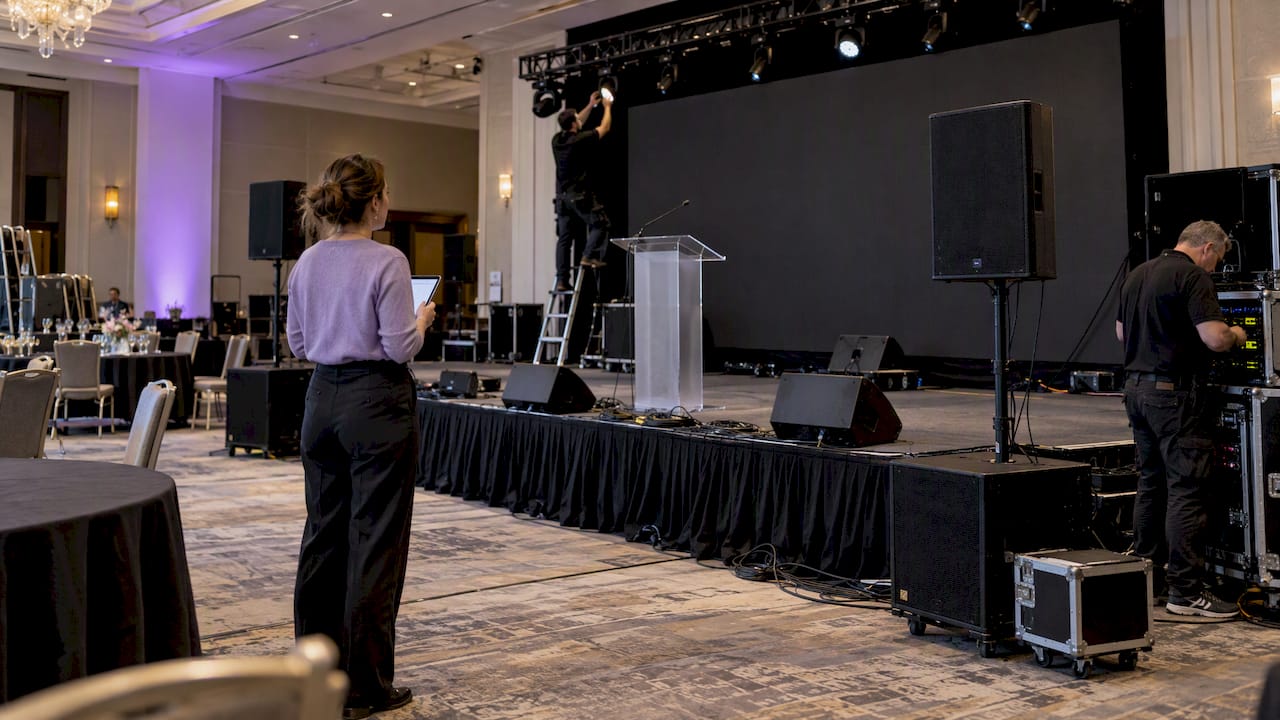
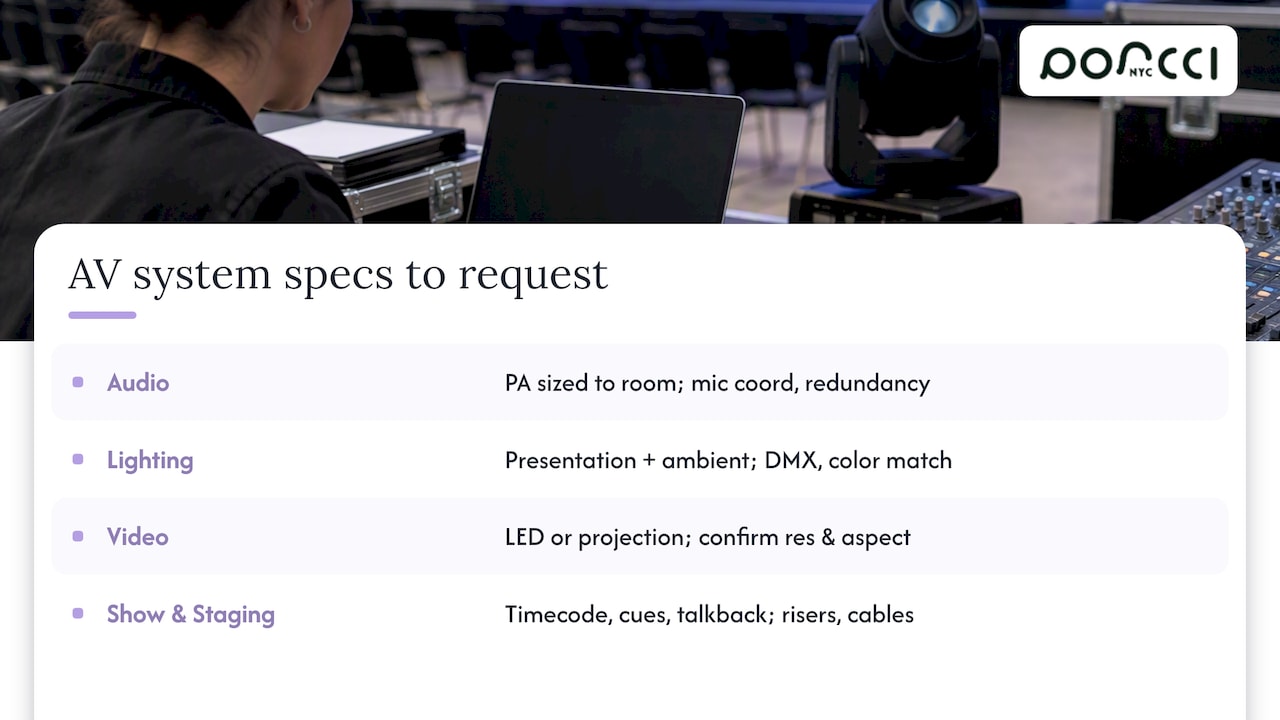
Audio carries the most weight on awards night because a dropped mic or muddy speech is the one failure every guest notices. Size your front-of-house PA to the room, not just the guest count, and plan wireless mic counts with frequency coordination so handheld and lapel mics do not interfere with each other during the program. Build in playback redundancy for your award stings and transition music, and set a monitor strategy so speakers and presenters can hear themselves on stage.
Lighting splits into two jobs: presentation lighting that keeps faces readable on camera and ambient or scenic lighting that sets the room’s tone. DMX control ties both together, and color matching to your brand palette makes a surprising difference in how polished the night feels. Spotlighting for award walk-ups and clean blackout control between segments are worth specifying by name in your contract, not assuming your vendor will default to them.
For video, LED walls offer brightness and color punch that work well in rooms with ambient light, while projection can be more cost-effective for simpler needs. Either way, confirm resolution and aspect ratio match your content, and ask how your media server formats slides and video so nothing gets stretched or cropped on show night. Confidence monitors facing the stage keep presenters from craning toward the big screen.
Show control ties it all together: timecode, cue lists, and talkback between your A1, lighting operator, and stage manager. On staging, plan riser layout and sightlines early, and treat cable management as a safety issue, not an afterthought. Our corporate AV glossary breaks down terms like DMX, FOH, and BOM if your vendor’s proposal reads like a foreign language.
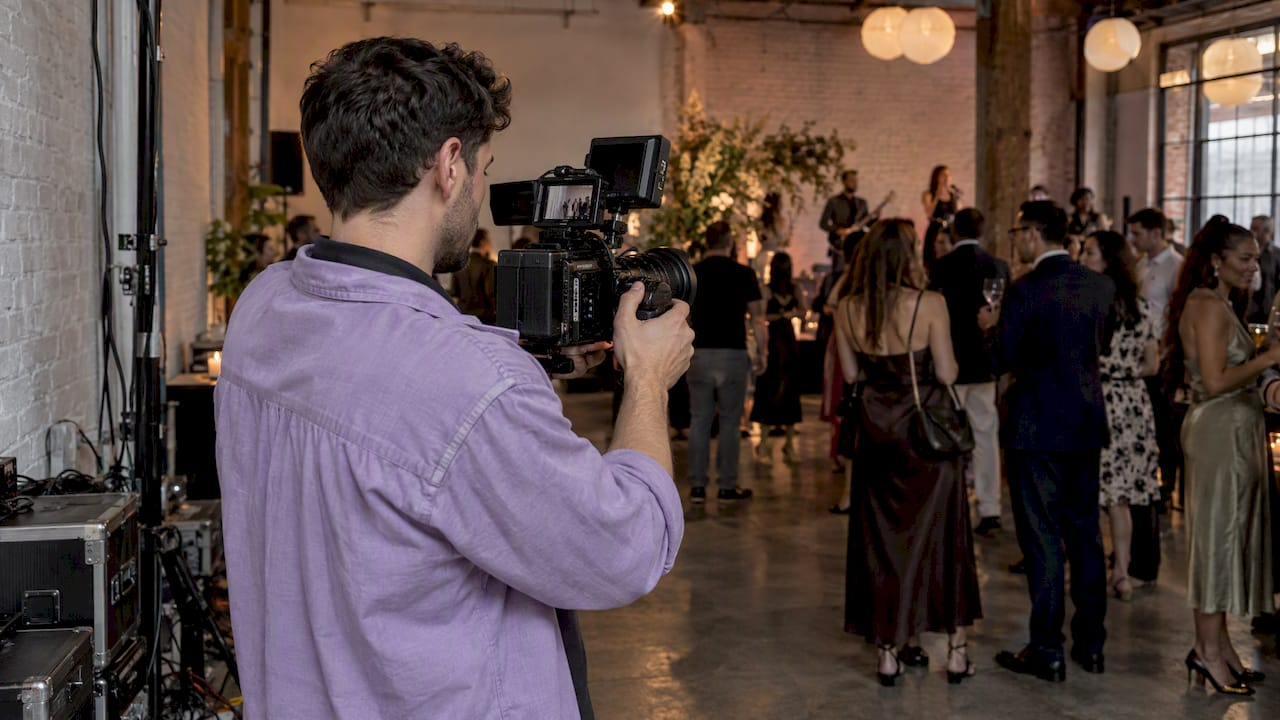
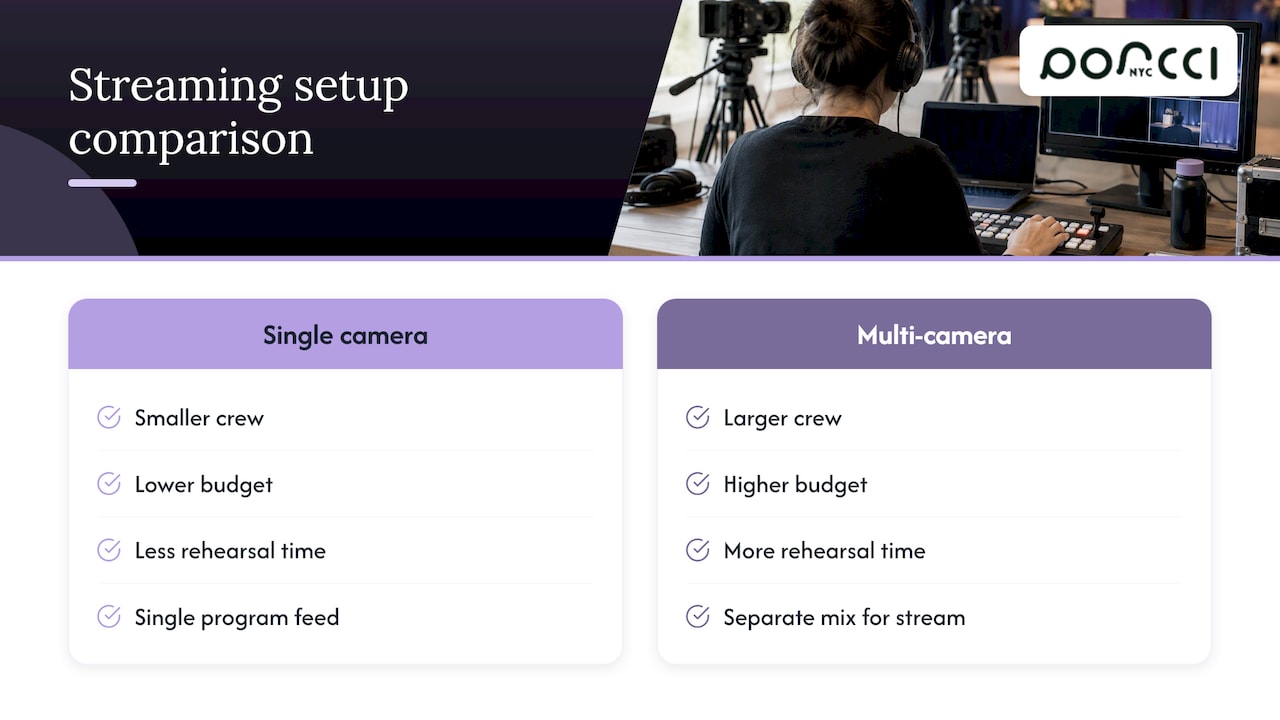
If part of your audience is watching from home, decide early whether you need a single-camera stream or a broadcast-grade multi-camera setup with its own separate mix. That decision changes your crew size, your budget, and how much rehearsal time you need to reserve.
Connectivity is the part planners underestimate most. Wired internet with a bonded backup connection protects you from a single point of failure, and you should confirm upstream bitrate with your venue’s IT contact well before show day. Choose your encoder, decide whether you need ISO recordings of individual camera feeds, and plan graphics and overlays that give remote viewers the same sense of occasion as the room.
Run a full bandwidth test during rehearsal, not during the live show. A stream that buffers during the keynote is far more visible than a minor lighting cue miss in the room.
Code compliance and inclusivity are not optional extras. They protect your guests and your event budget if something goes wrong.
• Use three-wire grounded extension cords for all temporary power, as required under OSHA’s wiring standards, and never staple or conceal cords behind walls or ceilings.
• Work with a licensed electrician on distribution and dimmer feeds, with circuits clearly labeled before load-in.
• Confirm CART or live captioning and assistive listening devices are available, consistent with ADA guidance on effective communication.
• Lay cable ramps across walkways, post signage where cords cross foot traffic, and confirm your vendor’s insurance certificate before the contract is signed.
OSHA’s electrical standards specifically prohibit using flexible cords as a substitute for fixed building wiring, which is a common shortcut that creates both a safety hazard and a liability gap.
A strong proposal looks organized before you ever meet the crew. These are the deliverables and questions that separate a dependable partner from a risky one.
• Require a written SOW, bill of materials, site survey notes, run-of-show document, crew call sheet, and insurance certificates before signing.
• Ask who the technical lead is for your event, what the backup plan is for playback and streaming failures, and for references from similar events.
• Watch for red flags: no written BOM, a vague crew call sheet, no rehearsal plan, or slow, inconsistent communication.
• Match crew size to event scale. A 150-guest awards dinner needs a different staffing ratio than a 600-person ballroom production, and an experienced A1 running audio is often the difference between a clean show and a scramble.
Pro Tip: Ask for the bill of materials before the quote, not after. A vendor who can list every microphone, cable, and fixture up front is one who has actually planned your event, not just priced it.
LED wall size and resolution, the number of camera feeds you record, crew hours during load-in, and custom scenic or lighting programming are the line items that move your budget the most. None of them are wrong to spend on, but they should match your event’s actual goals rather than get added because they look impressive on a proposal.
If your budget is tight, prioritize a strong PA system and clean sightlines over a bigger screen. Reuse house lighting and sound systems where the venue’s existing rig is solid, and keep camera complexity simple if streaming is a secondary feature rather than the main event. Industry guidance consistently points toward sizing production to the audience’s actual objectives rather than chasing flash for its own sake. Always build in contingency funds and paid rehearsal hours, since both get cut first and missed most.
Every event we run starts with the same three things: a site survey, a complete bill of materials, and one assigned technical lead who owns the show from load-in to breakdown. That structure is what lets us handle a last-minute cue change, a swapped award order, or a speaker running long without it showing on stage. Our rehearsal priority is always the same: test the failure points first, not the easy parts.
Whether you need a full AV and sound package, tech staff to run playback, or a planning team to handle the whole production, we provide packages designed for corporate events of various sizes. You can review our AV and sound rental options or get a quote tailored to your date and venue. After you reach out, expect a site survey booking, a preliminary equipment checklist, and a straight answer on date availability so you can plan with confidence.
Most corporate events need four to six months to plan AV properly, while large-scale productions often require closer to a year. Smaller gatherings can sometimes be arranged in just a few weeks if the scope stays simple.
A solid SOW includes a full bill of materials, site survey findings, a run-of-show document, crew call sheet, and confirmed insurance certificates. This documentation protects both sides and gives your vendor a fixed target instead of last-minute guesswork.
Under ADA guidance on effective communication, public accommodations should plan for auxiliary aids like captioning and assistive listening when hosting events with video or spoken content. Confirming this with your venue and AV vendor early avoids a last-minute scramble.
The most common hazard is using flexible extension cords as a substitute for permanent wiring, which OSHA’s electrical standards specifically prohibit. Always use grounded three-wire cords and keep them protected from foot traffic and damage.
We provide AV and sound system packages, tech staffing, and event planning support designed for corporate events of varying sizes. You can request a quote to get a site survey scheduled and a preliminary checklist for your date.
• AV Creative Production: The Key to Transforming Events - Freeman
• 1926.405 - Wiring methods, components, and equipment for general use. | OSHA
Operational AV checklist, a 12 week milestone map, and vendor ready SOW and BOM items event planners can drop into vendor briefs to prevent show-day...
Every corporate awards night needs six AV elements working together: front-of-house sound, wireless and wired microphones, stage and ambient lighting, visuals on LED or projection, a show control and playback system, and streaming gear if remote guests are watching. The single step that prevents a show-day meltdown is locking a written scope of work and bill of materials with your AV partner before you book anything else. Most corporate events need four to six months of lead time, though smaller gatherings can move faster.
TL;DR:
• Locking a detailed scope of work and bill of materials early helps prevent last-minute changes that can escalate costs and cause scheduling issues.
• A 12-week planning window is recommended for mid-size awards nights to ensure proper decision-making, with larger events sometimes needing up to a year.
• Prioritize a well-sized sound system and clear sightlines over elaborate visuals if budget constraints exist, focusing on the event’s actual goals.
• Confirm venue power, safety standards, and accessibility features such as captioning and assistive listening devices early to meet ADA and OSHA standards.
• Choose AV vendors who provide comprehensive documentation, including a written scope, bill of materials, rehearsal plans, and references, to ensure reliable execution.
• Planner’s quick AV checklist to include in vendor briefs
• Recommended timeline and milestone plan for awards night AV
• What each AV system does and what to specify
• Hybrid and streaming setup for remote attendees
• Electrical safety and accessibility essentials for your venue
• What to demand from an AV provider
• Which AV choices drive cost and where to invest
• How we build reliable awards-night AV
• Planning your next awards night with Porcci NYC
• FAQ
• Sources
Before you send out a single request for quote, build your own checklist. It keeps every vendor answering the same questions and makes proposals easy to compare side by side.
• Confirm venue power and stage dimensions, plus PA and monitor counts for the room size.
• Decide your wired versus wireless microphone mix and build in playback redundancy for award music cues.
• Map lighting zones separately for presentation areas and ambient or branded moments, and choose between LED walls and projection for visuals.
• Set your streaming and recording scope, including encoder backups and a separate broadcast mix if you are simulcasting.
• Add accessibility line items: live captioning, assistive listening devices, and clear slide specs for on-screen text.
• Define day-of staffing roles and the minimum crew size your event requires.
Our AV equipment checklist covers this in more depth if you want a version to hand directly to vendors.
Lead time depends on scale. Freeman’s guidance puts typical corporate events at four to six months, with large productions often require about a year, and smaller meetings can sometimes be arranged quickly if the scope stays simple. For a mid-size corporate awards night, a 12-week runway gives you room to make good decisions instead of rushed ones.
1. Weeks 1-2: Set your budget, confirm the venue, and define the scope of your AV needs.
2. Weeks 3-4: Schedule a site survey and request your bill of materials and written SOW from vendors.
3. Weeks 5-6: Lock lighting, audio, and video specs, and book electricians and rigging crew.
4. Weeks 7-9: Finalize content deadlines for videos, slides, and award graphics.
5. Weeks 10-11: Run a technical rehearsal with full cue lists and talent walk-throughs.
6. Week 12: Load in, test every system live, and hold a final run-of-show briefing.
An early SOW is what keeps this timeline from collapsing. It gives your vendor a fixed target instead of a moving one, which matters most in the final two weeks when changes get expensive.
Audio carries the most weight on awards night because a dropped mic or muddy speech is the one failure every guest notices. Size your front-of-house PA to the room, not just the guest count, and plan wireless mic counts with frequency coordination so handheld and lapel mics do not interfere with each other during the program. Build in playback redundancy for your award stings and transition music, and set a monitor strategy so speakers and presenters can hear themselves on stage.
Lighting splits into two jobs: presentation lighting that keeps faces readable on camera and ambient or scenic lighting that sets the room’s tone. DMX control ties both together, and color matching to your brand palette makes a surprising difference in how polished the night feels. Spotlighting for award walk-ups and clean blackout control between segments are worth specifying by name in your contract, not assuming your vendor will default to them.
For video, LED walls offer brightness and color punch that work well in rooms with ambient light, while projection can be more cost-effective for simpler needs. Either way, confirm resolution and aspect ratio match your content, and ask how your media server formats slides and video so nothing gets stretched or cropped on show night. Confidence monitors facing the stage keep presenters from craning toward the big screen.
Show control ties it all together: timecode, cue lists, and talkback between your A1, lighting operator, and stage manager. On staging, plan riser layout and sightlines early, and treat cable management as a safety issue, not an afterthought. Our corporate AV glossary breaks down terms like DMX, FOH, and BOM if your vendor’s proposal reads like a foreign language.
If part of your audience is watching from home, decide early whether you need a single-camera stream or a broadcast-grade multi-camera setup with its own separate mix. That decision changes your crew size, your budget, and how much rehearsal time you need to reserve.
Connectivity is the part planners underestimate most. Wired internet with a bonded backup connection protects you from a single point of failure, and you should confirm upstream bitrate with your venue’s IT contact well before show day. Choose your encoder, decide whether you need ISO recordings of individual camera feeds, and plan graphics and overlays that give remote viewers the same sense of occasion as the room.
Run a full bandwidth test during rehearsal, not during the live show. A stream that buffers during the keynote is far more visible than a minor lighting cue miss in the room.
Code compliance and inclusivity are not optional extras. They protect your guests and your event budget if something goes wrong.
• Use three-wire grounded extension cords for all temporary power, as required under OSHA’s wiring standards, and never staple or conceal cords behind walls or ceilings.
• Work with a licensed electrician on distribution and dimmer feeds, with circuits clearly labeled before load-in.
• Confirm CART or live captioning and assistive listening devices are available, consistent with ADA guidance on effective communication.
• Lay cable ramps across walkways, post signage where cords cross foot traffic, and confirm your vendor’s insurance certificate before the contract is signed.
OSHA’s electrical standards specifically prohibit using flexible cords as a substitute for fixed building wiring, which is a common shortcut that creates both a safety hazard and a liability gap.
A strong proposal looks organized before you ever meet the crew. These are the deliverables and questions that separate a dependable partner from a risky one.
• Require a written SOW, bill of materials, site survey notes, run-of-show document, crew call sheet, and insurance certificates before signing.
• Ask who the technical lead is for your event, what the backup plan is for playback and streaming failures, and for references from similar events.
• Watch for red flags: no written BOM, a vague crew call sheet, no rehearsal plan, or slow, inconsistent communication.
• Match crew size to event scale. A 150-guest awards dinner needs a different staffing ratio than a 600-person ballroom production, and an experienced A1 running audio is often the difference between a clean show and a scramble.
Pro Tip: Ask for the bill of materials before the quote, not after. A vendor who can list every microphone, cable, and fixture up front is one who has actually planned your event, not just priced it.
LED wall size and resolution, the number of camera feeds you record, crew hours during load-in, and custom scenic or lighting programming are the line items that move your budget the most. None of them are wrong to spend on, but they should match your event’s actual goals rather than get added because they look impressive on a proposal.
If your budget is tight, prioritize a strong PA system and clean sightlines over a bigger screen. Reuse house lighting and sound systems where the venue’s existing rig is solid, and keep camera complexity simple if streaming is a secondary feature rather than the main event. Industry guidance consistently points toward sizing production to the audience’s actual objectives rather than chasing flash for its own sake. Always build in contingency funds and paid rehearsal hours, since both get cut first and missed most.
Every event we run starts with the same three things: a site survey, a complete bill of materials, and one assigned technical lead who owns the show from load-in to breakdown. That structure is what lets us handle a last-minute cue change, a swapped award order, or a speaker running long without it showing on stage. Our rehearsal priority is always the same: test the failure points first, not the easy parts.
Whether you need a full AV and sound package, tech staff to run playback, or a planning team to handle the whole production, we provide packages designed for corporate events of various sizes. You can review our AV and sound rental options or get a quote tailored to your date and venue. After you reach out, expect a site survey booking, a preliminary equipment checklist, and a straight answer on date availability so you can plan with confidence.
Most corporate events need four to six months to plan AV properly, while large-scale productions often require closer to a year. Smaller gatherings can sometimes be arranged in just a few weeks if the scope stays simple.
A solid SOW includes a full bill of materials, site survey findings, a run-of-show document, crew call sheet, and confirmed insurance certificates. This documentation protects both sides and gives your vendor a fixed target instead of last-minute guesswork.
Under ADA guidance on effective communication, public accommodations should plan for auxiliary aids like captioning and assistive listening when hosting events with video or spoken content. Confirming this with your venue and AV vendor early avoids a last-minute scramble.
The most common hazard is using flexible extension cords as a substitute for permanent wiring, which OSHA’s electrical standards specifically prohibit. Always use grounded three-wire cords and keep them protected from foot traffic and damage.
We provide AV and sound system packages, tech staffing, and event planning support designed for corporate events of varying sizes. You can request a quote to get a site survey scheduled and a preliminary checklist for your date.
• AV Creative Production: The Key to Transforming Events - Freeman
• 1926.405 - Wiring methods, components, and equipment for general use. | OSHA