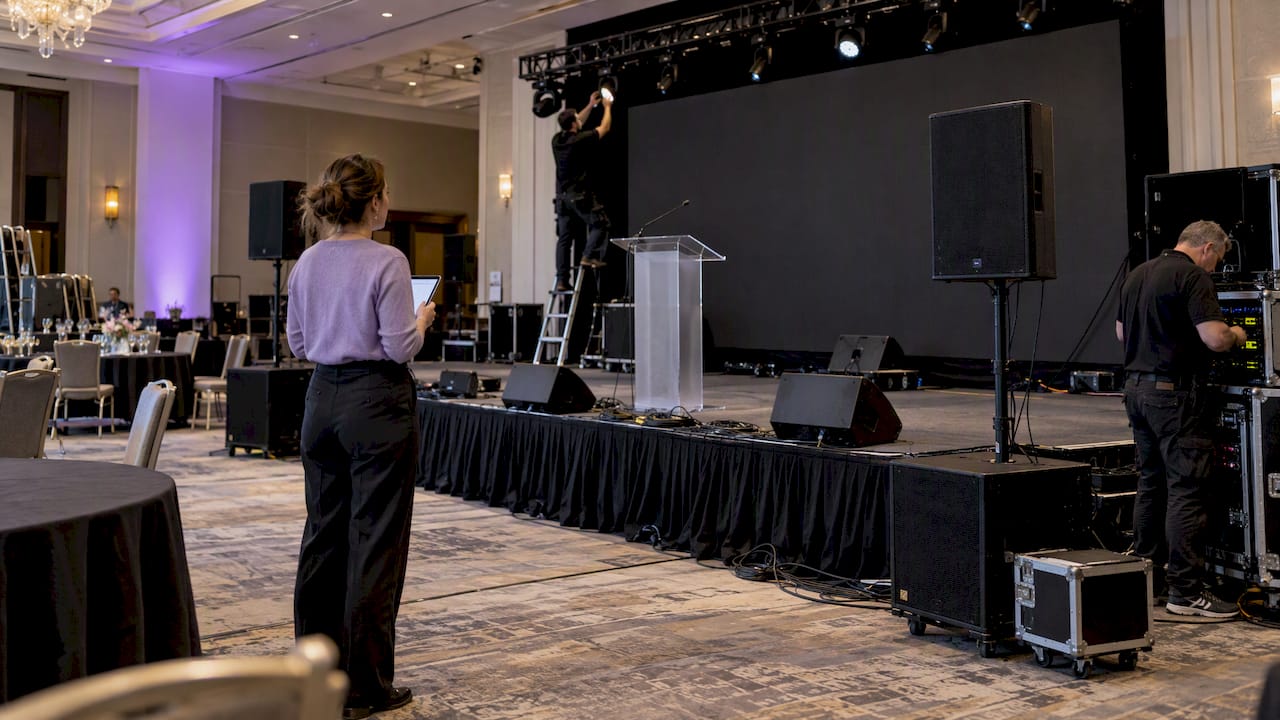
Master the corporate event staffing workflow to streamline planning and enhance attendee experience. Discover proven strategies for success!
TL;DR:
• A corporate event staffing workflow provides clear role definitions, zone assignments, and a chain of command to ensure coverage and swift issue resolution. Proper planning includes calculating peak surge needs, assigning fixed zones, and conducting timely post-event reviews for continuous improvement. Implementing these operational tactics reduces problems, enhances attendee experience, and increases event success.
Running a corporate event without a defined corporate event staffing workflow is like managing a construction site where nobody knows which wall they’re building. Staff show up to the same task, critical zones go uncovered, and registration lines stretch into hallways. The fallout is immediate: frustrated attendees, missed executive expectations, and a team scrambling to react instead of execute. This guide walks you through the full staffing process from pre-event preparation to post-event review, with operational tactics that actually hold up when three hundred guests arrive in the first twenty minutes.
• Your corporate event staffing workflow starts here
• Executing the workflow on event day
• Verification and post-event improvement
• Common pitfalls in event staffing workflows
• Our take on what actually changes outcomes
• How Porcci NYC supports your staffing workflow
• FAQ
| Point | Details |
|---|---|
| Staff for peak demand, not averages | Registration requires 1 staff per 75 attendees during peak windows, not steady-flow ratios. |
| Use zone ownership to prevent task collision | Assigning staff to fixed zones eliminates coverage gaps and speeds up issue resolution. |
| Apply a 10-20% contingency buffer | Build no-show and last-minute change protection into every staffing plan. |
| Centralize all dispatch through one point | A single-dispatch desk prevents duplicate responses and keeps task priorities clear. |
| Debrief daily and document everything | Post-event reviews drive measurable improvements to future staffing plans. |
The preparation phase is where most staffing failures are actually created, not on event day. By the time guests arrive, your options are limited. Starting four to eight weeks out gives you real leverage on recruitment, training, scheduling, and contingency planning.
Start by mapping every staffing role your event requires. For corporate events, this typically includes registration agents, ushers, session monitors, hospitality staff, crowd management personnel, and at least one supervisor per ten to twelve staff members. Each role needs a physical zone assignment, not just a general job description.
Zone ownership prevents the spread of problems across a floor. When a registration agent owns the east wing entrance and a crowd monitor owns the main hall, there is no ambiguity about who handles what. Issues get contained faster, escalations happen to the right person, and dead zones disappear from your floor plan.

Pro Tip: Create a physical zone map with staff names attached before the event. Distribute it to all supervisors so anyone can see at a glance who owns which area.
Generic headcount math will fail you. Apply an 80% utilization rate to your capacity estimates rather than assuming each staff member operates at theoretical maximum. A registration station that can theoretically handle thirty check-ins per hour will realistically process twenty-four under real conditions.
The table below shows how staffing ratios shift between steady-state and peak periods:
| Scenario | Recommended ratio | Notes |
|---|---|---|
| Registration (steady flow) | 1 staff per 150 attendees | Standard mid-event flow |
| Registration (peak surge) | 1 staff per 75 attendees | First 90 minutes, Day 1 |
| General floor coverage | 1 supervisor per 10-12 staff | Maintains operational oversight |
| Contingency buffer | 10-20% of total headcount | Higher for outdoor or complex events |
Most understaffing traces back to planning for average attendance rather than peak demand. Registration needs roughly twice your average headcount during the first ninety minutes of Day 1. Build that surge capacity into your plan from the start.
Add a standard contingency buffer of 10 to 20% on top of your base count to cover no-shows and last-minute changes. For outdoor events or multi-track conferences, push that buffer toward the higher end.
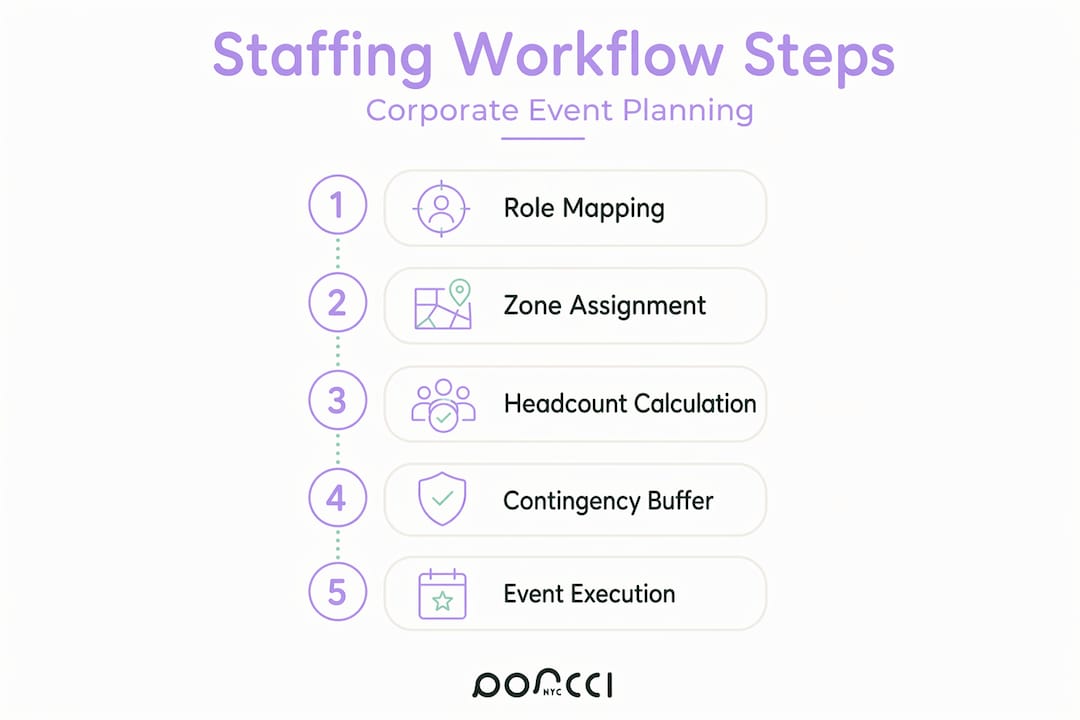
A plan that lives only in a spreadsheet breaks down fast once doors open. Execution requires live coordination, predictable response routes, and a clear chain of command.
Here is a step-by-step approach to operationalizing your staffing plan on event day:
1. Open a single-dispatch desk. A single-dispatch system routes all runner and support requests through one coordinator. This prevents three staff from responding to the same spilled coffee situation while a real issue in another zone goes unnoticed.
2. Assign runners to fixed routes, not general availability. Runners labeled “available as needed” create task collisions and dead zones. Assign each runner a specific zone or predictable loop, and they become reliable responders with known locations and response times.
3. Deploy surge staff to registration before doors open. Your peak arrival window is predictable. Position additional registration agents and floor ushers thirty minutes before scheduled open. Do not wait for lines to form before scaling up.
4. Hold a ten-minute pre-shift briefing. Cover role assignments, zone maps, escalation contacts, and any venue-specific logistics. This is not optional for corporate events with executive visibility.
5. Maintain a 1-supervisor-to-10-12-staff ratio throughout the day. Production teams and supervisors keep overlapping vendor scopes from colliding and maintain the run-of-show for complex events.
6. Stagger breaks with floater coverage. Adequate break coverage using overlapping shifts and floaters keeps response times fast during peak periods and prevents fatigue from degrading service quality. Use the 15-30-60 Backup Rule as a guide: add one to two floating runners to cover peak moments and scheduled breaks.
7. Track issues in real time. Use a shared digital log for task assignments, incident notes, and role adjustments. This data feeds directly into your post-event review.
Pro Tip: Give your dispatch coordinator a physical whiteboard or shared tablet screen showing all active runner assignments. Visual tracking cuts response times faster than any verbal check-in system.
Many planners treat the event as done once the last guest leaves. The ones who run consistently better events treat that moment as the start of their next planning cycle.
Here is what your post-event review should cover:
• Daily debriefs for multi-day events. Catch problems after Day 1 while you still have time to fix them. A fifteen-minute debrief with supervisors surfaces zone coverage gaps, runner overloads, and communication breakdowns before they repeat.
• Operational metrics that actually matter. Track registration throughput (guests processed per hour per station), issue close-out times (how long from report to resolution), and staff utilization rates by zone. These numbers tell you where the plan held and where it cracked.
• Worker performance documentation. Note which staff members handled surge periods well, which roles were over or understaffed, and whether your contingency buffer was sufficient. This documentation makes your next staffing request to an agency far more specific and effective.
• Invoice and compliance verification. Confirm staff hours against your schedule and verify that your staffing agency uses W-2 employees rather than independent contractors. Misclassification risks fall on you as the event organizer.
• Lessons learned updates. Revise your zone maps, staffing ratios, and role descriptions based on what the event actually demanded. Your staffing plan should get measurably better after every event.
Even experienced planners repeat the same mistakes. Knowing these in advance changes how you build your workflow.
• Planning for averages, not peaks. This is the single most common error in the event staffing process. Lines do not form at average volume. They form at the moment when four hundred people arrive in thirty minutes and you only staffed for two hundred.
• Uncoordinated runner requests. Without a single-dispatch system, managers call runners directly, and the same person gets pulled in three directions. Tasks pile up, priorities get lost, and zones go dark.
• Understaffed supervisors. One supervisor managing twenty people cannot realistically monitor issues, handle escalations, and keep their own zone covered. Stay within the one-to-twelve ratio regardless of budget pressure.
• Skipping break and handover coverage. A thirty-minute break with no floater covering a registration station creates a service gap that guests feel immediately. Handovers between shifts need a five-minute overlap minimum, not a back-pocket phone call.
• Ignoring corporate event logistics until event week. Transportation, load-in schedules, and vendor coordination all affect when staff need to be on site and in position. Consulting a resource like this corporate transport guide during planning prevents last-minute conflicts between staff arrivals and venue access windows.
“The biggest mistake in event staffing is generic role assignments without zone ownership, leading to dispersed problems and slow issue resolution.” (source)
I’ve planned and supported corporate events ranging from fifty-person executive roundtables to multi-day conferences with over a thousand attendees. What I’ve learned is that most staffing failures are not about headcount. They are about clarity.
The moment we moved from “cover the lobby” to “you own the east lobby from 8 AM to 12 PM and this is your escalation contact,” everything got sharper. Response times dropped. Supervisors stopped being interrupted by questions that staff should have been able to answer themselves.
Surge staffing is the other thing that consistently gets underinvested. I’ve watched planners confidently staff based on total RSVP counts, then watch their registration area collapse in the first hour. Building that peak surge into the plan from the start is not extra cost. It’s protection.
The post-event review feels like administrative overhead until you skip it once and repeat the same expensive mistake at your next event. The planners I respect most treat that debrief as the most valuable hour of the entire engagement.
— PORCCI
When you are managing the full scope of corporate event planning in NYC or New Jersey, staffing is only one piece of the puzzle. Porcci NYC brings together trained event staff, AV and sound system rentals, DJ services, photo booths, and lighting under one roof, so you are not coordinating five separate vendors on event day.
Our team understands how to staff corporate events with the right roles, zone assignments, and supervisory coverage built into every package. Whether your event needs a full production crew or targeted staffing support, we tailor our approach to your headcount, venue, and timeline. Explore our event staffing solutions or request a custom quote to see how we can take complexity off your plate.
A corporate event staffing workflow is a structured process covering role definition, zone assignment, headcount calculation, dispatch coordination, and post-event review. It gives every staff member a clear task, a physical zone, and an escalation path so the event runs without coverage gaps.
During peak arrival windows, plan for 1 staff per 75 attendees at registration. During steady-state flow, 1 per 150 is sufficient. Always apply an 80% utilization factor to avoid service failures under real conditions.
A contingency buffer is an additional 10 to 20% of your total planned headcount held in reserve to cover no-shows, illness, and last-minute changes. Outdoor or complex events should use the higher end of that range.
Zone ownership assigns each staff member clear physical territory and decision-making authority, which prevents task collisions and dead zones. It also speeds up problem escalation because supervisors always know who is responsible for each area.
Conduct a debrief within twenty-four hours, review operational metrics like registration throughput and issue close-out times, document worker performance, and update your staffing ratios and zone maps for future events. Treat each event as a data point for continuous improvement.
Master the corporate event staffing workflow to streamline planning and enhance attendee experience. Discover proven strategies for success!
TL;DR:
• A corporate event staffing workflow provides clear role definitions, zone assignments, and a chain of command to ensure coverage and swift issue resolution. Proper planning includes calculating peak surge needs, assigning fixed zones, and conducting timely post-event reviews for continuous improvement. Implementing these operational tactics reduces problems, enhances attendee experience, and increases event success.
Running a corporate event without a defined corporate event staffing workflow is like managing a construction site where nobody knows which wall they’re building. Staff show up to the same task, critical zones go uncovered, and registration lines stretch into hallways. The fallout is immediate: frustrated attendees, missed executive expectations, and a team scrambling to react instead of execute. This guide walks you through the full staffing process from pre-event preparation to post-event review, with operational tactics that actually hold up when three hundred guests arrive in the first twenty minutes.
• Your corporate event staffing workflow starts here
• Executing the workflow on event day
• Verification and post-event improvement
• Common pitfalls in event staffing workflows
• Our take on what actually changes outcomes
• How Porcci NYC supports your staffing workflow
• FAQ
| Point | Details |
|---|---|
| Staff for peak demand, not averages | Registration requires 1 staff per 75 attendees during peak windows, not steady-flow ratios. |
| Use zone ownership to prevent task collision | Assigning staff to fixed zones eliminates coverage gaps and speeds up issue resolution. |
| Apply a 10-20% contingency buffer | Build no-show and last-minute change protection into every staffing plan. |
| Centralize all dispatch through one point | A single-dispatch desk prevents duplicate responses and keeps task priorities clear. |
| Debrief daily and document everything | Post-event reviews drive measurable improvements to future staffing plans. |
The preparation phase is where most staffing failures are actually created, not on event day. By the time guests arrive, your options are limited. Starting four to eight weeks out gives you real leverage on recruitment, training, scheduling, and contingency planning.
Start by mapping every staffing role your event requires. For corporate events, this typically includes registration agents, ushers, session monitors, hospitality staff, crowd management personnel, and at least one supervisor per ten to twelve staff members. Each role needs a physical zone assignment, not just a general job description.
Zone ownership prevents the spread of problems across a floor. When a registration agent owns the east wing entrance and a crowd monitor owns the main hall, there is no ambiguity about who handles what. Issues get contained faster, escalations happen to the right person, and dead zones disappear from your floor plan.
Pro Tip: Create a physical zone map with staff names attached before the event. Distribute it to all supervisors so anyone can see at a glance who owns which area.
Generic headcount math will fail you. Apply an 80% utilization rate to your capacity estimates rather than assuming each staff member operates at theoretical maximum. A registration station that can theoretically handle thirty check-ins per hour will realistically process twenty-four under real conditions.
The table below shows how staffing ratios shift between steady-state and peak periods:
| Scenario | Recommended ratio | Notes |
|---|---|---|
| Registration (steady flow) | 1 staff per 150 attendees | Standard mid-event flow |
| Registration (peak surge) | 1 staff per 75 attendees | First 90 minutes, Day 1 |
| General floor coverage | 1 supervisor per 10-12 staff | Maintains operational oversight |
| Contingency buffer | 10-20% of total headcount | Higher for outdoor or complex events |
Most understaffing traces back to planning for average attendance rather than peak demand. Registration needs roughly twice your average headcount during the first ninety minutes of Day 1. Build that surge capacity into your plan from the start.
Add a standard contingency buffer of 10 to 20% on top of your base count to cover no-shows and last-minute changes. For outdoor events or multi-track conferences, push that buffer toward the higher end.
A plan that lives only in a spreadsheet breaks down fast once doors open. Execution requires live coordination, predictable response routes, and a clear chain of command.
Here is a step-by-step approach to operationalizing your staffing plan on event day:
1. Open a single-dispatch desk. A single-dispatch system routes all runner and support requests through one coordinator. This prevents three staff from responding to the same spilled coffee situation while a real issue in another zone goes unnoticed.
2. Assign runners to fixed routes, not general availability. Runners labeled “available as needed” create task collisions and dead zones. Assign each runner a specific zone or predictable loop, and they become reliable responders with known locations and response times.
3. Deploy surge staff to registration before doors open. Your peak arrival window is predictable. Position additional registration agents and floor ushers thirty minutes before scheduled open. Do not wait for lines to form before scaling up.
4. Hold a ten-minute pre-shift briefing. Cover role assignments, zone maps, escalation contacts, and any venue-specific logistics. This is not optional for corporate events with executive visibility.
5. Maintain a 1-supervisor-to-10-12-staff ratio throughout the day. Production teams and supervisors keep overlapping vendor scopes from colliding and maintain the run-of-show for complex events.
6. Stagger breaks with floater coverage. Adequate break coverage using overlapping shifts and floaters keeps response times fast during peak periods and prevents fatigue from degrading service quality. Use the 15-30-60 Backup Rule as a guide: add one to two floating runners to cover peak moments and scheduled breaks.
7. Track issues in real time. Use a shared digital log for task assignments, incident notes, and role adjustments. This data feeds directly into your post-event review.
Pro Tip: Give your dispatch coordinator a physical whiteboard or shared tablet screen showing all active runner assignments. Visual tracking cuts response times faster than any verbal check-in system.
Many planners treat the event as done once the last guest leaves. The ones who run consistently better events treat that moment as the start of their next planning cycle.
Here is what your post-event review should cover:
• Daily debriefs for multi-day events. Catch problems after Day 1 while you still have time to fix them. A fifteen-minute debrief with supervisors surfaces zone coverage gaps, runner overloads, and communication breakdowns before they repeat.
• Operational metrics that actually matter. Track registration throughput (guests processed per hour per station), issue close-out times (how long from report to resolution), and staff utilization rates by zone. These numbers tell you where the plan held and where it cracked.
• Worker performance documentation. Note which staff members handled surge periods well, which roles were over or understaffed, and whether your contingency buffer was sufficient. This documentation makes your next staffing request to an agency far more specific and effective.
• Invoice and compliance verification. Confirm staff hours against your schedule and verify that your staffing agency uses W-2 employees rather than independent contractors. Misclassification risks fall on you as the event organizer.
• Lessons learned updates. Revise your zone maps, staffing ratios, and role descriptions based on what the event actually demanded. Your staffing plan should get measurably better after every event.
Even experienced planners repeat the same mistakes. Knowing these in advance changes how you build your workflow.
• Planning for averages, not peaks. This is the single most common error in the event staffing process. Lines do not form at average volume. They form at the moment when four hundred people arrive in thirty minutes and you only staffed for two hundred.
• Uncoordinated runner requests. Without a single-dispatch system, managers call runners directly, and the same person gets pulled in three directions. Tasks pile up, priorities get lost, and zones go dark.
• Understaffed supervisors. One supervisor managing twenty people cannot realistically monitor issues, handle escalations, and keep their own zone covered. Stay within the one-to-twelve ratio regardless of budget pressure.
• Skipping break and handover coverage. A thirty-minute break with no floater covering a registration station creates a service gap that guests feel immediately. Handovers between shifts need a five-minute overlap minimum, not a back-pocket phone call.
• Ignoring corporate event logistics until event week. Transportation, load-in schedules, and vendor coordination all affect when staff need to be on site and in position. Consulting a resource like this corporate transport guide during planning prevents last-minute conflicts between staff arrivals and venue access windows.
“The biggest mistake in event staffing is generic role assignments without zone ownership, leading to dispersed problems and slow issue resolution.” (source)
I’ve planned and supported corporate events ranging from fifty-person executive roundtables to multi-day conferences with over a thousand attendees. What I’ve learned is that most staffing failures are not about headcount. They are about clarity.
The moment we moved from “cover the lobby” to “you own the east lobby from 8 AM to 12 PM and this is your escalation contact,” everything got sharper. Response times dropped. Supervisors stopped being interrupted by questions that staff should have been able to answer themselves.
Surge staffing is the other thing that consistently gets underinvested. I’ve watched planners confidently staff based on total RSVP counts, then watch their registration area collapse in the first hour. Building that peak surge into the plan from the start is not extra cost. It’s protection.
The post-event review feels like administrative overhead until you skip it once and repeat the same expensive mistake at your next event. The planners I respect most treat that debrief as the most valuable hour of the entire engagement.
— PORCCI
When you are managing the full scope of corporate event planning in NYC or New Jersey, staffing is only one piece of the puzzle. Porcci NYC brings together trained event staff, AV and sound system rentals, DJ services, photo booths, and lighting under one roof, so you are not coordinating five separate vendors on event day.
Our team understands how to staff corporate events with the right roles, zone assignments, and supervisory coverage built into every package. Whether your event needs a full production crew or targeted staffing support, we tailor our approach to your headcount, venue, and timeline. Explore our event staffing solutions or request a custom quote to see how we can take complexity off your plate.
A corporate event staffing workflow is a structured process covering role definition, zone assignment, headcount calculation, dispatch coordination, and post-event review. It gives every staff member a clear task, a physical zone, and an escalation path so the event runs without coverage gaps.
During peak arrival windows, plan for 1 staff per 75 attendees at registration. During steady-state flow, 1 per 150 is sufficient. Always apply an 80% utilization factor to avoid service failures under real conditions.
A contingency buffer is an additional 10 to 20% of your total planned headcount held in reserve to cover no-shows, illness, and last-minute changes. Outdoor or complex events should use the higher end of that range.
Zone ownership assigns each staff member clear physical territory and decision-making authority, which prevents task collisions and dead zones. It also speeds up problem escalation because supervisors always know who is responsible for each area.
Conduct a debrief within twenty-four hours, review operational metrics like registration throughput and issue close-out times, document worker performance, and update your staffing ratios and zone maps for future events. Treat each event as a data point for continuous improvement.