
Master the corporate gathering setup steps with our comprehensive guide. Ensure your event runs on time, on budget, and meets its goals.
TL;DR:
• Effective corporate gathering setup requires a phased approach connecting goals, budget, venue, and vendors into a cohesive plan.
• Thorough planning, clear communication, and technical rehearsals are essential to ensure successful event execution and post-event evaluation.
Corporate gathering setup steps are the structured sequence of planning and execution activities that determine whether your event meets its objectives or falls apart under pressure. From defining goals 12 months out to managing the final breakdown, every phase connects to the next. This guide walks corporate professionals and administrators through each critical step, covering prerequisites, venue selection, vendor management, day-of execution, and post-event evaluation. Follow this framework and your next corporate event will run on schedule, on budget, and on purpose.
The foundation of any successful corporate event is a clearly defined objective. Before you book a room or contact a vendor, you need to know what success looks like. Is the goal to close deals, recognize employees, launch a product, or build team cohesion? That answer shapes every decision that follows.
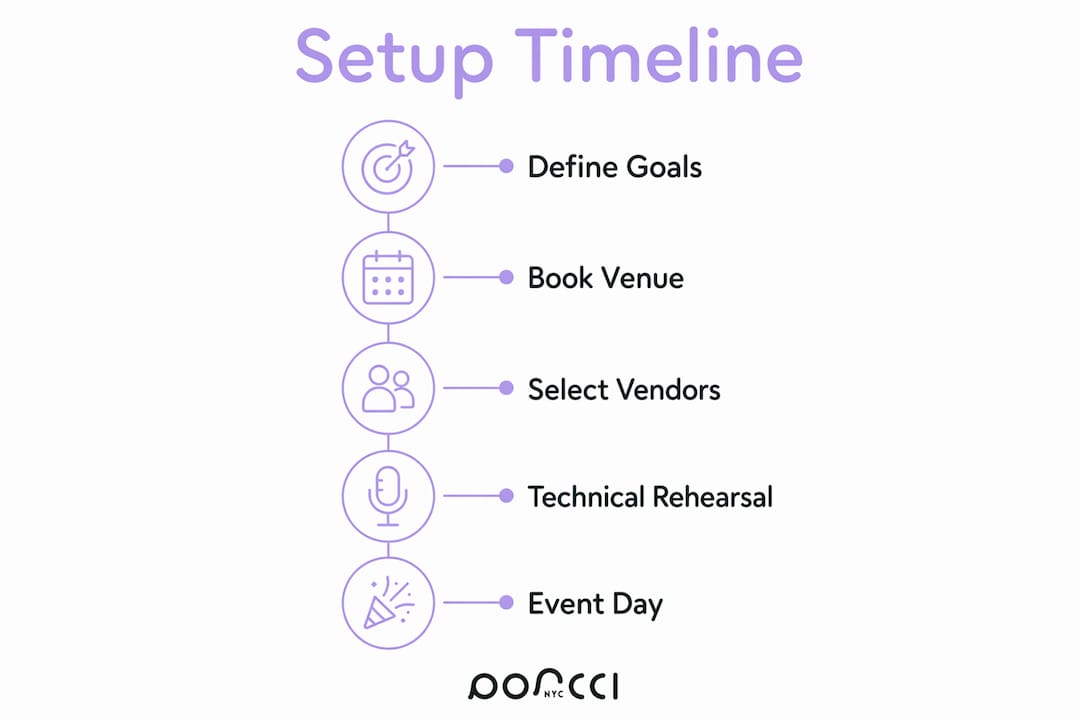
A phased planning timeline is the most reliable structure for corporate event planning. Goal definition should happen 12 to 9 months before the event, venue selection at 9 to 6 months, and contract execution at 8 to 5 months. This sequencing prevents the most common failure mode: making commitments before the strategy is locked.
Your budget structure matters as much as the total number. Divide your budget into categories like venue, catering, AV, labor, and marketing, then add a contingency fund from day one. Scope creep is the primary reason corporate events go over budget, and a pre-allocated contingency of 10 to 15 percent absorbs those surprises without derailing the plan.
Technology selection belongs in this early phase too. Platforms like Cvent, Bizzabo, and Eventbrite handle registration, attendee management, and communications. Choosing your event technology tools early means your data flows cleanly from registration through check-in.
Key prerequisites to lock in before any vendor outreach:
• Defined event objectives and measurable success metrics
• Approved budget with category breakdowns and contingency
• Confirmed event date range and internal stakeholder sign-off
• Selected event management platform for registration and communications
• Assigned internal point of contact with decision-making authority
Pro Tip: Build your event planning checklist before you open a single vendor conversation. Porcci NYC recommends using a stress-free event checklist as your master document from day one.
Venue selection is the single decision with the most downstream consequences. The wrong room creates problems that no amount of planning can fix: inadequate power, poor acoustics, restricted load-in windows, and inaccessible parking all compound on event day.

Start every venue evaluation with a structured walkthrough. Bring your AV vendor or technical lead with you. Assess ceiling height, column placement, natural light control, and floor load capacity. These physical constraints determine what production is even possible before you negotiate a contract.
Technical infrastructure is non-negotiable for corporate hospitality event setup. Your venue must support your connectivity requirements. A technical rehearsal requires at minimum 5 Mbps upload speed for HD streaming, with wired Ethernet preferred over Wi-Fi for mission-critical connections. Confirm dedicated bandwidth, not shared building Wi-Fi, is available.
Operational logistics often get overlooked until they become crises. Confirm load-in and load-out windows in writing. Designated staging zones and defined stop-work protocols prevent setup errors and keep your crew safe. Know exactly which freight elevator, dock, or service entrance your vendors will use and at what times.
• Capacity and layout options (theater, classroom, banquet, reception)
• Dedicated AV infrastructure and power access points
• Load-in and load-out windows with freight access confirmed
• Parking and public transit accessibility for attendees
• Contract terms covering exclusivity, catering restrictions, and overtime fees
Pro Tip: Always conduct your venue walkthrough with your AV provider present. What looks like a simple ballroom to a venue sales rep may have power limitations that affect your entire production plan.
Vendors are extensions of your event team, not outside contractors you hand off to and forget. Clear communication timelines and defined response windows embedded in contracts reduce ambiguity and protect your event flow. Treat every vendor relationship as a partnership with documented expectations on both sides.
Follow this process for every vendor category, from AV and catering to staffing and décor:
1. Write a precise scope of work before requesting quotes. Vague briefs produce vague proposals and surprise costs.
2. Get at least three quotes per vendor category. Price comparison matters, but so does evaluating responsiveness, references, and equipment quality.
3. Review each contract for deliverables, payment schedule, cancellation terms, and a named point of contact for event day.
4. Centralize all vendor information in a single tracker: contact names, contract status, payment due dates, and load-in times.
5. Schedule a pre-event call with each vendor within 30 days of the event to confirm logistics and resolve any open questions.
The most common vendor management mistake is treating the signed contract as the end of the relationship. It is the beginning. Regular check-ins, especially in the 30 days before the event, catch problems while there is still time to fix them.
Pro Tip: Add a communication protocol clause to every vendor contract. Specify the response window for day-of issues, the escalation contact if the primary rep is unreachable, and the method of communication (text, phone, or radio). This single clause has saved more events than any other contract term.
The run-of-show document is the operational spine of your event. It lists every activity in chronological order with assigned owners, durations, and dependencies. High-performing run-of-show schedules reflect strategy, budget, and operational dependencies rather than just a list of checkpoints. Every item connects to what comes before and after it.
Build your day-of sequence in this order:
1. Distribute the final run-of-show to all staff and vendors 48 hours before the event.
2. Complete a 24-hour pre-event checklist covering badge printing, scanner testing, connectivity, backup printers, cables, and staff role assignments.
3. Run a full technical rehearsal with all presenters and technical crew. Test every production element including AV, lighting, microphones, and internet connectivity. Skipping this step is the leading cause of live-show failures.
4. Brief all staff on their roles, escalation paths, and communication channels before doors open.
5. Assign a dedicated floor manager to monitor real-time event flow and handle troubleshooting without pulling the lead coordinator off schedule.
Badge check-in deserves special attention. Treat check-in hardware as mission-critical infrastructure. Have backup printers, spare badge stock, and a trained escalation staff member ready before the first attendee arrives. Long check-in lines set a negative tone that is hard to recover from.
| Task | Timing | Owner |
|---|---|---|
| Final run-of-show distributed | 48 hours before | Event lead |
| Technical rehearsal completed | 24 hours before | AV lead + presenters |
| Onsite checklist reviewed | Morning of event | Floor manager |
| Staff briefing completed | 90 minutes before doors | Event coordinator |
| Real-time flow monitoring | During event | Dedicated floor manager |
Pro Tip: Assign a dedicated event coordinator whose only job during the event is to watch the run-of-show clock and flag deviations. When the lead planner is pulled into troubleshooting, the schedule drifts fast.
Post-event work is where most corporate planners lose discipline, and where the most valuable institutional knowledge gets lost. A structured breakdown and evaluation process turns a one-time event into a repeatable system.
Start with an organized event strike. Assign crew members to specific zones and equipment categories before the event ends. Cross-reference your equipment inventory against what was delivered to confirm nothing is missing before vendors load out. Document any damage immediately with photos and written notes.
Close out vendor relationships properly. Process payments according to contract terms, confirm receipt of all deliverables, and send written confirmation of contract completion. This protects you legally and maintains the vendor relationships you will need for future events.
Gather attendee feedback within 24 hours of the event using tools like SurveyMonkey or Google Forms. Response rates drop sharply after the first day. Collect stakeholder feedback separately, since executives and attendees often have different definitions of success.
• Conduct a post-event debrief with your internal team within one week
• Document what worked, what failed, and what would be done differently
• Report on ROI metrics tied to your original event objectives
• Update your master planning checklist and vendor tracker with lessons learned
• Archive all contracts, invoices, and run-of-show documents for future reference
Successful corporate gathering setup steps require a phased approach that connects objectives, budget, venue, vendors, and execution into one coordinated plan.
| Point | Details |
|---|---|
| Start with objectives | Define measurable goals 12 to 9 months out before any vendor or venue contact. |
| Budget with contingency | Allocate 10 to 15 percent contingency from day one to absorb scope changes. |
| Vet venues technically | Confirm power, bandwidth, and load-in logistics during a walkthrough with your AV vendor. |
| Rehearse 24 hours out | Run a full technical rehearsal with all presenters to prevent live-show failures. |
| Evaluate every event | Collect feedback within 24 hours and document lessons learned for your next event. |
After working through hundreds of corporate events across New York City and New Jersey, the pattern we see most often is this: planners invest heavily in the visible elements like décor, catering, and entertainment, and underinvest in the operational infrastructure that makes those elements actually work. A stunning stage setup means nothing if the microphone cuts out during the keynote.
The most underrated step in the entire corporate gathering setup process is the vendor communication protocol. Most planners assume that a signed contract means everyone knows what to do. It does not. The vendors who perform best on event day are the ones who received a pre-event call within 30 days of the event, a confirmed load-in schedule, and a named escalation contact. That 20-minute call prevents 80 percent of day-of surprises.
We also push back on the idea that technology solves logistics problems. Platforms like Cvent and Bizzabo are powerful, but they amplify whatever process you feed into them. If your objectives are vague, your registration data will be vague. If your run-of-show has no owners assigned, the platform cannot fix that. Technology is a multiplier, not a substitute for clear planning.
The corporate events that run best are not the ones with the biggest budgets. They are the ones where every person on the team, from the AV crew to the registration staff, knows exactly what they are responsible for and who to call when something goes wrong. Build that clarity into your corporate event staffing workflow and your events will consistently outperform expectations.
— PORCCI
The technical backbone of any corporate gathering is its AV setup. Porcci NYC provides professional AV and sound system rentals across New York City, including full-service delivery, setup, and breakdown so your team can focus on the program rather than the equipment. For events in New Jersey, our Jersey City AV rentals cover everything from microphone systems and projectors to full sound rigs for large-scale corporate gatherings. Every rental package includes professional installation and on-call technical support. Contact Porcci NYC for a custom quote tailored to your event size and venue requirements.
The first steps are defining your event objectives and success metrics, then building a phased timeline that starts 12 to 9 months before the event. All venue and vendor decisions flow from a clear objective and approved budget.
Book your venue at the 9 to 6 month mark in your planning timeline. High-demand venues in cities like New York fill quickly, and early booking gives you time to conduct a proper technical walkthrough before signing.
A full technical rehearsal 24 hours before the event tests AV, lighting, microphones, and internet connectivity with all presenters present. Skipping it is the leading cause of live-show failures during transitions and presentations.
Get at least three quotes per vendor category, lock contracts with clear deliverables and a named day-of contact, and schedule a pre-event call within 30 days of the event. Treat vendors as team members with defined communication protocols, not outside contractors.
Collect attendee feedback within 24 hours using a survey tool, conduct an internal debrief within one week, and document lessons learned against your original objectives. Archive all contracts and run-of-show documents to build a repeatable planning system.
Master the corporate gathering setup steps with our comprehensive guide. Ensure your event runs on time, on budget, and meets its goals.
TL;DR:
• Effective corporate gathering setup requires a phased approach connecting goals, budget, venue, and vendors into a cohesive plan.
• Thorough planning, clear communication, and technical rehearsals are essential to ensure successful event execution and post-event evaluation.
Corporate gathering setup steps are the structured sequence of planning and execution activities that determine whether your event meets its objectives or falls apart under pressure. From defining goals 12 months out to managing the final breakdown, every phase connects to the next. This guide walks corporate professionals and administrators through each critical step, covering prerequisites, venue selection, vendor management, day-of execution, and post-event evaluation. Follow this framework and your next corporate event will run on schedule, on budget, and on purpose.
The foundation of any successful corporate event is a clearly defined objective. Before you book a room or contact a vendor, you need to know what success looks like. Is the goal to close deals, recognize employees, launch a product, or build team cohesion? That answer shapes every decision that follows.
A phased planning timeline is the most reliable structure for corporate event planning. Goal definition should happen 12 to 9 months before the event, venue selection at 9 to 6 months, and contract execution at 8 to 5 months. This sequencing prevents the most common failure mode: making commitments before the strategy is locked.
Your budget structure matters as much as the total number. Divide your budget into categories like venue, catering, AV, labor, and marketing, then add a contingency fund from day one. Scope creep is the primary reason corporate events go over budget, and a pre-allocated contingency of 10 to 15 percent absorbs those surprises without derailing the plan.
Technology selection belongs in this early phase too. Platforms like Cvent, Bizzabo, and Eventbrite handle registration, attendee management, and communications. Choosing your event technology tools early means your data flows cleanly from registration through check-in.
Key prerequisites to lock in before any vendor outreach:
• Defined event objectives and measurable success metrics
• Approved budget with category breakdowns and contingency
• Confirmed event date range and internal stakeholder sign-off
• Selected event management platform for registration and communications
• Assigned internal point of contact with decision-making authority
Pro Tip: Build your event planning checklist before you open a single vendor conversation. Porcci NYC recommends using a stress-free event checklist as your master document from day one.
Venue selection is the single decision with the most downstream consequences. The wrong room creates problems that no amount of planning can fix: inadequate power, poor acoustics, restricted load-in windows, and inaccessible parking all compound on event day.
Start every venue evaluation with a structured walkthrough. Bring your AV vendor or technical lead with you. Assess ceiling height, column placement, natural light control, and floor load capacity. These physical constraints determine what production is even possible before you negotiate a contract.
Technical infrastructure is non-negotiable for corporate hospitality event setup. Your venue must support your connectivity requirements. A technical rehearsal requires at minimum 5 Mbps upload speed for HD streaming, with wired Ethernet preferred over Wi-Fi for mission-critical connections. Confirm dedicated bandwidth, not shared building Wi-Fi, is available.
Operational logistics often get overlooked until they become crises. Confirm load-in and load-out windows in writing. Designated staging zones and defined stop-work protocols prevent setup errors and keep your crew safe. Know exactly which freight elevator, dock, or service entrance your vendors will use and at what times.
• Capacity and layout options (theater, classroom, banquet, reception)
• Dedicated AV infrastructure and power access points
• Load-in and load-out windows with freight access confirmed
• Parking and public transit accessibility for attendees
• Contract terms covering exclusivity, catering restrictions, and overtime fees
Pro Tip: Always conduct your venue walkthrough with your AV provider present. What looks like a simple ballroom to a venue sales rep may have power limitations that affect your entire production plan.
Vendors are extensions of your event team, not outside contractors you hand off to and forget. Clear communication timelines and defined response windows embedded in contracts reduce ambiguity and protect your event flow. Treat every vendor relationship as a partnership with documented expectations on both sides.
Follow this process for every vendor category, from AV and catering to staffing and décor:
1. Write a precise scope of work before requesting quotes. Vague briefs produce vague proposals and surprise costs.
2. Get at least three quotes per vendor category. Price comparison matters, but so does evaluating responsiveness, references, and equipment quality.
3. Review each contract for deliverables, payment schedule, cancellation terms, and a named point of contact for event day.
4. Centralize all vendor information in a single tracker: contact names, contract status, payment due dates, and load-in times.
5. Schedule a pre-event call with each vendor within 30 days of the event to confirm logistics and resolve any open questions.
The most common vendor management mistake is treating the signed contract as the end of the relationship. It is the beginning. Regular check-ins, especially in the 30 days before the event, catch problems while there is still time to fix them.
Pro Tip: Add a communication protocol clause to every vendor contract. Specify the response window for day-of issues, the escalation contact if the primary rep is unreachable, and the method of communication (text, phone, or radio). This single clause has saved more events than any other contract term.
The run-of-show document is the operational spine of your event. It lists every activity in chronological order with assigned owners, durations, and dependencies. High-performing run-of-show schedules reflect strategy, budget, and operational dependencies rather than just a list of checkpoints. Every item connects to what comes before and after it.
Build your day-of sequence in this order:
1. Distribute the final run-of-show to all staff and vendors 48 hours before the event.
2. Complete a 24-hour pre-event checklist covering badge printing, scanner testing, connectivity, backup printers, cables, and staff role assignments.
3. Run a full technical rehearsal with all presenters and technical crew. Test every production element including AV, lighting, microphones, and internet connectivity. Skipping this step is the leading cause of live-show failures.
4. Brief all staff on their roles, escalation paths, and communication channels before doors open.
5. Assign a dedicated floor manager to monitor real-time event flow and handle troubleshooting without pulling the lead coordinator off schedule.
Badge check-in deserves special attention. Treat check-in hardware as mission-critical infrastructure. Have backup printers, spare badge stock, and a trained escalation staff member ready before the first attendee arrives. Long check-in lines set a negative tone that is hard to recover from.
| Task | Timing | Owner |
|---|---|---|
| Final run-of-show distributed | 48 hours before | Event lead |
| Technical rehearsal completed | 24 hours before | AV lead + presenters |
| Onsite checklist reviewed | Morning of event | Floor manager |
| Staff briefing completed | 90 minutes before doors | Event coordinator |
| Real-time flow monitoring | During event | Dedicated floor manager |
Pro Tip: Assign a dedicated event coordinator whose only job during the event is to watch the run-of-show clock and flag deviations. When the lead planner is pulled into troubleshooting, the schedule drifts fast.
Post-event work is where most corporate planners lose discipline, and where the most valuable institutional knowledge gets lost. A structured breakdown and evaluation process turns a one-time event into a repeatable system.
Start with an organized event strike. Assign crew members to specific zones and equipment categories before the event ends. Cross-reference your equipment inventory against what was delivered to confirm nothing is missing before vendors load out. Document any damage immediately with photos and written notes.
Close out vendor relationships properly. Process payments according to contract terms, confirm receipt of all deliverables, and send written confirmation of contract completion. This protects you legally and maintains the vendor relationships you will need for future events.
Gather attendee feedback within 24 hours of the event using tools like SurveyMonkey or Google Forms. Response rates drop sharply after the first day. Collect stakeholder feedback separately, since executives and attendees often have different definitions of success.
• Conduct a post-event debrief with your internal team within one week
• Document what worked, what failed, and what would be done differently
• Report on ROI metrics tied to your original event objectives
• Update your master planning checklist and vendor tracker with lessons learned
• Archive all contracts, invoices, and run-of-show documents for future reference
Successful corporate gathering setup steps require a phased approach that connects objectives, budget, venue, vendors, and execution into one coordinated plan.
| Point | Details |
|---|---|
| Start with objectives | Define measurable goals 12 to 9 months out before any vendor or venue contact. |
| Budget with contingency | Allocate 10 to 15 percent contingency from day one to absorb scope changes. |
| Vet venues technically | Confirm power, bandwidth, and load-in logistics during a walkthrough with your AV vendor. |
| Rehearse 24 hours out | Run a full technical rehearsal with all presenters to prevent live-show failures. |
| Evaluate every event | Collect feedback within 24 hours and document lessons learned for your next event. |
After working through hundreds of corporate events across New York City and New Jersey, the pattern we see most often is this: planners invest heavily in the visible elements like décor, catering, and entertainment, and underinvest in the operational infrastructure that makes those elements actually work. A stunning stage setup means nothing if the microphone cuts out during the keynote.
The most underrated step in the entire corporate gathering setup process is the vendor communication protocol. Most planners assume that a signed contract means everyone knows what to do. It does not. The vendors who perform best on event day are the ones who received a pre-event call within 30 days of the event, a confirmed load-in schedule, and a named escalation contact. That 20-minute call prevents 80 percent of day-of surprises.
We also push back on the idea that technology solves logistics problems. Platforms like Cvent and Bizzabo are powerful, but they amplify whatever process you feed into them. If your objectives are vague, your registration data will be vague. If your run-of-show has no owners assigned, the platform cannot fix that. Technology is a multiplier, not a substitute for clear planning.
The corporate events that run best are not the ones with the biggest budgets. They are the ones where every person on the team, from the AV crew to the registration staff, knows exactly what they are responsible for and who to call when something goes wrong. Build that clarity into your corporate event staffing workflow and your events will consistently outperform expectations.
— PORCCI
The technical backbone of any corporate gathering is its AV setup. Porcci NYC provides professional AV and sound system rentals across New York City, including full-service delivery, setup, and breakdown so your team can focus on the program rather than the equipment. For events in New Jersey, our Jersey City AV rentals cover everything from microphone systems and projectors to full sound rigs for large-scale corporate gatherings. Every rental package includes professional installation and on-call technical support. Contact Porcci NYC for a custom quote tailored to your event size and venue requirements.
The first steps are defining your event objectives and success metrics, then building a phased timeline that starts 12 to 9 months before the event. All venue and vendor decisions flow from a clear objective and approved budget.
Book your venue at the 9 to 6 month mark in your planning timeline. High-demand venues in cities like New York fill quickly, and early booking gives you time to conduct a proper technical walkthrough before signing.
A full technical rehearsal 24 hours before the event tests AV, lighting, microphones, and internet connectivity with all presenters present. Skipping it is the leading cause of live-show failures during transitions and presentations.
Get at least three quotes per vendor category, lock contracts with clear deliverables and a named day-of contact, and schedule a pre-event call within 30 days of the event. Treat vendors as team members with defined communication protocols, not outside contractors.
Collect attendee feedback within 24 hours using a survey tool, conduct an internal debrief within one week, and document lessons learned against your original objectives. Archive all contracts and run-of-show documents to build a repeatable planning system.