Master your events with this event day coordination guide. Learn tools for flawless execution, from checklists to team briefings.
TL;DR:
• Event day coordination involves managing vendors, staff, and logistics in real time to ensure smooth event execution. It relies on tools like checklists, a run of show, a team briefing, and a command center, all working together to prevent delays and chaos. Proper use of these tools helps coordinators stay ahead of schedule, address issues promptly, and deliver successful events.
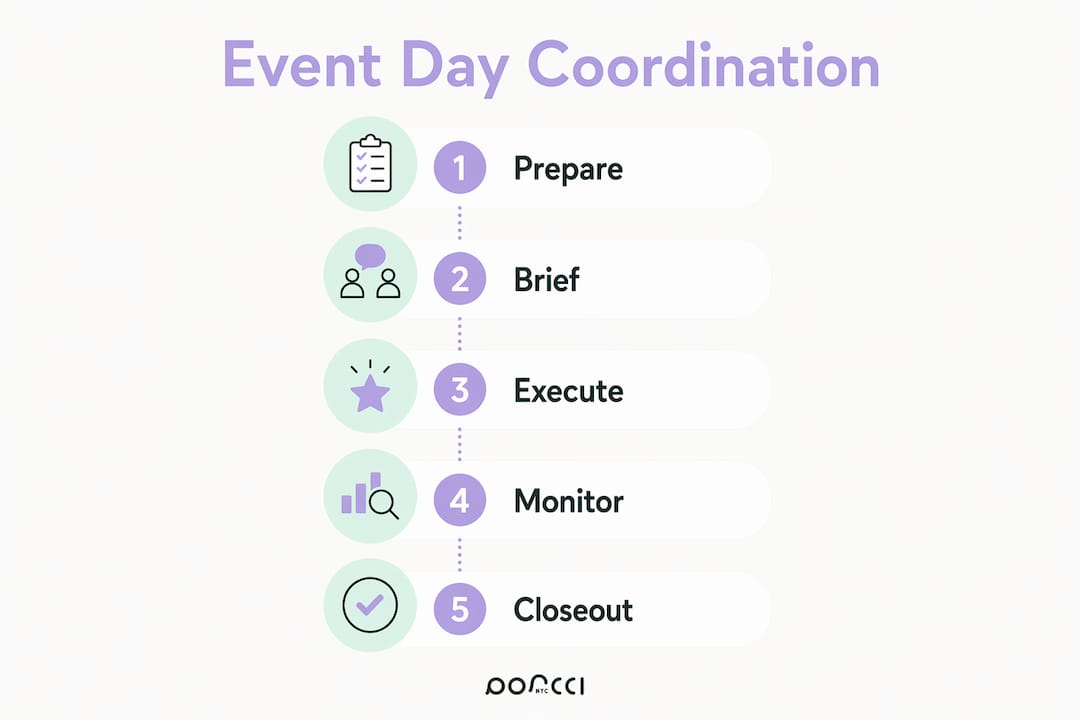
Event day coordination is the real-time orchestration of people, vendors, and logistics to deliver a flawless event on execution day. In the industry, this practice is also called day-of event management. It is the phase where every decision made in advance either pays off or falls apart. This event day coordination guide covers the four tools that separate smooth events from chaotic ones: a structured checklist, a dependency-aware run of show, a focused team briefing, and a centralized command center.
A shared event day checklist tracks every task from vendor confirmations through setup to wrap-up in one place. Without it, critical items fall through the cracks between team members. The checklist is not a to-do list. It is a live accountability tool that every team member references throughout the day.
Structure your checklist across four stages:
1. Final confirmations (24 hours out): Confirm arrival times with all vendors. Verify venue access windows, power availability, and load-in routes. Send final headcount to catering. Confirm AV and sound equipment delivery windows.
2. Morning setup: Walk the venue against your floor plan. Test all microphones, speakers, and lighting rigs. Confirm staff assignments at each station. Review the run of show with department leads.
3. Real-time coordination: Track vendor arrivals against the schedule. Log any deviations immediately. Communicate timeline shifts to all affected parties within five minutes.
4. Same-day wrap-up: Confirm vendor breakdown schedules. Collect all rental equipment. Debrief with the lead coordinator before the venue closes.
Bizzabo’s 50-point onsite checklist covers badge printing, connectivity checks, staff roles, sponsor setups, and safety protocols before doors open. That level of detail reflects what professional day-of event management actually requires. Start your checklist 24 hours before the event and review it again on the morning of the event for critical readiness checks.
Pro Tip: Use a shared digital tool like Google Sheets or Notion so every team member sees real-time checklist updates. Avoid paper checklists at large events. A missed checkbox on paper stays invisible until it becomes a problem.

For a full event planning checklist that covers the weeks leading up to event day, Porcci NYC has a dedicated resource worth bookmarking.
A run of show is the operational timeline for your event. It differs from a checklist in one key way: the checklist tracks readiness, while the run of show sequences every action in real time. Think of the checklist as your pre-flight inspection and the run of show as the flight plan.
A functional run of show template includes these columns:
| Column | Purpose |
|---|---|
| Time | Exact start time for each item |
| Owner | The person responsible for executing the item |
| Location | Where the action takes place |
| Dependencies | What must happen first before this item can start |
| Status | Live tracking: pending, in progress, or complete |
The dependencies and status columns are the most skipped and the most critical. Expo Pass emphasizes that these two columns are what allow coordinators to diagnose and manage cascading delays in real time. If the AV setup runs 20 minutes late, the status column flags it immediately. The dependencies column shows you exactly which items downstream are now at risk.
Attendee communications should appear verbatim in the run of show. Include the exact wording for MC announcements, safety briefings, and program transitions. This removes ambiguity and keeps every guest-facing moment on time.
Pro Tip: Assign one person as the run of show owner. That person calls every cue, tracks every status update, and communicates changes. Shared ownership of the run of show means no one owns it.
The morning briefing is the single most underused tool in day-of event management. Most coordinators skip it or keep it informal. That is a mistake. A structured briefing aligns every team member before the first guest arrives.
Abastio recommends a 10-minute huddle that covers four topics:
• Timeline overview: Walk through the run of show highlights. Flag any known risks or tight transitions.
• Individual roles: Each team member states their primary responsibility and their backup contact.
• Communication channels: Confirm which radio channel or app everyone uses. Eliminate side group chats.
• Escalation protocol: Introduce the 60-second fix rule.
The 60-second fix rule is simple. If a team member cannot resolve an issue within 60 seconds, they escalate immediately to the lead coordinator. This rule prevents minor problems from stalling the entire event while someone tries to solve them alone.
A dedicated command center with a single decision-maker replaces informal group chats for clear operational control. The command center holds the master schedule, radio list, venue maps, vendor contacts, and escalation paths. One person has final authority. Every issue gets logged. Nothing gets lost in a text thread.
Pro Tip: Post a one-page briefing sheet at the command center. It should list every team member’s name, role, radio channel, and cell number. When things move fast, people need information in seconds, not minutes.
For guidance on staffing your event team, Porcci NYC covers hiring, briefing, and deployment best practices in detail.
Coordinating event timelines during a live event requires staying ahead of the schedule, not reacting to it. The coordinator’s job is to anticipate the next transition before the current one finishes.
1. Stay 15 minutes ahead. Abastio’s guidance is to confirm handoffs before they are due. Check with the catering team 30 minutes before dinner service, not five. Confirm the DJ or AV operator is ready before the previous segment ends.
2. Communicate changes immediately. When the timeline shifts, notify every affected party within five minutes. A delay that one vendor knows about and another does not creates compounding problems.
3. Log every deviation. Write down what changed, when it changed, and who was notified. This log protects you in vendor disputes and helps you improve future events.
4. Maintain visual oversight. The lead coordinator should not be stuck in one room. Move through the venue. See what is happening at registration, on stage, and in the catering area. Problems are easier to solve before they escalate.
Treating the timeline as your primary operating system and maintaining a deliberate lead time is the single most effective event execution tip for preventing delays. Reactive coordination always costs more time than proactive coordination.
For technical vendor coordination, especially around AV and sound, entertainment setup guidance from Porcci NYC covers the specific steps that keep those vendors on track.
Effective event day coordination requires a checklist for readiness, a dependency-aware run of show for sequencing, a structured team briefing, and a single-authority command center working together in real time.
| Point | Details |
|---|---|
| Start the checklist early | Begin your day-of checklist 24 hours out and review it again on event morning. |
| Build a dependency-aware run of show | Include timing, owner, location, dependencies, and live status columns to prevent cascading delays. |
| Run a 10-minute morning briefing | Cover timeline, roles, communication channels, and the 60-second escalation rule before doors open. |
| Stay 15 minutes ahead | Confirm every handoff before it is due to avoid compounding delays during the event. |
| Centralize command authority | One person holds final decision-making power and logs every issue in real time. |
After coordinating events ranging from corporate gatherings to large private celebrations across New York City and New Jersey, the pattern is consistent. The events that go wrong do not fail because of bad vendors or bad venues. They fail because the coordinator was reacting instead of leading.
The most common mistake we see is treating the run of show as a document rather than a live tool. Planners build a beautiful timeline, print it out, and then stop updating it the moment the first thing changes. By hour two, the printed run of show is fiction. The fix is simple: assign one person to own the run of show and update it in real time, every time something shifts.
The second mistake is over-relying on group chats for communication. Group chats create noise. They bury urgent messages under casual updates. A single command center with clear authority and a radio system cuts through that noise every time.
The coordinators who run the smoothest events are not the ones who prevent every problem. They are the ones who solve problems fast and keep the energy moving forward. That mindset, combined with the right tools, is what separates good events from great ones.
— PORCCI
When your coordination plan is solid, the right equipment makes it real. Porcci NYC provides AV and sound system rentals in NYC that arrive on time, set up professionally, and operate reliably through every segment of your event. For planners working in New Jersey, Jersey City AV rentals cover the same standard of service. Porcci NYC also offers DJ services, photo booths, lighting, and staffing support, all coordinated as a single package so your vendor list stays short and your event day stays focused. Contact Porcci NYC to build a rental package around your specific event timeline and venue.
Event day coordination is the real-time management of vendors, staff, and logistics on the day of an event. It uses tools like a checklist, run of show, and command center to keep the event on schedule.
A checklist tracks readiness tasks before and during the event. A run of show sequences every action in real time with timing, ownership, and dependencies assigned to each item.
Start your checklist 24 hours before the event and review it again on the morning of the event. Bizzabo recommends this approach to handle pre-arrival setup, badge testing, and staff preparation.
The 60-second fix rule means any team member who cannot resolve an issue within 60 seconds escalates it immediately to the lead coordinator. This prevents small problems from stalling the entire event.
Coordinators should stay at least 15 minutes ahead of the current timeline item. Confirming handoffs early, such as checking with catering 30 minutes before dinner, prevents compounding delays.
Master your events with this event day coordination guide. Learn tools for flawless execution, from checklists to team briefings.
TL;DR:
• Event day coordination involves managing vendors, staff, and logistics in real time to ensure smooth event execution. It relies on tools like checklists, a run of show, a team briefing, and a command center, all working together to prevent delays and chaos. Proper use of these tools helps coordinators stay ahead of schedule, address issues promptly, and deliver successful events.
Event day coordination is the real-time orchestration of people, vendors, and logistics to deliver a flawless event on execution day. In the industry, this practice is also called day-of event management. It is the phase where every decision made in advance either pays off or falls apart. This event day coordination guide covers the four tools that separate smooth events from chaotic ones: a structured checklist, a dependency-aware run of show, a focused team briefing, and a centralized command center.
A shared event day checklist tracks every task from vendor confirmations through setup to wrap-up in one place. Without it, critical items fall through the cracks between team members. The checklist is not a to-do list. It is a live accountability tool that every team member references throughout the day.
Structure your checklist across four stages:
1. Final confirmations (24 hours out): Confirm arrival times with all vendors. Verify venue access windows, power availability, and load-in routes. Send final headcount to catering. Confirm AV and sound equipment delivery windows.
2. Morning setup: Walk the venue against your floor plan. Test all microphones, speakers, and lighting rigs. Confirm staff assignments at each station. Review the run of show with department leads.
3. Real-time coordination: Track vendor arrivals against the schedule. Log any deviations immediately. Communicate timeline shifts to all affected parties within five minutes.
4. Same-day wrap-up: Confirm vendor breakdown schedules. Collect all rental equipment. Debrief with the lead coordinator before the venue closes.
Bizzabo’s 50-point onsite checklist covers badge printing, connectivity checks, staff roles, sponsor setups, and safety protocols before doors open. That level of detail reflects what professional day-of event management actually requires. Start your checklist 24 hours before the event and review it again on the morning of the event for critical readiness checks.
Pro Tip: Use a shared digital tool like Google Sheets or Notion so every team member sees real-time checklist updates. Avoid paper checklists at large events. A missed checkbox on paper stays invisible until it becomes a problem.
For a full event planning checklist that covers the weeks leading up to event day, Porcci NYC has a dedicated resource worth bookmarking.
A run of show is the operational timeline for your event. It differs from a checklist in one key way: the checklist tracks readiness, while the run of show sequences every action in real time. Think of the checklist as your pre-flight inspection and the run of show as the flight plan.
A functional run of show template includes these columns:
| Column | Purpose |
|---|---|
| Time | Exact start time for each item |
| Owner | The person responsible for executing the item |
| Location | Where the action takes place |
| Dependencies | What must happen first before this item can start |
| Status | Live tracking: pending, in progress, or complete |
The dependencies and status columns are the most skipped and the most critical. Expo Pass emphasizes that these two columns are what allow coordinators to diagnose and manage cascading delays in real time. If the AV setup runs 20 minutes late, the status column flags it immediately. The dependencies column shows you exactly which items downstream are now at risk.
Attendee communications should appear verbatim in the run of show. Include the exact wording for MC announcements, safety briefings, and program transitions. This removes ambiguity and keeps every guest-facing moment on time.
Pro Tip: Assign one person as the run of show owner. That person calls every cue, tracks every status update, and communicates changes. Shared ownership of the run of show means no one owns it.
The morning briefing is the single most underused tool in day-of event management. Most coordinators skip it or keep it informal. That is a mistake. A structured briefing aligns every team member before the first guest arrives.
Abastio recommends a 10-minute huddle that covers four topics:
• Timeline overview: Walk through the run of show highlights. Flag any known risks or tight transitions.
• Individual roles: Each team member states their primary responsibility and their backup contact.
• Communication channels: Confirm which radio channel or app everyone uses. Eliminate side group chats.
• Escalation protocol: Introduce the 60-second fix rule.
The 60-second fix rule is simple. If a team member cannot resolve an issue within 60 seconds, they escalate immediately to the lead coordinator. This rule prevents minor problems from stalling the entire event while someone tries to solve them alone.
A dedicated command center with a single decision-maker replaces informal group chats for clear operational control. The command center holds the master schedule, radio list, venue maps, vendor contacts, and escalation paths. One person has final authority. Every issue gets logged. Nothing gets lost in a text thread.
Pro Tip: Post a one-page briefing sheet at the command center. It should list every team member’s name, role, radio channel, and cell number. When things move fast, people need information in seconds, not minutes.
For guidance on staffing your event team, Porcci NYC covers hiring, briefing, and deployment best practices in detail.
Coordinating event timelines during a live event requires staying ahead of the schedule, not reacting to it. The coordinator’s job is to anticipate the next transition before the current one finishes.
1. Stay 15 minutes ahead. Abastio’s guidance is to confirm handoffs before they are due. Check with the catering team 30 minutes before dinner service, not five. Confirm the DJ or AV operator is ready before the previous segment ends.
2. Communicate changes immediately. When the timeline shifts, notify every affected party within five minutes. A delay that one vendor knows about and another does not creates compounding problems.
3. Log every deviation. Write down what changed, when it changed, and who was notified. This log protects you in vendor disputes and helps you improve future events.
4. Maintain visual oversight. The lead coordinator should not be stuck in one room. Move through the venue. See what is happening at registration, on stage, and in the catering area. Problems are easier to solve before they escalate.
Treating the timeline as your primary operating system and maintaining a deliberate lead time is the single most effective event execution tip for preventing delays. Reactive coordination always costs more time than proactive coordination.
For technical vendor coordination, especially around AV and sound, entertainment setup guidance from Porcci NYC covers the specific steps that keep those vendors on track.
Effective event day coordination requires a checklist for readiness, a dependency-aware run of show for sequencing, a structured team briefing, and a single-authority command center working together in real time.
| Point | Details |
|---|---|
| Start the checklist early | Begin your day-of checklist 24 hours out and review it again on event morning. |
| Build a dependency-aware run of show | Include timing, owner, location, dependencies, and live status columns to prevent cascading delays. |
| Run a 10-minute morning briefing | Cover timeline, roles, communication channels, and the 60-second escalation rule before doors open. |
| Stay 15 minutes ahead | Confirm every handoff before it is due to avoid compounding delays during the event. |
| Centralize command authority | One person holds final decision-making power and logs every issue in real time. |
After coordinating events ranging from corporate gatherings to large private celebrations across New York City and New Jersey, the pattern is consistent. The events that go wrong do not fail because of bad vendors or bad venues. They fail because the coordinator was reacting instead of leading.
The most common mistake we see is treating the run of show as a document rather than a live tool. Planners build a beautiful timeline, print it out, and then stop updating it the moment the first thing changes. By hour two, the printed run of show is fiction. The fix is simple: assign one person to own the run of show and update it in real time, every time something shifts.
The second mistake is over-relying on group chats for communication. Group chats create noise. They bury urgent messages under casual updates. A single command center with clear authority and a radio system cuts through that noise every time.
The coordinators who run the smoothest events are not the ones who prevent every problem. They are the ones who solve problems fast and keep the energy moving forward. That mindset, combined with the right tools, is what separates good events from great ones.
— PORCCI
When your coordination plan is solid, the right equipment makes it real. Porcci NYC provides AV and sound system rentals in NYC that arrive on time, set up professionally, and operate reliably through every segment of your event. For planners working in New Jersey, Jersey City AV rentals cover the same standard of service. Porcci NYC also offers DJ services, photo booths, lighting, and staffing support, all coordinated as a single package so your vendor list stays short and your event day stays focused. Contact Porcci NYC to build a rental package around your specific event timeline and venue.
Event day coordination is the real-time management of vendors, staff, and logistics on the day of an event. It uses tools like a checklist, run of show, and command center to keep the event on schedule.
A checklist tracks readiness tasks before and during the event. A run of show sequences every action in real time with timing, ownership, and dependencies assigned to each item.
Start your checklist 24 hours before the event and review it again on the morning of the event. Bizzabo recommends this approach to handle pre-arrival setup, badge testing, and staff preparation.
The 60-second fix rule means any team member who cannot resolve an issue within 60 seconds escalates it immediately to the lead coordinator. This prevents small problems from stalling the entire event.
Coordinators should stay at least 15 minutes ahead of the current timeline item. Confirming handoffs early, such as checking with catering 30 minutes before dinner, prevents compounding delays.