Discover how to manage party logistics in NYC & NJ effectively. Lock in venue details, streamline schedules, and ensure a successful event.
Lock your venue’s get-in windows and build a production schedule before you do anything else. That single action prevents the most common cascade of day-of failures: vehicles arriving without dock slots, vendors stacking up at the same loading bay, and crew standing idle while equipment sits in a holding yard. Event logistics management covers venue coordination, transportation, equipment setup, vendor management, staffing, and technology — and every one of those threads runs through the production schedule.
• Venue dock booking: Confirm the loading dock dimensions, booking policy, and available windows in writing before signing the venue contract.
• Vehicle count: Know how many trucks, vans, and crew vehicles you need before you can assign arrival windows.
• Production schedule owner: Assign one named logistics lead who owns the master document and all vendor communications.
Pro Tip: Assign a single on-site logistics lead and marshal the yard from the first vehicle arrival. Without one person controlling the loading bay, vehicles self-marshal and the resulting gridlock can delay your entire build by hours.
• What does a party logistics checklist look like?
• Week-by-week timeline for managing event logistics
• How do you audit a venue for docks, lifts, and routes?
• How to build a marshalled yard and dock-booking plan
• Managing equipment, manifests, and freight
• Contingency planning, insurance, and risk assessment
• How to run the day-of operations and get-out sequence
• When should you hire an event logistics partner?
• A local perspective on NYC and NJ event logistics
• Porcci NYC covers your logistics from dock to dance floor
• Useful sources and templates
• FAQ
Effective event logistics breaks into three phases. Use this as your master reference.
Pre-event
• Venue confirmation, dock booking, and out-of-hours access charges in writing
• Insurance certificates from every vendor (general liability minimum)
• RAMS / method statements for any rigging or elevated work
• Vendor contact sheet with delivery windows, vehicle registrations, and driver names
• Labeled crates and inbound shipping manifest (item, dimensions, weight, destination room, setup priority)
On-site
• Marshalled yard with a named marshal holding the dock booking sheet
• Printed run-of-show distributed to every vendor and crew member
• Single communications channel (radios primary, phone secondary)
• Technical rehearsal window confirmed before doors open
• Vendor manifests and bay signage posted at the loading dock
Post-event
• Reverse-load (LIFO) plan briefed before the event starts
• Outbound dock slots pre-booked for strike
• Return shipping labels attached to every crate during build
• Damage documentation completed and signed off by each vendor before departure
| Template | What it contains |
|---|---|
| Vendor contact/manifest | Company, contact name, mobile, vehicle reg, arrival window, cargo type, assigned door |
| Inbound shipping manifest | Item ID, description, dimensions, weight, destination room, setup priority |
| Dock booking sheet | Arrival window, vehicle reg, driver name, cargo type, assigned bay |
| Run-of-show | Minute-by-minute schedule, role assignments, escalation contacts |
For events over roughly 200 attendees, detailed planning should begin 10–12 weeks out. Multi-venue or multi-day events may need six months or more.
| Milestone | Key actions |
|---|---|
| 12 weeks out | Confirm venue, sketch vehicle/storage plan, assign logistics lead, draft initial supplier list |
| 8 weeks out | Begin inbound freight planning, finalize kit lists, draft production schedule and RAMS for rigging |
| 4 weeks out | Final supplier briefing, verify lift and doorway measurements, label crates, manifest inbound deliveries |
| 2 weeks out | Final venue walk, confirm dock slots, security passes, and any local parking restrictions |
| Week of | Circulate minute-by-minute run-of-show, confirm driver names and vehicle registrations, finalize marshal plan |
• At 12 weeks, the logistics lead should be named and have venue access to begin the site walk process.
• At 4 weeks, every crate should carry a unique ID, a fragile label where needed, and a setup-priority number.
• At 2 weeks, confirm dock slot times in writing — not just verbally.
Pro Tip: Never trust venue specs online. Measure the freight elevator, doorways, and service corridor yourself. A piece of kit that fits on paper can fail at the loading dock because the venue’s listed dimensions include the door frame, not the clear opening.
A thorough venue evaluation covers capacity, loading dock specs, and vendor access policies — all confirmed before contracts are signed.
Measurements to record on the site walk:
• Loading dock clear height and width
• Freight elevator interior dimensions and weight capacity
• All door widths along the service route
• Ceiling height in the event space and any rigging points
• Distance from dock to stage (affects crew time and equipment trolley needs)
Documents to request from the venue:
• Dock booking policy and available windows
• Vehicle weight and height restrictions for the service road
• Out-of-hours access charges and security badge requirements
• Any restrictions on generator placement or external power connections
Walk the full unload route with your largest piece of equipment in mind. Validate lift dimensions in person, not from a brochure. Mark holding areas for empty crates on your venue floor plan.
Pro Tip: Photograph every step of the service route during your site walk and embed those images directly into the production schedule. When a driver asks where to go at 6:00 AM, a photo is faster than a paragraph.
Marshalled yards and dock booking systems using 15–30 minute slots are critical. Missing a slot can cause long holding-yard waits and cascade delays across your entire build.
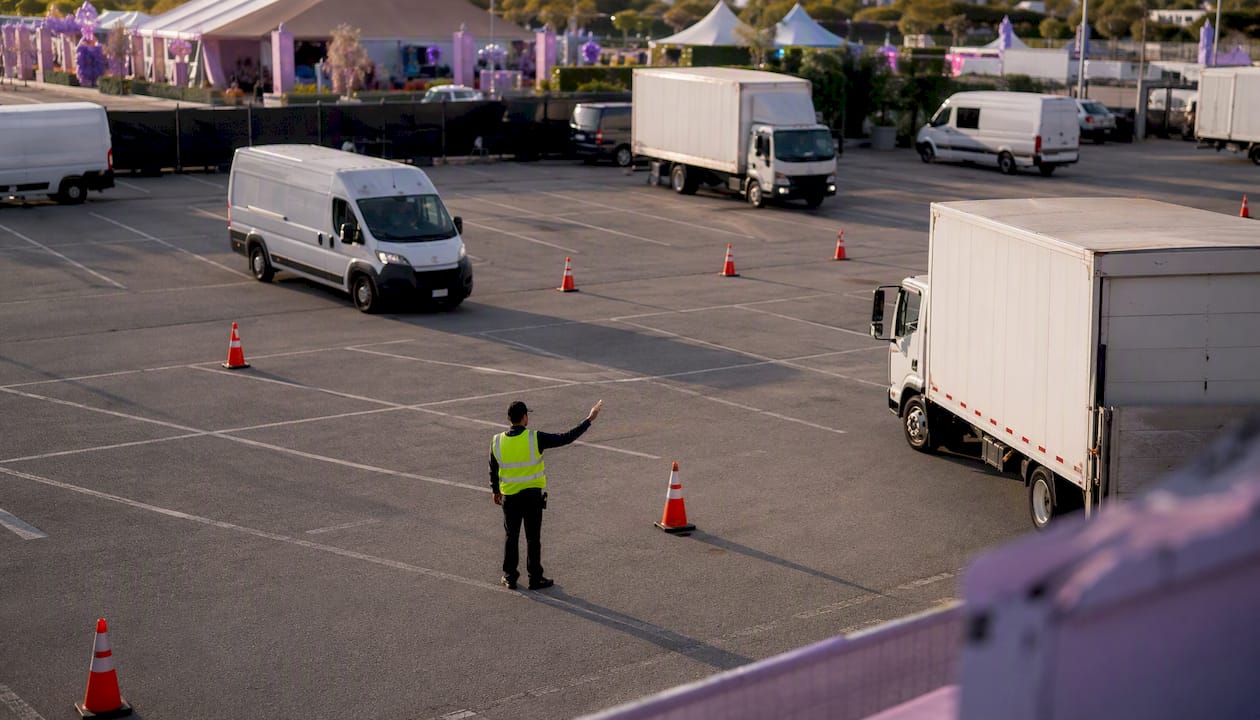
A yard marshal wears high-vis, carries the dock booking sheet, and controls every vehicle movement from arrival to departure. Without that role filled, vehicles self-marshal and block each other.
Dock booking sheet columns: arrival window, vehicle registration, driver name and mobile, cargo type, assigned door, and departure time.
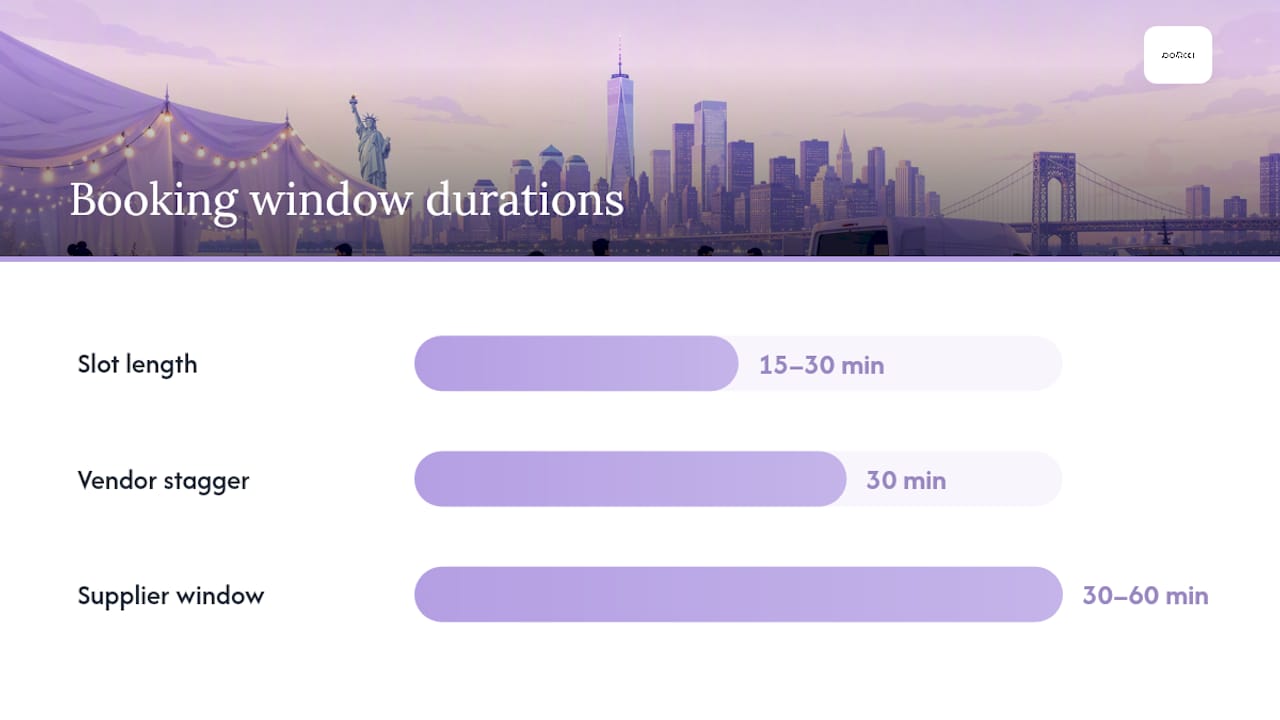
Stagger vendor arrival windows by at least 30 minutes and give each supplier a 30–60 minute window rather than a fixed time. Two vendors at the same bay at the same time is one of the most common causes of cascading delays.
On-day yard rules:
• No vehicle enters the dock area without checking in with the marshal
• Vehicles that miss their window go to the holding area and re-queue
• Get-out vehicles stage in reverse build order (last in, first out)
• The marshal holds the only copy of the dock booking sheet on site
Pro Tip: Stage get-out vehicles in reverse build order before the event ends. Place a dedicated marshal on the loading bay for strike. Pre-briefing the get-out sequence during build can save two or more hours at midnight.
Loading trucks in stop sequence — with stage-first items accessible at the back of the truck — reduces on-site re-handling and saves significant crew time across multiple stops.
A shipping manifest lists every item with its dimensions, weight, destination room, and setup priority. For multi-vendor sites, this document prevents missing items and determines load order.
Labeling and crate-handling rules:
• Unique ID on every crate (matching the manifest)
• Fragile labels and orientation arrows where needed
• Setup priority number (1 = first out of the truck)
• Empty crate storage area marked on the floor plan before build begins
For short-term staging, a local warehouse near the venue is preferable to storing empties in the event space, where they create safety hazards and slow crew movement. For sound system setup and AV equipment specifically, keep the manufacturer’s packing materials until after the event.
If international freight is involved, an ATA Carnet simplifies customs for temporary imports. U.S. procedures differ from those in other countries; consult a licensed freight forwarder before shipping across borders.
Pro Tip: Assign one person to clear all inbound manifest queries. When multiple vendors deliver simultaneously, questions about where a crate goes can stall the entire dock if there is no single authority.
Budget a logistics contingency of 10–15% of your logistics line. Generator hires, overtime labor, and expedited deliveries are the costs most often missed in the first draft of a budget.
Insurance checklist:
• General liability (vendor minimum, confirmed by certificate)
• Hired-and-non-owned vehicle coverage for any rented trucks
• Workers’ compensation for all crew on site
• Equipment transit insurance for high-value AV and production gear
• Review every certificate before the vendor’s arrival window
Permits and paperwork to collect:
• Vendor insurance certificates (request 30 days before the event)
• Driver documents and vehicle registrations for all delivery vehicles
• Municipal permits for street parking or load zones if the venue has no private dock
• ADR documentation for any hazardous items (batteries, fuel)
For rigging or elevated work, request a method statement and RAMS from the supplier at the 8-week milestone. Tie contingency triggers to specific timeline milestones: if a supplier has not confirmed by 2 weeks out, activate the backup. For event budget planning guidance that covers contingency allocation in detail, that resource walks through line-by-line budget templates.
Pro Tip: Tie every contingency trigger to a named milestone. “If the AV supplier has not confirmed vehicle registration by Day minus 7, call the backup vendor.” Vague contingency plans do not get activated under pressure.
1. Marshal arrival (T-minus 3 hours): Yard marshal on site, dock booking sheet printed, holding area coned off.
2. Vendor load-in (T-minus 2.5 hours): Suppliers arrive in assigned windows; manifests checked at the bay.
3. AV install and rigging (T-minus 2 hours): Production lead confirms power, cable runs, and rigging points.
4. Soundcheck and technical rehearsal (T-minus 1 hour): Full AV test, mic check, lighting cue run.
5. Pre-doors safety sweep (T-minus 30 minutes): Walk the space, confirm fire exits clear, registration ready.
6. Doors open: No further deliveries to the dock; all vendor vehicles clear the loading area.
7. Strike brief (during event, not after): Brief all crew on get-out sequence, LIFO vehicle order, and dock slot times.
8. Get-out (post-event): Vehicles arrive in reverse build order; marshal controls bay; damage documentation completed before any vendor departs.
Strike requires its own schedule and pre-briefing. Planning get-out during build reduces strike time and improves safety. For entertainment setup specifics in NYC and NJ, the event entertainment setup guide covers photo booth, DJ, and karaoke positioning in detail.
Pre-doors checklist:
• All AV equipment tested and signed off by the production lead
• Safety sweep completed and documented
• Registration desk staffed and guest list confirmed
• Final vendor confirmations received (no outstanding deliveries)
Pro Tip: Brief the strike sequence during build, not at midnight when everyone is tired. A five-minute briefing at load-in saves two hours of confusion at get-out.
Consider bringing in a specialist when your event crosses any of these thresholds: more than 200 guests, multiple delivery vehicles, international freight, multi-venue or multi-day format, or limited in-house logistics experience. A partner’s real value is coordination and venue relationships, not just vehicles.
Questions to ask any logistics partner:
• Who runs the yard, and will they be on site from the first vehicle arrival?
• What is your backup plan if a delivery vehicle breaks down?
• Can you show evidence of past experience at this specific venue or venue type?
• How do you handle dock booking systems and out-of-hours access?
• Who is the live on-site contact, and what is their direct mobile number?
For top staffing tips that apply when vetting a partner’s crew, that resource covers shift scheduling and briefing standards worth asking about.
Pro Tip: Ask the partner for a sample production schedule from a comparable event. A partner who cannot produce one has probably never run a marshalled yard.
Locking venue get-in windows and assigning a named logistics lead before any other planning step is the single action that prevents the most common cascade of day-of failures in NYC and NJ event logistics.
| Point | Details |
|---|---|
| Start planning early | Events over 200 guests need logistics planning to begin 10–12 weeks out. |
| Lock the dock first | Confirm dock dimensions, booking windows, and vehicle restrictions in writing before signing the venue contract. |
| Marshal the yard | Assign a named yard marshal and use 30–60 minute staggered arrival windows to prevent loading bay conflicts. |
| Manifest and label everything | Every crate needs a unique ID, setup priority, and destination room on the inbound manifest. |
| Porcci NYC handles it end-to-end | Porcci NYC provides equipment delivery, marshalled yard support, production scheduling, staffing, and entertainment for NYC and NJ events. |
Operating across New York City and New Jersey, we see the same pressure points repeat at nearly every venue. Manhattan loading docks are often shared with residential or commercial tenants, which means your dock window is non-negotiable — arrive five minutes late and you may wait an hour. In New Jersey, suburban venues frequently lack a dedicated freight elevator, so the service route walk is not optional; it is where you discover the staircase that makes your largest speaker cabinet impossible to move.
Curb rules in NYC add another layer. Many venues sit on streets with alternate-side parking, commercial vehicle time restrictions, or no-standing zones that apply during your load-in window. Municipal permits for street loading zones are available but require lead time; we always advise clients to apply at least three weeks out. These are the details that a production schedule built from a template alone will miss — local knowledge fills the gap.
Planning a party in NYC or New Jersey means coordinating equipment, crew, and entertainment across one of the most logistically demanding markets in the country. Porcci NYC takes that weight off your plate with a fully managed service that includes equipment delivery, on-site setup and breakdown, marshalled yard coordination, production scheduling, and professional staffing.
For entertainment, choose from DJ services, photo booth rentals, and karaoke machine rentals — all with delivery, setup, and a dedicated on-site technician included. Before you reach out, have your guest count, venue address, and the dimensions of your largest equipment item ready. Request a quote and we will send back a timeline sense-check within one business day.
| Template / Resource | What it contains |
|---|---|
| Load-in schedule | Vendor arrival windows, vehicle registrations, assigned bays, and cargo types |
| Inbound shipping manifest | Item ID, dimensions, weight, destination room, setup priority |
| Dock booking sheet | Arrival window, driver name, vehicle reg, cargo type, assigned door |
| RAMS checklist | Risk assessment and method statement template for rigging and height work |
| Run-of-show | Minute-by-minute schedule with role assignments and escalation contacts |
Authoritative references used in this guide:
• Event logistics: a planner’s guide to delivery on the day | Paragon Logistics
• Event Logistics — Engineerica
• The complete guide on event logistics for planners | Dryfta
• Event logistics planning — Loopyah
• Event Logistics Planning Guide for Organizers | Abastio
• How to Optimize Delivery Routes for Party and Event Rentals | Event Rental Systems
• Event Logistics Management: A Complete 2026 Guide | Freeformhouse
Porcci NYC resources:
• Backyard party equipment checklist for smaller events
• Request a quote for a full logistics and entertainment package
For events over 200 guests, begin detailed logistics planning 10–12 weeks out. Multi-venue or multi-day events may need six months or more.
A marshalled yard is a controlled loading area where one named person directs all vehicle movements using a dock booking sheet. Without it, vehicles self-marshal and block each other, causing cascade delays across your entire build.
At minimum: a current general liability insurance certificate, driver documents and vehicle registration for delivery vehicles, and a method statement for any rigging or elevated work.
The load-in schedule, the live contact sheet, and the minute-by-minute run-of-show. Keep them updated in real time and distribute them to every vendor and crew member.
Yes. Porcci NYC provides equipment delivery, setup, breakdown, marshalled yard coordination, staffing, DJ services, photo booth rentals, and karaoke machine rentals for events across NYC and New Jersey.
Discover how to manage party logistics in NYC & NJ effectively. Lock in venue details, streamline schedules, and ensure a successful event.
Lock your venue’s get-in windows and build a production schedule before you do anything else. That single action prevents the most common cascade of day-of failures: vehicles arriving without dock slots, vendors stacking up at the same loading bay, and crew standing idle while equipment sits in a holding yard. Event logistics management covers venue coordination, transportation, equipment setup, vendor management, staffing, and technology — and every one of those threads runs through the production schedule.
• Venue dock booking: Confirm the loading dock dimensions, booking policy, and available windows in writing before signing the venue contract.
• Vehicle count: Know how many trucks, vans, and crew vehicles you need before you can assign arrival windows.
• Production schedule owner: Assign one named logistics lead who owns the master document and all vendor communications.
Pro Tip: Assign a single on-site logistics lead and marshal the yard from the first vehicle arrival. Without one person controlling the loading bay, vehicles self-marshal and the resulting gridlock can delay your entire build by hours.
• What does a party logistics checklist look like?
• Week-by-week timeline for managing event logistics
• How do you audit a venue for docks, lifts, and routes?
• How to build a marshalled yard and dock-booking plan
• Managing equipment, manifests, and freight
• Contingency planning, insurance, and risk assessment
• How to run the day-of operations and get-out sequence
• When should you hire an event logistics partner?
• A local perspective on NYC and NJ event logistics
• Porcci NYC covers your logistics from dock to dance floor
• Useful sources and templates
• FAQ
Effective event logistics breaks into three phases. Use this as your master reference.
Pre-event
• Venue confirmation, dock booking, and out-of-hours access charges in writing
• Insurance certificates from every vendor (general liability minimum)
• RAMS / method statements for any rigging or elevated work
• Vendor contact sheet with delivery windows, vehicle registrations, and driver names
• Labeled crates and inbound shipping manifest (item, dimensions, weight, destination room, setup priority)
On-site
• Marshalled yard with a named marshal holding the dock booking sheet
• Printed run-of-show distributed to every vendor and crew member
• Single communications channel (radios primary, phone secondary)
• Technical rehearsal window confirmed before doors open
• Vendor manifests and bay signage posted at the loading dock
Post-event
• Reverse-load (LIFO) plan briefed before the event starts
• Outbound dock slots pre-booked for strike
• Return shipping labels attached to every crate during build
• Damage documentation completed and signed off by each vendor before departure
| Template | What it contains |
|---|---|
| Vendor contact/manifest | Company, contact name, mobile, vehicle reg, arrival window, cargo type, assigned door |
| Inbound shipping manifest | Item ID, description, dimensions, weight, destination room, setup priority |
| Dock booking sheet | Arrival window, vehicle reg, driver name, cargo type, assigned bay |
| Run-of-show | Minute-by-minute schedule, role assignments, escalation contacts |
For events over roughly 200 attendees, detailed planning should begin 10–12 weeks out. Multi-venue or multi-day events may need six months or more.
| Milestone | Key actions |
|---|---|
| 12 weeks out | Confirm venue, sketch vehicle/storage plan, assign logistics lead, draft initial supplier list |
| 8 weeks out | Begin inbound freight planning, finalize kit lists, draft production schedule and RAMS for rigging |
| 4 weeks out | Final supplier briefing, verify lift and doorway measurements, label crates, manifest inbound deliveries |
| 2 weeks out | Final venue walk, confirm dock slots, security passes, and any local parking restrictions |
| Week of | Circulate minute-by-minute run-of-show, confirm driver names and vehicle registrations, finalize marshal plan |
• At 12 weeks, the logistics lead should be named and have venue access to begin the site walk process.
• At 4 weeks, every crate should carry a unique ID, a fragile label where needed, and a setup-priority number.
• At 2 weeks, confirm dock slot times in writing — not just verbally.
Pro Tip: Never trust venue specs online. Measure the freight elevator, doorways, and service corridor yourself. A piece of kit that fits on paper can fail at the loading dock because the venue’s listed dimensions include the door frame, not the clear opening.
A thorough venue evaluation covers capacity, loading dock specs, and vendor access policies — all confirmed before contracts are signed.
Measurements to record on the site walk:
• Loading dock clear height and width
• Freight elevator interior dimensions and weight capacity
• All door widths along the service route
• Ceiling height in the event space and any rigging points
• Distance from dock to stage (affects crew time and equipment trolley needs)
Documents to request from the venue:
• Dock booking policy and available windows
• Vehicle weight and height restrictions for the service road
• Out-of-hours access charges and security badge requirements
• Any restrictions on generator placement or external power connections
Walk the full unload route with your largest piece of equipment in mind. Validate lift dimensions in person, not from a brochure. Mark holding areas for empty crates on your venue floor plan.
Pro Tip: Photograph every step of the service route during your site walk and embed those images directly into the production schedule. When a driver asks where to go at 6:00 AM, a photo is faster than a paragraph.
Marshalled yards and dock booking systems using 15–30 minute slots are critical. Missing a slot can cause long holding-yard waits and cascade delays across your entire build.
A yard marshal wears high-vis, carries the dock booking sheet, and controls every vehicle movement from arrival to departure. Without that role filled, vehicles self-marshal and block each other.
Dock booking sheet columns: arrival window, vehicle registration, driver name and mobile, cargo type, assigned door, and departure time.
Stagger vendor arrival windows by at least 30 minutes and give each supplier a 30–60 minute window rather than a fixed time. Two vendors at the same bay at the same time is one of the most common causes of cascading delays.
On-day yard rules:
• No vehicle enters the dock area without checking in with the marshal
• Vehicles that miss their window go to the holding area and re-queue
• Get-out vehicles stage in reverse build order (last in, first out)
• The marshal holds the only copy of the dock booking sheet on site
Pro Tip: Stage get-out vehicles in reverse build order before the event ends. Place a dedicated marshal on the loading bay for strike. Pre-briefing the get-out sequence during build can save two or more hours at midnight.
Loading trucks in stop sequence — with stage-first items accessible at the back of the truck — reduces on-site re-handling and saves significant crew time across multiple stops.
A shipping manifest lists every item with its dimensions, weight, destination room, and setup priority. For multi-vendor sites, this document prevents missing items and determines load order.
Labeling and crate-handling rules:
• Unique ID on every crate (matching the manifest)
• Fragile labels and orientation arrows where needed
• Setup priority number (1 = first out of the truck)
• Empty crate storage area marked on the floor plan before build begins
For short-term staging, a local warehouse near the venue is preferable to storing empties in the event space, where they create safety hazards and slow crew movement. For sound system setup and AV equipment specifically, keep the manufacturer’s packing materials until after the event.
If international freight is involved, an ATA Carnet simplifies customs for temporary imports. U.S. procedures differ from those in other countries; consult a licensed freight forwarder before shipping across borders.
Pro Tip: Assign one person to clear all inbound manifest queries. When multiple vendors deliver simultaneously, questions about where a crate goes can stall the entire dock if there is no single authority.
Budget a logistics contingency of 10–15% of your logistics line. Generator hires, overtime labor, and expedited deliveries are the costs most often missed in the first draft of a budget.
Insurance checklist:
• General liability (vendor minimum, confirmed by certificate)
• Hired-and-non-owned vehicle coverage for any rented trucks
• Workers’ compensation for all crew on site
• Equipment transit insurance for high-value AV and production gear
• Review every certificate before the vendor’s arrival window
Permits and paperwork to collect:
• Vendor insurance certificates (request 30 days before the event)
• Driver documents and vehicle registrations for all delivery vehicles
• Municipal permits for street parking or load zones if the venue has no private dock
• ADR documentation for any hazardous items (batteries, fuel)
For rigging or elevated work, request a method statement and RAMS from the supplier at the 8-week milestone. Tie contingency triggers to specific timeline milestones: if a supplier has not confirmed by 2 weeks out, activate the backup. For event budget planning guidance that covers contingency allocation in detail, that resource walks through line-by-line budget templates.
Pro Tip: Tie every contingency trigger to a named milestone. “If the AV supplier has not confirmed vehicle registration by Day minus 7, call the backup vendor.” Vague contingency plans do not get activated under pressure.
1. Marshal arrival (T-minus 3 hours): Yard marshal on site, dock booking sheet printed, holding area coned off.
2. Vendor load-in (T-minus 2.5 hours): Suppliers arrive in assigned windows; manifests checked at the bay.
3. AV install and rigging (T-minus 2 hours): Production lead confirms power, cable runs, and rigging points.
4. Soundcheck and technical rehearsal (T-minus 1 hour): Full AV test, mic check, lighting cue run.
5. Pre-doors safety sweep (T-minus 30 minutes): Walk the space, confirm fire exits clear, registration ready.
6. Doors open: No further deliveries to the dock; all vendor vehicles clear the loading area.
7. Strike brief (during event, not after): Brief all crew on get-out sequence, LIFO vehicle order, and dock slot times.
8. Get-out (post-event): Vehicles arrive in reverse build order; marshal controls bay; damage documentation completed before any vendor departs.
Strike requires its own schedule and pre-briefing. Planning get-out during build reduces strike time and improves safety. For entertainment setup specifics in NYC and NJ, the event entertainment setup guide covers photo booth, DJ, and karaoke positioning in detail.
Pre-doors checklist:
• All AV equipment tested and signed off by the production lead
• Safety sweep completed and documented
• Registration desk staffed and guest list confirmed
• Final vendor confirmations received (no outstanding deliveries)
Pro Tip: Brief the strike sequence during build, not at midnight when everyone is tired. A five-minute briefing at load-in saves two hours of confusion at get-out.
Consider bringing in a specialist when your event crosses any of these thresholds: more than 200 guests, multiple delivery vehicles, international freight, multi-venue or multi-day format, or limited in-house logistics experience. A partner’s real value is coordination and venue relationships, not just vehicles.
Questions to ask any logistics partner:
• Who runs the yard, and will they be on site from the first vehicle arrival?
• What is your backup plan if a delivery vehicle breaks down?
• Can you show evidence of past experience at this specific venue or venue type?
• How do you handle dock booking systems and out-of-hours access?
• Who is the live on-site contact, and what is their direct mobile number?
For top staffing tips that apply when vetting a partner’s crew, that resource covers shift scheduling and briefing standards worth asking about.
Pro Tip: Ask the partner for a sample production schedule from a comparable event. A partner who cannot produce one has probably never run a marshalled yard.
Locking venue get-in windows and assigning a named logistics lead before any other planning step is the single action that prevents the most common cascade of day-of failures in NYC and NJ event logistics.
| Point | Details |
|---|---|
| Start planning early | Events over 200 guests need logistics planning to begin 10–12 weeks out. |
| Lock the dock first | Confirm dock dimensions, booking windows, and vehicle restrictions in writing before signing the venue contract. |
| Marshal the yard | Assign a named yard marshal and use 30–60 minute staggered arrival windows to prevent loading bay conflicts. |
| Manifest and label everything | Every crate needs a unique ID, setup priority, and destination room on the inbound manifest. |
| Porcci NYC handles it end-to-end | Porcci NYC provides equipment delivery, marshalled yard support, production scheduling, staffing, and entertainment for NYC and NJ events. |
Operating across New York City and New Jersey, we see the same pressure points repeat at nearly every venue. Manhattan loading docks are often shared with residential or commercial tenants, which means your dock window is non-negotiable — arrive five minutes late and you may wait an hour. In New Jersey, suburban venues frequently lack a dedicated freight elevator, so the service route walk is not optional; it is where you discover the staircase that makes your largest speaker cabinet impossible to move.
Curb rules in NYC add another layer. Many venues sit on streets with alternate-side parking, commercial vehicle time restrictions, or no-standing zones that apply during your load-in window. Municipal permits for street loading zones are available but require lead time; we always advise clients to apply at least three weeks out. These are the details that a production schedule built from a template alone will miss — local knowledge fills the gap.
Planning a party in NYC or New Jersey means coordinating equipment, crew, and entertainment across one of the most logistically demanding markets in the country. Porcci NYC takes that weight off your plate with a fully managed service that includes equipment delivery, on-site setup and breakdown, marshalled yard coordination, production scheduling, and professional staffing.
For entertainment, choose from DJ services, photo booth rentals, and karaoke machine rentals — all with delivery, setup, and a dedicated on-site technician included. Before you reach out, have your guest count, venue address, and the dimensions of your largest equipment item ready. Request a quote and we will send back a timeline sense-check within one business day.
| Template / Resource | What it contains |
|---|---|
| Load-in schedule | Vendor arrival windows, vehicle registrations, assigned bays, and cargo types |
| Inbound shipping manifest | Item ID, dimensions, weight, destination room, setup priority |
| Dock booking sheet | Arrival window, driver name, vehicle reg, cargo type, assigned door |
| RAMS checklist | Risk assessment and method statement template for rigging and height work |
| Run-of-show | Minute-by-minute schedule with role assignments and escalation contacts |
Authoritative references used in this guide:
• Event logistics: a planner’s guide to delivery on the day | Paragon Logistics
• Event Logistics — Engineerica
• The complete guide on event logistics for planners | Dryfta
• Event logistics planning — Loopyah
• Event Logistics Planning Guide for Organizers | Abastio
• How to Optimize Delivery Routes for Party and Event Rentals | Event Rental Systems
• Event Logistics Management: A Complete 2026 Guide | Freeformhouse
Porcci NYC resources:
• Backyard party equipment checklist for smaller events
• Request a quote for a full logistics and entertainment package
For events over 200 guests, begin detailed logistics planning 10–12 weeks out. Multi-venue or multi-day events may need six months or more.
A marshalled yard is a controlled loading area where one named person directs all vehicle movements using a dock booking sheet. Without it, vehicles self-marshal and block each other, causing cascade delays across your entire build.
At minimum: a current general liability insurance certificate, driver documents and vehicle registration for delivery vehicles, and a method statement for any rigging or elevated work.
The load-in schedule, the live contact sheet, and the minute-by-minute run-of-show. Keep them updated in real time and distribute them to every vendor and crew member.
Yes. Porcci NYC provides equipment delivery, setup, breakdown, marshalled yard coordination, staffing, DJ services, photo booth rentals, and karaoke machine rentals for events across NYC and New Jersey.