Discover what is event delivery service and how it ensures seamless transport, setup, and pack-up for your next event. Simplify your planning!
TL;DR:
• Proper event delivery encompasses transportation, on-site setup, and post-event removal, not just transportation itself.
• Planning and coordinating these elements with specialized providers ensure timely arrivals, accurate placement, and smooth event execution.
Most people hear “event delivery service” and picture a van dropping off boxes. That assumption leaves a lot of expensive surprises on the day of your event. A true event delivery service covers transport, setup, and post-event pack-up as a coordinated system, not just getting items from point A to point B. Before you plan your next private party or corporate function, understanding this distinction will save you time, money, and a lot of stress.
• What event delivery service really covers
• Key components of a strong event delivery plan
• Why timing and reliability define delivery success
• Event delivery vs. event management
• Our honest take on event delivery planning
• Let Porccinyc handle your next event delivery
• FAQ
| Point | Details |
|---|---|
| More than transportation | Event delivery includes on-site setup, storage coordination, and post-event pickup, not just transport. |
| Planning details matter | Specifying who, what, where, when, and how prevents the most common delivery failures. |
| Timing is non-negotiable | Delays in event delivery directly disrupt setup schedules and hurt the attendee experience. |
| Logistics vs. management | Event delivery focuses on physical handling, while event management covers strategy and overall coordination. |
| Specialized providers win | Working with providers who know venue access rules and handle delicate equipment reduces costly errors. |
When people ask what is event delivery service, they are usually expecting a simple answer. The reality is more layered. Event logistics involves planning and coordinating the transportation, on-site handling, and post-event removal of every physical element your event requires.
Think about what actually needs to move for a corporate gala or a wedding reception. You have:
• Sound systems, speakers, and microphones
• Lighting rigs and power distribution equipment
• Photo booths, backdrops, and props
• Staging, furniture, and branded signage
• Catering equipment and serving stations
Each of these items requires more than a drop-off. Someone needs to receive them, place them correctly, and verify that nothing is damaged or missing. After the event, those same items need to be broken down and removed on schedule. That full cycle is what event delivery services explained properly should describe. It is end-to-end coordination, not a single trip.
What separates event delivery from a general courier is specialization. A standard shipping company delivers to a loading dock and moves on. An event delivery provider understands venue access restrictions, floor plan requirements, and the fact that some items are irreplaceable. A broken backdrop or late DJ setup cannot be fixed with a refund after the fact.
Pro Tip: When reviewing a provider’s scope, ask specifically whether setup and breakdown are included. Many quote transport only, and the gap in coverage shows up at the worst possible time.
Understanding what is event delivery and setup in theory is one thing. Building a plan that actually works on event day is another. The five critical checkpoints every effective event delivery plan should address are: who, what, where, when, and how.
1. Who receives the delivery. Designate a named point of contact at the venue, not just a general staff member. This person confirms arrival, checks items against the manifest, and directs placement. For larger events, consider a dedicated staffing role specifically for this.
2. What is being delivered. Document every item with dimensions, quantities, and any special handling requirements. Fragile AV equipment, for example, requires padding and climate-controlled transport in some cases.
3. Where items go at the venue. Specify the exact access point, freight elevator location, and final placement zone for each item. Vague drop-off instructions are a primary cause of on-site delays.
4. When the delivery windows open and close. Align delivery timing with venue access hours and your setup schedule. Early deliveries can create conflicts with other vendors or venue operations.
5. How items are moved inside the venue. Know in advance whether a forklift, hand truck, or manual crew is needed. Some venues have strict rules about equipment used on their floors.
Common pitfalls include assuming the venue staff will handle placement, failing to share the delivery schedule with all vendors, and not accounting for elevator wait times in high-rise venues. Unclear drop-off arrangements are consistently a bigger problem than transportation itself.
Pro Tip: Create a one-page delivery brief that includes the contact name, phone number, venue access details, and item checklist. Share it with every party involved at least 48 hours in advance.
Event delivery does not operate on flexible timelines. A retail shipment arriving a day late is an inconvenience. A late sound system on the day of a corporate conference is a crisis. That difference defines the entire approach to event logistics.
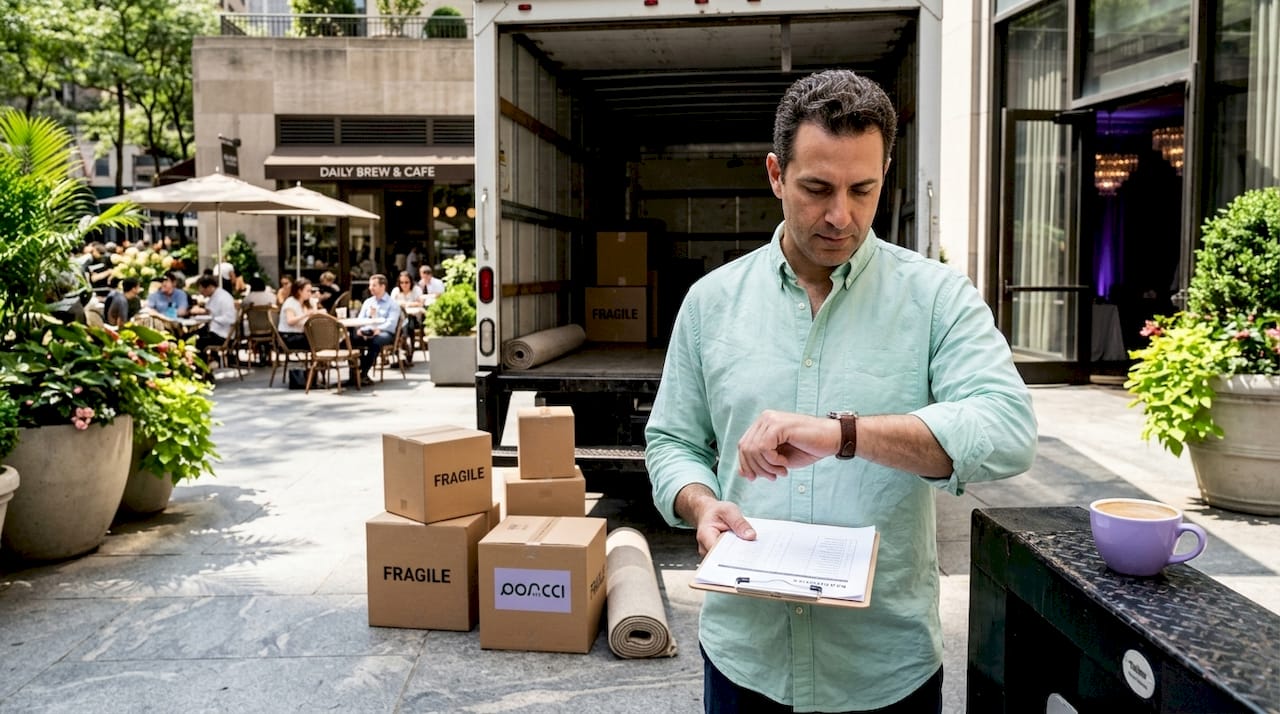
Delays directly harm attendee experience and compress the setup window, which increases the chance of errors during assembly. When setup crews are rushed, equipment gets placed incorrectly, cables get run improperly, and safety checks get skipped.
Several factors make reliable event delivery distinctly challenging:
• Venue windows are fixed and non-negotiable
• Multiple vendors often share the same loading area
• Traffic in dense urban areas like NYC and NJ adds unpredictable time
• Some items, like floral arrangements or temperature-sensitive catering supplies, have strict handling requirements
Real-time tracking and route optimization are not optional for professional event delivery providers. They are the baseline. Knowing where a shipment is at any given moment allows coordinators to adjust setup schedules and communicate proactively with venue contacts.
Proactive communication is what separates a minor hiccup from a full disruption. When a delivery team calls ahead about a 20-minute delay, your crew can adjust. When they simply show up late with no warning, your entire setup timeline collapses.
For complex events with multiple rental items, check out event equipment essentials to build a delivery manifest before you finalize your plan.
These two terms overlap enough to cause real confusion. Clearing that up helps you assign responsibilities correctly and avoid gaps in coverage.
Event logistics covers the physical movement, storage, and on-site handling of materials. Event management is the broader discipline that covers the vision, budget, vendor relationships, programming, and overall experience.
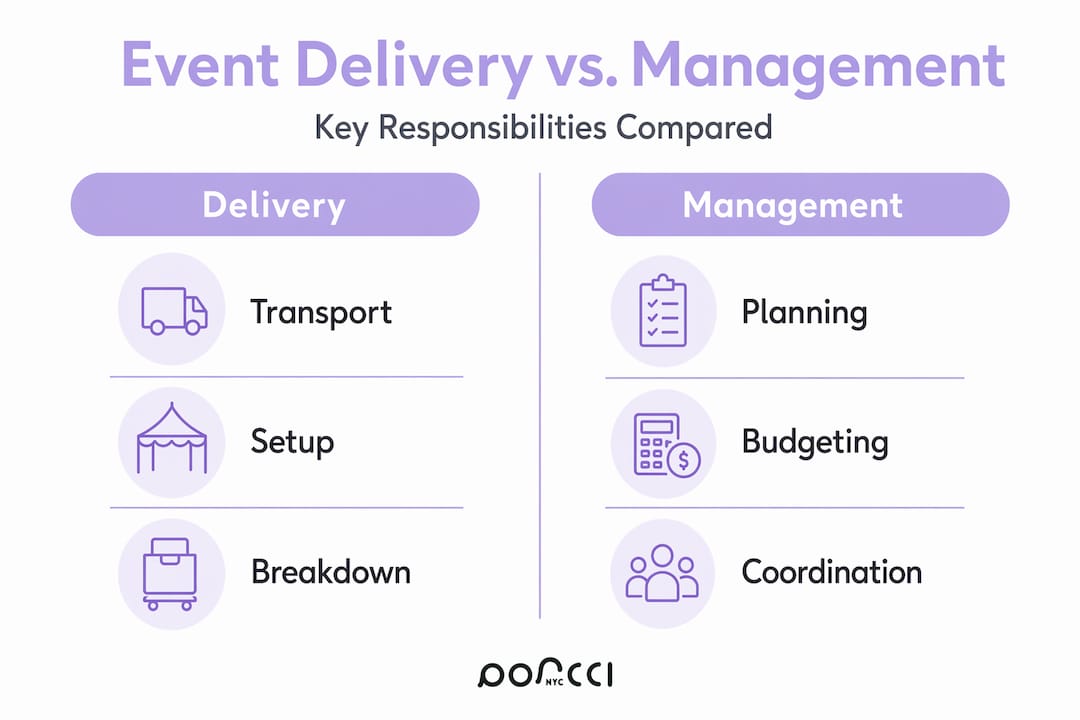
| Aspect | Event delivery service | Event management |
|---|---|---|
| Primary focus | Physical transport, setup, and breakdown | Strategy, budgeting, vendor coordination |
| Timing concern | Delivery windows, access schedules | Full event timeline from planning to wrap-up |
| Key skill | Logistics, handling, route planning | Communication, creativity, project oversight |
| Typical provider | Specialized courier or rental company | Event planner or agency |
The relationship between the two is complementary. Event management sets the plan. Event delivery executes the physical components of that plan. Problems occur when event managers assume delivery logistics will “just work out” without a dedicated provider or plan.
Specialized logistics providers bring expertise in venue-specific access rules, equipment handling, and supply chain coordination that most general event managers simply do not carry. For large-scale or multi-vendor events, that expertise is what keeps everything running on schedule. A good overview of how production and delivery connect is available in this event production guide if you want to see how the roles fit together.
I have seen events fall apart not because the caterer was bad or the band showed up unprepared, but because nobody owned the delivery plan. The sound system arrived at the wrong entrance. The photo booth showed up after guests were already in the room. The lighting rig had nowhere to go because the setup crew did not know it was coming.
What I have learned from years of coordinating events across NYC and New Jersey is that the importance of event setup and delivery is almost always underestimated until something goes wrong. Organizers invest heavily in the guest experience but treat delivery as an afterthought.
My honest advice: treat your delivery plan with the same level of detail you give your run-of-show. Name a real person to manage receiving. Write down every access point and time window. Build in 30 minutes of buffer before your setup crew is scheduled to start. And work with rental and delivery providers who ask you these questions upfront, because that means they already know where the problems hide.
The events that run smoothly are not the ones where everything went perfectly. They are the ones where someone planned for what could go wrong.
— PORCCI
At Porccinyc, we build delivery, setup, and breakdown into every rental package we offer across NYC and New Jersey. You do not have to coordinate a separate logistics team or worry about whether your photo booth or DJ equipment will arrive on time. We handle it. Our team knows the venues, the access rules, and the setup timelines that make events work without the last-minute scramble.
Whether you are planning a wedding, a corporate function, or a private party, our event planning services are built to take the coordination work off your plate. Ready to get started? Walk through our booking process and let us put together a plan that fits your event exactly.
An event delivery service handles the transport, on-site setup, and post-event removal of physical materials needed for an event. It goes beyond standard shipping to include placement, assembly, and breakdown.
A provider collects items from a warehouse or supplier, delivers them to the venue within a scheduled window, handles placement according to a floor plan, and returns to break down and collect everything after the event ends.
Event logistics focuses on physical handling and transport, while event management covers strategy, budgeting, and the overall coordination of the event experience. The two work together but serve distinct roles.
Event venues have fixed access windows, and setup crews depend on deliveries arriving on schedule. Even a short delay compresses setup time, increases errors, and can directly affect the attendee experience.
According to Event Kit’s delivery framework, a solid plan identifies who receives deliveries, what items are included, exact drop-off locations, delivery time windows, and the equipment needed to move items inside the venue.
Discover what is event delivery service and how it ensures seamless transport, setup, and pack-up for your next event. Simplify your planning!
TL;DR:
• Proper event delivery encompasses transportation, on-site setup, and post-event removal, not just transportation itself.
• Planning and coordinating these elements with specialized providers ensure timely arrivals, accurate placement, and smooth event execution.
Most people hear “event delivery service” and picture a van dropping off boxes. That assumption leaves a lot of expensive surprises on the day of your event. A true event delivery service covers transport, setup, and post-event pack-up as a coordinated system, not just getting items from point A to point B. Before you plan your next private party or corporate function, understanding this distinction will save you time, money, and a lot of stress.
• What event delivery service really covers
• Key components of a strong event delivery plan
• Why timing and reliability define delivery success
• Event delivery vs. event management
• Our honest take on event delivery planning
• Let Porccinyc handle your next event delivery
• FAQ
| Point | Details |
|---|---|
| More than transportation | Event delivery includes on-site setup, storage coordination, and post-event pickup, not just transport. |
| Planning details matter | Specifying who, what, where, when, and how prevents the most common delivery failures. |
| Timing is non-negotiable | Delays in event delivery directly disrupt setup schedules and hurt the attendee experience. |
| Logistics vs. management | Event delivery focuses on physical handling, while event management covers strategy and overall coordination. |
| Specialized providers win | Working with providers who know venue access rules and handle delicate equipment reduces costly errors. |
When people ask what is event delivery service, they are usually expecting a simple answer. The reality is more layered. Event logistics involves planning and coordinating the transportation, on-site handling, and post-event removal of every physical element your event requires.
Think about what actually needs to move for a corporate gala or a wedding reception. You have:
• Sound systems, speakers, and microphones
• Lighting rigs and power distribution equipment
• Photo booths, backdrops, and props
• Staging, furniture, and branded signage
• Catering equipment and serving stations
Each of these items requires more than a drop-off. Someone needs to receive them, place them correctly, and verify that nothing is damaged or missing. After the event, those same items need to be broken down and removed on schedule. That full cycle is what event delivery services explained properly should describe. It is end-to-end coordination, not a single trip.
What separates event delivery from a general courier is specialization. A standard shipping company delivers to a loading dock and moves on. An event delivery provider understands venue access restrictions, floor plan requirements, and the fact that some items are irreplaceable. A broken backdrop or late DJ setup cannot be fixed with a refund after the fact.
Pro Tip: When reviewing a provider’s scope, ask specifically whether setup and breakdown are included. Many quote transport only, and the gap in coverage shows up at the worst possible time.
Understanding what is event delivery and setup in theory is one thing. Building a plan that actually works on event day is another. The five critical checkpoints every effective event delivery plan should address are: who, what, where, when, and how.
1. Who receives the delivery. Designate a named point of contact at the venue, not just a general staff member. This person confirms arrival, checks items against the manifest, and directs placement. For larger events, consider a dedicated staffing role specifically for this.
2. What is being delivered. Document every item with dimensions, quantities, and any special handling requirements. Fragile AV equipment, for example, requires padding and climate-controlled transport in some cases.
3. Where items go at the venue. Specify the exact access point, freight elevator location, and final placement zone for each item. Vague drop-off instructions are a primary cause of on-site delays.
4. When the delivery windows open and close. Align delivery timing with venue access hours and your setup schedule. Early deliveries can create conflicts with other vendors or venue operations.
5. How items are moved inside the venue. Know in advance whether a forklift, hand truck, or manual crew is needed. Some venues have strict rules about equipment used on their floors.
Common pitfalls include assuming the venue staff will handle placement, failing to share the delivery schedule with all vendors, and not accounting for elevator wait times in high-rise venues. Unclear drop-off arrangements are consistently a bigger problem than transportation itself.
Pro Tip: Create a one-page delivery brief that includes the contact name, phone number, venue access details, and item checklist. Share it with every party involved at least 48 hours in advance.
Event delivery does not operate on flexible timelines. A retail shipment arriving a day late is an inconvenience. A late sound system on the day of a corporate conference is a crisis. That difference defines the entire approach to event logistics.
Delays directly harm attendee experience and compress the setup window, which increases the chance of errors during assembly. When setup crews are rushed, equipment gets placed incorrectly, cables get run improperly, and safety checks get skipped.
Several factors make reliable event delivery distinctly challenging:
• Venue windows are fixed and non-negotiable
• Multiple vendors often share the same loading area
• Traffic in dense urban areas like NYC and NJ adds unpredictable time
• Some items, like floral arrangements or temperature-sensitive catering supplies, have strict handling requirements
Real-time tracking and route optimization are not optional for professional event delivery providers. They are the baseline. Knowing where a shipment is at any given moment allows coordinators to adjust setup schedules and communicate proactively with venue contacts.
Proactive communication is what separates a minor hiccup from a full disruption. When a delivery team calls ahead about a 20-minute delay, your crew can adjust. When they simply show up late with no warning, your entire setup timeline collapses.
For complex events with multiple rental items, check out event equipment essentials to build a delivery manifest before you finalize your plan.
These two terms overlap enough to cause real confusion. Clearing that up helps you assign responsibilities correctly and avoid gaps in coverage.
Event logistics covers the physical movement, storage, and on-site handling of materials. Event management is the broader discipline that covers the vision, budget, vendor relationships, programming, and overall experience.
| Aspect | Event delivery service | Event management |
|---|---|---|
| Primary focus | Physical transport, setup, and breakdown | Strategy, budgeting, vendor coordination |
| Timing concern | Delivery windows, access schedules | Full event timeline from planning to wrap-up |
| Key skill | Logistics, handling, route planning | Communication, creativity, project oversight |
| Typical provider | Specialized courier or rental company | Event planner or agency |
The relationship between the two is complementary. Event management sets the plan. Event delivery executes the physical components of that plan. Problems occur when event managers assume delivery logistics will “just work out” without a dedicated provider or plan.
Specialized logistics providers bring expertise in venue-specific access rules, equipment handling, and supply chain coordination that most general event managers simply do not carry. For large-scale or multi-vendor events, that expertise is what keeps everything running on schedule. A good overview of how production and delivery connect is available in this event production guide if you want to see how the roles fit together.
I have seen events fall apart not because the caterer was bad or the band showed up unprepared, but because nobody owned the delivery plan. The sound system arrived at the wrong entrance. The photo booth showed up after guests were already in the room. The lighting rig had nowhere to go because the setup crew did not know it was coming.
What I have learned from years of coordinating events across NYC and New Jersey is that the importance of event setup and delivery is almost always underestimated until something goes wrong. Organizers invest heavily in the guest experience but treat delivery as an afterthought.
My honest advice: treat your delivery plan with the same level of detail you give your run-of-show. Name a real person to manage receiving. Write down every access point and time window. Build in 30 minutes of buffer before your setup crew is scheduled to start. And work with rental and delivery providers who ask you these questions upfront, because that means they already know where the problems hide.
The events that run smoothly are not the ones where everything went perfectly. They are the ones where someone planned for what could go wrong.
— PORCCI
At Porccinyc, we build delivery, setup, and breakdown into every rental package we offer across NYC and New Jersey. You do not have to coordinate a separate logistics team or worry about whether your photo booth or DJ equipment will arrive on time. We handle it. Our team knows the venues, the access rules, and the setup timelines that make events work without the last-minute scramble.
Whether you are planning a wedding, a corporate function, or a private party, our event planning services are built to take the coordination work off your plate. Ready to get started? Walk through our booking process and let us put together a plan that fits your event exactly.
An event delivery service handles the transport, on-site setup, and post-event removal of physical materials needed for an event. It goes beyond standard shipping to include placement, assembly, and breakdown.
A provider collects items from a warehouse or supplier, delivers them to the venue within a scheduled window, handles placement according to a floor plan, and returns to break down and collect everything after the event ends.
Event logistics focuses on physical handling and transport, while event management covers strategy, budgeting, and the overall coordination of the event experience. The two work together but serve distinct roles.
Event venues have fixed access windows, and setup crews depend on deliveries arriving on schedule. Even a short delay compresses setup time, increases errors, and can directly affect the attendee experience.
According to Event Kit’s delivery framework, a solid plan identifies who receives deliveries, what items are included, exact drop-off locations, delivery time windows, and the equipment needed to move items inside the venue.